-
-
-

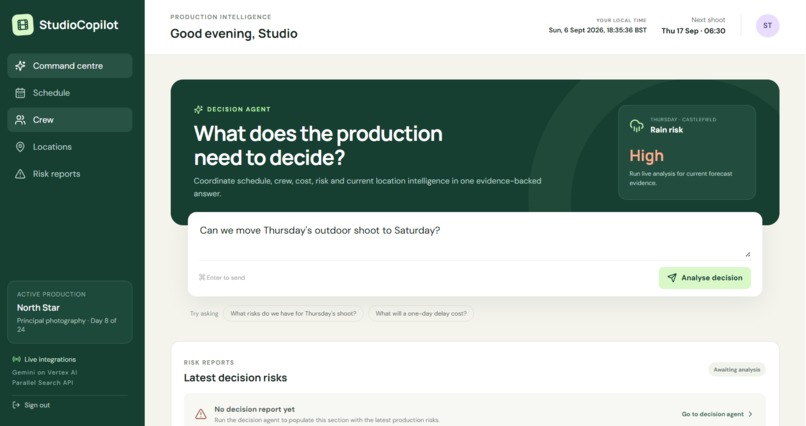
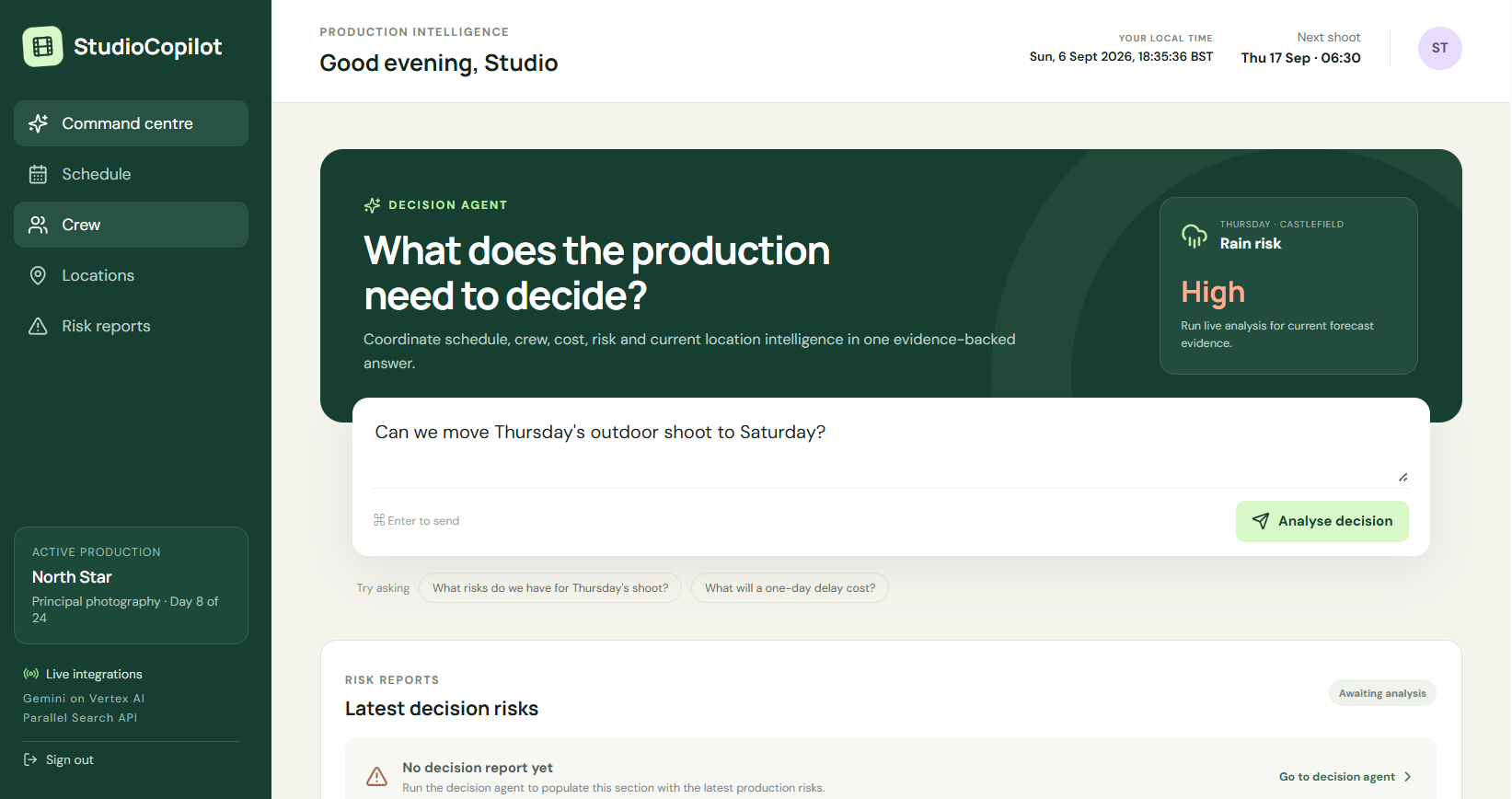
AI Generated image of a representation of the App
-
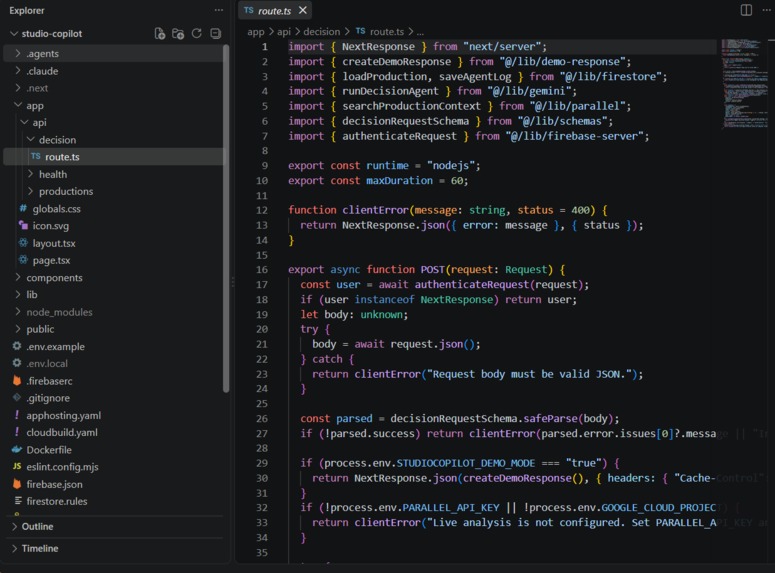
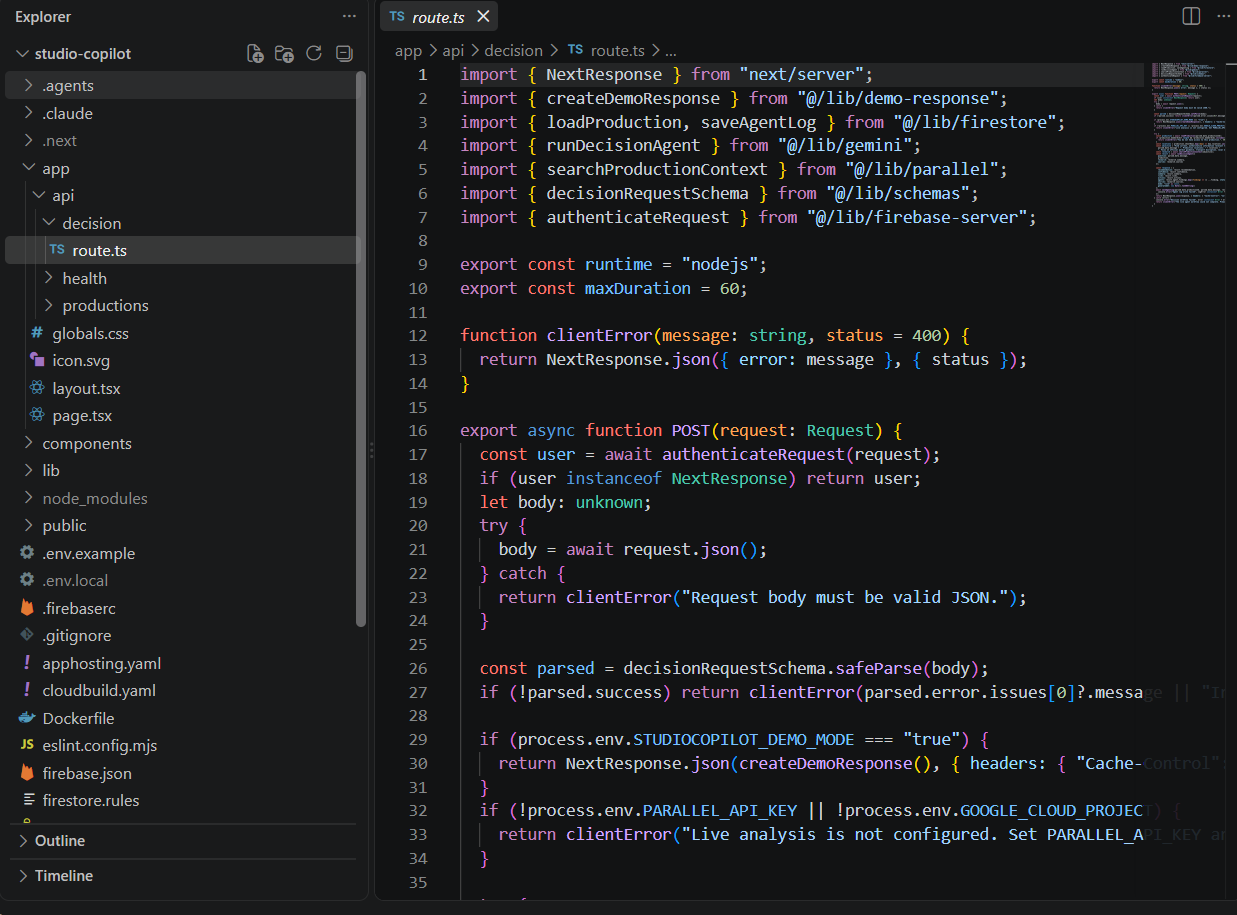
IDE Showing the app/api/decision.route.ts document

Inspiration
Film and television productions depend on dozens of interconnected decisions. A schedule change can affect crew availability, locations, equipment costs, permits, weather exposure and the wider production budget.
I created StudioCopilot to bring those fragmented considerations into one production operations centre. The goal was not to replace an experienced production manager, but to help that person reach faster, better-informed decisions using private production records and current, traceable evidence.
## What it does
StudioCopilot combines production data with live research to answer operational questions such as:
- Can an outdoor shoot be moved to another day?
- Which crew members are available?
- What locations and scenes would be affected?
- What risks could disrupt the schedule?
- What could a delay cost?
The application includes dedicated modules for:
- Shoot scheduling
- Crew details and availability
- Production locations and addresses
- Equipment costs and scene assignments
- Evidence-backed production analysis
A producer can ask a question in natural language. StudioCopilot coordinates six specialist perspectives covering production, research, weather and risk, crew, budget and the final decision.
The result includes a recommendation, confidence score, identified risks, suggested actions and links to supporting research. StudioCopilot keeps a human production manager responsible for the final operational decision.
## How I built it
I built StudioCopilot as a full-stack Next.js and TypeScript application.
The production dashboard provides responsive interfaces for managing schedules, crew and locations. The associated API endpoints validate all submitted records with Zod before storing them in Cloud Firestore.
Firebase Authentication supports verified email/password accounts and Google sign-in. The server independently verifies Firebase ID tokens, checks an explicit email allowlist and can enforce production membership through Firebase user IDs.
For live decision analysis, StudioCopilot uses:
Parallel Search API for current public-web research and supporting sources
Gemini on Vertex AI for structured production reasoning
Cloud Firestore for production records and decision logs
Secret Manager for server-side credentials
Artifact Registry for container images
Cloud Build for repeatable builds and deployments
Cloud Run for the live application
The workflow retrieves the relevant production context, researches current external factors and passes both into a constrained Gemini decision process. Research content is treated as untrusted evidence rather than instructions.
## Challenges I ran into
One major challenge was maintaining a clear boundary between live intelligence and demonstration data. I designed the application to fail closed when live services are unavailable rather than silently presenting fictional research as current information.
Authentication also required careful coordination between Firebase and the Cloud Run backend. Firebase configuration values are embedded into the browser build, while the server must verify tokens against the correct Firebase project. Safe diagnostics helped identify and resolve an early project-audience mismatch without logging tokens or personal information.
Cloud deployment introduced several infrastructure challenges, including:
- Configuring Application Default Credentials
- Assigning least-privilege service permissions
- Supplying build-time Firebase configuration safely
- Managing Secret Manager versions
- Creating the Firestore database in the correct region
- Handling manual Cloud Build image tags
- Coordinating resources across Firebase and Google Cloud projects
The production modules created another challenge: updates needed to preserve relationships between schedules, locations and assigned crew. StudioCopilot prevents a location or crew member from being deleted while still assigned to a scheduled shoot.
## Accomplishments that I'm proud of
I am particularly proud that StudioCopilot is more than an AI chat interface. It combines structured production management with live, cited research and visibly separated specialist findings.
Other accomplishments include:
- A complete authenticated Cloud Run deployment
- Functional scheduling, crew and location modules
- Validated Firestore-backed CRUD APIs
- Evidence-linked Parallel research
- Structured Gemini responses through Vertex AI
- Secure server-side token verification
- An explicit verified-account allowlist
- Protected secrets and deny-by-default data rules
- A responsive interface suitable for desktop and mobile production teams
- A production dependency audit with no known vulnerabilities
## What I learned
I learned that useful production AI depends as much on data boundaries and provenance as it does on model capability.
Gemini is most valuable when it receives structured production context and a clearly constrained decision task. Parallel adds value by supplying current evidence that the model should not invent, particularly around weather, transport, permits, events and operational hazards.
I also learned that authentication configuration must be treated as part of the deployed application architecture. A valid client sign-in is not enough; the backend must independently verify the token's signature, issuer, audience, expiry and verified-email status.
Most importantly, I learned that an effective decision assistant should explain its reasoning, expose uncertainty and leave accountable decisions with qualified people.
## What's next for StudioCopilot
The next stage is to expand StudioCopilot from a production decision assistant into a broader collaborative production platform.
Planned improvements include:
- Multiple productions and production-member invitations
Role-based access for producers, assistant directors and department heads
Call-sheet generation and distribution
Calendar and scheduling integrations
Crew conflict and availability detection
Location permit and access tracking
Budget forecasting and approval workflows
Production document uploads and retrieval
Automated risk monitoring and notifications
Audit history for production-record changes
Custom production dashboards and reports
Stronger operational monitoring, backup and recovery controls
The long-term goal is to give every production team a secure, evidence- backed operational picture without removing the judgement and accountability that professional filmmaking requires.

Log in or sign up for Devpost to join the conversation.