Inspiration
Every designer I know has the same folder: final_v7_REAL. Years of client work sit on a NAS, with brand guidelines, packaging, photography and abandoned concepts. Then a new brief arrives and the work starts from a blank canvas, because nobody remembers which old project held the answer.
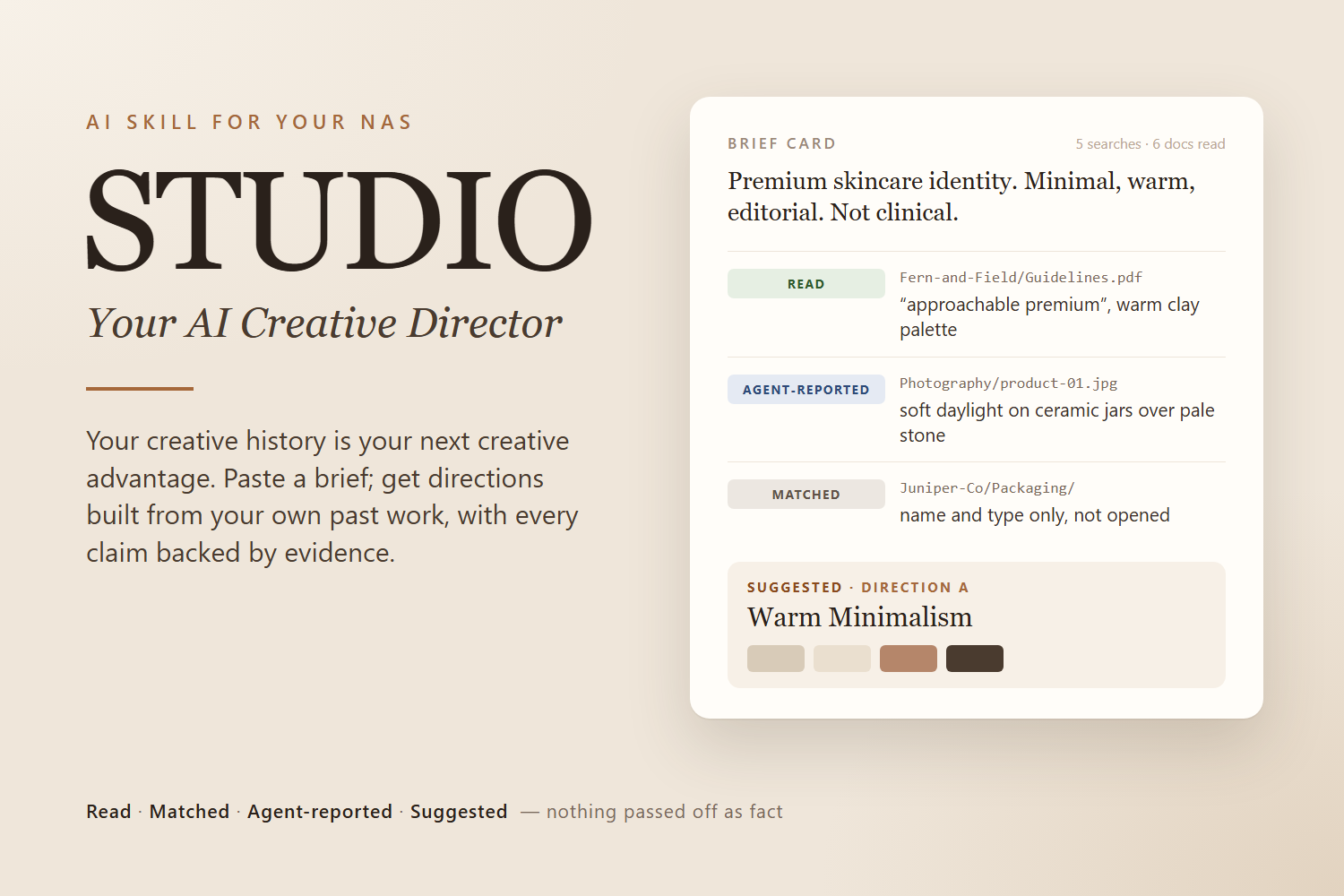
AI tools don't fix this. Moodboard generators invent images from nothing. Keyword search returns a list of files and leaves the thinking to you. I wanted something that behaves like a creative director who has actually read your archive: "Your guidelines for that skincare client two years ago solved this exact tension. Here's the file, and here's the sentence."
That's STUDIO: Your AI Creative Director.
What it does
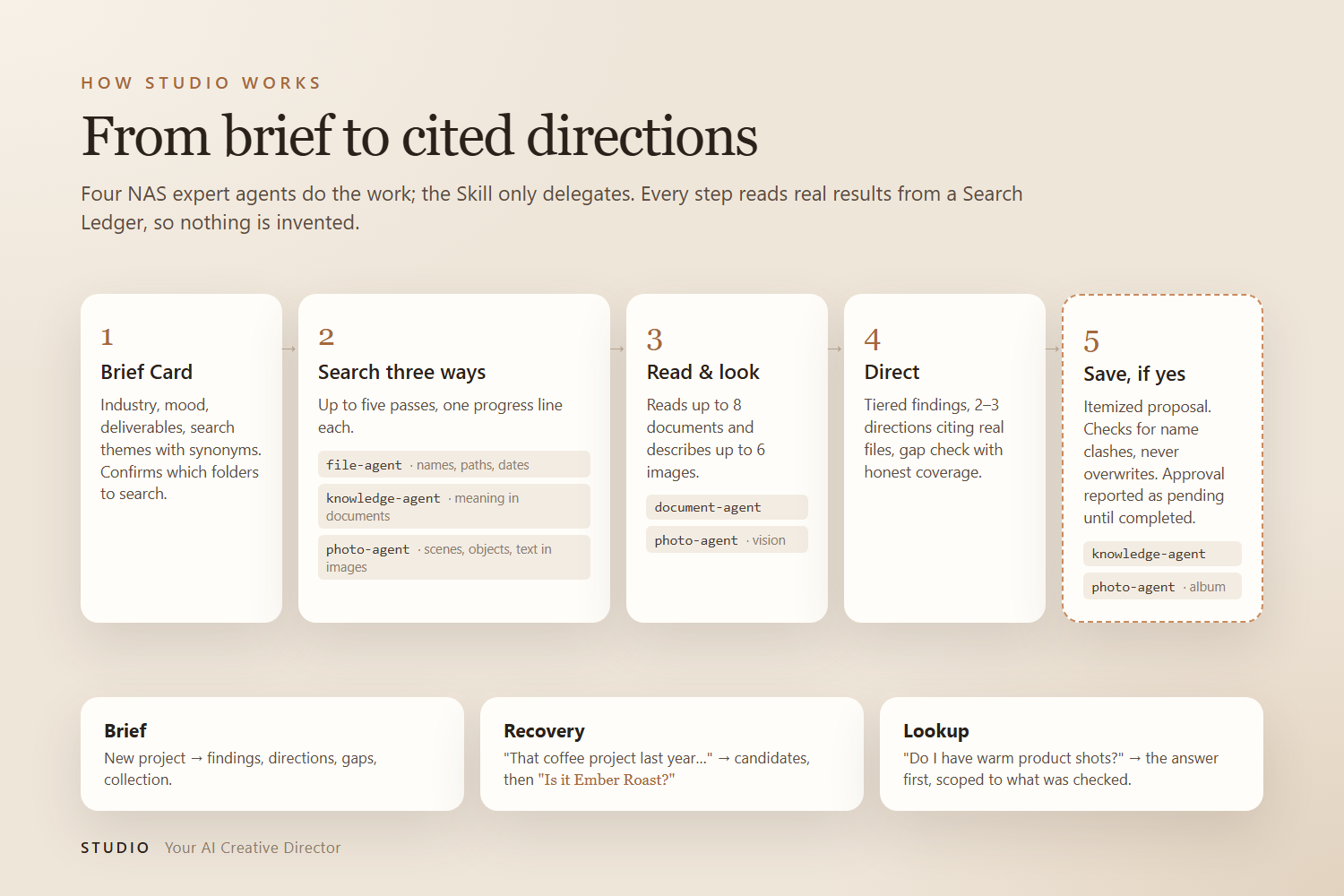
Paste a brief. STUDIO:
- Distills it into a Brief Card: industry, mood, deliverables, and search themes with synonyms ("warm" also means sand, stone, terracotta).
- Searches the archive three ways through the NAS's expert agents:
- by name, with
file-agent - by meaning inside documents, with
knowledge-agent, so a project whose folder name says nothing can still surface - by image content, with
photo-agent's scene search and vision model
- by name, with
- Reads the strongest documents with
document-agentand quotes what they actually say about positioning, palette and typography. - Ranks findings by evidence, not by guesswork.
- Proposes two or three creative directions, each citing real files, and links past decisions to the new brief.
- Runs a gap check: which deliverables exist, which have alternatives, and which were not found in the searched scope.
- Saves a collection note or album, but only after an explicit yes to an itemized list.
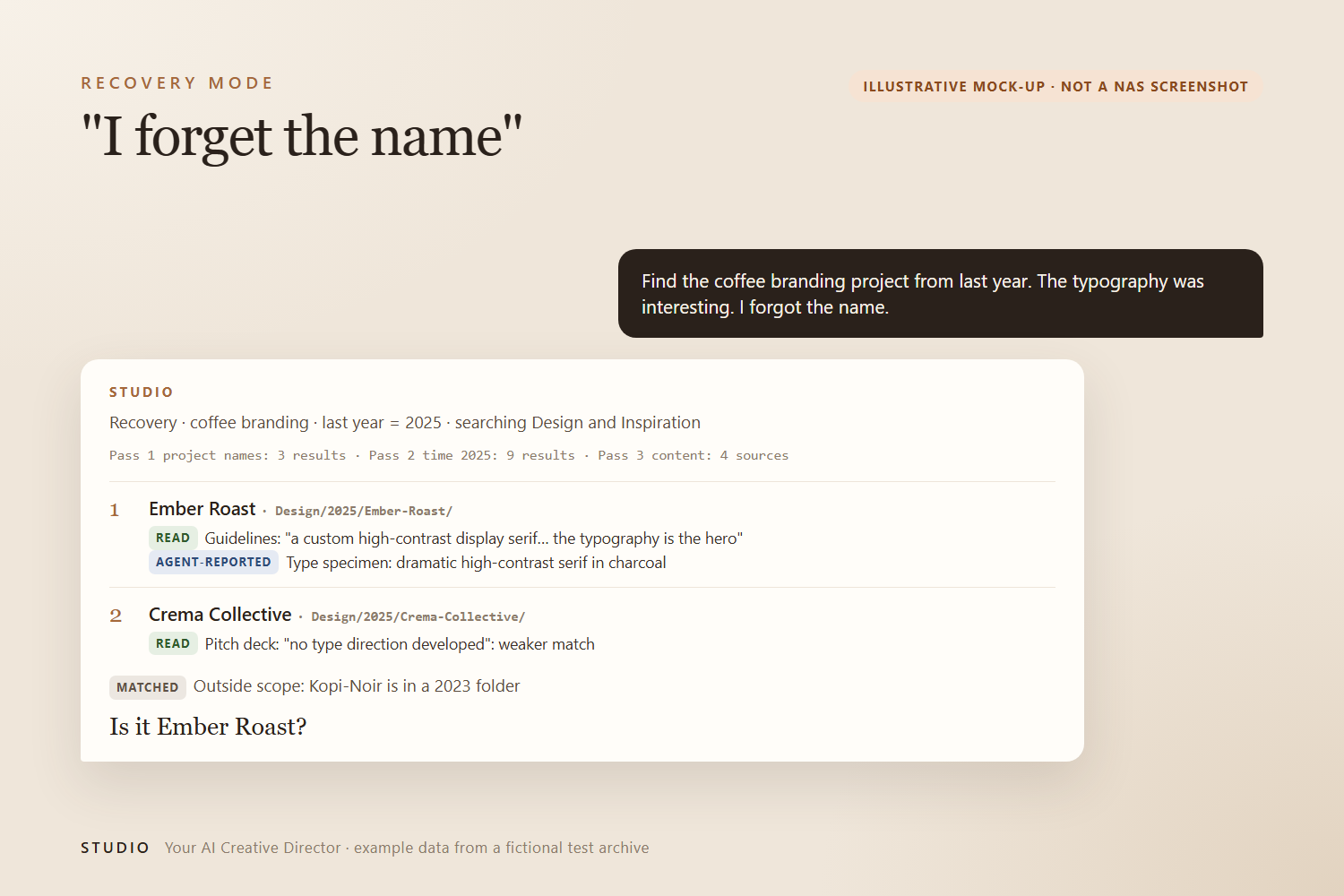
It also handles two lighter requests. Recovery is "find that coffee project from last year, I forget the name"; it ends with "Is it Ember Roast?". Lookup is "do I have warm product photography?"; it answers first.
The idea that makes it different: the Evidence Ledger
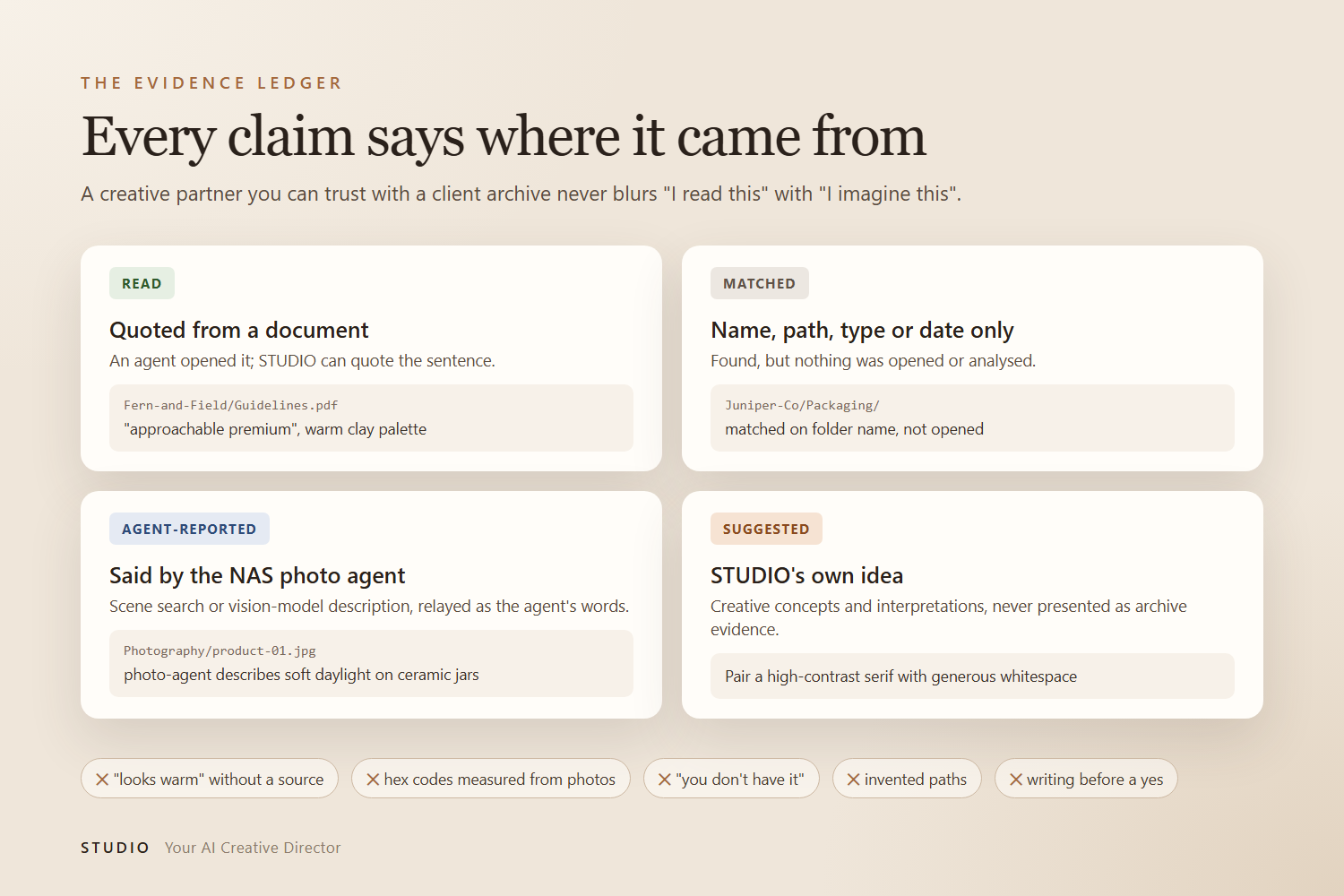
Every claim STUDIO makes carries one of four labels:
| Label | Meaning |
|---|---|
| READ | Quoted from a document an agent actually read |
| MATCHED | Matched on name, path, type or date only; nothing was opened |
| AGENT-REPORTED | Returned by the NAS photo agent, relayed and not verified |
| SUGGESTED | STUDIO's own creative idea or interpretation |
A creative tool that blurs "I read this" with "I imagine this" can't be trusted with a client's archive. STUDIO never says a file "looks warm" unless a document or the vision agent said so. It never converts a described colour into a hex code. It says "not found in the searched scope", never "you don't have it".
How I built it
A Uliya Skill is Markdown, not code. The parent Skill may only delegate to registered experts, so the real engineering is the orchestration and the failure handling.
- Read the real catalog first. I worked from the official
uliya-skill-kitcapability catalog and checker rather than assumptions. That changed the design. I had planned a text-only Skill that "never sees images". The catalog showedphoto-agentoffers scene, object and in-image text search plus a vision-language model. So STUDIO uses image understanding, but labels it AGENT-REPORTED and never presents it as fact. - A Search Ledger carries state. Each delegation logs its step, expert, state and result count. Later steps read only real
completedresults, so a path can never be invented. - All five delegation states are handled:
completed,failed,cancelled,waiting_userandwaiting_approval. A save that is waiting for approval is reported as pending, never as done, and is never sent twice. - Read-only until approved. Before saving, STUDIO checks the destination for a name clash and never overwrites.
- Tested before touching a NAS. I built a fictional designer archive of about 50 files, including deliberate traps:
- a skincare project whose folder name never says skincare
- a project that matches by name but has the opposite mood
- guidelines that say "avoid warm tones"
- a duplicate, an unreadable file and an empty folder
I ran 10 scenarios as text simulations, each in a fresh context, graded them against an answer key, fixed 24 defects, and re-ran the failures. The final package passes the official checker with zero errors and zero warnings.
Challenges
- Honesty is harder than features. The first round of simulations failed three scenarios. Two failed on a single unlabelled sentence, such as "only one project has warm product shots", that went beyond what had actually been read. The fix was a rule that every interpretation is SUGGESTED, and every summary is scoped to the items actually read or described.
- One-size workflow. The third failure: early versions forced every request through creative directions and a save offer, even "find my old project", so STUDIO never asked "is it this one?". Three request modes fixed both the length and the logic.
- A real bug a checker can't catch. An apostrophe in a saved note ("client's") would end the single-quoted delegate instruction early. STUDIO now converts apostrophes to typographic ones when assembling instructions.
- My own test leaked the answers. The Skill's examples used the same project names as the test archive. I replaced them with neutral names, so the simulation tests reasoning, not recall.
- A mangled catalog. The English catalog's descriptions had lost their Chinese words. I relied only on the intact fields: action names, parameters, effects and approval values.
What I learned
The interesting part of an AI agent isn't what it can do; it's what it refuses to pretend. Labelling evidence turned out to be both the safety feature and the product.
What's next
STUDIO has not run on a UGREEN AI NAS yet. If selected as a finalist, I'll validate it on the provided device against a prepared archive:
- a skincare brief that must surface a project only its guidelines reveal
- a forgotten coffee project recovered from a vague memory
- a brief with no matches, which must stop honestly
I'll also measure real approval prompts, document formats and vision-model output.
Built by Ifeoluwa Adegbulugbe for the UGREEN Hackathon 2026 on AI NAS. Claude (Anthropic), via Claude Code, assisted with drafting, testing and revising the Skill text under my direction.
Built With
- agent-orchestration-file-agent
- claude
- document-agent
- knowledge-agent
- photo-agent-vision-language-model
- ugos
- ugreen-ai-nas
- uliya
- uliya-skill-kit-markdown
