-
-
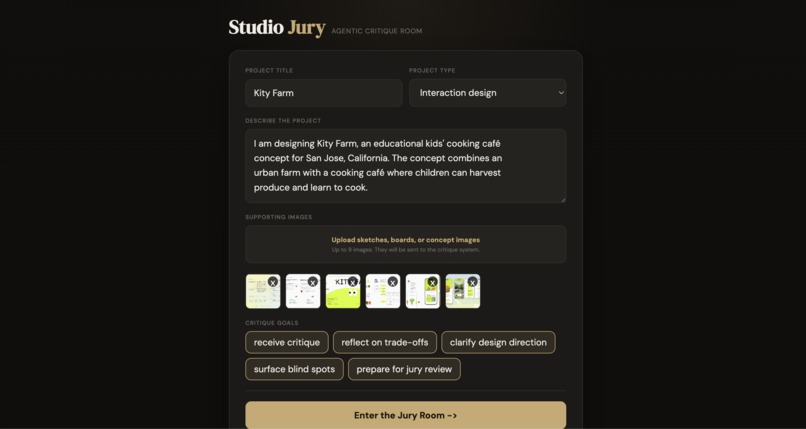
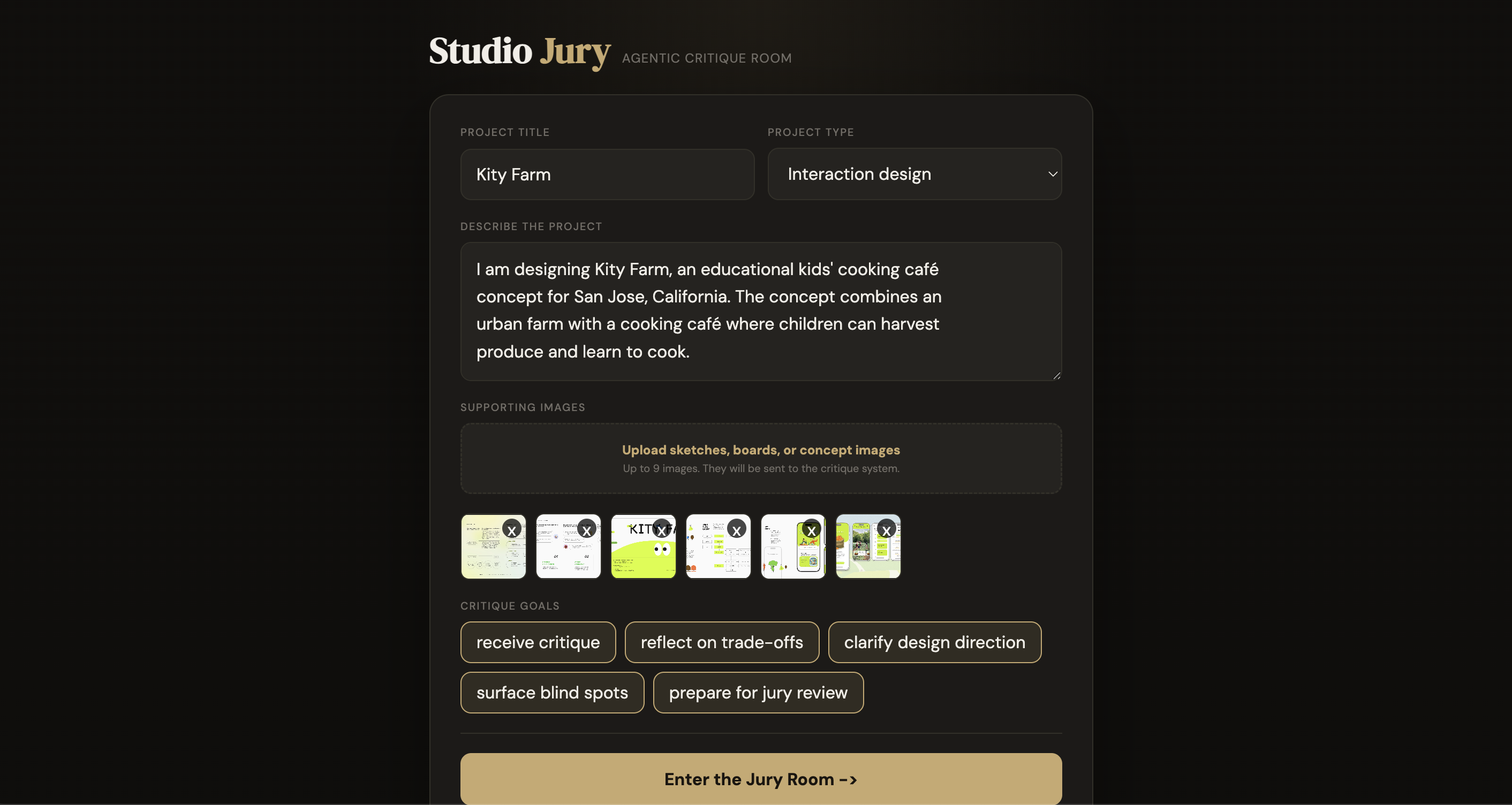
landing page
-
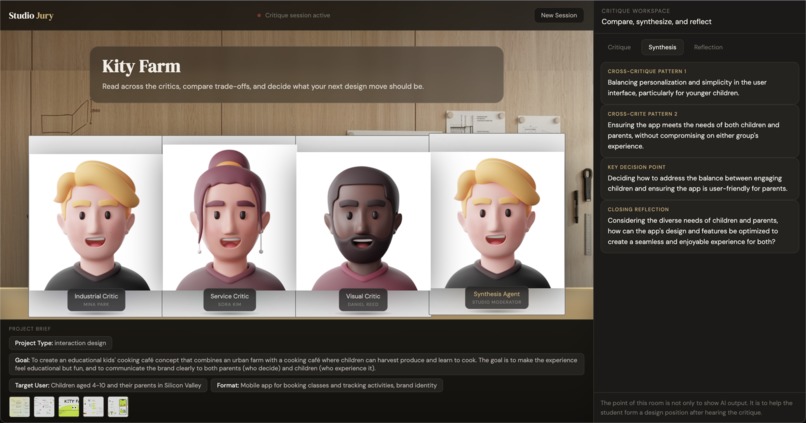
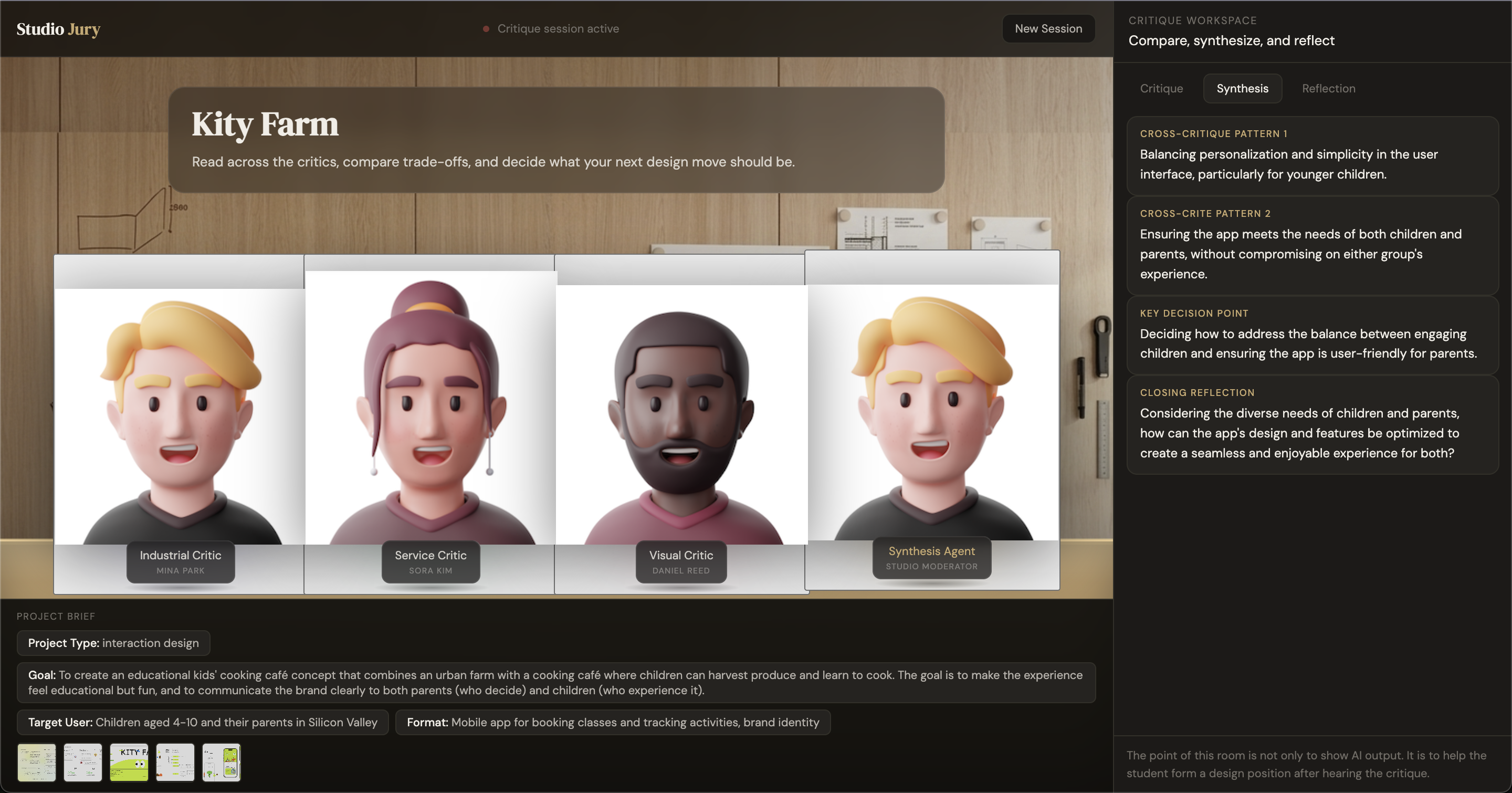
jury page
Inspiration
What if AI critique worked like a real studio jury — multiple perspectives, structured feedback, and reflective dialogue?
We were inspired by a gap in design education: students often do not need just "more feedback," but help thinking more clearly about their own work.
In studio environments, critique is not only about whether a design looks good. It involves framing the problem, understanding trade-offs, articulating intent, and defending decisions. However, students do not always have access to instructors or peers at the exact moment they need that kind of structured reflection.
At the same time, general AI tools like Claude, GPT, or Gemini can already provide feedback on design work. But because they are built for many domains, their responses are often broad rather than grounded in specific design disciplines.
This led us to build Studio Jury, an agentic critique system that simulates a studio-style design review panel and helps students reflect on their design reasoning.
What it does
Studio Jury allows a student to submit:
- a written project description
- visual materials such as sketches, concept boards, or layouts
The system then performs a multi-agent critique flow:
Brief Interpreter
- Converts the raw student input into a structured project brief.
Industrial Design Critic
Reviews usability, ergonomics, feasibility, and real-world interaction.
3.Service Design Critic
- Reviews the journey, touchpoints, and system-level experience.
4.Visual Communication Critic
- Reviews clarity, hierarchy, storytelling, and communication.
- Synthesis Agent -Combines the critiques into shared patterns, tensions, and key decision points.
The goal is not to give a single long AI answer, but to help the student move from:
raw idea → structured critique→ reflection→clearer design reasoning
How we built it
We built the project as a multimodal critique system with a simple full-stack architecture.
Backend The backend is built with:
- Node.js
- Express
- AWS Bedrock / Amazon Nova Lite The backend receives:
- project description text
- project type
- critique goals
- uploaded images encoded in base64
It then normalizes the input and runs a critique pipeline. The orchestration flow is:
- normalize student input
- generate a project brief
- run critique agents in parallel
- synthesize the outputs into a combined reflection This agentic pipeline helped us preserve role separation instead of collapsing everything into one generic prompt.
Frontend The frontend is built with:
- React
- Vite We first started with a very simple interface, but later redesigned it into a more intentional experience called Studio Jury.
The current frontend includes:
- a project submission screen
- image upload support
- a jury-room style interface
- visible critique roles
- critique, synthesis, and reflection panels
We also integrated custom avatar and background assets to make the interaction feel more like entering a critique session than chatting with a generic AI assistant.
Prompt Design A big part of the project was prompt architecture.
Instead of asking one model to "critique the design," we created role-specific prompts so that each agent focuses on a different lens and returns a structured output format:
- Observation
- Concern
- Suggestion
- Trade-off
- Reflection Prompt That structure made the output easier to compare and more useful for learning.
Challenges we ran into
Translating the concept into an MVP Our original concept included multiple agents and a strong reflection loop, but the first working version was much simpler. One challenge was deciding what to keep for the MVP while still preserving the core idea.
Making the frontend match the product idea A generic textarea plus response box technically worked, but it did not communicate the value of the system well. We had to redesign the interface so it felt like a critique environment rather than a normal chatbot.
Keeping the multi-agent system coherent Different agents can easily become repetitive or overlap too much. It was challenging to define prompts that were distinct enough to produce different perspectives while still feeling like parts of one coherent critique system.
Working within model and time constraints For the MVP, we used Nova Lite, which was a practical choice for speed and implementation. But for deeper reasoning and more nuanced critique, a stronger model such as Nova Pro would likely improve the quality of synthesis and reflection.
Accomplishments that we're proud of
Designing an agentic critique system that simulates a studio-style design review instead of a typical AI chatbot.
Building a multi-disciplinary AI critique panel, where different agents evaluate a design from industrial design, service design, and visual communication perspectives.
Creating a structured critique format (Observation, Concern, Suggestion, Trade-off, Reflection) that helps students compare feedback and think more clearly about their decisions.
Implementing a working multimodal MVP that accepts both written project descriptions and visual materials.
Successfully combining design thinking and backend engineering to build a functioning AI critique pipeline using Amazon Nova.
What we learned
We learned a lot in three main areas.
- AI can support reasoning, not just generation One of the biggest lessons was that AI becomes much more interesting when it helps users think, compare, and reflect, rather than only produce polished outputs.
This project pushed us to think about human-AI interaction as scaffolding, not replacement.
Prompt structure matters a lot We learned that the quality of the system depends heavily on how roles are separated and how outputs are structured. Giving each agent a focused job produced more meaningful critique than asking for one broad response.
Product thinking is different from UI thinking This project helped us think more systematically about:
user needs
decision flows
interaction goals
what the real output of the system should be
In our case, the real output is not the critique text itself. The real output is the student's improved reasoning.
What's next for Studio Jury - agentic critique system for student designers
If we continue developing Studio Jury, these are the next things we would build:
- Let users choose which critique aspect they want to focus on most, and make that choice actually influence backend behavior.
- Upgrade from Nova Lite to Nova Pro for deeper reasoning and stronger synthesis.
- Add a live Reflection Agent instead of only a reflection workspace.
- Support follow-up conversations with a specific critic after the first round of critique.
- Let students revise their design and run a second critique cycle to compare improvement over time.
- Improve memory and session history so the system can track how a concept evolves.
In other words, we want to move toward:
single critique session → iterative design learning loop

Log in or sign up for Devpost to join the conversation.