-
-
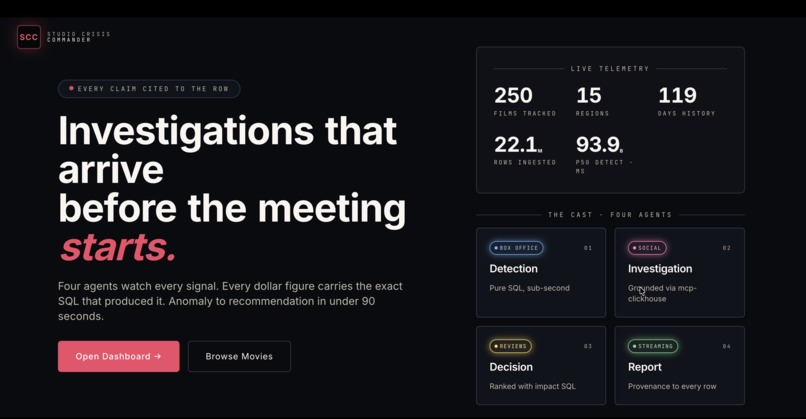
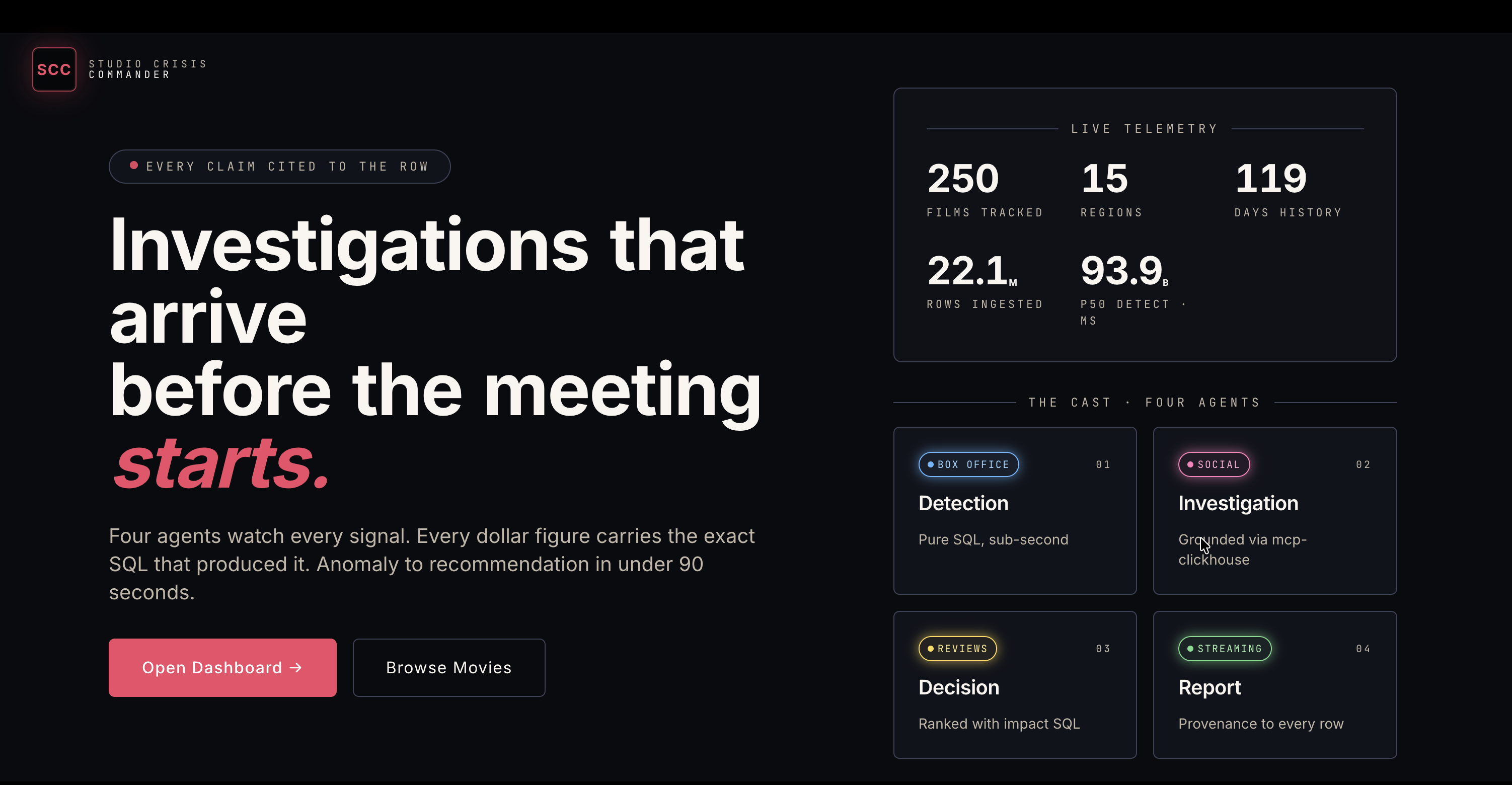
Landing Page 1
-
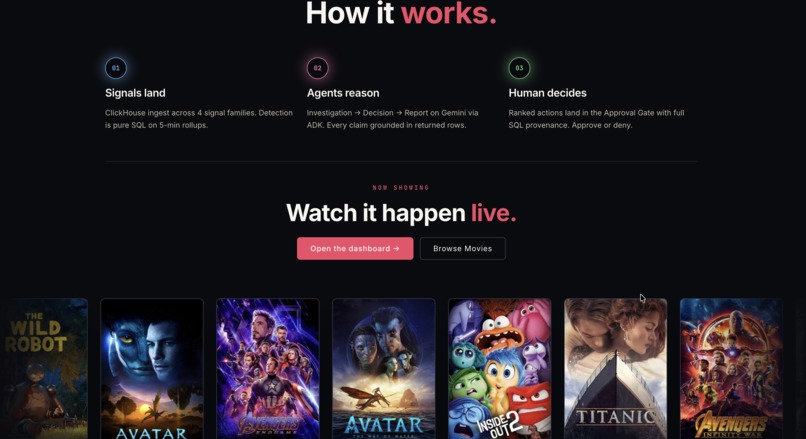
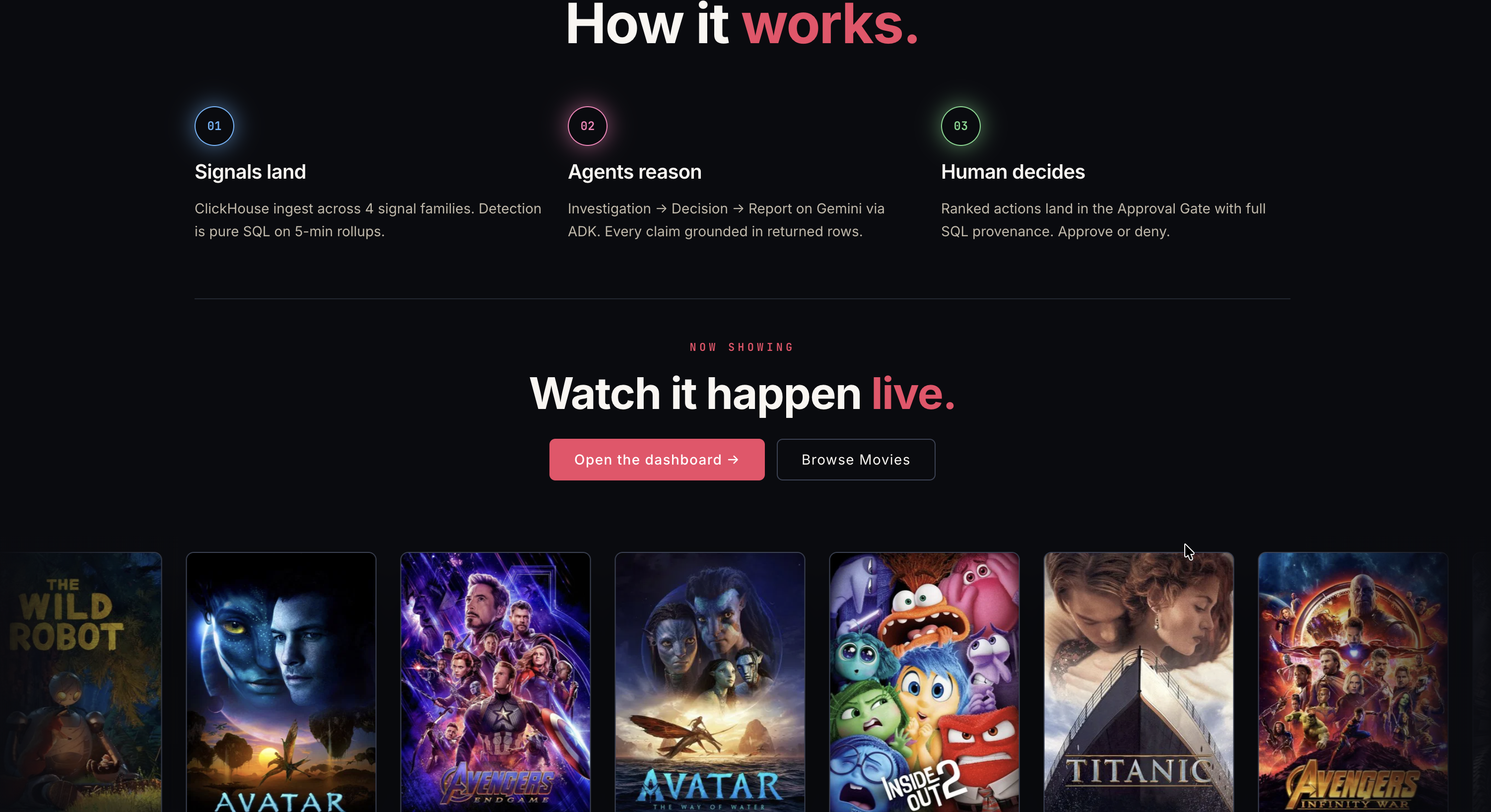
Landing Page 2
-
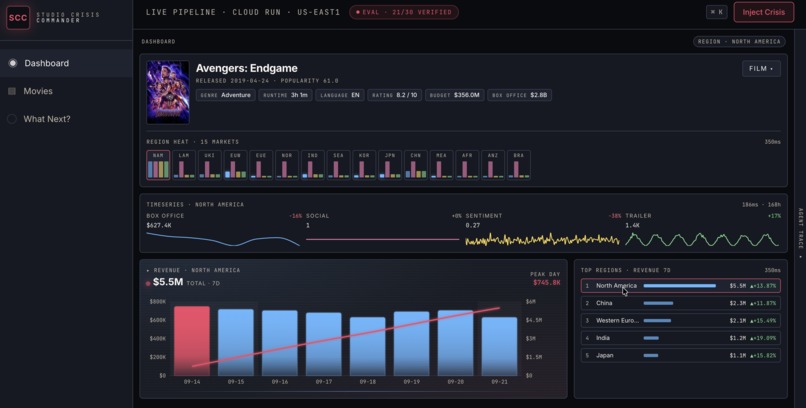
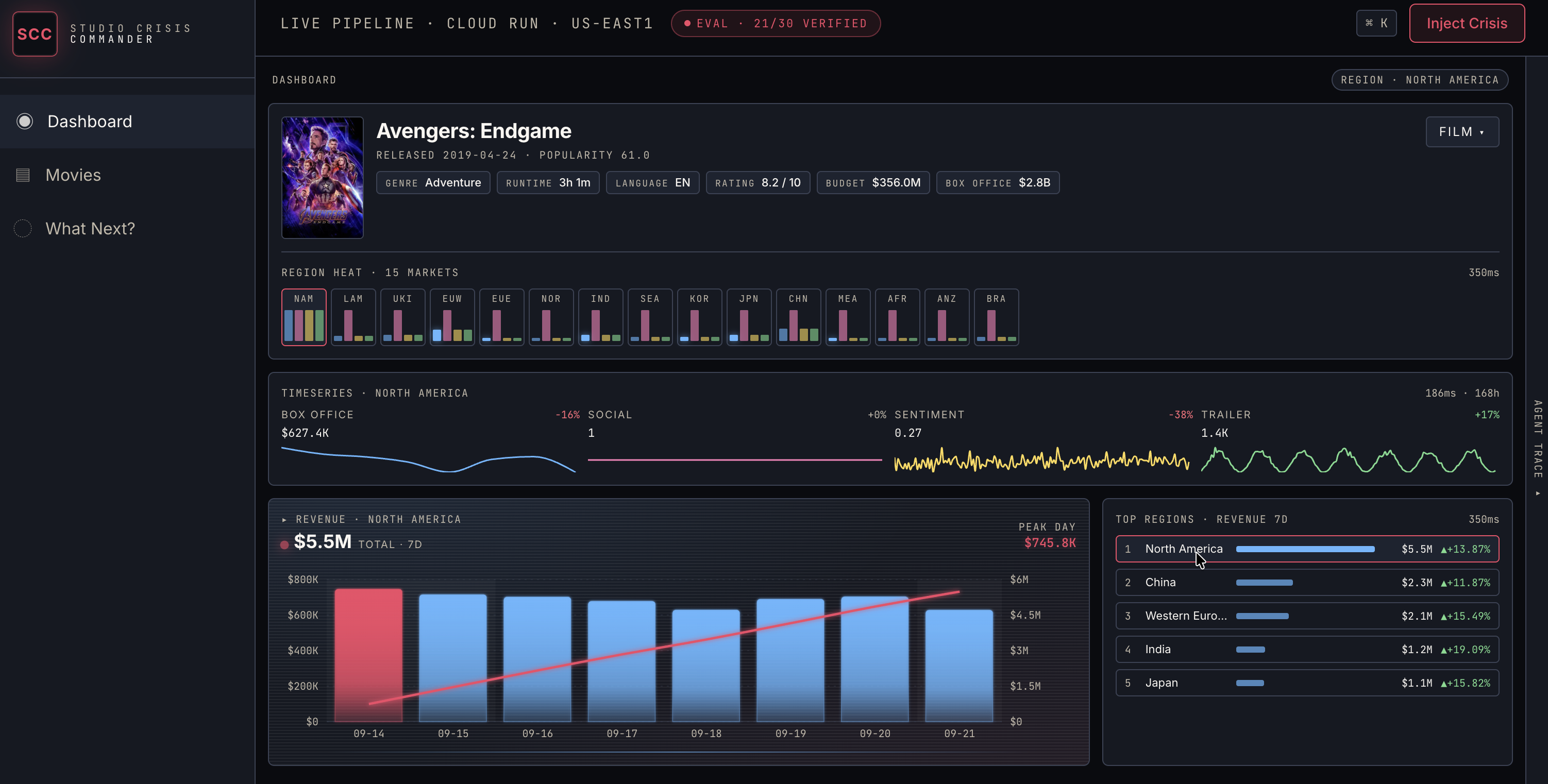
Movies Analytics Dashboard
-
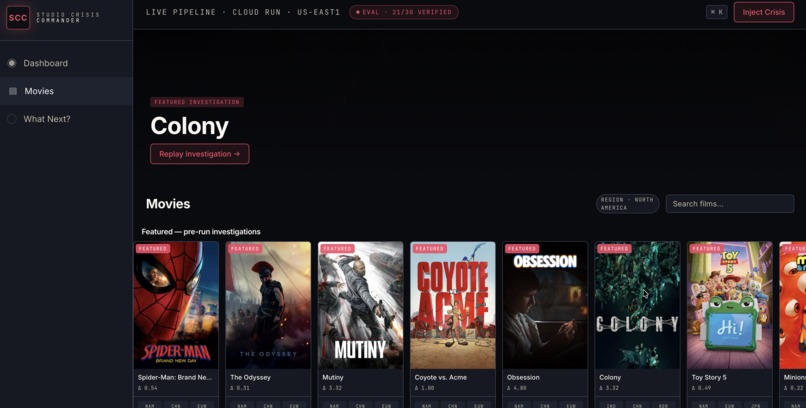
Movies Search Dashboard
-
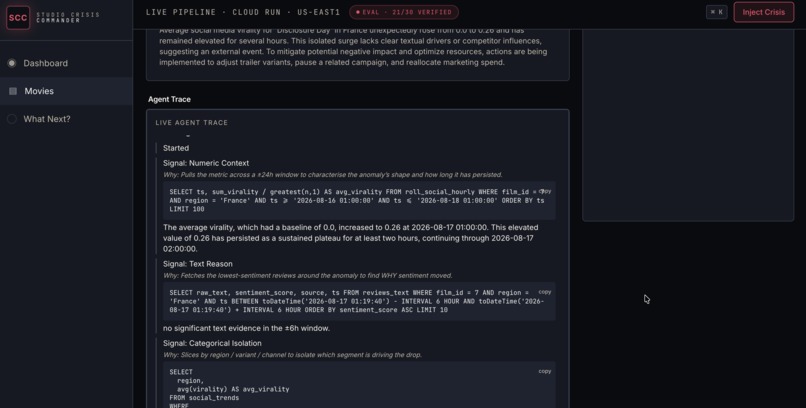
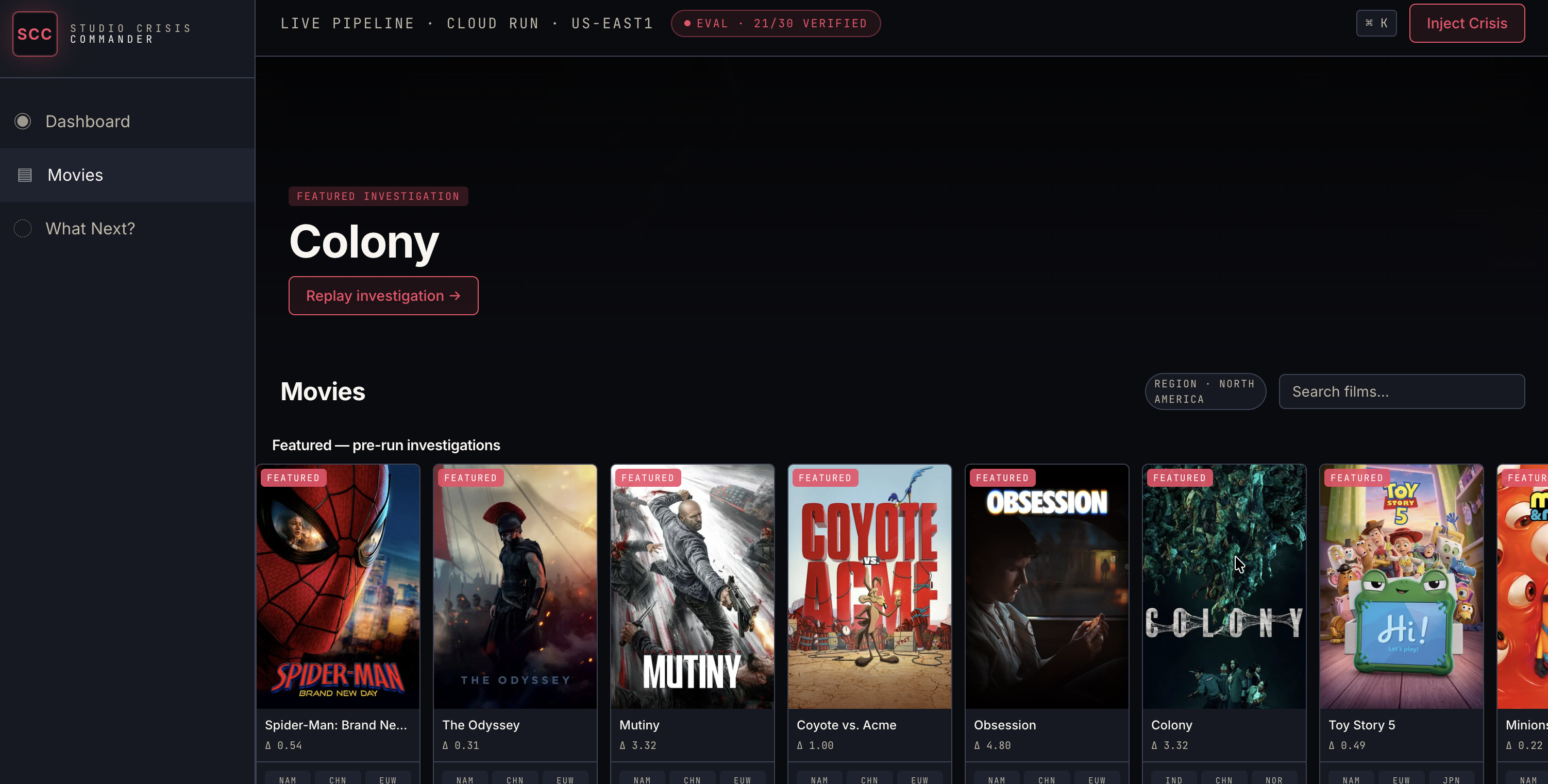
Movie Detail Page
Studio Crisis Commander
An agentic newsroom for the 2 a.m. crisis DM. Movie-first. Region-aware. Every dollar figure traceable to the SQL that produced it.
Live: scc-frontend.us-east1.run.app · Code: github.com/dgupta98/studio-crisis-commander · Video: (link before submit)
🎬 Inspiration
Every major studio has the same 2 a.m. Slack DM. Refunds jumped in Germany. A trailer variant just launched. Sentiment on X is bleeding for one film in one market. And somebody, somewhere, has to decide whether to pull the trailer right now or wait for the war room to wake up.
The data to answer that question exists. It's sitting in a warehouse, sliced across 250 films × 15 regions × 120 days — roughly 50 million numeric rows and 150 thousand text rows of box office, streaming, refunds, reviews, and social. The problem isn't observability. The problem is that turning telemetry into a defensible recommendation is a human coordination task — five Slack threads, three notebooks, and a VP.
We wanted to prove that an agentic system can do the coordination and keep the receipts. Not "an LLM guesses a plan," but a four-agent pipeline where every claim points at the exact SQL row that justifies it, every dollar figure carries the query that produced it, and a human still holds the gate on anything material.
🧠 What it does
Studio Crisis Commander is a movie-first, multi-region ops center for editorial and marketing teams. The product surface has three primary routes — Dashboard, Movies, and Movie Detail — plus a Landing page and a persistent Agent Trace drawer that follows you across screens.
The core loop is a four-agent pipeline:
| # | Agent | What it does | Model / Tech |
|---|---|---|---|
| 1 | Detection | Rolling z-scores against per-film baselines. Pure SQL — no LLM in the hot path. | ClickHouse, milliseconds |
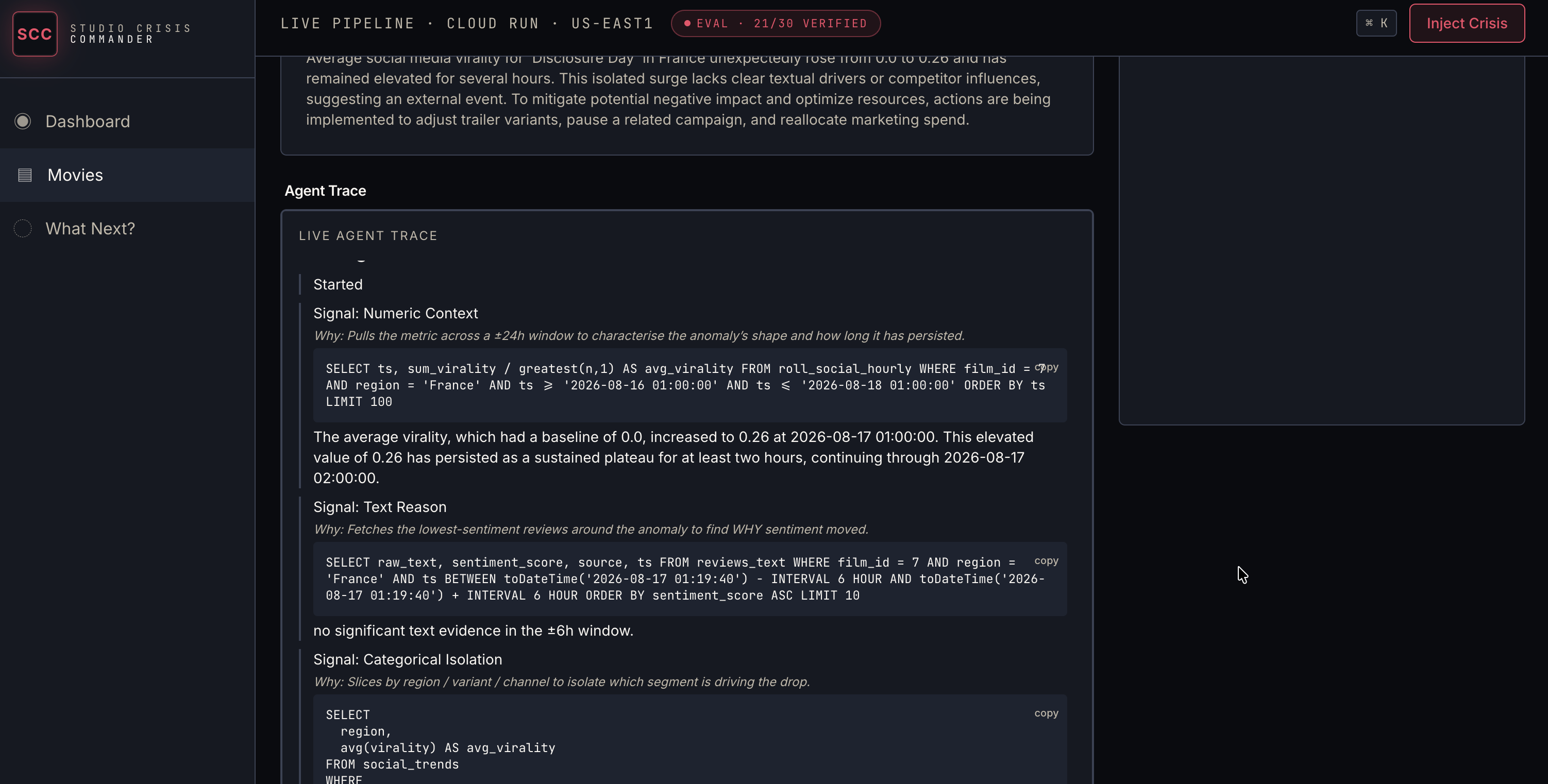
| 2 | Investigation | Fans out to four grounded sub-agents (numeric / text / categorical / temporal), each running one MCP query. | Gemini 2.5 Flash + Pro via ADK |
| 3 | Decision | Synthesizes findings into 1–3 ranked actions, each with an impact_usd and an impact_sql. |
Gemini 2.5 Pro |
| 4 | Report | Executive summary; every headline number carries a source_query popover. |
Gemini 2.5 Flash |
Anything above the impact threshold waits at an approval gate. Auto-executed decisions carry a rollback timer. Every step lands in an append-only audit table.
The flow, end-to-end
The dashboard is now built around the film as the primary object, not the anomaly feed:
- Land on Dashboard → pick a movie from the
FilmPicker. - The RegionHeatBar blooms — 15 markets, colored by signal family, showing where the film is actually bleeding.
- Pick a region → the workspace scopes:
TimeseriesGridshows 4-up sparklines for box office / social / streaming / reviews,DashboardWorkspaceswaps to that region's latest investigation. - Hit Inject Crisis → pick one region or many. The backend fans out N parallel pipelines. The bottom-docked
PipelineTickergrows one pill per run, each with its own detection→investigation→decision→report progress dots. Click any pill to focus that run's trace. - On Movie Detail, past runs are clickable — the whole workspace time-travels into that historical run's detection, decision, and report.
The whole surface stays in sync via a single Zustand store with per-run event buckets. Mirror-on-focus keeps existing panels reading from top-level singletons; a useScopeMatches() hook blanks any panel whose loaded data doesn't belong to the currently-selected film × region.
📊 How we built it
Data plane
ClickHouse Cloud, us-east1. One Layer-1 build pipeline seeds the warehouse from the TMDB catalog (Kaggle bulk + live API) and expands it with a deterministic synthetic generator: ~50 M numeric rows, ~150 K text rows (real reviews + Gemini-authored longform), and a crisis injector that records ground truth for the eval harness. Direct clickhouse-connect clients live only in the build pipeline and the Layer-2 materialized-view setup.
Every agent ClickHouse call flows through the mcp-clickhouse MCP server — enforced by a boundary-grep test in CI. The MCPToolset is pooled across the four sub-agents so one stdio subprocess handles all four in-flight queries, saving ~15s of cold-start on Cloud Run.
Runtime AI
- Gemini 2.5 Flash / Pro via
google-genaiandgoogle-cloud-aiplatform - Google ADK for
SequentialAgentorchestration and MCP toolset lifecycle - Zero third-party AI libraries — no LangChain, no LlamaIndex, no CrewAI, no third-party LLMs
API
FastAPI + Server-Sent Events. The interesting endpoints:
POST /inject-crisis                     ← accepts region OR regions[] (multi-region fan-out)
GET  /stream/investigation/{run_id}     ← SSE, one connection per run
GET  /catalog/films/{id}                ← film metadata + top_regions with 7d deltas
GET  /catalog/films/{id}/runs           ← past-runs list
GET  /catalog/films/{id}/runs/{did}     ← full audit triple for a decision (time-travel)
GET  /films/{id}/latest-investigation?region=REGION
GET  /metrics/{film_id}/regions         ← 15-region telemetry rollup for the heat bar
The runtime keeps a background ClickHouse warmer (SELECT 1 every 4 min) so the compute pool never auto-suspends between demos, and a cached-triple fallback so a downstream flake replays a real, pre-recorded pipeline run instead of erroring out.
Frontend
React 18 + Vite + TypeScript + Tailwind + Framer Motion + Zustand + React Query. The store owns the SSE lifecycle — panels never touch the network directly. A per-run event bucket lets multi-region injects display N independent traces without any run stomping on another.
Deploy
Two Cloud Run services (backend + frontend), min-instances=1 on the API so telemetry never cold-starts. Cloud Build auto-deploys on push to main from backend/** and frontend/** paths.
📈 Accuracy — with receipts
Most hackathon projects claim "high accuracy" with no receipts. We ship an eval harness that runs 30 scenarios end-to-end and reports a per-type breakdown. The artifact lives at data/eval_runs/replay-latest.json and reproduces via ./scripts/eval_replay.py.
Current: 21 / 30 = 70% primary-cause accuracy across 8 crisis types.
| Crisis type | N | Correct | Accuracy |
|---|---|---|---|
| refund_spike | 4 | 4 | 100% |
| trailer_variant_underperformance | 4 | 4 | 100% |
| marketing_overspend_low_roi | 4 | 4 | 100% |
| streaming_completion_drop | 3 | 3 | 100% |
| negative_social_virality | 4 | 2 | 50% |
| competitor_release_impact | 4 | 2 | 50% |
| regional_sentiment_collapse | 4 | 1 | 25% |
| review_score_divergence | 3 | 1 | 33% |
The failure modes are almost entirely narrative — the agent finds the right signal but attributes it to a plausible-adjacent cause (e.g. "regional_sentiment_collapse" gets read as "negative_social_virality" because the driving platform is Twitter, just downstream of the actual sentiment collapse). Those are contract-shape problems we can fix; we chose to submit with the honest number rather than tune to it.
🚧 What broke, and what we learned
The bugs we're still a little bitter about
The single _closeStream ref that killed every multi-region demo.
Our first multi-region cut kept overwriting one close() handle on every connectStream(). So spawning 3 parallel runs left exactly one alive — the last one. Symptoms: pipeline pills that stared at you with all-hollow dots forever. Fix was a per-runId Record<string, () => void> closer map. Two-line diff, four hours of debugging.
Zustand persist keeping zombie runs alive across sessions.
Runs from before that fix landed had streamState: 'streaming' frozen in localStorage. Every reload restored them into the ticker. Fixed by (a) bumping persist version to invalidate old payloads, (b) removing activeRuns from the persisted partial entirely — SSE can't be resumed anyway — and (c) a 3-minute stale filter as a runtime guard.
Cloud Run's dependency roulette.
We shipped google-cloud-aiplatform[adk]>=1.101.0. Cloud Build resolved the latest ADK on rebuild, and a newer version moved StdioConnectionParams under a different path. Container exit(1)'d before it could bind :8080. Pinned every direct dep to the versions the local venv actually runs. Bump deliberately from now on.
The design decisions that survived
- Pooled MCP toolset over per-agent subprocesses. Sharing one
mcp-clickhousestdio subprocess across the four sub-agents cut cold-start by ~15s. Safe because theSequentialAgentnever overlaps two tool calls on the same stdio pipe. - Movie-first over anomaly-first. The old design led with the anomaly feed. Users had no anchor — they'd see "trailer variant regression in DE" and ask which movie? Leading with the film + heat bar reframes the question and makes multi-region a first-class idea.
- Cached-triple fallback as an SLO tool, not a demo hack. Regenerating a triple costs $0.10. The bundled 30 buy us 100% demo uptime independent of ClickHouse's mood.
✨ What's next
- A single movie-intelligence hub across every source. The
/what-nexttab in the app already maps out the direction: fold in YouTube, Instagram, TikTok, X, IMDb, Wikipedia, blogs, news portals, and OTT platforms as first-class investigation signals alongside ClickHouse telemetry. Same four-agent pipeline, wider surface area — trailers and reels for creative diagnosis, editorial + Wikipedia for context, IMDb + OTT for release/availability, cross-source sentiment for the audience-vs-critic split. Regional + language filtering, real-time updates, and a fake-news / duplicate filter round it out. The point isn't more dashboards — it's giving the agents more places to look before they cite a claim. - Multimodal trailer analysis. Feed trailer variants directly to Gemini's video understanding and let it hypothesize which visual moments correlate with drop-off. Pairs naturally with the trailer-and-teaser source above.
- Auto-executed actions with a rollback timer for the two lowest-impact types.
- Adversarial eval scenarios where the true root cause is a compound of two crisis types — the class that dropped us from 30/30 to 21/30.
The pitch, in one sentence: Watch every signal, cite every claim, ship every recommendation — before the meeting starts.
Built With
- clickhouse
- cloud-run
- cloud-scheduler
- fastapi
- framer-motion
- gcp
- gemini
- google-adk
- google-cloud-aiplatform
- google-genai
- mcp-clickhouse
- playwright
- pydantic
- pytest
- python
- react
- recharts
- secret-manager
- tailwind
- typescript
- uvicorn
- vite
- vitest
- zustand


Log in or sign up for Devpost to join the conversation.