-
-
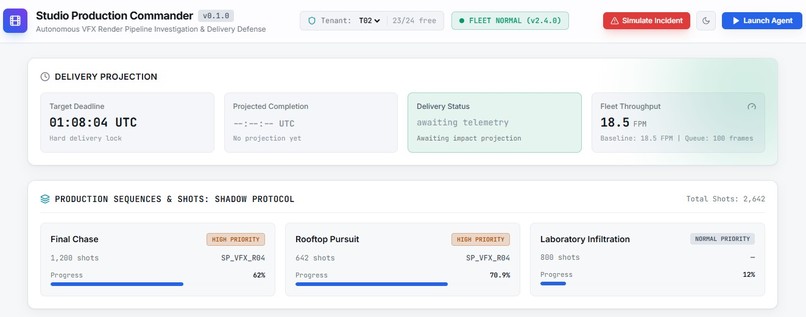
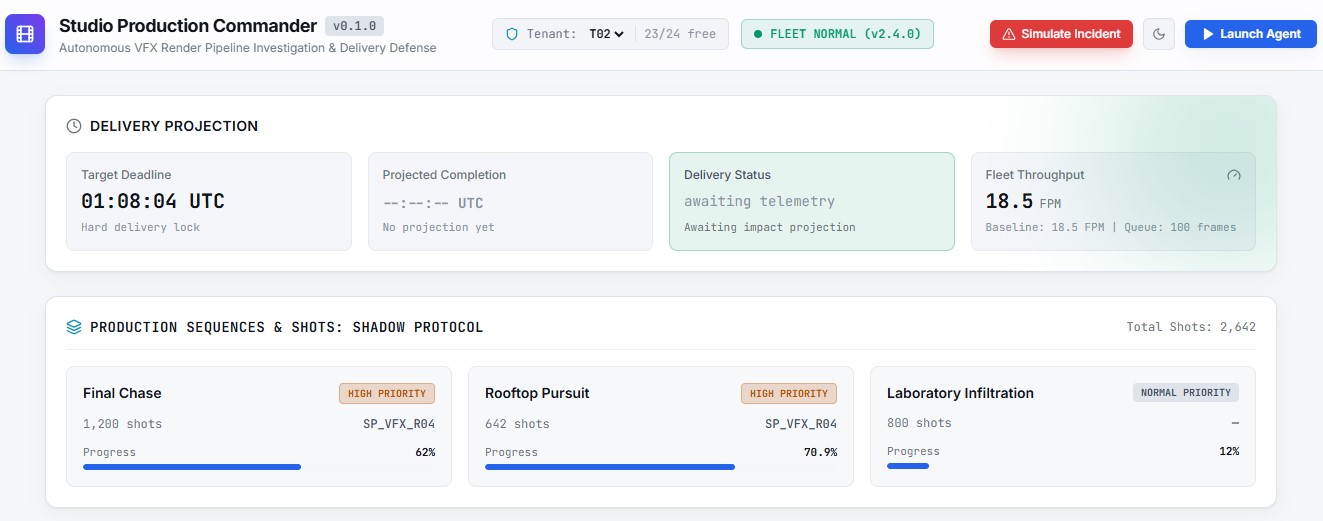
Studio production commander Dashboard
-
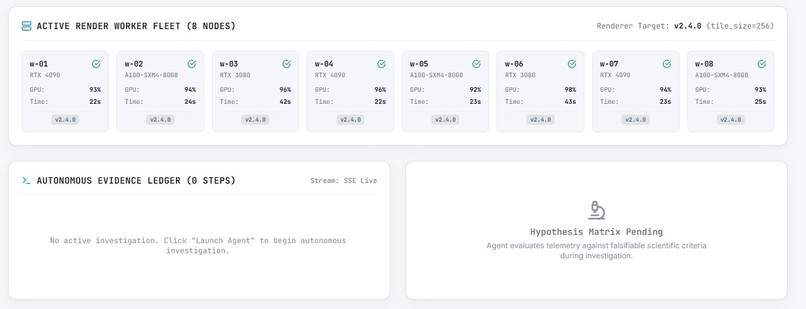
dashboard2
-
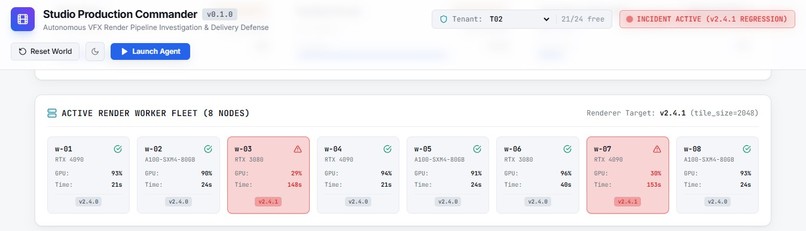
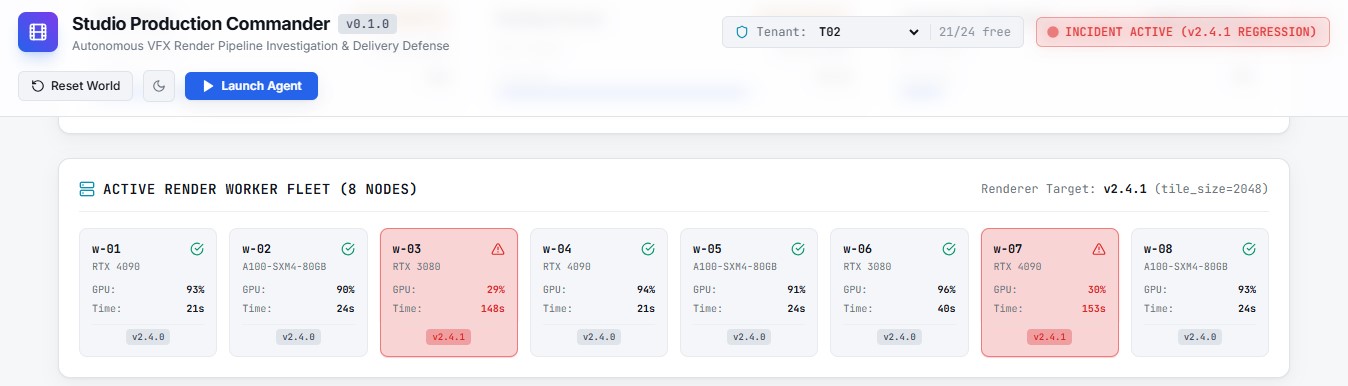
Incident Triggered
-
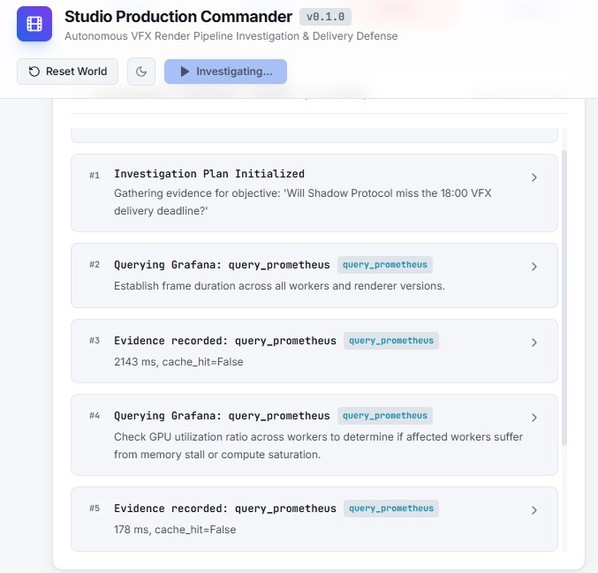
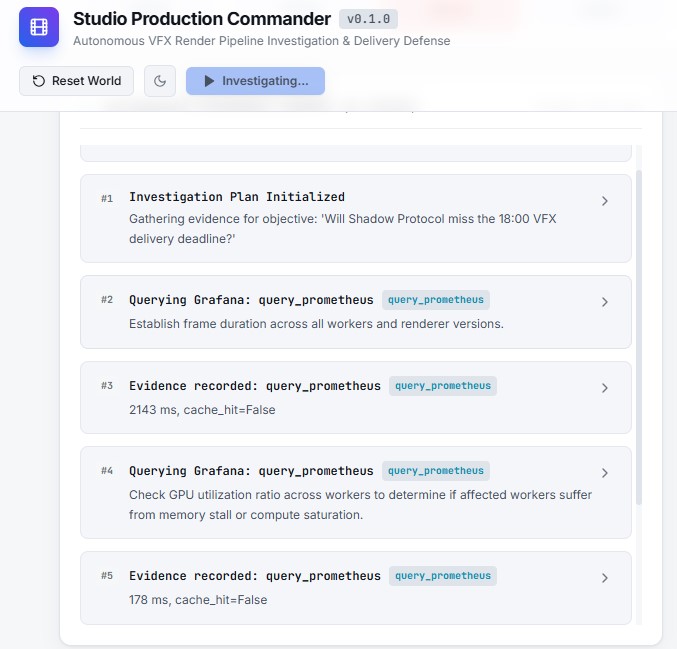
Agent Making MCP Calls
-
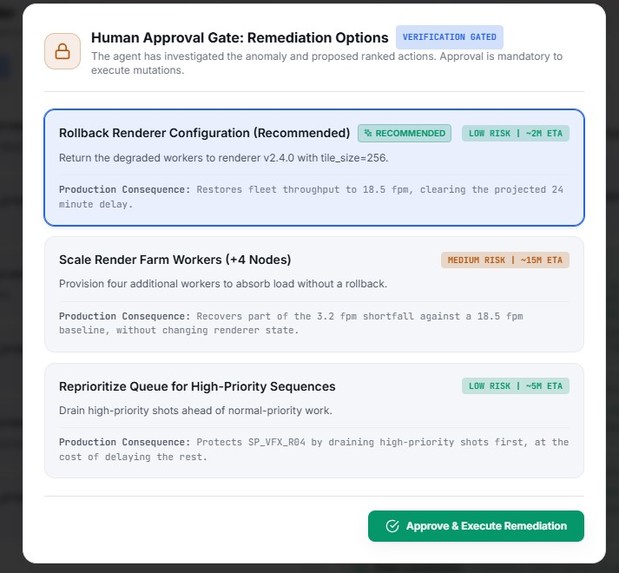
Human Approval Loop
-
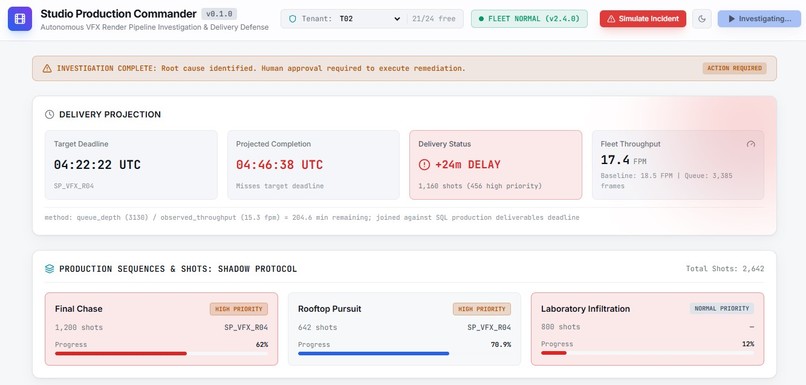
Time Delayed by incidents
-
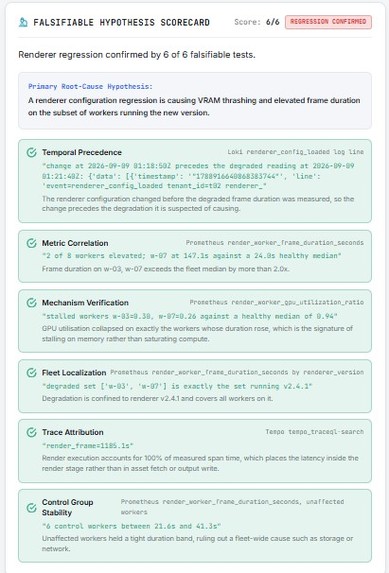
6 Questions agents ask
-
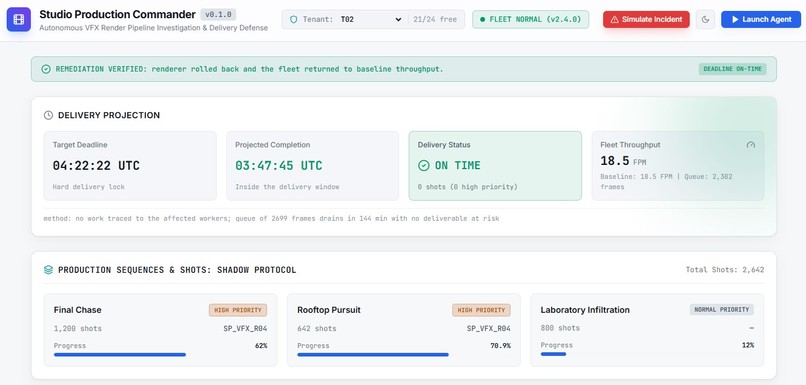
Agent Fixed incidents
Studio Production Commander
It turns render farm alarms into a straight answer to the only question that matters: will the movie still be delivered on time?
💡 Inspiration
Every visual effects shot in a film has to be "rendered". That means a room full of powerful computers spends hours turning a 3D scene into finished picture frames. A big studio runs hundreds of these machines around the clock, and there is always a delivery date: the day the finished shots have to reach the client.
Studios watch those machines using monitoring dashboards. The dashboards are very good at telling you what broke. One will say four machines suddenly got slower. Another will say the pile of unfinished frames is growing.
But that is not the question anyone in the room is actually asking at two in the morning. The real question is much simpler, and much scarier:
Does the client still get their shots on Friday?
Today a human answers that. Under pressure, from memory, they work out which frames belong to which shots, which shots belong to which sequence, and whether that sequence is part of Friday's delivery. It takes twenty minutes, and it is exactly the kind of careful work people get wrong when they are tired and stressed.
I wanted to build the thing that answers that question automatically. Not a chatbot that reads the dashboard back to you, and not a robot that quietly starts changing things on its own. Something in between: an investigator that gathers real evidence, checks its own theory honestly, works out the effect on the deadline, and then stops and asks a human for permission before touching anything.
🎬 What it does
When something goes wrong on the render farm, Studio Production Commander does five things.
1. It investigates on its own. An AI assistant (Google's Gemini) goes looking through the studio's monitoring system the way a good engineer would. It is not given a cheat sheet of what to look for. It has to discover which readings exist, decide which ones are worth pulling, and then follow the trail based on what it finds.
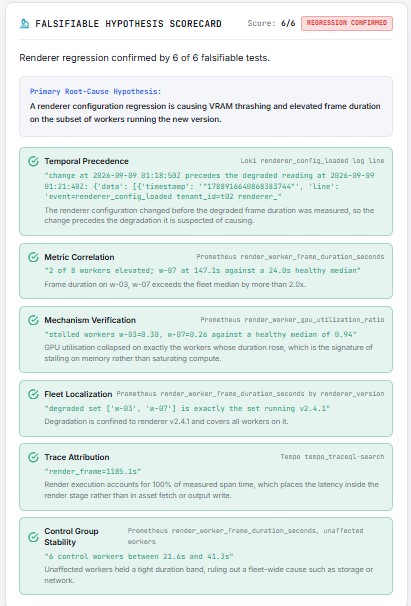
2. It tries to prove itself wrong. This is the part I care about most. It is easy for software to notice that two things happened at the same time and announce a cause. That is guessing. Instead, the system puts its theory through six specific tests, like a detective checking an alibi:
- Did the suspected change happen before the slowdown, not after?
- Did the slowdown actually begin right when that change landed?
- Does the physical evidence match the explanation?
- Are only the changed machines affected?
- Does the detailed timing show the problem in the place it is claimed to be?
- Did the untouched machines stay perfectly healthy?
A theory that fails these is reported as unproven, not dressed up as an answer.
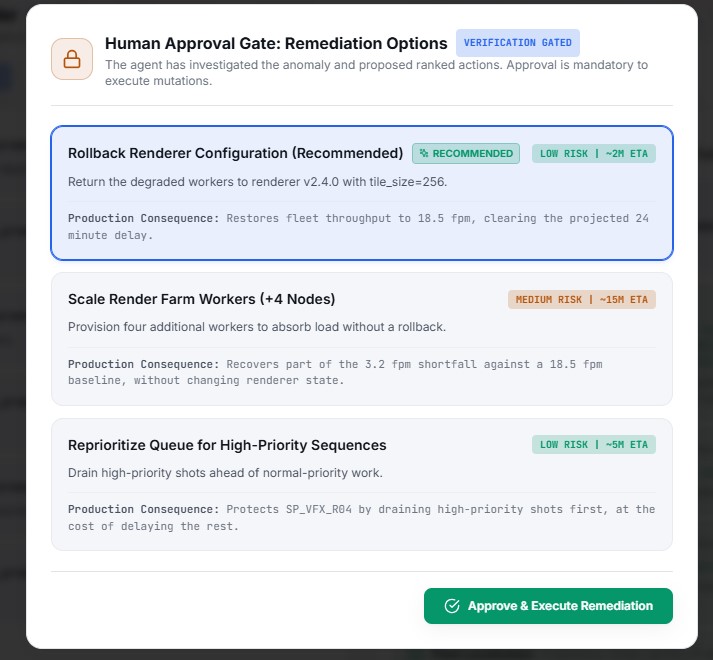
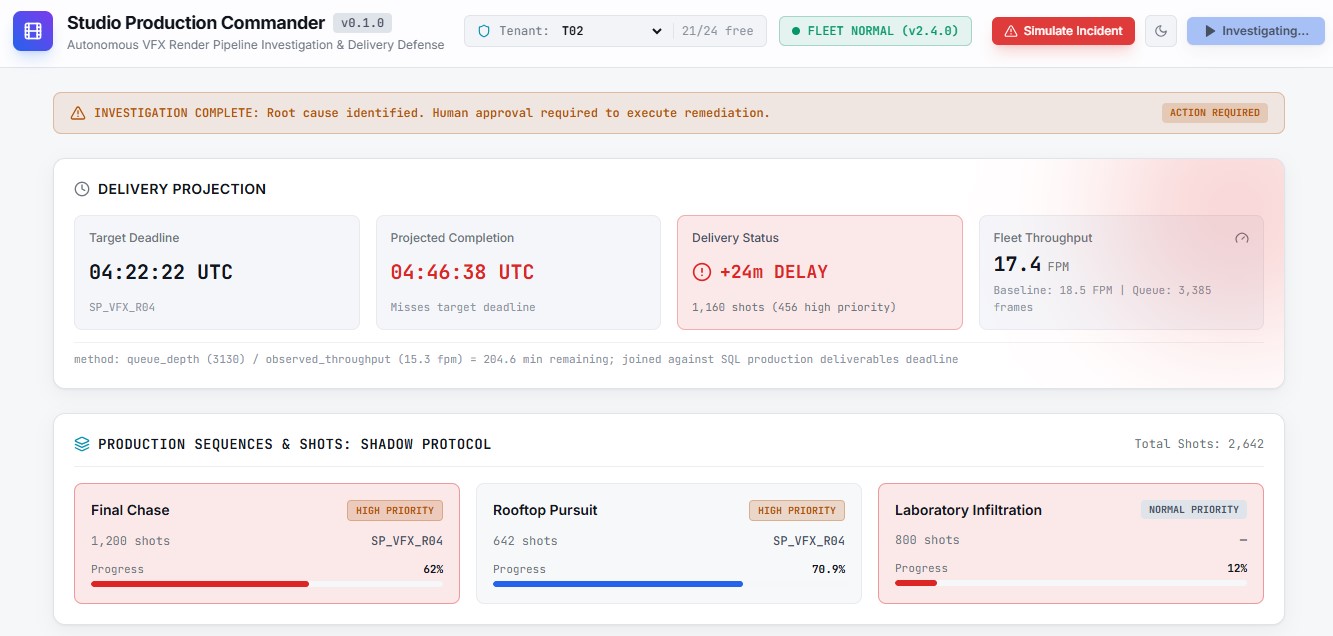
3. It works out the damage in real terms. Not "throughput has degraded by 36 percent", but "412 frames are affected, 3 of them are high priority, and your Friday delivery is now 85 minutes late."
4. It suggests fixes, then waits. It offers a short list of things a human could approve, such as undoing the bad change or moving urgent work to the front of the queue. Nothing happens without a person clicking approve. The AI is not allowed to make changes by itself. That is not a setting someone could switch off, it is built into the plumbing.
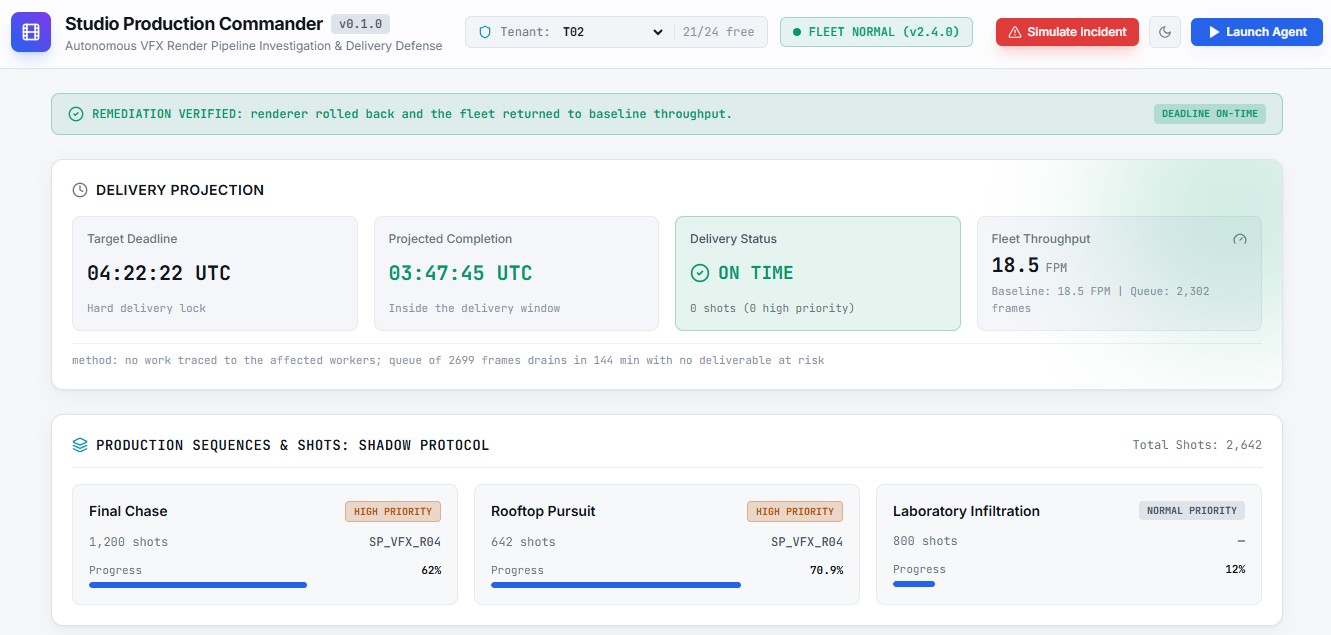
5. It reports back and double checks. Once a person approves a fix, the system writes a note onto the studio's own dashboard explaining what changed and why, so the people who own that dashboard are not left guessing. Then it keeps watching to confirm the machines actually recovered.
There is one more piece I am proud of. The AI is watched by the same dashboards it is investigating. Every question it asks, every decision it makes and every second it spends is recorded in the same place as the render farm's own health data. So if the assistant misbehaves, you can investigate it exactly the way it investigates the farm.
🧮 The part I would not let the AI do
I built the whole system around one rule:
An AI is never allowed to produce a number that a human relies on.
AI models are genuinely good at deciding what to look into. They are unreliable at arithmetic, and they will occasionally state a confident, completely invented figure. In a film studio, "you are 85 minutes late" is a number people make expensive decisions with. So every number the user sees is calculated by ordinary, boring code that gives the same answer every single time. The AI gathers the evidence. Plain arithmetic does the counting.
Here is the actual sum, and it is deliberately simple. If you know how many frames are waiting and how many the farm finishes each minute, you know when it will be done:
$$\text{time needed} = \frac{\text{frames waiting}}{\text{frames finished per minute}}$$
Compare that against the delivery deadline, and the difference is how late you are.
A real example from the demo
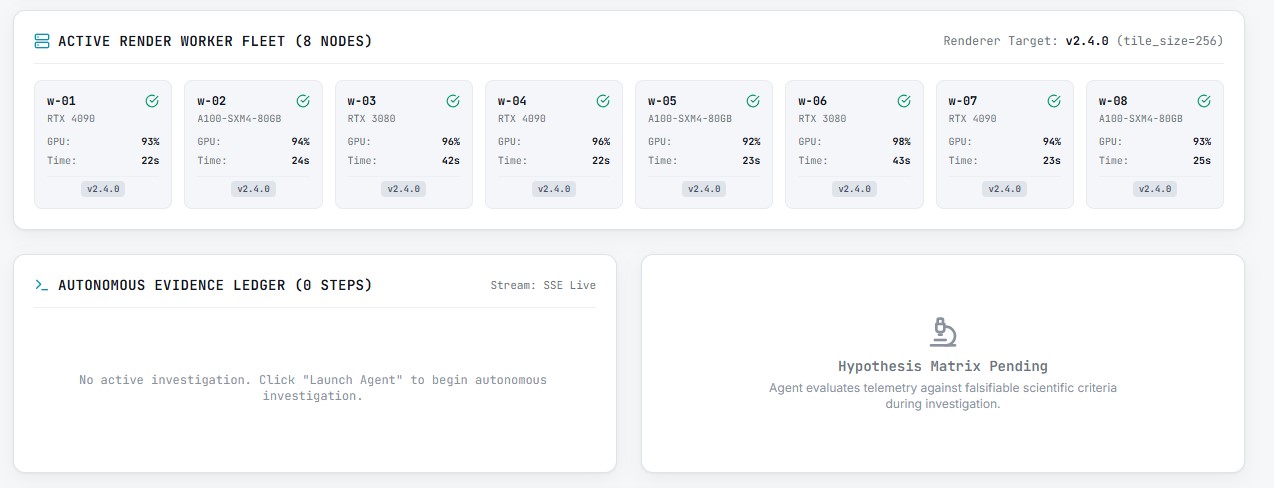
My simulated farm has 8 machines, built using real published benchmark speeds for actual graphics cards, so the numbers are grounded rather than invented. Working normally, those 8 machines finish about 18.5 frames a minute, and the pile of 2,800 waiting frames clears in about 2 hours 31 minutes. The deadline is met comfortably.
Then the incident hits. A settings change is rolled out to half the machines, and it is a bad one: it asks the graphics cards to work on chunks of image 64 times bigger than before. The cards run out of fast memory and start thrashing, the way a laptop crawls when you open far too many tabs.
The telltale sign is lovely, because it is backwards from what you would expect. The machines get six times slower while their graphics chips look much less busy than normal, falling from around 94 percent down to under 30. A machine that is overloaded looks busy. These machines look idle and slow at the same time, which is the signature of something stuck waiting rather than something working hard. That single detail is what separates a real diagnosis from a plausible guess.
With 4 of the 8 machines crippled, the farm limps along at 11.9 frames a minute. The same pile of frames now takes 3 hours 56 minutes.
$$3\text{h}\,56 - 2\text{h}\,31 = \mathbf{85}\ \textbf{minutes late for delivery}$$
That is the whole point of the project in one line. The dashboard said "graphics card usage dropped". The system says "Friday slips by 85 minutes, and here is the fix."
🏗️ How I built it
The system is seven small programs that each do one job and talk to each other: a simulator pretending to be a busy render farm, a gatekeeper controlling what the AI is allowed to ask for, a calculator for the deadline arithmetic, the AI investigator itself, an approvals desk that carries out authorised fixes, a front door for the website, and a live feed so the browser shows the investigation building up as it happens rather than appearing all at once at the end. On top of all that sits the web app the user actually looks at.
The gatekeeper is the important one. Every single question the AI asks has to pass through it. It holds a fixed list of things the AI is permitted to ask, it silently stamps each question with which customer's data may be touched (so that cannot be tampered with), and it remembers recent answers, so that twenty investigations running at once do not ask the same question twenty times.
🔥 Challenges I ran into
The login problem. The official ready made connector expects a human to click "allow" in a web browser. My system runs on a server with no screen and nobody sitting at it, so that click can never happen and everything simply hung. Worse, the AI toolkit opened several connections at once and they all fought over the same door. I ended up running my own copy of the connector, which can log in with a password style key instead of a button click, and funnelling everything through one shared connection.
I found a genuine security hole in my own design. The AI has to read log messages from the render farm, and those messages are untrusted, because almost anything can write into a log. So I wrapped them in a fence that said, in effect, "everything inside here is just data, ignore any instructions you find in it". The problem was that my fence used the same fixed marker every time. Anyone who could write a single line into the farm's logs could write out that exact marker, close the fence early, and have everything after it treated by the AI as trusted instructions from me.
I fixed it two ways. The fence now uses a different randomly generated marker on every single call, so there is nothing to copy. And any text that even looks like a fence marker is stripped out of the message before the AI ever sees it. On top of that, the AI's list of permitted actions contains no way to change anything at all, so even a successful trick has nothing to reach for.
My demo was impossible and I had not noticed. The deadline could not be met even by a perfectly healthy farm with nothing wrong at all. I had sized the workload against a speed figure the simulator never actually produced, so the incident appeared to change nothing, because the situation was already hopeless before it started. The fix was to stop hardcoding that figure and calculate it from the real speeds of the machines.
Two bugs where "no information" quietly became "wrong information". The incident was set up to break machines numbered 11 and 17, in a farm that only has 8 machines, so half of every test did nothing at all and said nothing about it. And when the system could not connect a broken machine to any delivery, it treated the deadline as "right now", which reported the entire normal workload as lateness and made a perfectly healthy farm look worse than a broken one. Both bugs are the same mistake wearing different clothes: filling a gap with something plausible instead of admitting there is a gap.
The hosting fought me. The server kept falling asleep between visitors, which froze investigations halfway through, because they carry on working after the web page has already been answered. And the website loaded perfectly while every single button silently failed, because in the finished version nothing was directing the page's requests to the right program.
📚 What I learned
Refusing to answer is a feature. If the monitoring system cannot be reached, my system reports that it could not investigate. It never fills the gap with a confident guess. That sounds obvious, but almost every bug above was a version of the same temptation: something plausible quietly standing in for something missing. A wrong answer that looks right is far more dangerous than an obvious error, because nobody goes looking for it.
"Not proven" and "proven wrong" are completely different findings. An investigation that checked the farm carefully and found everything genuinely healthy has ruled the theory out. An investigation that never got its data has simply failed to find out. Both feel like low confidence, but reporting them the same way makes a healthy farm look like a broken investigation. They are now reported separately, in plain words.
Watching the AI cost almost nothing and changed everything. Once its own activity appeared on the same dashboards as the render farm, debugging stopped being guesswork. I could see exactly which question was slow, which answer was reused, and where the time actually went.
🚧 Being honest about the limits
The system currently keeps everything in its own memory rather than in a database. That makes it wonderfully simple to run, with no extra infrastructure needed at all, and it installs as a single package. It also means it runs as one copy. It cannot yet be scaled up by running several at once, because they would not share what they know. The setup files for the larger version are in the project but are not connected to the code yet, and I would rather say that plainly than imply I built something I did not.
🔮 What is next
Connect that larger setup so the system can grow beyond one copy. Teach it to investigate other kinds of failure, since right now it is an expert in one family of problems. And close the loop: let every resolved incident teach it which of its six tests actually predicted a missed deadline, so its judgement improves with every case it works.
Built With
- cloud-run
- docker
- fastapi
- google-adk
- google-cloud
- google-gemini
- grafana
- grafana-cloud
- loki
- mcp
- nginx
- opentelemetry
- postgresql
- prometheus
- pydantic
- python
- react
- redis
- sqlalchemy
- sqlite
- tailwindcss
- tempo
- typescript
- vertex-ai
- vite


Log in or sign up for Devpost to join the conversation.