-
-
Cover / YouTube thumbnail
-
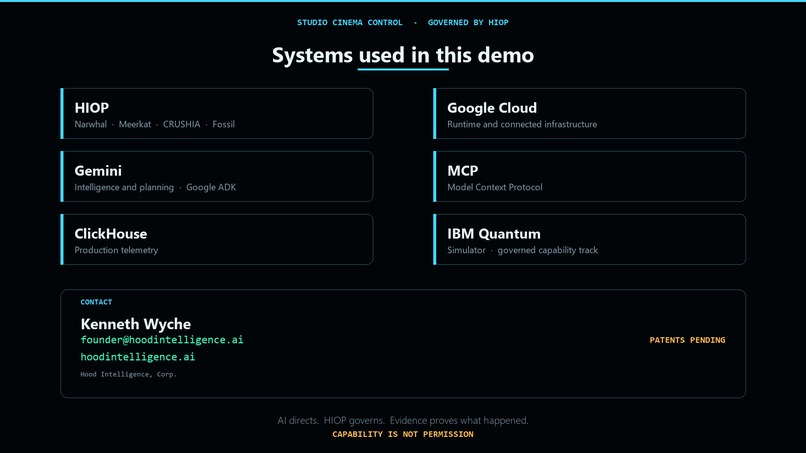
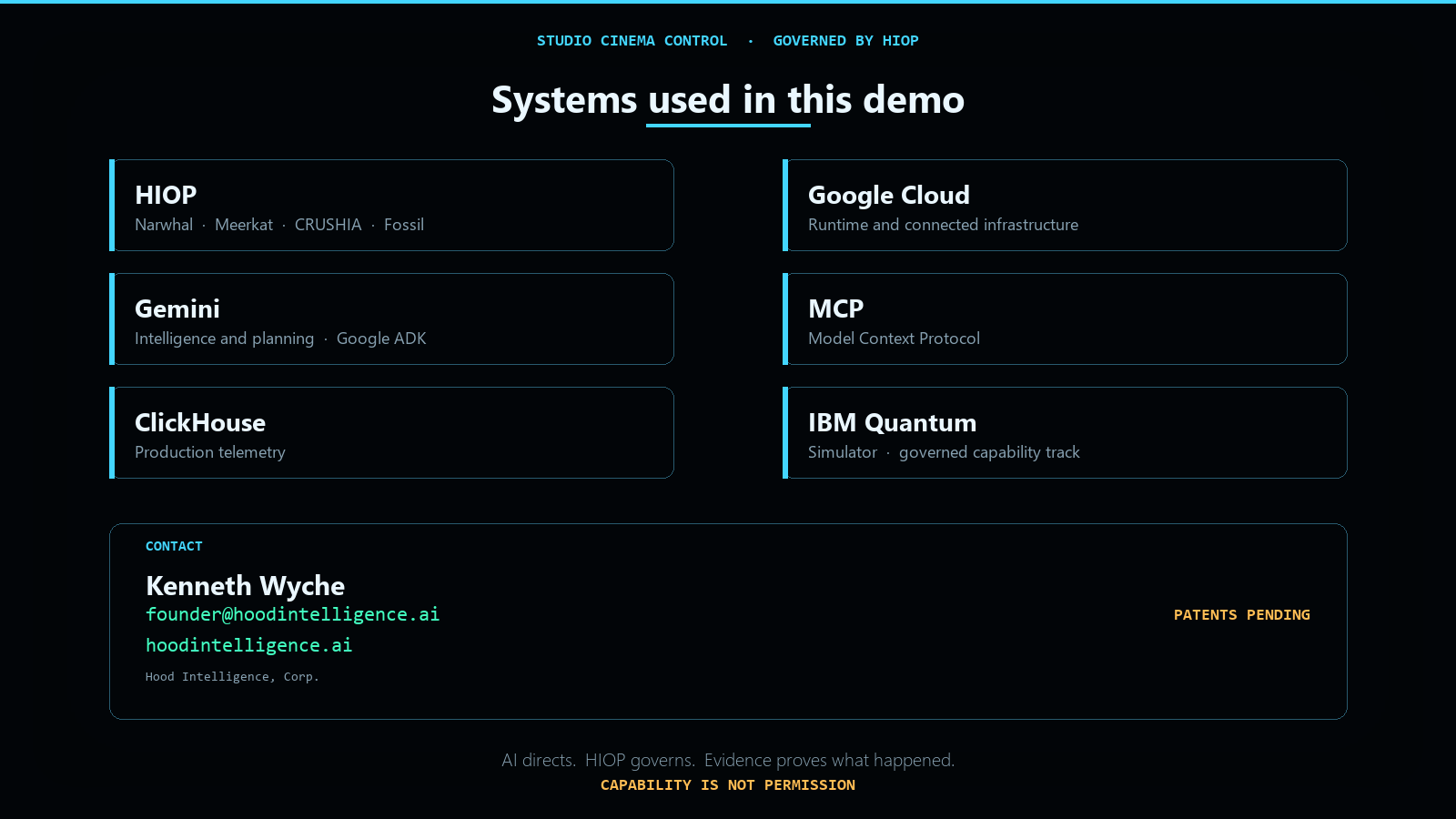
Systems + Kenneth Wyche + Patents ending
-
In-video name card
-
Same card from the video
-
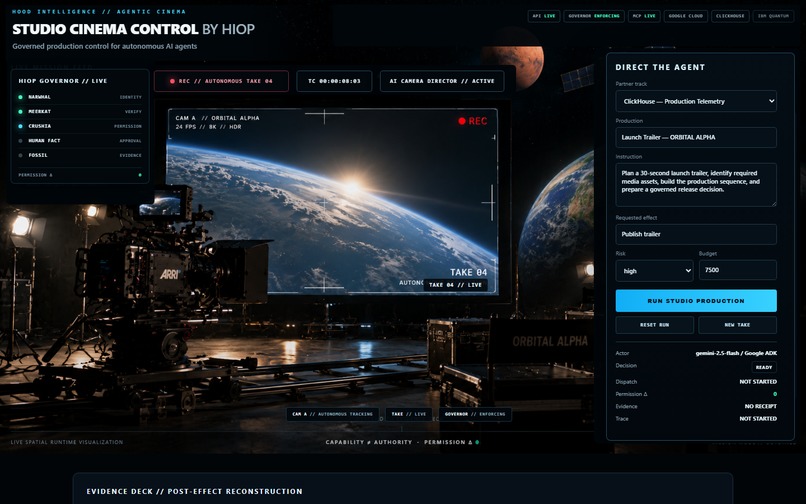
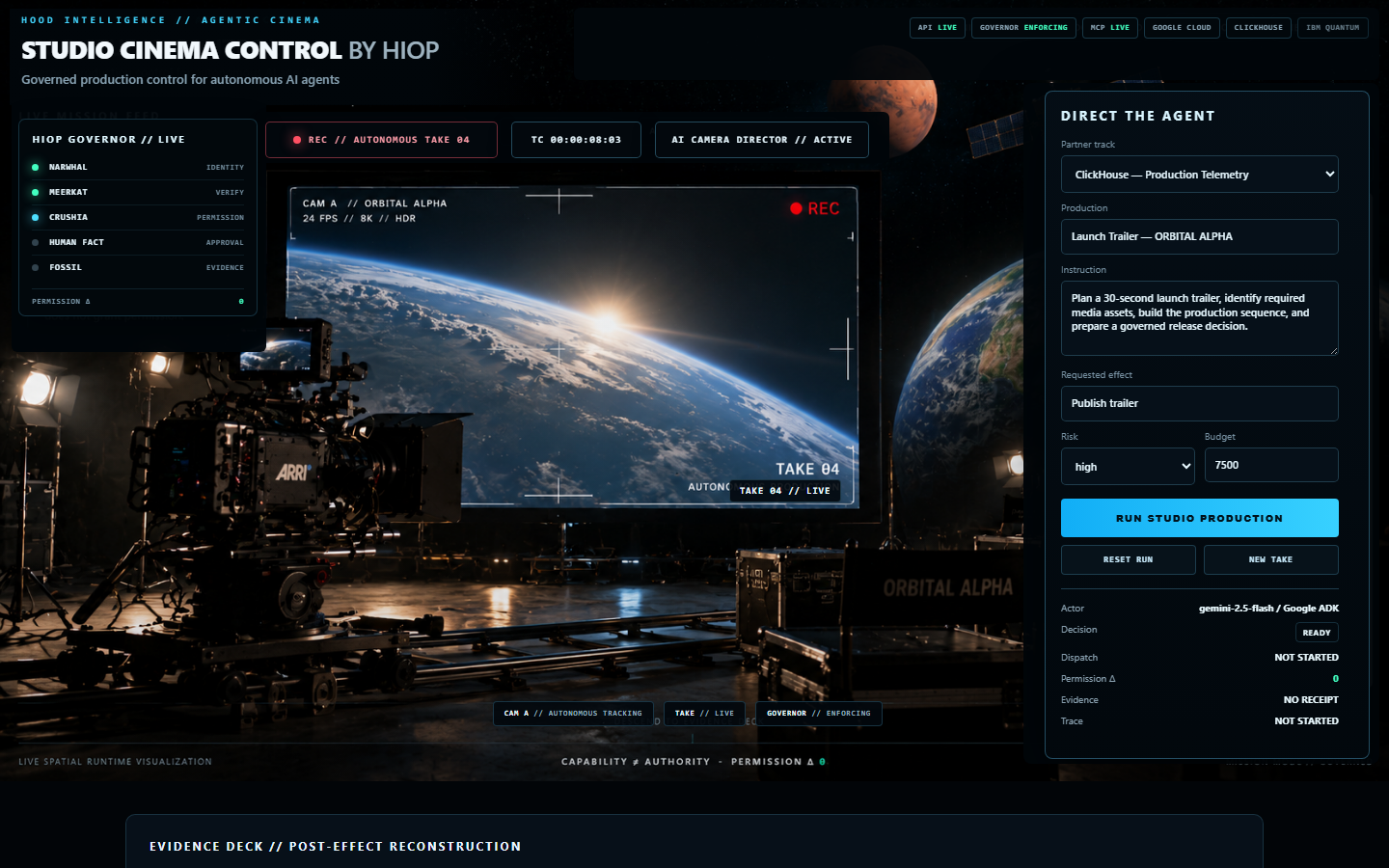
Devpost gallery #1 — full studio UI
-
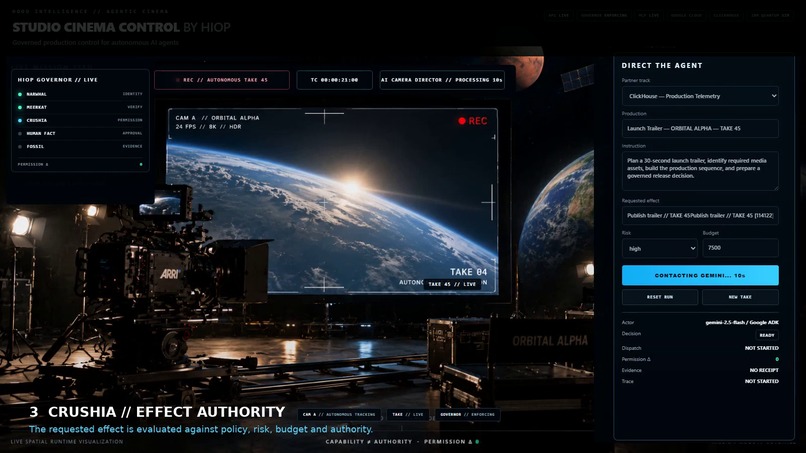
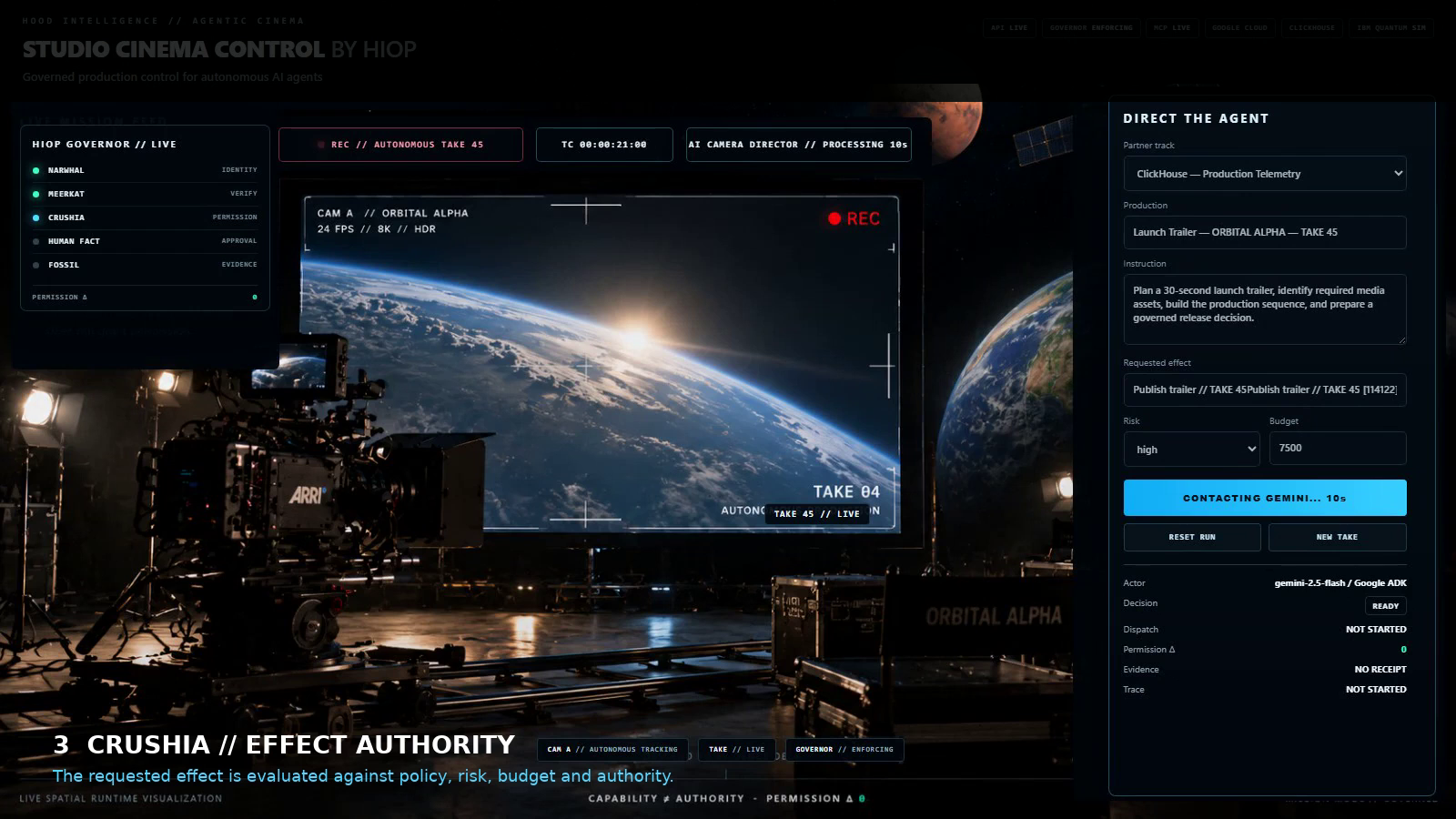
Live run — Gemini + CRUSHIA + TAKE 45
Inspiration
AI agents are becoming capable of planning, using tools, calling APIs, and taking actions across real systems. But capability is not the same thing as permission.
We built Studio Cinema Control by HIOP to demonstrate a different model for agentic AI: Gemini can provide intelligence and direct a workflow, while HIOP independently governs whether a consequential action is actually authorized to occur.
Our core principle is simple:
AI directs. HIOP governs. Evidence proves what happened. Capability is not permission.
What it does
Studio Cinema Control is a governed agentic production workflow.
Gemini proposes an action, but the agent cannot simply execute because it has access to a tool.
HIOP processes the request through a governed sequence:
Request → Identity → Verification → Authority → Human Approval when required → Fresh Authority Decision → Dispatch → Evidence
The demonstration shows:
- Gemini 2.5 Flash providing AI intelligence and planning
- Narwhal establishing actor identity
- Meerkat verifying the request and operating context
- CRUSHIA evaluating effect-level authority
- Human approval being recorded without automatically granting execution authority
- A fresh authority decision before execution
- Controlled dispatch only after permission is granted
- Fossil preserving evidence of the governed action
- Permission remaining bounded throughout the workflow
The interface also demonstrates HIOP operating around connected infrastructure including Google Cloud and Gemini, MCP, ClickHouse production telemetry, and an IBM Quantum simulator.
How we built it
We built the demonstration as an agentic workflow with Gemini at the intelligence layer and HIOP at the authority and evidence layer.
The system separates four concepts that are often collapsed together in autonomous-agent systems:
- What the AI knows
- What the AI can do
- What the AI is authorized to do
- What actually happened
When Gemini proposes an effect, HIOP evaluates the actor, request, context, and authority before dispatch.
If human approval is required, execution remains blocked. The approval becomes a new governed fact and the request goes through a fresh authority decision. Only a fresh permit can unlock dispatch.
After execution, HIOP preserves evidence connecting the request, authority decision, execution, and observed result.
ClickHouse provides production telemetry for the workflow, while MCP provides a standardized connection layer for tools and services.
Challenges we ran into
One of the hardest problems was making human approval safe.
A simple approval button can accidentally become a privilege-escalation mechanism: once a human says yes, the system may treat that approval as unlimited permission to execute.
We designed the workflow differently.
Approval does not directly dispatch the action. It becomes an input fact, and HIOP evaluates authority again before execution.
We also had to keep AI capability separate from operational authority. An agent learning something new, gaining access to another tool, or becoming more capable should not silently increase what it is allowed to cause.
Accomplishments that we're proud of
We demonstrated a complete governed agentic workflow rather than only an AI response.
The demo visibly moves through identity, verification, authority, approval, fresh authorization, execution, and evidence.
We are especially proud of demonstrating the invariant:
Permission delta = 0
Nothing the agent learns during the workflow silently increases its authority.
We also demonstrated how HIOP can operate as a neutral control layer around third-party AI and infrastructure rather than requiring ownership of the underlying model, cloud, tool, or compute system.
What we learned
Agentic AI governance cannot stop at model safety or authentication.
Knowing who an agent is matters. Controlling what systems it can access matters. But consequential autonomous systems also need a way to answer a more precise question:
Is this actor authorized to cause this specific effect, right now, under these conditions?
We also learned that evidence should be part of execution architecture rather than something reconstructed afterward from unrelated logs.
What's next for Studio Cinema Control by HIOP
The next step is expanding the same governed-action architecture beyond cinema workflows into enterprise agents, software operations, mission systems, scientific workflows, robotics, and other consequential autonomous environments.
The underlying goal remains the same:
Allow AI systems to become increasingly capable without allowing capability itself to become authority.
Built With
- clickhouse
- css
- fastapi
- google-adk
- google-cloud
- html
- javascript
- mcp
- python
- sqlite

Log in or sign up for Devpost to join the conversation.