-
predict score
Inspiration
As students, we’ve often wondered how academic performance could be predicted based on behavioral and educational factors. With growing interest in educational analytics and data-driven decision-making, we decided to explore this space by building a machine learning model that can help anticipate student outcomes using real-world data.
What it does
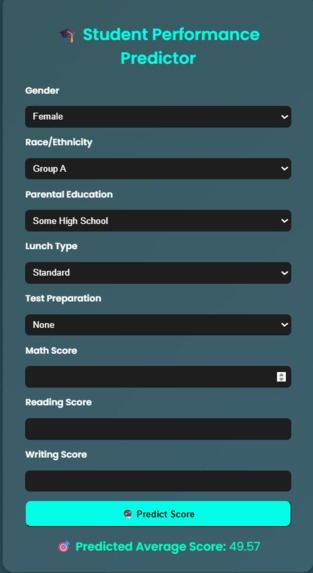
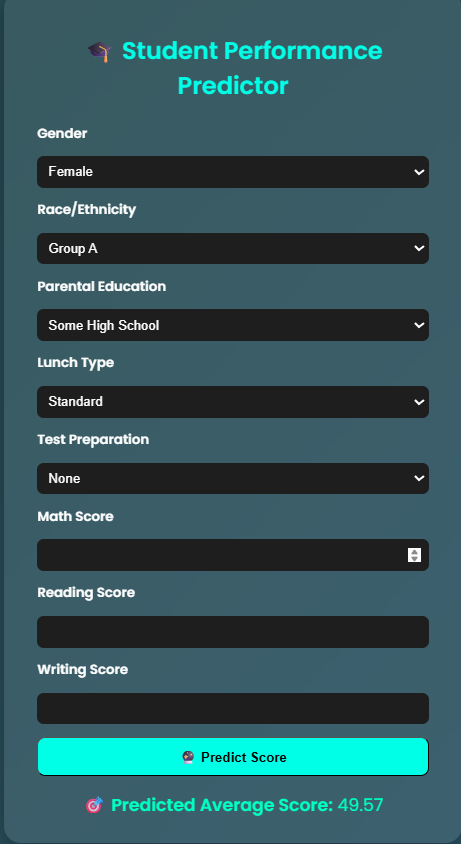
Student Performance Predictor is a simple yet effective tool that takes in inputs like study time, exam scores, and parental education level, and predicts whether a student is likely to pass or fail. The goal is to offer an early indicator for educators, mentors, or students themselves.
How we built it
- We began by collecting and cleaning a dataset containing various academic and personal attributes of students.
- Using scikit-learn, we trained and evaluated multiple classification models such as Logistic Regression and Random Forest to find the best fit for our problem.
- The backend was developed using Flask, which serves the trained model and processes user inputs.
- We then built a clean and responsive front-end using HTML and CSS, allowing users to interact with the model through a simple form.
Challenges we ran into
- Choosing the right model and tuning its hyperparameters for reliable results
- Connecting the backend ML model with the frontend in a minimal, efficient way
- Making the application simple enough for non-technical users to try out
Accomplishments that we're proud of
- Developed an end-to-end ML-powered web application from scratch
- Created a fully functional and user-friendly interface
- Learned how to host and manage code effectively using GitHub
What we learned
Through this project, we gained a deeper understanding of:
- Data preprocessing techniques and handling real-world datasets
- Building and evaluating machine learning classification models
- Deploying ML models using Flask
- Creating intuitive web interfaces and integrating them with backend logic
What's next for Student Performance Predictor
We see great potential to extend this project beyond its current capabilities. Some of the ideas we’re exploring next include:
- Deploying the application online using platforms like Render, Vercel, or AWS so that it’s accessible to a wider audience without requiring local setup.
- Adding more features, such as grade prediction instead of binary pass/fail classification, based on a larger and more diverse dataset. 3.Incorporating data visualization to help users better understand how different features affect performance predictions.
- Expanding the dataset to include data from different educational boards or countries to improve generalizability and accuracy.
- Building an admin dashboard for schools or educators to upload multiple student records and receive insights at scale.
- Integrating feedback loops where students can reflect on their results and receive personalized study suggestions.
We’re excited to keep improving the model and user experience based on feedback and future use cases.

Log in or sign up for Devpost to join the conversation.