Project Story: SchoolDaddy – AI Agent for Graduate Student Success
Inspiration
As a graduate student juggling coursework, research, and personal commitments, I often struggled to keep track of my own performance and well-being. I realized that many students face similar challenges—limited time, multiple deadlines, and difficulty identifying early signs of academic or personal stress.
This inspired me to create SchoolDaddy, an AI-powered platform that acts as a personal academic and well-being assistant. The goal is to help students proactively monitor their performance, prioritize tasks, and receive actionable insights before challenges escalate.
What it does
SchoolDaddy is a unified platform that:
- Monitors student performance and well-being over time.
- Identifies at-risk students using predictive models.
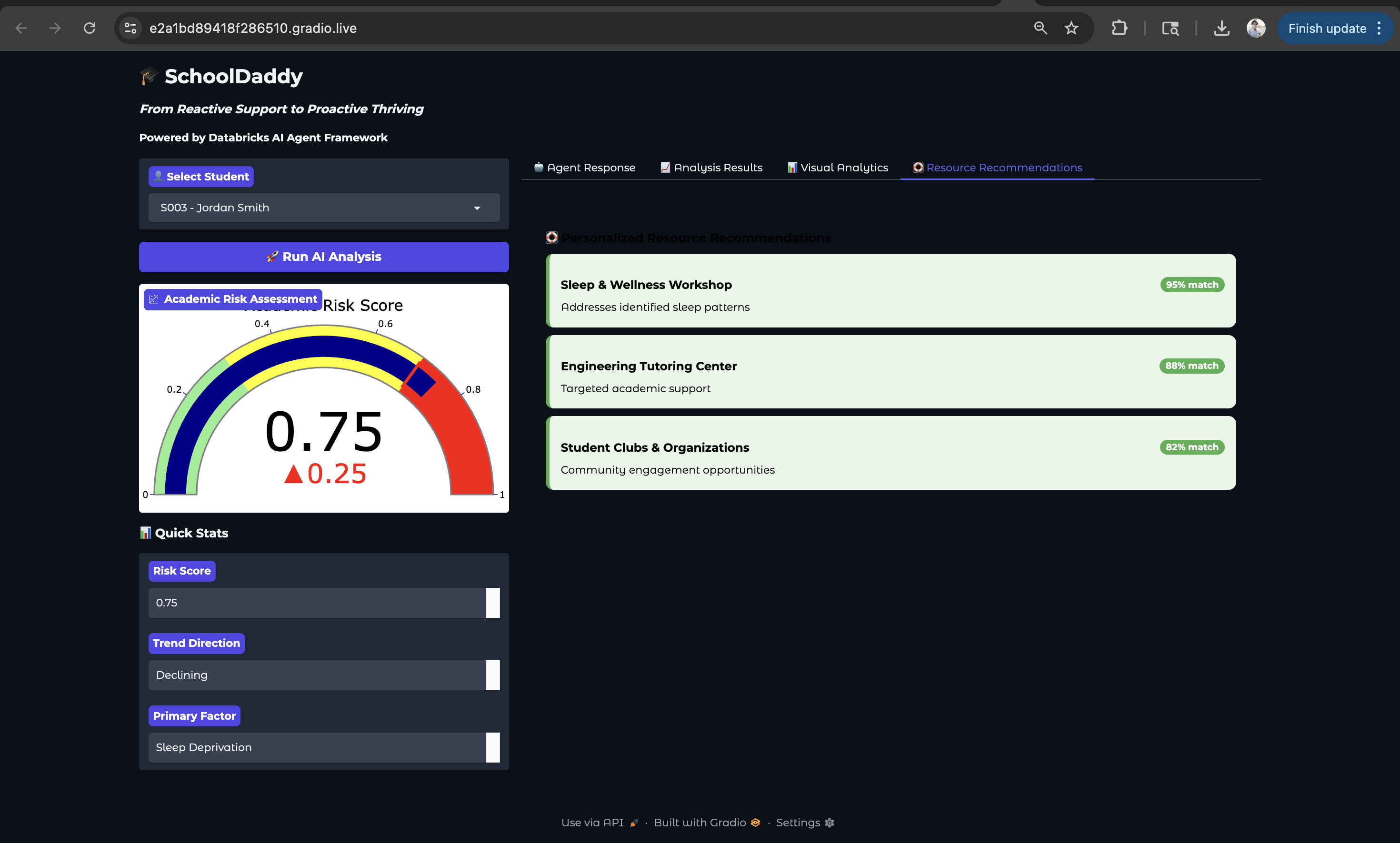
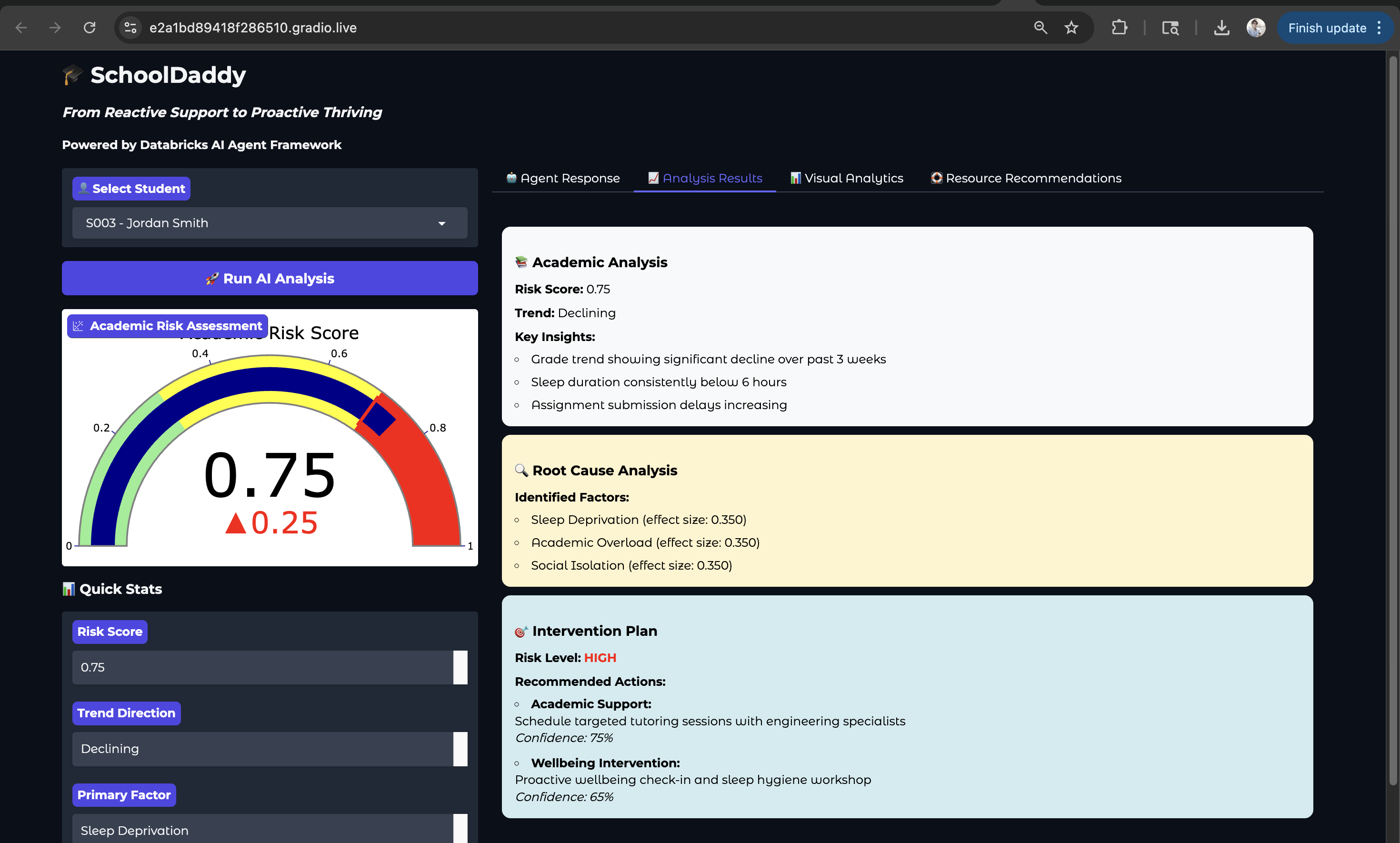
- Provides actionable insights and personalized recommendations.
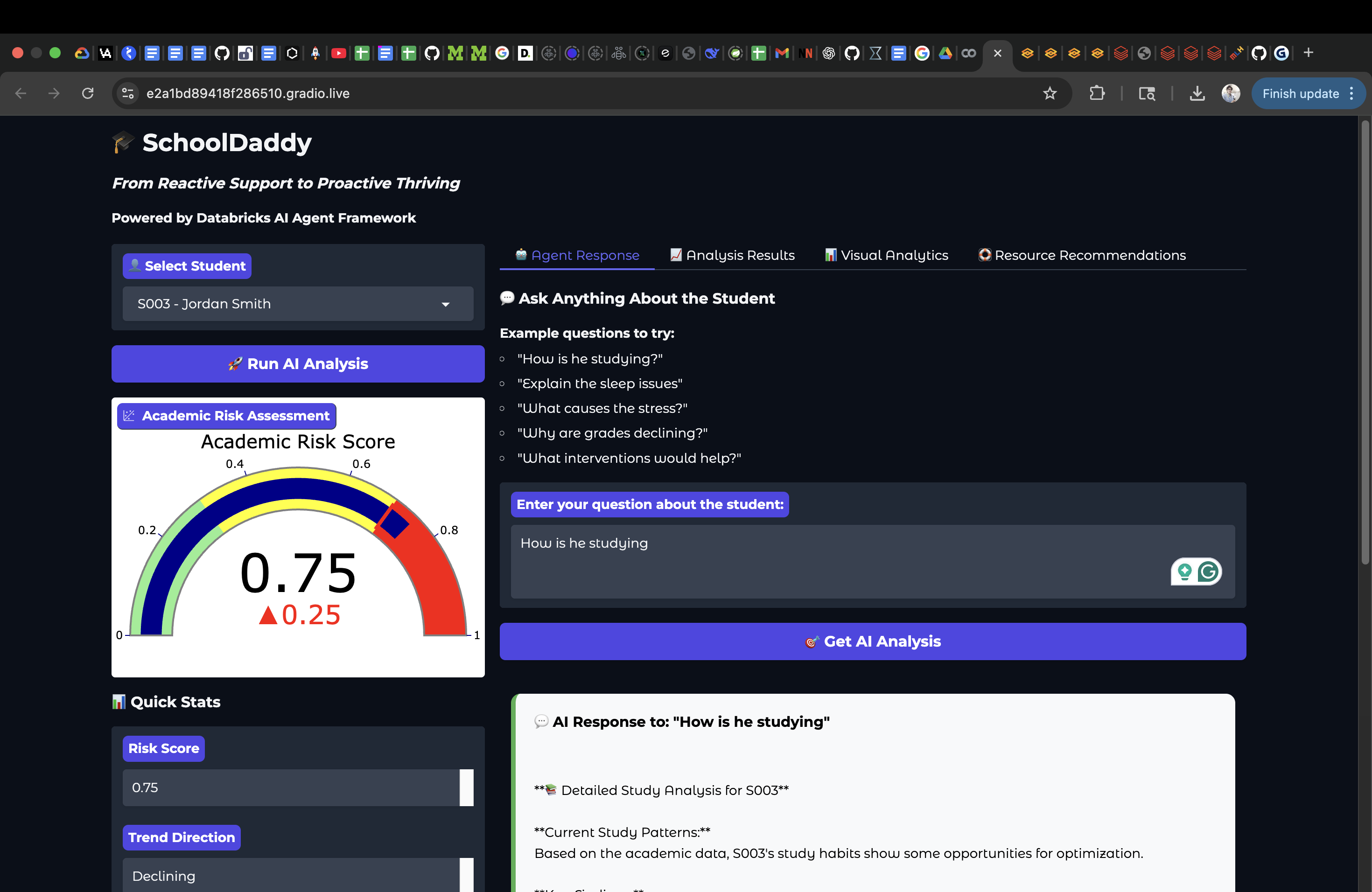
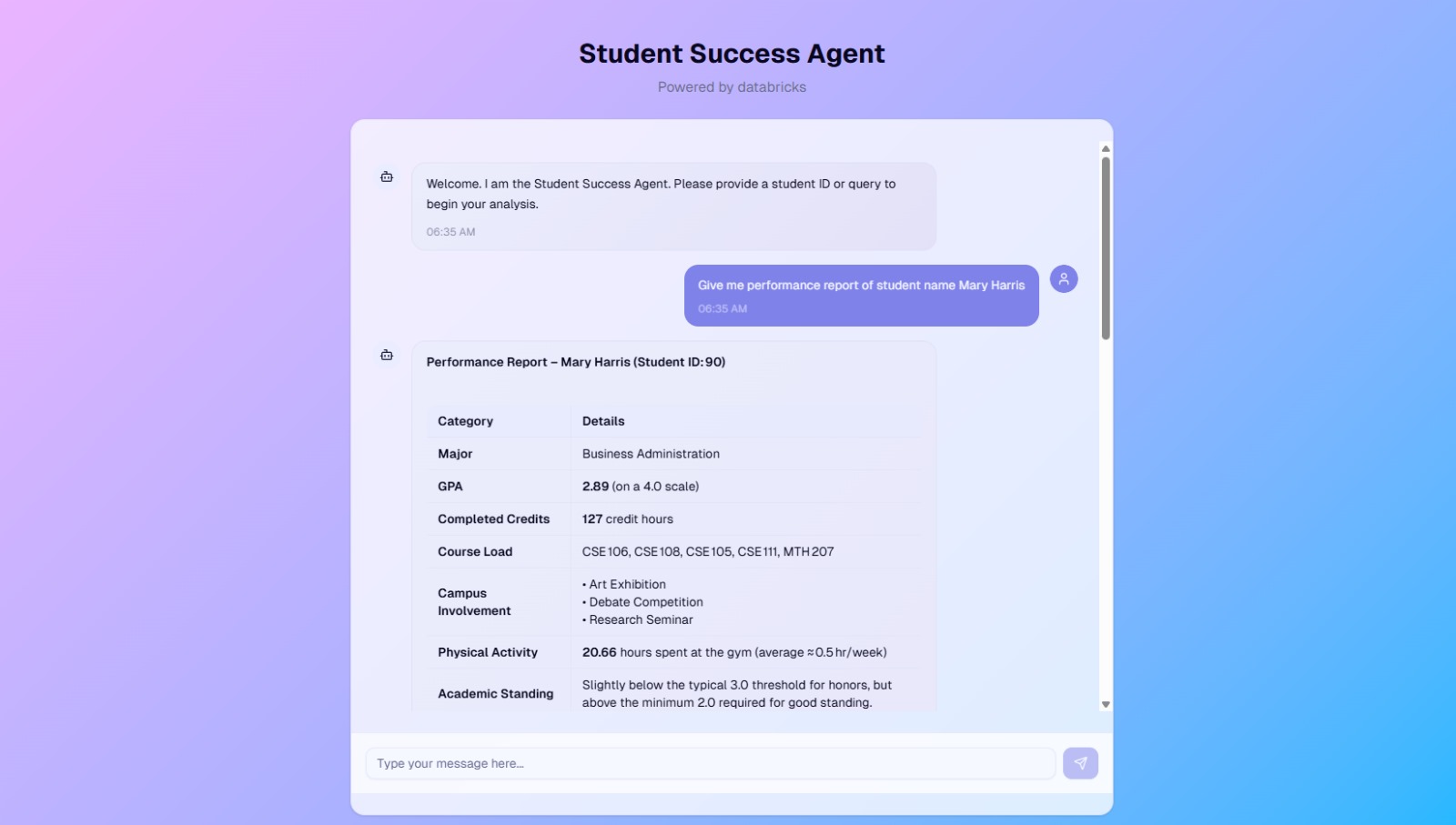
- Supports natural language queries so students can ask, for example:
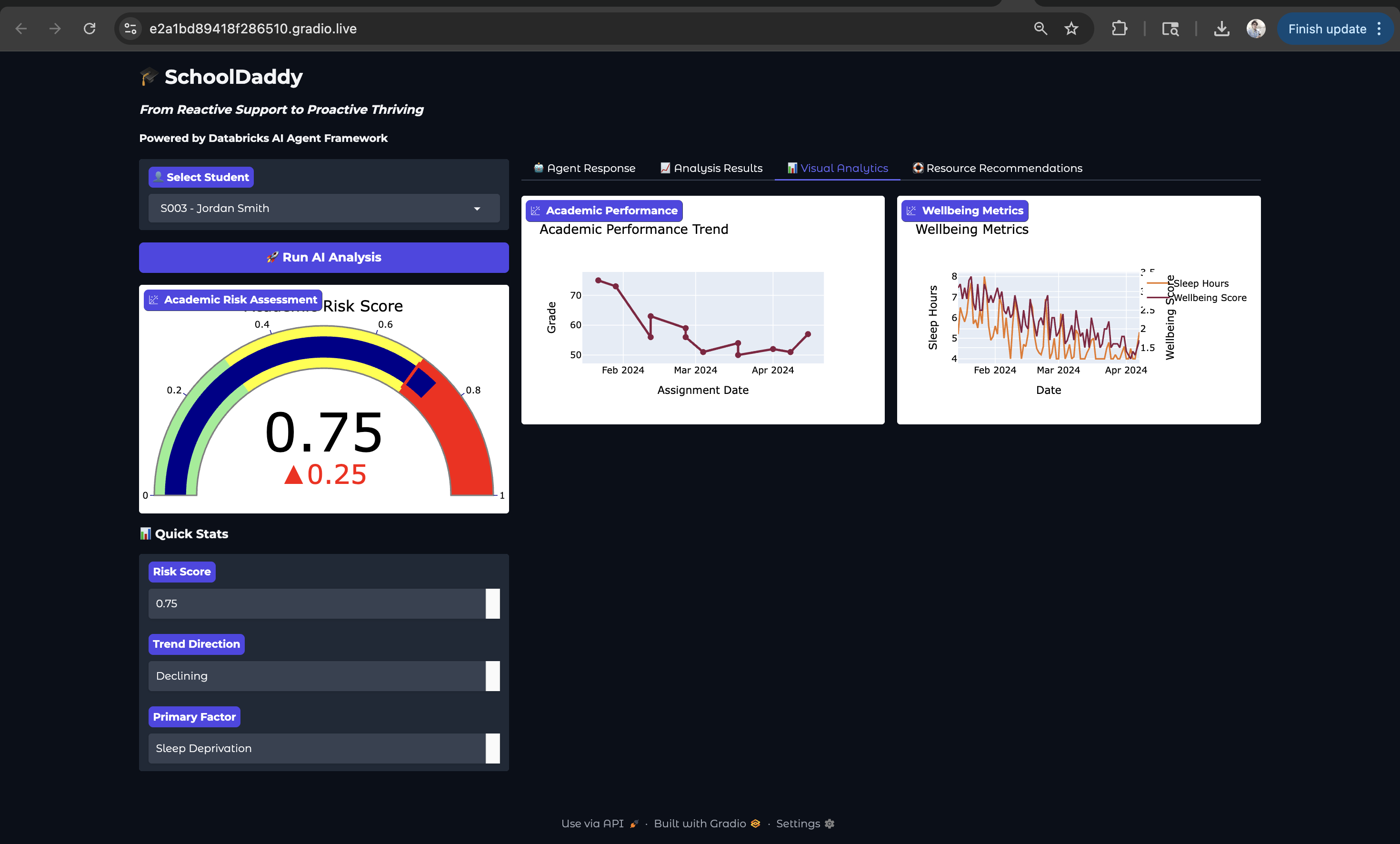
> “Which tasks should I prioritize this week to avoid falling behind?” - Visualizes progress trends and risk factors through interactive dashboards.
In essence, it helps students like me balance multiple commitments and make data-driven decisions about time and effort allocation.
How we built it
The project leverages a multi-layer AI and data ecosystem:
- Synthetic Data Generation – Simulated academic schedules, task deadlines, well-being scores, and engagement metrics using Python (
pandas,NumPy,datetime,random). - Predictive Intelligence – RandomForestClassifier models track risk levels and predict performance dips based on behavioral and temporal trends. Integrated with MLflow for experiment tracking.
- Causal Analysis – Planned integration with DoWhy/EconML to understand why a student might be struggling, rather than just flagging them.
- Databricks Integration – Centralized all data and ML pipelines in Databricks Lakehouse. Delta tables and PySpark handle large-scale processing efficiently.
- AI Agent & RAG Workflow – The AI agent allows natural language queries. Retrieval-Augmented Generation (RAG) fetches relevant context from the dataset and provides actionable insights.
- Interface Layer – Gradio dashboards with Plotly visualizations give real-time feedback and task prioritization guidance.
This setup allows even a busy student to query their academic and well-being metrics without diving into raw data.
Challenges we ran into
- Data Realism – Modeling realistic student behavior and stress patterns for synthetic datasets was tricky.
- Feature Engineering – Identifying meaningful signals from engagement, assignment completion, and well-being metrics required multiple iterations.
- System Integration – Combining Databricks pipelines, ML models, and the Gradio interface while ensuring real-time responsiveness was challenging.
- Causal Inference – Understanding root causes behind performance dips is complex, especially when multiple factors (time constraints, personal issues, workload) interact.
Accomplishments that we're proud of
- Successfully simulated a graduate student ecosystem with multi-tasking and time constraints.
- Built predictive models capable of identifying students at risk of falling behind.
- Developed an AI agent with natural language querying, making insights accessible to non-technical users.
- Designed an interactive, cloud-ready dashboard that visualizes both academic performance and well-being trends.
What we learned
- Managing and analyzing multi-dimensional student data provides actionable insights beyond raw grades.
- AI and causal analysis can be applied to personal time and task management, not just institutional risk monitoring.
- Integrating RAG workflows with Databricks enhances the context-awareness of AI responses for real-world decision-making.
- Building a student-centric AI platform requires balancing prediction, explanation, and usability.
What's next for SchoolDaddy
- Connect to live graduate student schedules and task-tracking apps for real-time recommendations.
- Incorporate personalized time management guidance to help students prioritize based on deadlines and energy levels.
- Add real-time intervention suggestions (e.g., study reminders, wellness check-ins) using the AI agent.
- Enhance causal analysis to suggest actions that directly mitigate academic or well-being risks.
- Expand the platform to support collaborative workflows for students working on group projects or research teams.
SchoolDaddy – Helping graduate students thrive by combining predictive AI, personalized guidance, and actionable insights.
Built With
- ai
- ai-agents
- colab
- databricks
- gradio
- groq
- javascript
- llm
- next.js
- python
- vo


Log in or sign up for Devpost to join the conversation.