Inspiration
College students live in a pile of disconnected tools. Assignments sit in Blackboard, deadlines arrive in email, events live in Google Calendar, and none of it answers the question students actually have in the moment: what should I do right now?
We built StudentOS to turn that chaos into one clear next step.
What it does
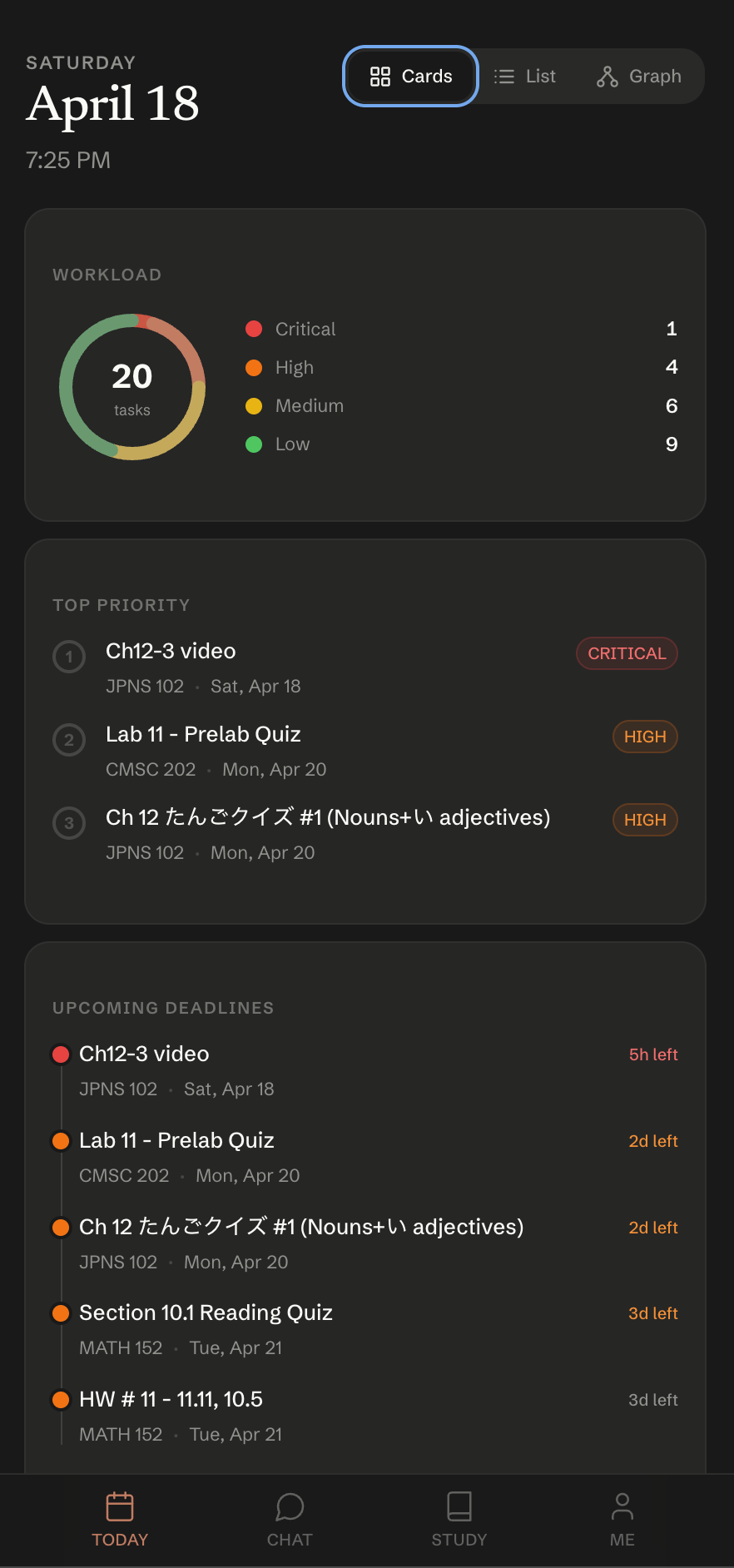
StudentOS is an AI-powered academic command center for college students. It pulls together LMS screenshots, Gmail, Google Calendar, time, and location to generate a prioritized dashboard with urgent tasks, a daily brief, and one actionable next step.
It also includes a Study mode that turns lecture notes or a typed topic into flashcards and quizzes, plus an AI advisor that can help students prioritize work, break down assignments, and draft emails to professors.
How we built it
We built the app with Next.js 15 and TypeScript on the frontend, Convex for backend data and syncing, and NextAuth for Google sign-in. For integrations, we connected the Gmail API and Google Calendar API so the app can reason over real academic context.
The AI layer routes between local Ollama models during development and Gemini for demo-quality analysis. We use vision to read LMS screenshots and lecture notes, structured JSON output to generate tasks, flashcards, and quizzes, streaming for conversational chat, and tool-backed assistants for richer academic context.
Challenges we ran into
The biggest challenge was that students do not live in one clean system. Different classes use different workflows, and many useful sources do not offer a friendly API. To handle that, we designed around screenshots as a universal input, then had to structure and deduplicate tasks coming from screenshots, email, calendar, and stored data.
We also spent a lot of time tuning prompts so the app would return useful, typed outputs instead of generic AI summaries.
What we learned
We learned that multimodal AI becomes much more useful when it is grounded in the student's real context instead of a blank chat box. We also learned how important structured outputs, fallback model routing, and thoughtful UX are when you want AI to feel dependable instead of flashy.
What's next
Next we want to improve persistence across every feature, make task completion and editing smoother, and deepen the academic assistant so it can proactively help students plan their week, stay on top of deadlines, and study with less stress.
Built With
- convex
- gmail-api
- google-calendar-api
- google-gemini-api
- next.js-15
- nextauth.js
- ollama
- openai-realtime-api
- shadcn/ui
- tailwind-css
- typescript
- vercel
- zustand


Log in or sign up for Devpost to join the conversation.