EngageSense AI
A Rule-Based System for Real-Time Student Engagement Detection Using Head Pose and Eye Gaze
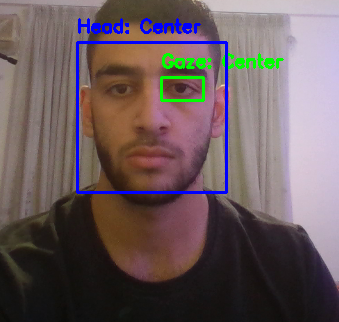
EngageSense AI is a lightweight, fully interpretable, rule-based computer vision system designed to detect real-time student engagement in online learning environments using behavioral cues only.
Unlike emotion-driven deep learning systems, EngageSense AI relies exclusively on head pose and eye gaze geometry to infer attentional engagement. The system operates in real time on CPU-only hardware and achieves 82.2% classification accuracy without requiring model training or GPU acceleration .
Table of Contents
- Overview
- Motivation
- Research Contribution
- System Architecture
- Engagement Scoring Model
- Dataset and Evaluation
- Results
- Technical Stack
- Installation
- Usage
- Project Structure
- Ethical Considerations
- Limitations
- Future Work
- Citation
1. Overview
EngageSense AI detects student engagement in real time by analyzing:
- Eye gaze direction
- Head pose orientation
The system classifies engagement into three categories:
- Engaged
- Partially Engaged
- Not Engaged
The model is deterministic and fully rule-based, ensuring complete interpretability and transparency .
2. Motivation
Online learning environments make it difficult for instructors to observe traditional engagement indicators such as:
- Eye contact
- Posture
- Attentiveness
Existing AI solutions typically rely on:
- Emotion recognition
- Deep neural networks
- Large labeled datasets (e.g., DAiSEE, AffectNet)
However, emotional expressions do not necessarily reflect attentional focus, and deep learning systems:
- Require large datasets
- Depend on GPU acceleration
- Act as black-box models
- Lack transparency
EngageSense AI addresses this gap by using purely behavioral, interpretable rules for engagement detection .
3. Research Contribution
EngageSense AI provides:
- A fully rule-based engagement detection system
- No training or pretraining required
- Real-time operation at approximately 25 FPS on CPU hardware
- Transparent decision logic
- Competitive performance (82.2% accuracy)
This project demonstrates that behavioral cues alone are sufficient for reliable engagement detection in educational contexts .
4. System Architecture
The system consists of four main modules:
- Webcam Frame Capture (OpenCV)
- Feature Extraction (MediaPipe FaceMesh + Dlib)
- Rule-Based Inference Engine
- Output Visualization
According to the system diagram in the methodology report (Figure 1, page 8) , the pipeline follows:
Webcam → Landmark Extraction → Gaze & Head Pose Estimation → Rule-Based Scoring → Engagement Classification → Visualization
5. Engagement Scoring Model
The engagement score is computed using a weighted combination of gaze and head pose:
[ E = 0.6G + 0.4H ]
Where:
- G = Gaze value ∈ {1, 0.5, 0}
- H = Head pose value ∈ {1, 0.5, 0}
Gaze receives a higher weight because it correlates more strongly with attentional focus .
State Definitions
Gaze / Head Pose States:
- 1 → Fully aligned with screen
- 0.5 → Slight deviation
- 0 → Looking away
Classification Thresholds
- Engaged → E ≥ 0.7
- Partially Engaged → 0.4 ≤ E < 0.7
- Not Engaged → E < 0.4
This rule-based design ensures complete interpretability and traceability of predictions .
6. Dataset and Evaluation
A manually annotated dataset of approximately 1,000 frames was created for evaluation .
Each frame was labeled into:
- Engaged
- Partially Engaged
- Not Engaged
Evaluation Metrics
The following metrics were computed:
- Accuracy
- Precision
- Recall
- F1-score
- Confusion Matrix
Metric definitions are formally presented in Table 2 of the methodology report (page 8) .
7. Results
The system achieved:
- Overall Accuracy: 82.2%
- Real-Time Speed: ~25 FPS (CPU only)
Performance by Class
| Class | Precision | Recall | F1-score |
|---|---|---|---|
| Engaged | 0.819 | 0.844 | 0.831 |
| Partially Engaged | 0.834 | 0.832 | 0.833 |
| Not Engaged | 0.812 | 0.790 | 0.801 |
(Metrics reported in Chapter 4, Results section) .
The confusion matrix (Figure 2, page 9) shows that most misclassifications occur between Engaged and Partially Engaged, which is expected due to subtle boundary transitions .
8. Technical Stack
- Python 3.x
- OpenCV (real-time frame capture)
- MediaPipe FaceMesh (eye landmark extraction)
- Dlib (68-point facial landmark model for head pose)
- NumPy
- Scikit-learn (evaluation metrics)
9. Installation
git clone https://github.com/yourusername/EngageSense-AI.git
cd EngageSense-AI
pip install -r requirements.txt
Ensure that:
- A working webcam is connected
- Python 3.8+ is installed
10. Usage
python main.py
The system will:
- Activate webcam capture
- Extract gaze and head pose features
- Compute engagement score
- Display real-time engagement state
11. Project Structure
EngageSense-AI/
│
├── main.py
├── capture.py
├── feature_extraction.py
├── scoring_model.py
├── evaluation.py
├── utils/
├── dataset/
├── results/
└── README.md
12. Ethical Considerations
EngageSense AI was designed with strict privacy preservation principles:
- No raw video frames are stored
- Only numerical behavioral features are retained
- No identifiable facial images are saved
- Fully compliant with classroom ethical standards
As described in the methodology (Chapter 3, page 8) .
13. Limitations
- Dataset size is limited (~1,000 frames)
- Initial evaluation included limited participant diversity
- Only behavioral cues used (no posture, blinking, or multimodal signals)
Generalizability may improve with larger, multi-user datasets .
14. Future Work
Planned improvements include:
- Expanding dataset across multiple users
- Multi-student detection in a single frame
- Integration with Learning Management Systems
- Hybrid rule-based + lightweight ML models
- Additional behavioral cues (posture, blink rate)
Outlined in Chapter 6 of the research report .
15. Citation
If you use this work, please cite:
Mostafa, H., & Ghattas, R. "EngageSense AI: A Rule-Based System for Real-Time Student Engagement Detection Using Head Pose and Eye Gaze." Beirut Arab University, 2025-2026.
