Inspiration
The inspiration for this project came from the need to create a simple yet effective system to manage student data. In educational institutions, keeping track of student information, marks, and performance is crucial. I wanted to build a tool that could handle these tasks efficiently while being easy to use. This project also served as a great opportunity to practice and improve my C++ programming skills, especially in file handling and data management.
What it does
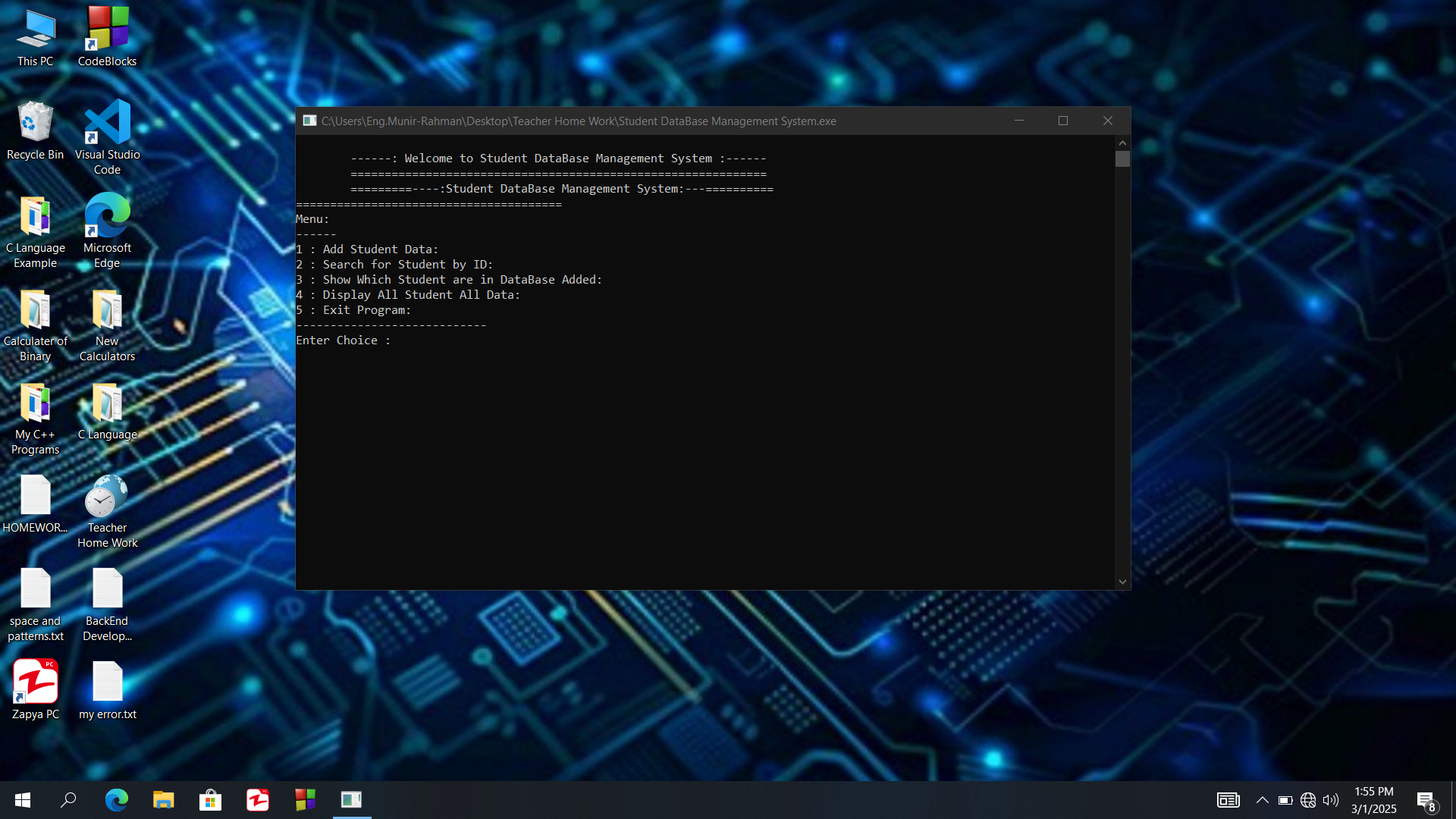
The Student Database Management System (SD) is a console-based application that allows users to:
- Add Student Data: Input details such as name, ID, contact information, class, and marks in various subjects.
- Search for Students by ID: Retrieve and display the details of a specific student using their unique ID.
- Display All Student Data: Show a list of all students and their details stored in the system.
- Calculate Total Marks and Percentage: Automatically compute the total marks and percentage for each student based on their subject scores. ## How we built it The project was built using C++ and leverages file handling to store and retrieve student data. Here's a breakdown of the key components:
- Data Structure: A
structnamedStudentDataBasewas created to store student information, including name, ID, contact details, class, and marks. - File Operations: The system uses
fopen,fprintf, andfcloseto write and read data from a text file (Student DataBase Management System.txt). - Menu-Driven Interface: A loop-based menu allows users to choose between adding data, searching for students, displaying all data, or exiting the program.
- Functions: Modular functions like
AddStudentData,SearchStudentByID, andDisplayAllStudentswere implemented to handle specific tasks. ## Challenges we ran into - Data Persistence: Initially, the student data was stored in a local array, which was lost after the function exited. This made it impossible to search for students after adding them. To solve this, I switched to file-based storage.
- File Handling Errors: Ensuring the file opened correctly and handling edge cases (e.g., empty files) was challenging. I added error checks to handle these scenarios.
- User Input Validation: Validating user inputs (e.g., ensuring marks are within 0-100) required additional logic to prevent invalid data from being stored.
- Search Functionality: Implementing an efficient search mechanism was tricky. I had to read the file line by line and parse the data to find the matching student ID. ## Accomplishments that we're proud of
- Functional System: The project successfully meets its core objectives of adding, searching, and displaying student data.
- File Handling: Implementing file operations to store and retrieve data was a significant achievement.
- Modular Code: Breaking down the program into functions made the code more organized and maintainable.
- Learning Experience: This project deepened my understanding of C++ programming, especially in file handling and data structures. ## What we learned
- File Handling in C++: I learned how to use
FILE*,fopen,fprintf, andfcloseto manage data storage. - Data Structures: Using
structto organize and store related data was a valuable experience. - Input Validation: Implementing checks to ensure valid user inputs improved the robustness of the system.
- Problem-Solving: Overcoming challenges like data persistence and search functionality enhanced my debugging and problem-solving skills. ## What's next for Student DB in C++
- Graphical User Interface (GUI): Transitioning from a console-based application to a GUI using frameworks like Qt or wxWidgets.
- Database Integration: Replacing file storage with a database system like SQLite for better scalability and performance.
- Advanced Search Options: Adding more search filters (e.g., by name, class, or marks) to make the system more versatile.
- Data Encryption: Implementing encryption to secure sensitive student data.
- Report Generation: Adding functionality to generate reports (e.g., mark sheets, class performance summaries) in PDF format.
- User Authentication: Implementing login and access control to restrict unauthorized access to the system.


Log in or sign up for Devpost to join the conversation.