-
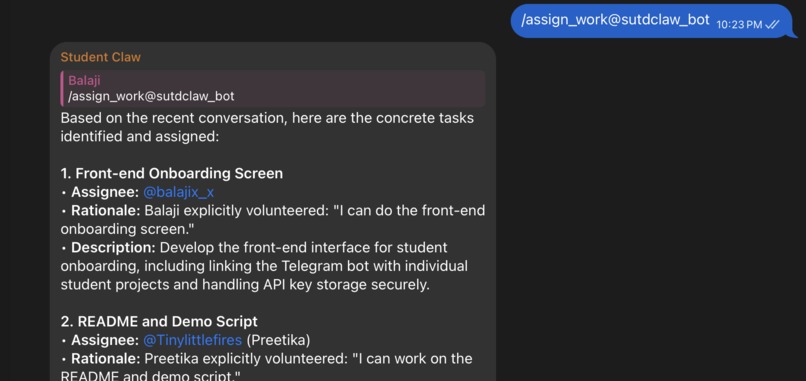
Telegram chat with Student Claw
-
Inspiration
Balancing coursework at SUTD with running Echosphere and Dojo Education tutoring sessions highlighted a massive bottleneck in student collaboration: discussions happen in Telegram, but tracking happens in Notion or Docs. This constant context-switching causes lost files, missed deadlines, and subjective peer evaluations driven by recency bias. We built Student Claw to intercept this chaos natively—an autonomous project manager that lives directly inside the group chat.
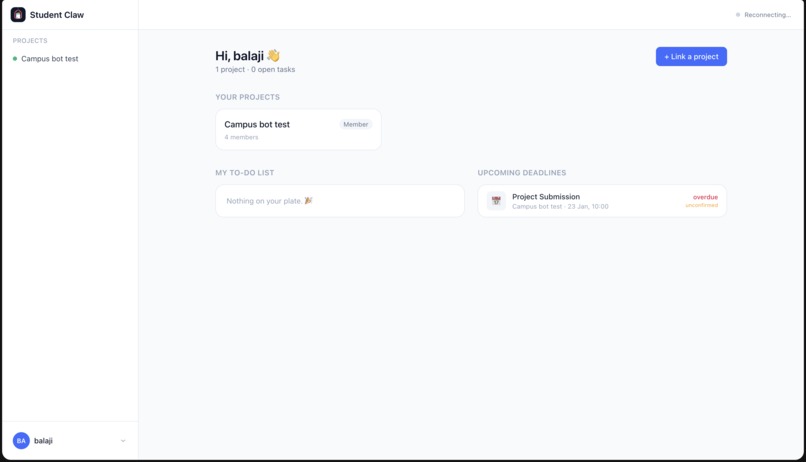
Student Claw is a decoupled microservices ecosystem operating across a Telegram bot and a synchronized Next.js web dashboard.Backend Infrastructure: We used FastAPI and PostgreSQL to manage state and ensure strict project isolation.Multi-Modal RAG: When users upload documents or images, Qwen 2.5 VL 72B performs deep OCR to extract semantic meaning. These extractions are embedded into a Qdrant vector database. During a query, the system retrieves relevant context by computing the cosine similarity between the embedded query vector and the stored document vectors
Agentic Orchestration: Agnes AI acts as the core intelligence layer, using a bounded tool-calling loop to automatically extract deadlines, assign tasks, and evaluate peer contributions.Real-Time Sync: A Next.js dashboard receives zero-latency updates via Server-Sent Events (SSE) tied to our Redis pub/sub channels.
How we built it
Challenges we ran into
Our biggest hurdle was Telegram's strict 10-second webhook timeout. When the AI agent required multiple tool-calling iterations to search the vector database and mutate task states, the connection would drop. We solved this by decoupling ingestion from execution—using an asynchronous Redis worker to process heavy AI reasoning in the background while instantly acknowledging the user's message. Furthermore, securely syncing tasks to Google Calendar required implementing AES-256-GCM encryption at rest for OAuth refresh tokens.
Built With
- agnes.ai
- docker
- python
- typescript

Log in or sign up for Devpost to join the conversation.