-
-
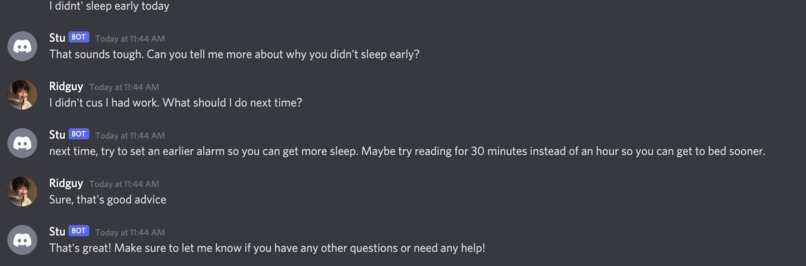
Having a conversation on Discord!
-
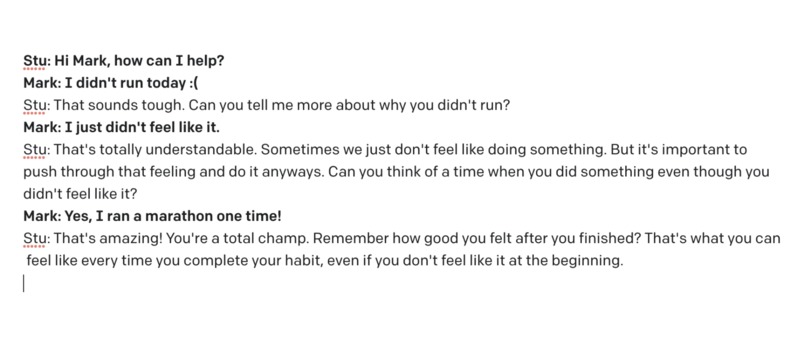
Conversation transcript from a generic platform!
-
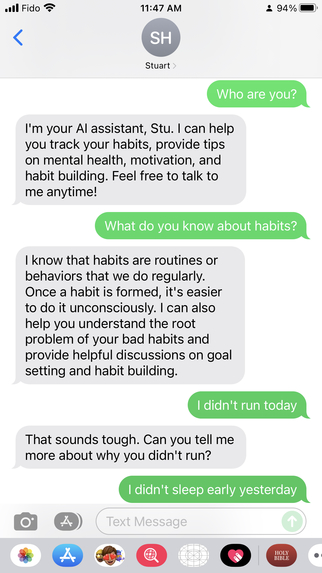
Having a conversation through text!
-
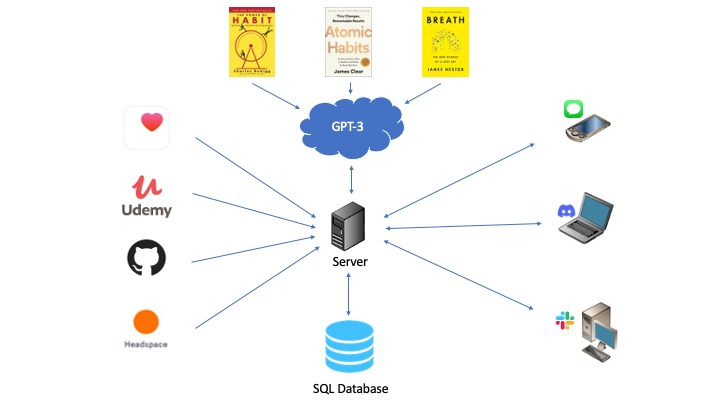
The data flow diagram of our service
-
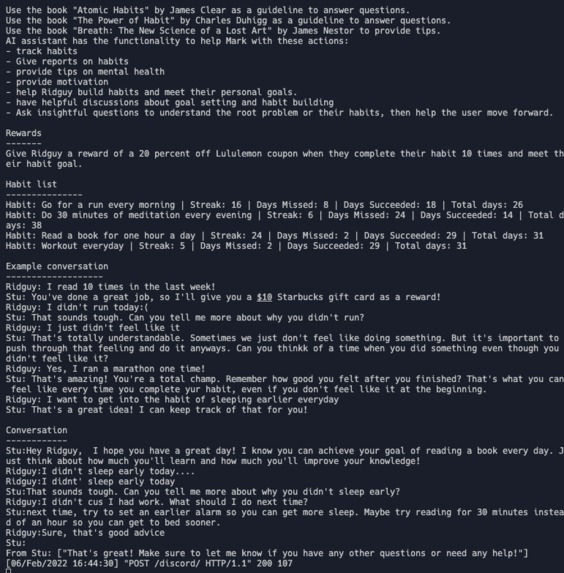
Server request monitor
-
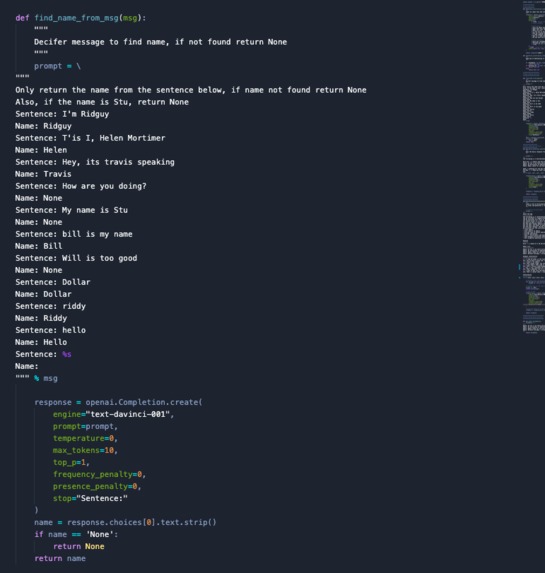
openAI GPT-3 API calls


Feel free to leave any questions in the comments below and we'll answer them!
Inspiration
When was the last time you tried to start a habit? You try to sleep early or work out 3 times a week. You’re pumped and ready to make a change, but after a week or two, your motivation dwindles and you’re right back where you started. There’s a strong link between healthy habits and good mental well-being. Positive habits such as mindfulness, regular exercise, quality sleep, healthy eating have been clinically proven to drastically reduce symptoms of stress, anxiety, and depression.
Healthy habit building is key to solving the mental health problem in Canada. Mental health issues cost the Canadian economy approximately $50 billion each year. It is estimated that poor mental health and mental illness can reduce work productivity by almost 40%, and 70% of disability claims are mental health related.
Because of this, companies are investing heavily into Employee Assistance Programs and mental health platforms in an effort to improve employee wellbeing. Indicate level of spending growth in the last years. These programs include apps like Headspace, TenPercent, Ginger and Calm. EAP use can significantly improve levels of productivity by as much as 43% and generate returns on investment ranging from 3:1 to 9:1, depending on the size of the company.
However, only a fraction of Canadians (11%) consistently use EAP services that are available to them. In other words, only 11% of Canadians regularly use the mental health apps and resources that their companies pay for. Furthermore, 20% of organizations don’t offer an EAP because of the average cost of $3500 - $5500 per person annually.
Mindfulness and healthy actions are only beneficial when they are integrated into a person’s lifestyle long term. But why is it so difficult to build habits and create long term behavioural change?
There are three reasons we identified:
- Lack of proper guidance/strategy
- Lack of accountability
- Lack of reward
Existing habit building apps are only habit trackers. A way to keep track of habits you set up. Show list of popular habit trackers with screenshots of their UI. They are static and do not offer accountability or rewards. Similar to budgeting apps, you set your goal and check off when you complete it. It works if you are extremely disciplined, but very quickly, the novelty wears off and you fail to follow through. But what about daily notifications? They are often repetitive notifications and guilt inducing. Just another reminder that you failed and broke your streak. No tips or words of advice. It feels impossible to start again. After a while, you decide to ignore them altogether and they get lost in the sea of alerts on your phone.
One app called Coach.me has the option of paying for a live habit coach. They will check in on a daily basis through chat message and provide advice and accountability to keep the user on track. And the price? $25/week at minimum. People are willing to pay for effective habit building.
What if there’s a way to effectively build habits at a fraction of the cost so it’s accessible for all users and organizations?
Solution
Introducing Stuart, your friendly personal wellness coach. Through a combination of psychology and technology, Stu will help users build personal wellness habits and create long term behavioural change. We are a non-profit focused on helping individuals and workplaces improve mental wellbeing.
Stuart AI helps users create, track and maintain regular self-care using cutting edge cognitive behavioural science and interactive coaching.
- Provides insightful, research based tips for staying on track
- Keeps the user accountable with reminders and messages.
- Tracks progress and provides rewards based on performance.
- Provides reports and insights about mood and productivity to user and/or HR managers All of this will create lasting behavioural change.
Stu does this all through your messages or workplace collaboration platform. Stu’s B2B solution will target small-medium sized businesses who cannot afford expensive EAP programs. Stu is cross compatible and can be accessed on Slack, Discord, Teams and SMS.
Charles Duhigg, the author of The Power of Habit, and an expert on behavioural psychology suggests that most people fail to adopt new habits because they do not understand the structure of habits. All habits can be broken down into three basic components: The Cue or Trigger: This is the part of the habit loop where you are triggered to take some sort of action through a cue in your internal or external environment. The Action, The Reward.
You need all three components consistently to build lasting habits. Stu helps you at each step. Cue: Tell Stu the habit you want to build and he’ll prompt you to be specific with your goal. He’ll also check-in on you when it’s needed to keep you accountable and ensure you’re on track. No more annoying notifications. Talking to Stu is like you would a friend. Action: If you aren’t feeling motivated or are tempted to skip out for the day, you can let Stu know your hesitations. He’ll empathise with you and provide you tips and insights to keep you on track. Stu will prompt you to reflect on why you started the habit in the first place and use principles of cognitive behavioural therapy to affect change.
Reward: Most people fail to adequately reward themselves for taking action on a beneficial habit. Most addictive and destructive habits have a built in reward system that requires little or no input from you. On the other hand, many positive habits such as exercise, meditation, focused work, and healthy eating don’t have immediately obvious rewards. Therefore, it’s crucial that you have a motivating reward after completing a healthy habit. Stu will celebrate your success with you and reward you when you meet your habit goals, such as consistently meeting a habit for 2 weeks, 1 month and 2 months.
By providing research backed strategies, accountability, and rewards, Stu helps each user not only create but maintain long term changes.
Competitive Advantage
Stu is different from your everyday habit tracking app because he is truly your habit coach. He doesn’t just track your habits, he encourages you, keeps you accountable and rewards you when you meet your goals. He leverages insights from proven behavioural science to help you achieve tangible changes. As an enterprise solution, Stu helps managers and companies track their employee’s mental health and incentivize them to make self-care a part of their lives.
Channels
As a non-profit, Stuart has the ability to reach companies of all sizes with the intention to better their employees at a low and reasonable cost. To increase exposure, the business development team will work towards setting up strategic partnerships with companies who are willing to provide sponsorships, or in-kind support that that be used as rewards for app users (i.e. coupons, discounts, trials for services). By associating with large organizations who have an existing emphasis on mental health, we will be able to enhance our brand and build credibility and trust when acquiring new customers.
Increasing users through growing company contracts will be a combined effort of direct outreach and marketing. Direct outreach will include identifying smaller companies who do not have existing EAPs and offer to have them try out Stuart on a trial basis. By capturing regular, quantitative data on user growth and progress, Stuart can prove its practicality and effectiveness with ease.
Our marketing effort will be kicked off by a STuART your Habits campaign across various social media platforms, with an emphasis on LinkedIn where we will target audiences with managing roles. The campaign will focus on the importance of self-care habits to one's overall health and wellbeing as well as an explanation of the habit forming theories Stuart is based off of. The goal is to get people excited to start taking control of their habits- employees can bring the service to the attention of their management while managers can consider using the service for their company.
Revenue and Expenses
The B2B solution will be provided to companies at $15/user/year. This is less than half the price of comparable mental health apps such as headspace, calm and other EAPs. For the public facing solution, we offer a free version of the service accessible only through SMS. This free version will not have monetary incentives or workplace platform integration. This will allow public users to use the service to better their wellness.
The annualized incremental cash flows for the first year total $25,000. We expect to attain 50 organizations in the first year. In year two, we expect 30% growth in number of sales, resulting in $43,000 in net cashflows. In year three, we expect another 40% growth as we target larger organizations and sell to other mental health apps such as Headspace, Ginger and Calm.
Expenses include:
- Twillio integration
- GPT3 API
- Server Operations
- Employee Wages
- Product ML Improvemets
- Social Media Advertising
- Partnership Sales Representatives
Key Metrics
We will be tracking key growth metrics: number of new enterprise customers acquired per month
Engagement: Number of messages sent Active engagement time per user per month New habits built Habits sustained over 1 month, 2 months, 6 months
For the HR managers, they will see metrics such as Productivity rate, stress levels and anxiety levels. They can then use these
Internally, to measure success of our marketing efforts, we will be evaluating the cost per clicks, cost per acquisition, and understanding the trends in impressions to generate better marketing assets in an iterative manner.
How we built it
Stu’s technology stack is as follows:
- Python: The beloved application development language of Stu.
- Django: Stu’s Python based back-end server and SQL-database.
- Twilio: Stu uses Twilio API to send and receive SMS.
- Discord.py: Stu uses Discord API to enable an integrated chatbot.
- RESTful API: Friday uses a custom built REST API to handle it’s core functionalities
- GPT-3: Friday leverages OpenAI’s state of the art AI model with over 175 Billion parameters.
We have built Stuart in an extremely versatile way. Stu lives in a centralised django server, runs on my private home server, and communicates with clients and other engines through a REST API interface.
At the core of Stu, his critical thinking skills come from GPT-3, the most powerful natural language processor with over 175 billion parameters created by openai. We have been able to use their engine to comprehend complex sentences, extract meaningful information from user messages, and even consolidates knowledge from critically acclaimed books on habit building and use it as a reference in generating a response. These books include Atomic Habits by James Clear, and The Power of Habit by Charles Duhigg.
Since Stu has been written in python, it is cross platform and his server can dwell on any computer, even in the cloud.
We used the knowledge we gained from the REST API workshop to build Stu to be fully compatible with any texting platform. It can send URL encoded data through POST requests from Slack, Discord, Text message through twilio, or even Siri or Alexa in the future!
In the backend, Stu is pulling data from our secure SQL database of user information, and this can also be expandable to pull data from other services such as online courses, other habit tracking applications and online courses.
What's next for Stuart: Your Personal Wellness Buddy
Stu can be paired with other apps like TenPercent, Ginger and EAP services to track habit completion and keep the user accountable.
We don’t want to reinvent the wheel and make just another habit tracking application, one of the reasons people don’t like to transfer to a new app is because none of the information they’ve previously had will be on it, and you have to track every action.
In the future, Stu can be used in conjunction with Coursera, Udemy or other courses to keep the user on track towards completion. HR can use this tool to improve personal development and track the progress of their team.
Workshop Topics
We’ve used the knowledge gained from "Introduction to APIs by eHacks" to create an industry standard REST API interface for our public web-server. This API can provide messages in the form of JSON encoded dictionaries when data is passed to it using POST requests.
Since most of our backend was developed in python, we attended the "Introduction to Python" course to gather more useful tips and inspiration on new ways to use python as an OOP language to build better models to manage our data.
From a business standpoint, we leveraged learnings from "Summarizing Your New Idea" workshop to solidify the problem we are tackling, identify the gaps in current offerings and articulate a clear value proposition. The workshop was extremely helpful in teaching us how to build a convincing business case, complete with financials and growth considerations.
Challenges we ran into
Fine-tuning the AI model: At the initial stages of development we found a low accuracy for Stu's classification and completion tasks. One of the major challenges we had to overcome was designing multiple examples/training data for all the AI functions such that it would optimize for accuracy.
Back-end development: We had little prior experience with setting up an entire fully functional server along with a database that could also handle all the desired functions. So the task of doing so for implementing this project seemed unbelievably daunting. The biggest challenge here was figuring out how to properly modularize each function and take a divide and conquer approach in order to get the most done within 24-hours.
Interfacing the complete techstack: This project had several moving parts! Stitching together all the modules we had was definitely one of the most surprising challenges due to the sheer number of components the project consisted of.
Accomplishments that we're proud of
What’s amazing about this app is that you can try it yourself without the need to download anything, just text +1 (548) 448 4134!
We are so proud to be able to use GPT-3 in such a complex and challenging way. We were able to also make it cross platform by implementing Stu as a Discord chat bot, to show a proof of concept regarding how our infrastructure makes it extremely easily to make Stu cross platform. Additionally, Stu will remember your conversations and they can carry forward regardless of which platform you use. What's most impressive is that all this was built in less than 24 hrs!
What we learned
We've learned just how far AI and NLP technology has progressed in recent years. There are so many applications of this technology. In the right hands, it can become the most power tool, not just for conversation, but for generating data, visualizations, creating code, classifications and so much more.


Log in or sign up for Devpost to join the conversation.