Inspiration
All of our team members have grandparents. One of them, Ryan's grandmother Susan, has cataracts and deteriorating vision. Daily tasks for her, such as moving around her apartment and crossing the street, become inconvenient or even dangerous. She does not have a caretaker who can follow her wherever she goes, so she ends up trapped on her couch because she does not want to risk injury. This problem has become a reality for many elderly and blind individuals. Buying a dog is expensive. Using a walker is difficult. We needed a way to bridge that gap.
What it does
STRYDE is a smart belt that uses ultrasonic sensors, vibration motors, and an AI-powered camera to help visually impaired people navigate their surroundings.
The main idea is simple. If there's an obstacle on your left, the belt vibrates on your left. If there's something on your right, it vibrates on your right. As you get closer to an obstacle, the vibration becomes faster, eventually turning into a continuous buzz when you're very close.
Our prototype uses four ultrasonic sensors positioned around the belt to detect obstacles in different directions. Each sensor is paired with a vibration motor, allowing users to feel where an obstacle is without having to look at a screen or listen to constant audio instructions.
We also wanted STRYDE to do more than just detect obstacles. After all, knowing something is in front of you isn't the same as knowing what it is.
That's where our camera and iPhone app come in. Using a button on the belt, users can take a picture of their surroundings and have Claude AI describe what's in front of them. The app then reads the response aloud.
We built three different button controls:
Single press: Takes a photo and describes the surroundings.
Double press: Reads signs, labels, and other visible text.
Long press: Mutes or unmutes the vibration motors.
The belt handles obstacle detection on its own, meaning the vibration system can still work even without a phone or internet connection. The app is there when users need more information about their surroundings.
How we built it
We started by figuring out how to turn distance measurements into something a person could actually feel. We decided to use ultrasonic sensors because they were relatively inexpensive, easy to work with, and could measure the distance to nearby objects.
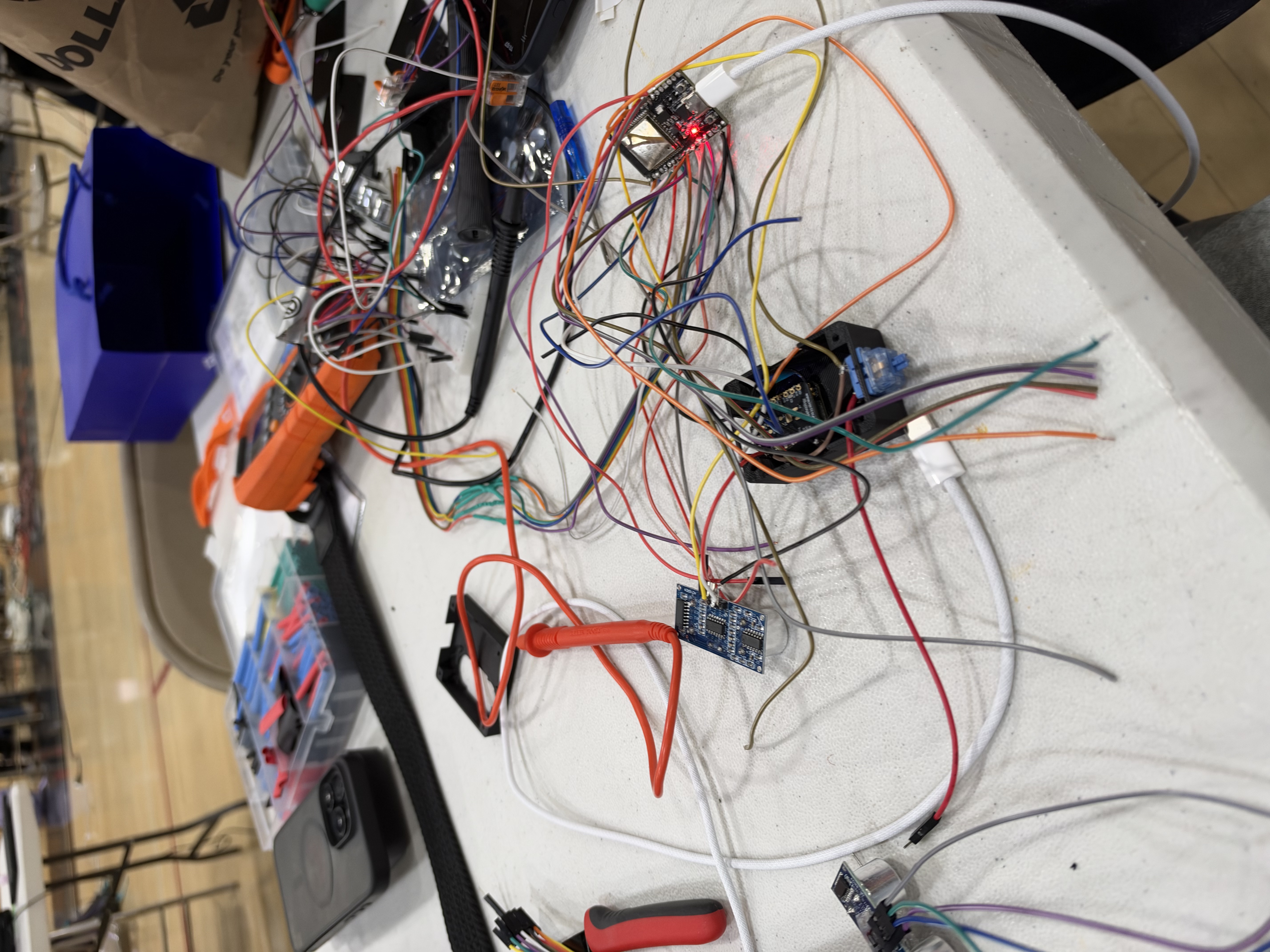
For the main hardware, we used an ESP32-DevKitC connected to four HC-SR04 ultrasonic sensors, four vibration motors, and a button.
Each ultrasonic sensor sends out a sound pulse and measures how long it takes to return. Our code uses that time to calculate how far away an object is. From there, the ESP32 decides how frequently the corresponding vibration motor should buzz.
We programmed the sensors to detect objects within approximately two meters. Anything farther away won't trigger a vibration. As an object gets closer, the time between vibrations decreases. When the object is within approximately 50 centimeters, the motor produces a continuous buzz.
We also had to make sure the sensors weren't interfering with each other. Since they all rely on ultrasonic sound waves, triggering them simultaneously could cause inaccurate readings. To fix this, we programmed them to take measurements one at a time and added filtering to reduce inconsistent readings.
For the camera system, we used a XIAO ESP32-S3 Sense. We decided to separate the camera from the main sensor controller because handling image capture and Bluetooth communication was already complicated enough without adding obstacle detection to the same board.
The two ESP32 boards communicate through a wired serial connection. The main ESP32 handles the sensors and vibrations, while the XIAO handles the camera and communicates with the iPhone using Bluetooth Low Energy.
We then built an iOS app using Swift and SwiftUI. The app connects to the belt, displays sensor information, and communicates with Claude through the Anthropic API.
When the user presses the button, the camera takes a photo and sends it to the phone over Bluetooth. Since images are much larger than regular sensor readings, we had to split the image into smaller packets and reconstruct it on the phone.
Once the image reaches the app, we send it to Claude along with the sensor readings. Claude analyzes the image and returns a short description, which the app reads aloud using Apple's text-to-speech system.
Finally, we designed our own 3D-printable housing using OpenSCAD. We created separate compartments for the electronics and worked on mounting everything to a wearable belt. This ended up being a much bigger part of the project than we originally expected.
Challenges we ran into
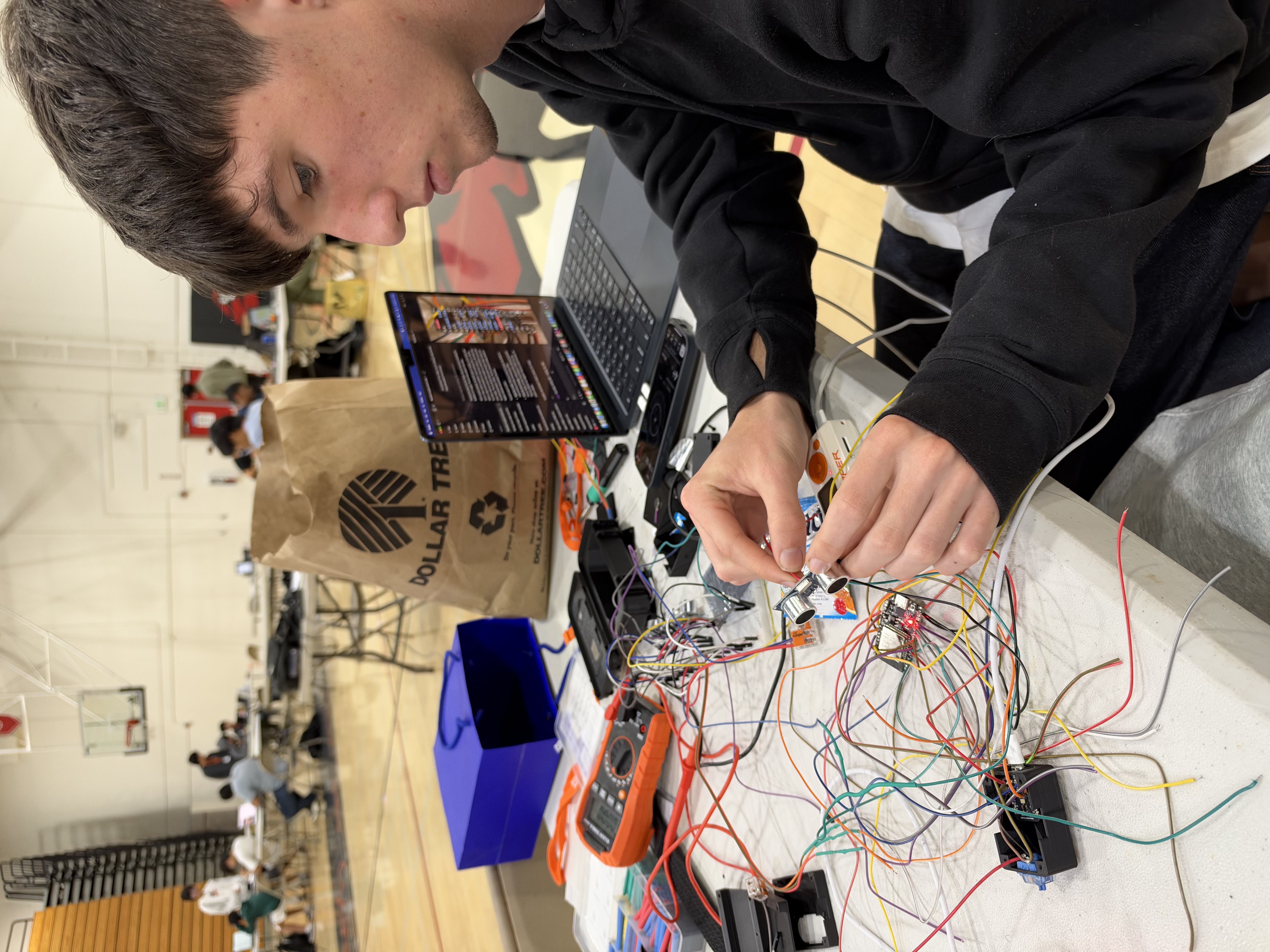
One of our biggest challenges was simply getting all the hardware to work together. On paper, connecting a few sensors, motors, and microcontrollers sounded straightforward. In reality, we spent a surprising amount of time figuring out why something wasn't working.
Accomplishments that we're proud of
We're also happy with how much of the project we built ourselves. From soldering the electronics and designing the housing to programming the ESP32 boards and developing the iPhone app, we got to work on almost every part of the system.
What we learned
We learned a lot about microcontrollers, ultrasonic sensors, serial communication, Bluetooth Low Energy, and building an iOS app. We also gained experience working with camera data and integrating Claude through an API.
On the hardware side, we learned how much small details matter. Bad solder joints, loose wires, and poor component placement can cause just as many problems as bugs in the code.
We also got better at troubleshooting. Instead of randomly changing things and hoping they worked, we started testing individual components and narrowing down where problems were coming from.
Another thing we learned was that more features don't always make something better. When designing STRYDE, we had to think about what would actually be useful for someone with visual impairments.
For example, constantly reading out distances like "one meter away" or "fifty centimeters away" would probably get annoying pretty quickly. A simple vibration that gets faster as someone approaches an obstacle communicates the same information without requiring constant attention.
We also realized the importance of designing around the person using the product rather than just the technology we wanted to include.
What's next for Stryde
Although we're happy with what we managed to build, STRYDE is still a prototype, and there's a lot we would like to improve.
Our first priority would be improving the hardware. We want to clean up the wiring, improve the soldered connections, and make the belt smaller and more comfortable. We also need to replace the prototype's direct motor wiring with a properly protected motor-driver circuit.
We would also like to improve the obstacle detection system. Ultrasonic sensors have limitations, especially when detecting small objects, certain surfaces, or obstacles that are very low or above waist level. Adding different types of sensors could help us cover those blind spots.
On the software side, we want to make the app more reliable and improve the speed of the image transfer and AI responses. Ideally, users should be able to request a description without having to think about how long the technology takes to respond.
Another feature we'd like to explore is more advanced navigation. Right now, STRYDE focuses on detecting nearby obstacles and describing surroundings. In the future, we'd like to investigate how it could help users navigate toward destinations as well.
Most importantly, we want to test STRYDE with visually impaired users and get their feedback. We designed the belt based on what we thought would be useful, but we know there's a difference between building something that works technically and building something that someone would actually want to use every day.
What's next for Stryde
Although we're happy with what we managed to build, STRYDE is still a prototype, and there's a lot we would like to improve.
Our first priority would be improving the hardware. We want to clean up the wiring, improve the soldered connections, and make the belt smaller and more comfortable. We also need to replace the prototype's direct motor wiring with a properly protected motor-driver circuit.
We would also like to improve the obstacle detection system. Ultrasonic sensors have limitations, especially when detecting small objects, certain surfaces, or obstacles that are very low or above waist level. Adding different types of sensors could help us cover those blind spots.
On the software side, we want to make the app more reliable and improve the speed of the image transfer and AI responses. Ideally, users should be able to request a description without having to think about how long the technology takes to respond.
Another feature we'd like to explore is more advanced navigation. Right now, STRYDE focuses on detecting nearby obstacles and describing surroundings. In the future, we'd like to investigate how it could help users navigate toward destinations as well.
Most importantly, we want to test STRYDE with visually impaired users and get their feedback. We designed the belt based on what we thought would be useful, but we know there's a difference between building something that works technically and building something that someone would actually want to use every day.
Our goal isn't to replace traditional mobility aids like white canes or guide dogs. We want STRYDE to provide another way for people like Susan to understand their surroundings and feel more comfortable moving around independently.
Built With
- c++
- esp32

