-
-
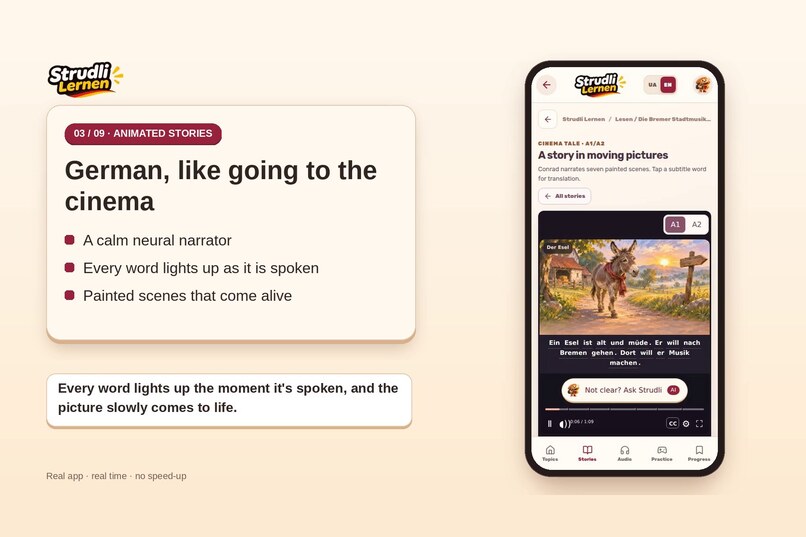
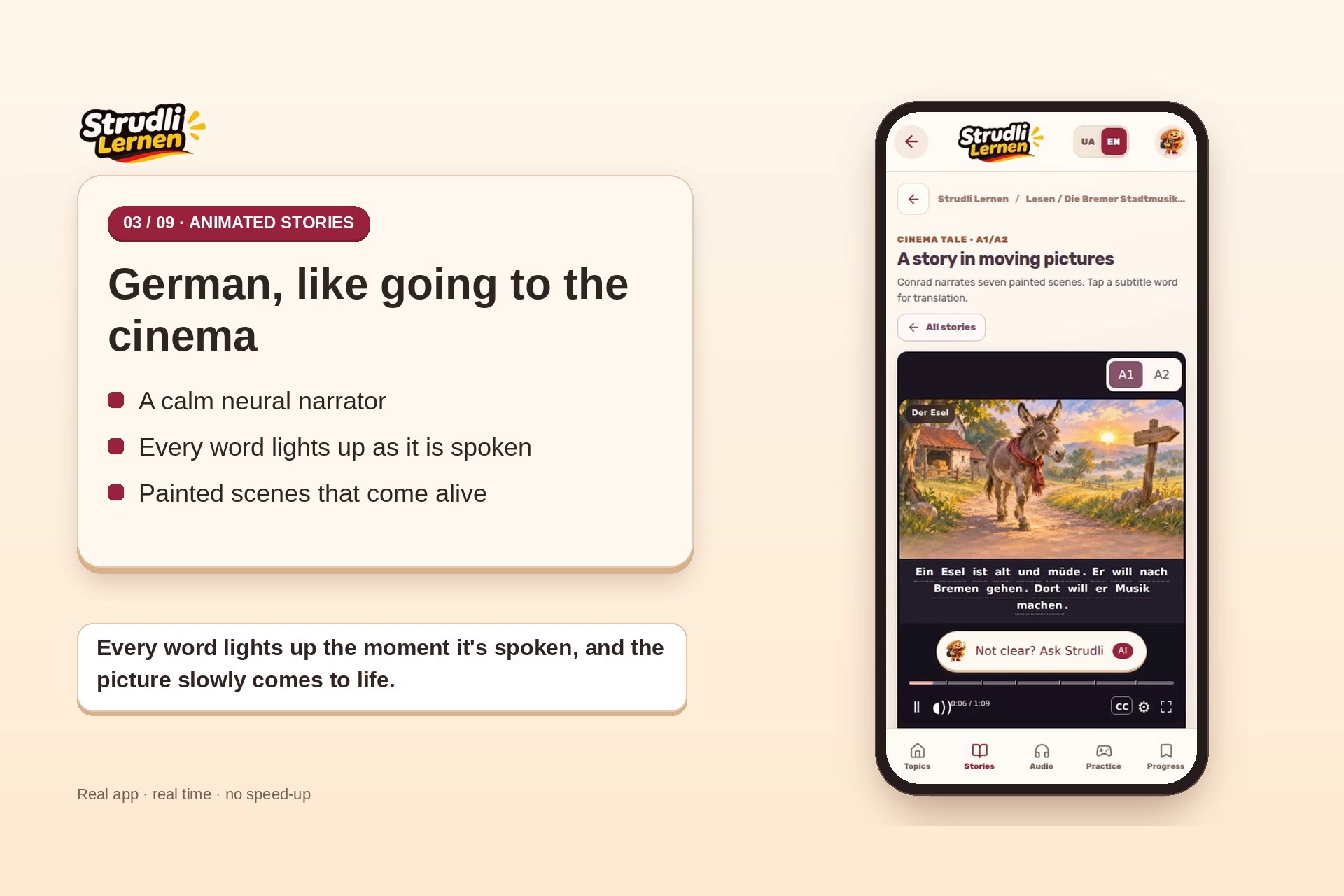
Cinematic stories: a calm narrator, every word lights up as it is spoken, painted scenes come alive.
-
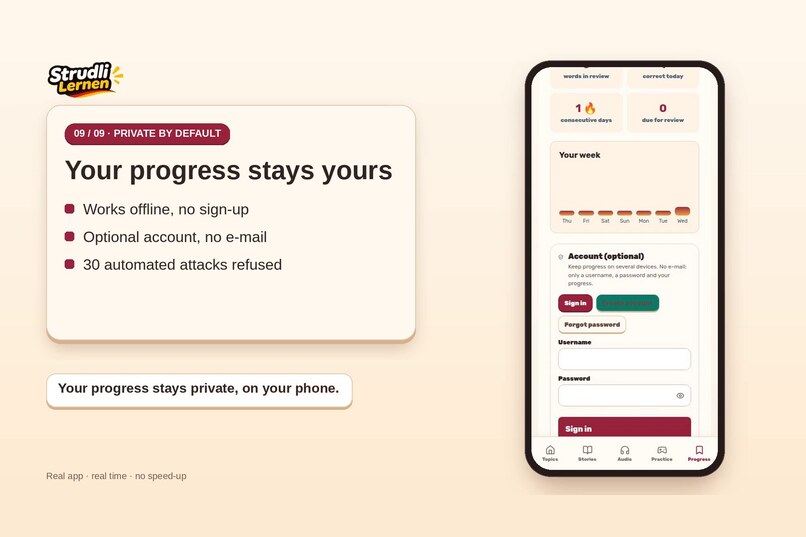
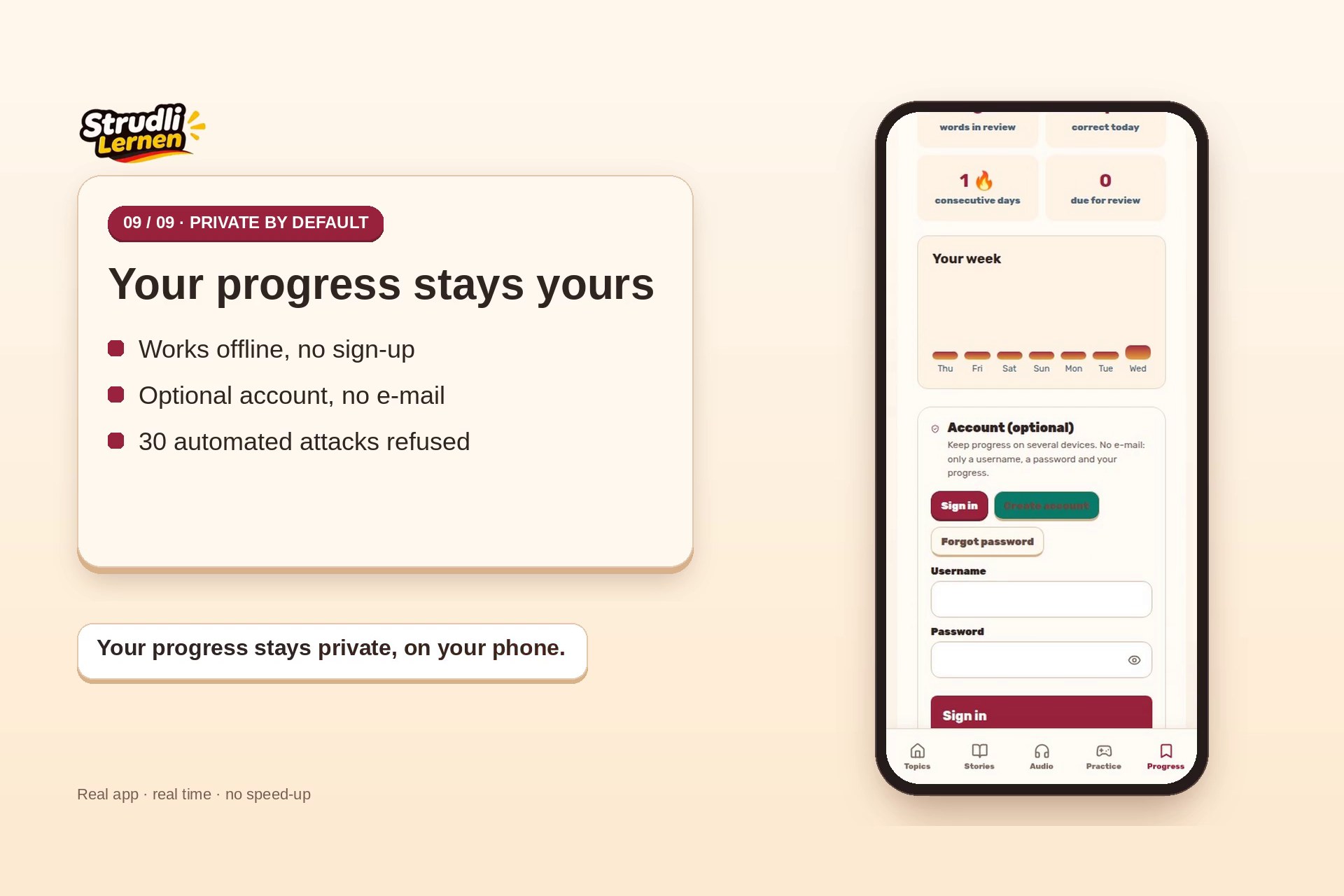
Private by default: progress stays on the phone, optional account without e-mail, automated attack tests.
-
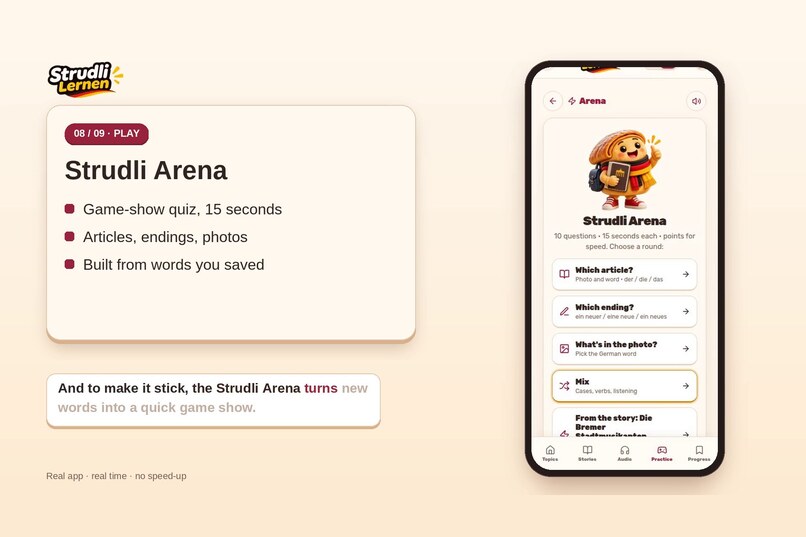
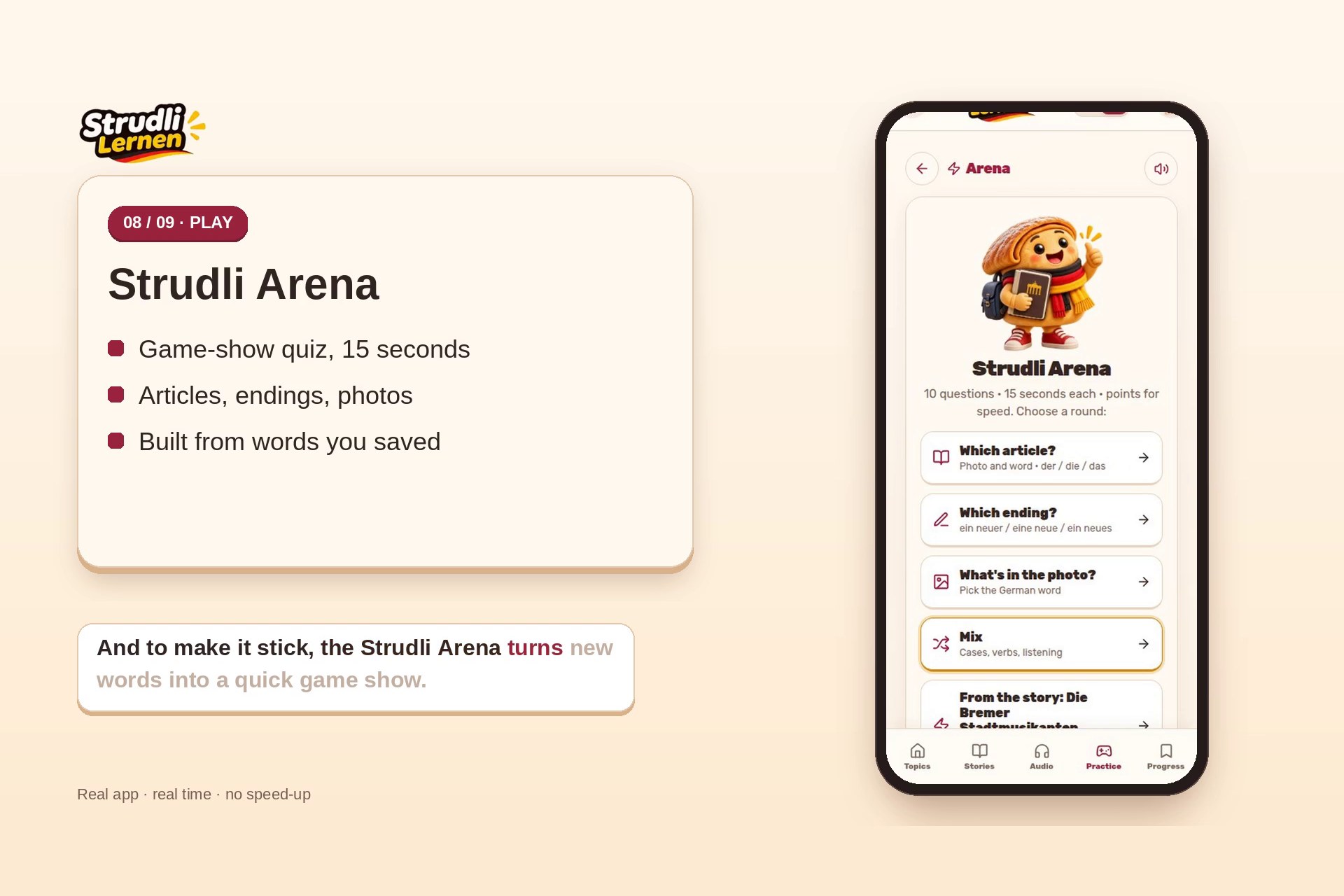
Strudli Arena: a 15-second game-show quiz built from the words you saved.
-
Made by immigrants, for immigrants. Free, in any phone browser, Ukrainian and English today.
-
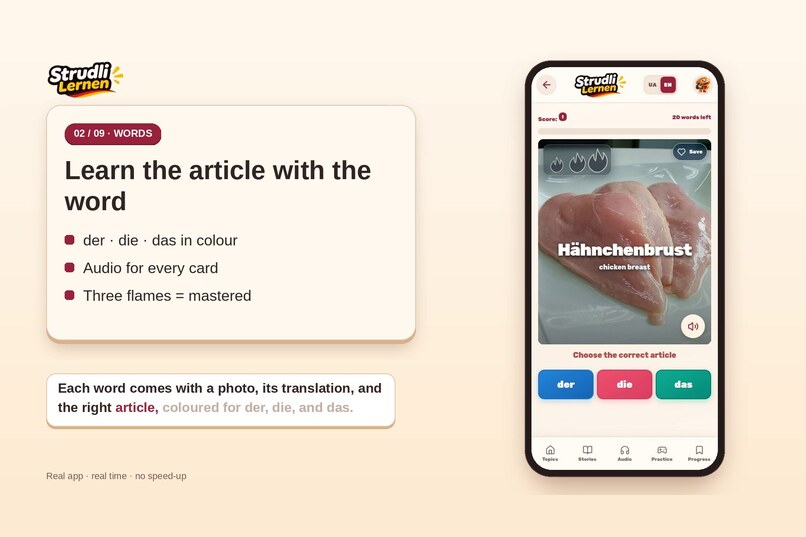
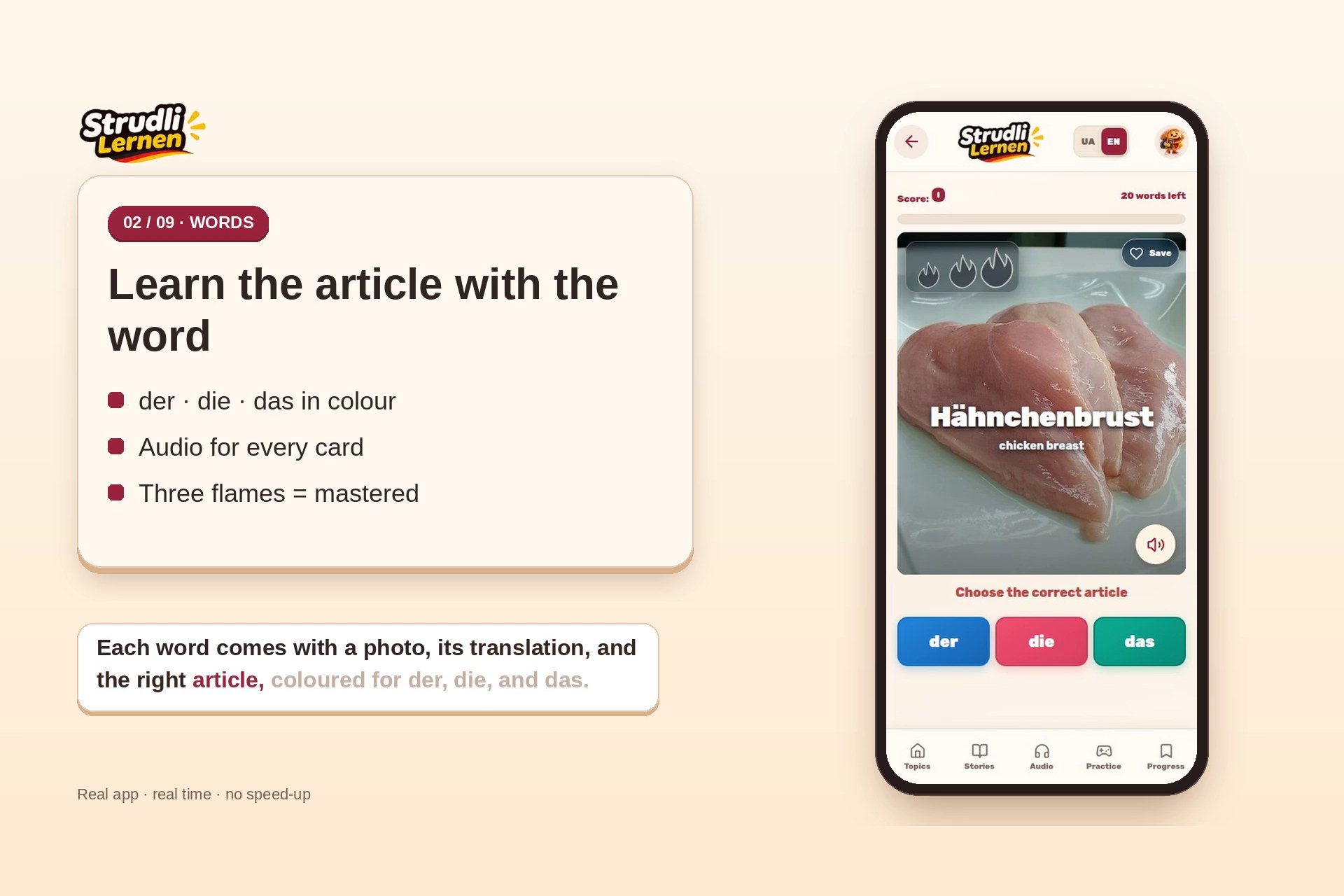
1,177 photo word cards with der/die/das colours, audio and three-flame mastery.
-
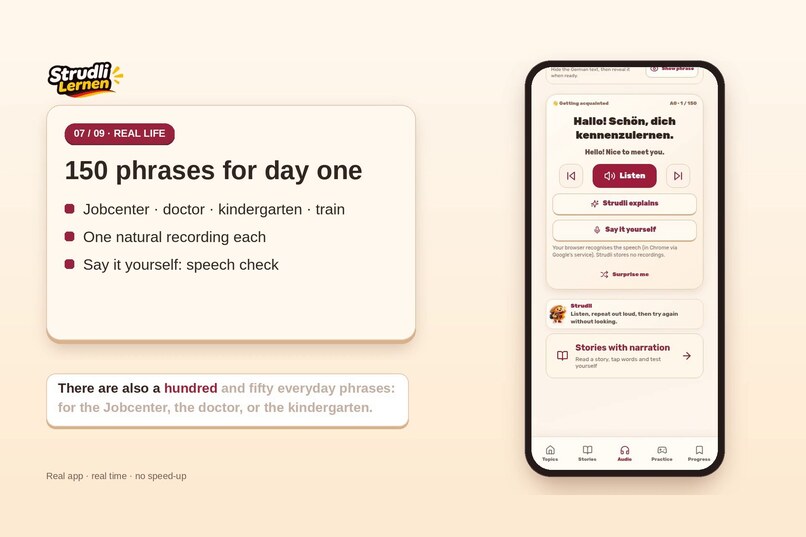
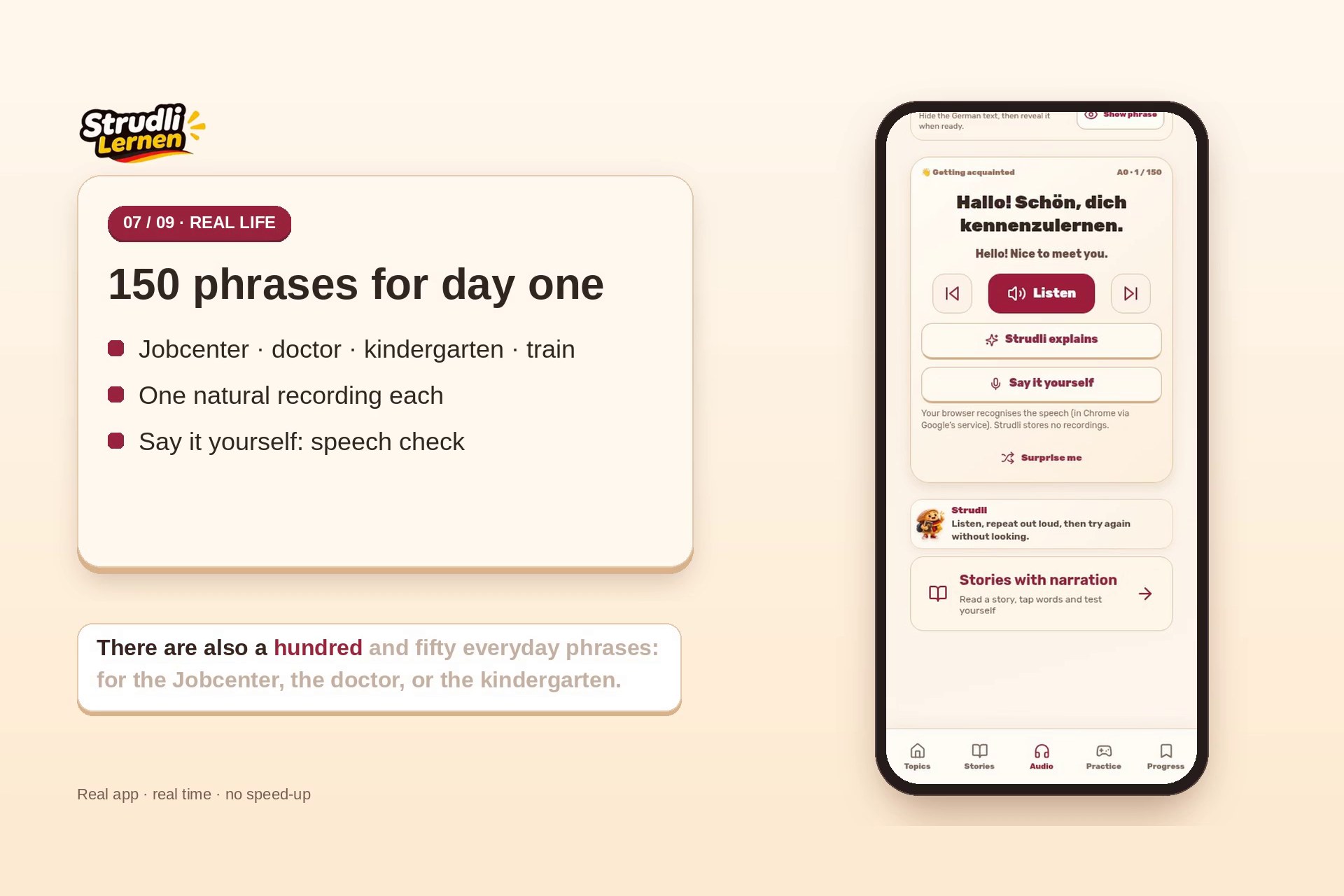
150 everyday phrases for day one (Jobcenter, doctor, kindergarten), recorded as natural speech, with a speech check.
-
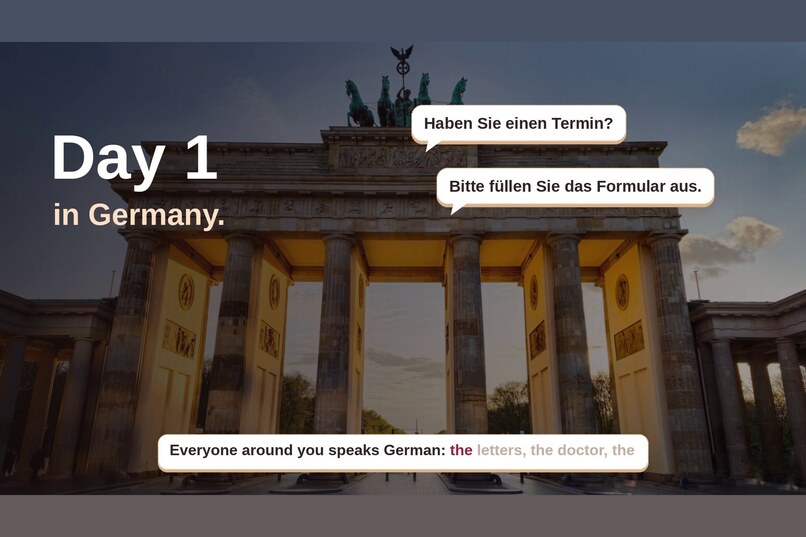
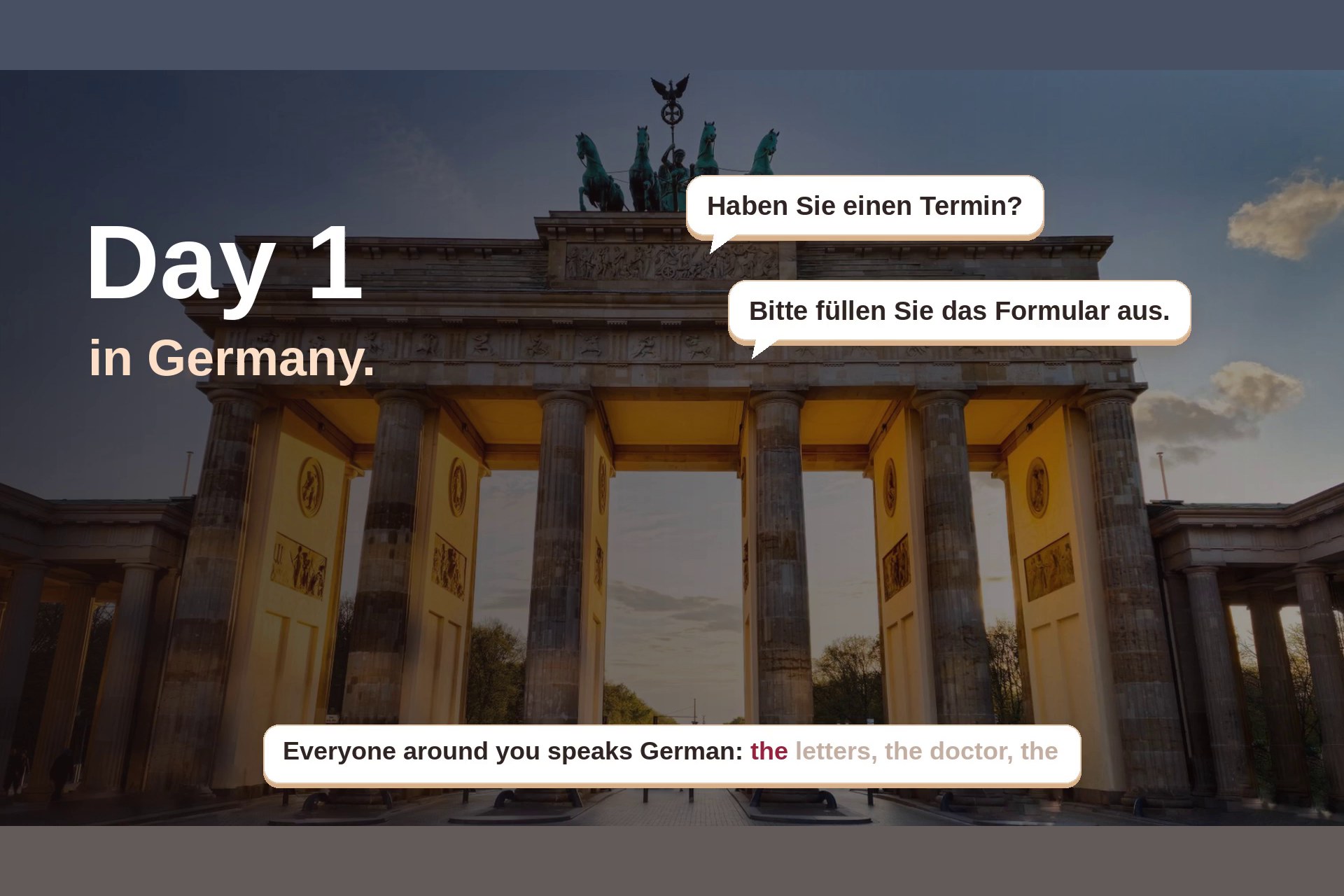
Day 1 in Germany: letters, offices and appointments — everything is in German.
-
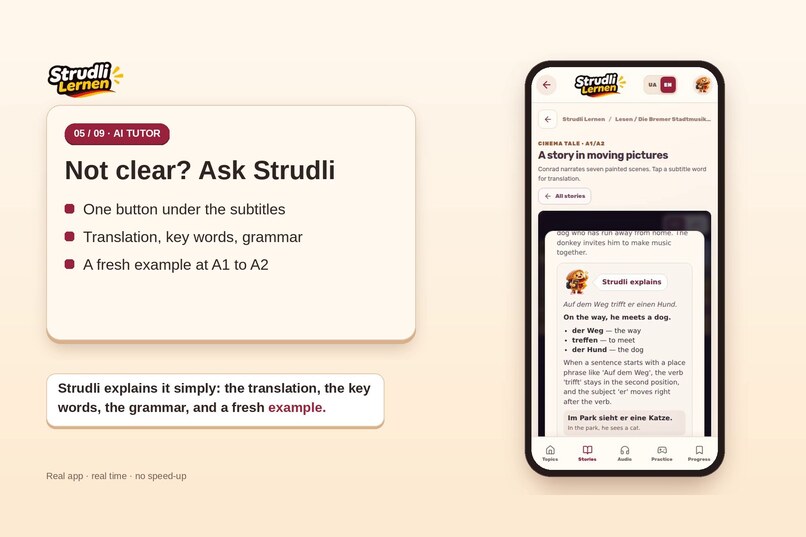
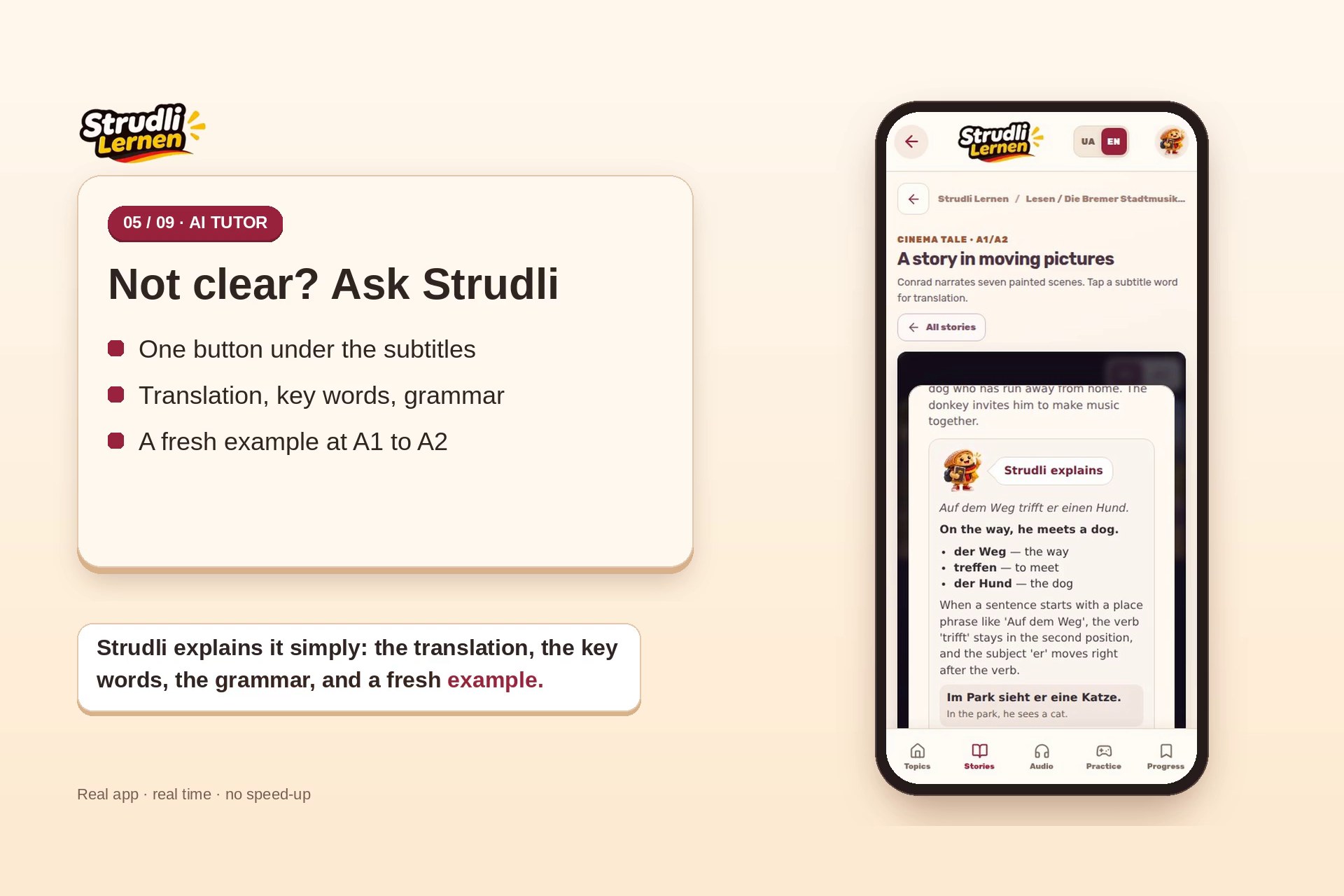
Not clear? Ask Strudli: the AI tutor explains the sentence in Ukrainian or English — translation, key words, grammar.
What it does — in one line
Strudli Lernen is a free phone app that teaches newcomers in Germany everyday German (A1–A2) like going to the cinema: watch a painted story, tap any word, ask the AI tutor Strudli why the sentence works, then say it yourself.
Made by immigrants, for immigrants. Live app: https://wortwelt-de-ua.vercel.app/ · Code: https://github.com/rostys-fintech/strudli-lernen · Demo: https://youtu.be/dUiNFmGVbRk
The problem — and who it helps
1.42 million people with Ukrainian citizenship (Central Register of Foreigners, May 2026) and 14 million foreign nationals in total (Destatis, end of 2025) live in Germany. In their first weeks everything is in German — letters, the Bürgeramt, the Jobcenter, the doctor, the kindergarten — but a course place is often months away: in 2026 the BAMF first stopped admitting voluntary participants to integration courses (about 129,500 people, roughly 40 % of expected participants) and since August processes them only with lower priority.
So people learn alone, in the evening, on a phone. As newcomers from Ukraine we ran into three concrete problems ourselves:
- Phone voices read sentences word by word — nobody learns natural German that way.
- The translation is missing exactly at the hard word.
- Grammar is explained in German or English, not in your own language.
Who it helps: adult newcomers at A0–A2, starting with Ukrainian speakers (Ukrainian and English explanations today; Arabic, Turkish and Farsi next).
The solution — main features
| Feature | What the learner gets |
|---|---|
| Cinematic stories | Painted scenes that gently animate, a calm neural narrator, every word lights up exactly when it is spoken (real speech timestamps), A1 and A2 versions, three comprehension questions, native fullscreen video on iPhone. Three episodes of Die Bremer Stadtmusikanten (21 scenes). |
| Tap any word | Meaning in this sentence (sie = she or they by context), separable verbs as one unit, IPA, a simple example, save for later. |
| Strudli explains (AI tutor) | One tap under the subtitles or next to any phrase: translation, key words with articles, the grammar point and a fresh A1–A2 example — in Ukrainian or English. Paste a line from a real letter and Strudli explains it too. |
| Say it yourself | Speech recognition marks each spoken word green or red. |
| 150 phrases for day one | Jobcenter, doctor, kindergarten, train — each recorded as one natural sentence. |
| 1,177 photo word cards | 47 everyday topics, der/die/das colours, audio, three-flame mastery. |
| Strudli Arena | A 15-second game-show quiz built from the words you saved. |
| Private by default | No sign-up; progress stays on the phone; optional account without e-mail; works offline after the first visit. |
How AI is implemented
- Model/API: Google Gemini via its OpenAI-compatible endpoint (free tier), with automatic fallback across several Gemini models when one is busy or out of quota; Vercel AI Gateway as an alternative provider. Code:
api/strudli-ai.js. - Prompting and output control: the system prompt fixes the level (A1–A2), the learner's language and a strict JSON shape (
translation,keyWordswith articles,grammar,example). The server validates the shape, retries with the next model if the answer is unusable, and renders plain text only. - Safety: input is limited to short German text; code and prompt-injection attempts are refused; a daily cap protects the free tier; 28 automated attack tests run in CI.
- Graceful failure: if the AI is unavailable, the human-checked dictionary translation is shown instead — nothing breaks.
- More AI in the product: the browser's Web Speech API checks pronunciation; Microsoft neural TTS (edge-tts) narrates and returns word-boundary timestamps for the karaoke highlighting; image generation painted the 21 story scenes from one style guide and character sheet.
Creativity & originality
- Stories you watch, not texts you read: narration, highlighting and gentle animation turn A1 reading into a short film.
- The AI explains the exact sentence the learner is stuck on, in their own language — not a generic chatbot.
- A friendly mascot guide (Strudli, a pastry with a German flag scarf) appears in every section and explains how it works.
Usefulness & real-world impact
Free, no install, no sign-up, works on any phone browser and offline after the first visit. Content follows real first-week situations (offices, health, school, transport). Results so far: 1,177 cards, 150 recorded phrases, 3 cinematic episodes × 2 levels, word-timing match rate 98–100 %, 0 missing glosses on 1,000+ tappable story words.
What I built, what I learned, and AI-assisted development
Built during the hackathon period (27 Oct – 25 Nov 2026): the cinematic story player and three episodes, the AI tutor and speech check, Strudli Arena, 150 recorded phrases, the optional account, 139 new photos and a security hardening pass. Before that, the app (then called WortWelt) was a word-card app with practice exercises and classic reading stories. Dated pull requests: docs/hackathon/BUILD_HISTORY.md.
Learned: estimated word timings failed, the voice service's own word boundaries made highlighting 98–100 % exact; Safari cannot fullscreen interactive HTML, so fullscreen uses a real H.264 video; AI output must be checked — the AI glossed sie as "she" where the story meant "they", so we added per-token context glosses; AI-written security code first only stripped markup, an attack test showed it must refuse it.
AI-assisted development (disclosure): Claude (Claude Code) and ChatGPT wrote most of the code, story scripts and glosses through pull requests. I reviewed every change on a phone, approved every photo and scene, and rejected or changed AI output where it was wrong (details: docs/hackathon/AI_DEVELOPMENT_LOG.md). 30+ automated content checks, TypeScript, the production build and the attack tests gate every merge.
Try it
- Open https://wortwelt-de-ua.vercel.app/ on a phone (or Chrome device mode).
- Home → Die Bremer Stadtmusikanten → play → tap any subtitle word → Not clear? Ask Strudli.
- Audio → any phrase → Say it yourself (Chrome or Safari, allow the microphone).
- Practice → Strudli Arena.
Run locally: git clone https://github.com/rostys-fintech/strudli-lernen && cd strudli-lernen && npm install && npm run build (README has setup, features, technologies and environment variables; no secrets in the repo).
Limitations
A1–A2 only; explanations in Ukrainian and English only; no speech recognition in Firefox; the free AI tier can be busy — then the checked fallback appears.
Credits
Photos: Wikimedia Commons, Pexels, Unsplash (credit pages in the app). Fonts: Rubik, Nunito (OFL). Icons: lucide-react (ISC). Die Bremer Stadtmusikanten: original retelling of the public-domain Grimm tale. Narration: Microsoft neural voices via edge-tts.
Built With
- chatgpt
- claude
- edge-tts
- ffmpeg
- github-actions
- google-gemini
- microsoft-neural-tts
- playwright
- react
- typescript
- upstash-redis
- vercel
- vercel-ai-gateway
- vite
- web-speech-api
