-
-
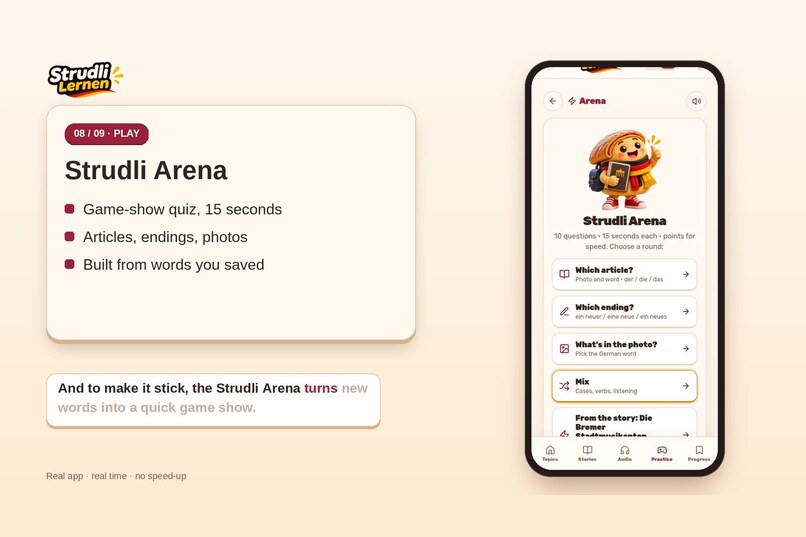
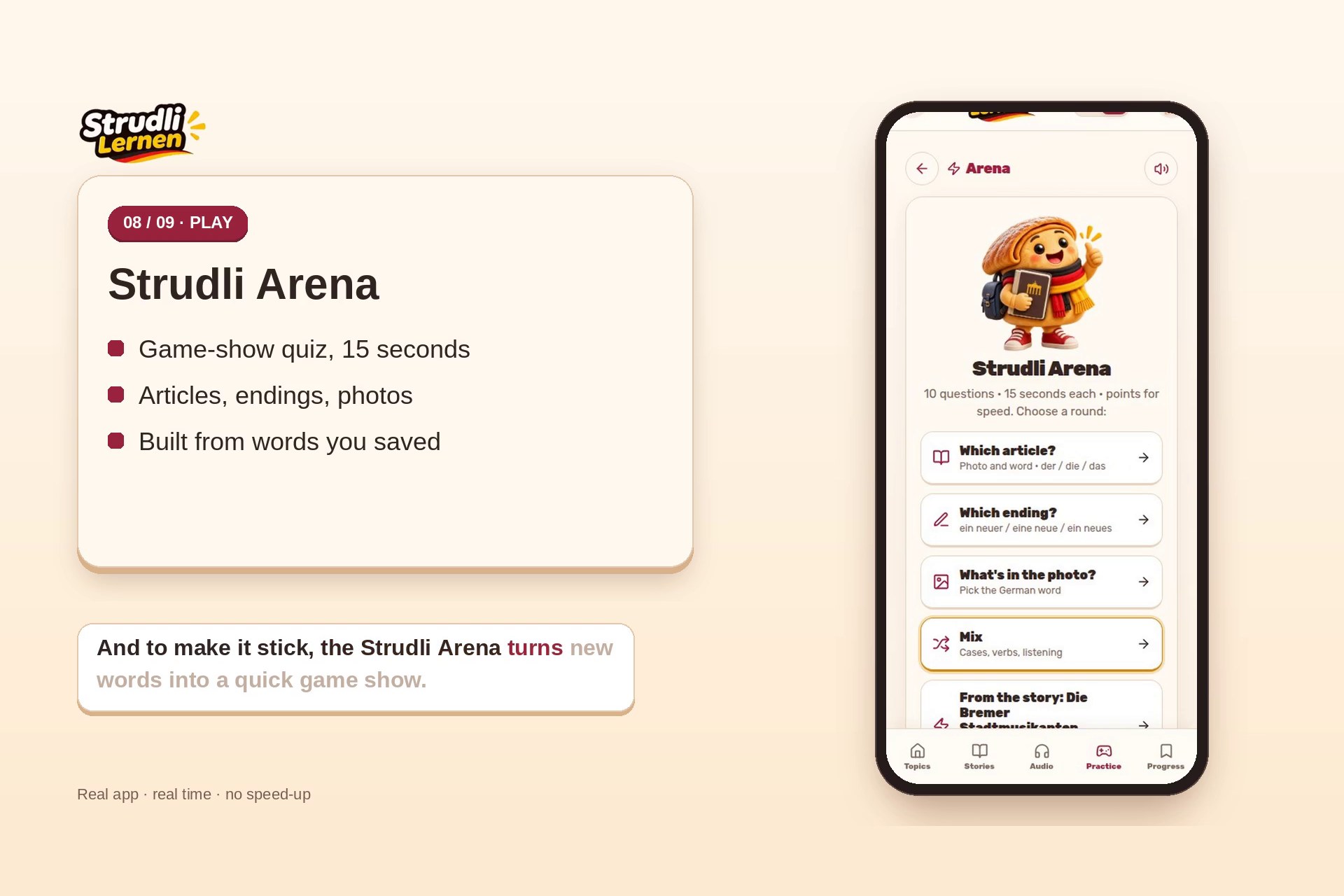
Strudli Arena: a 15-second game-show quiz built from the words you saved.
-
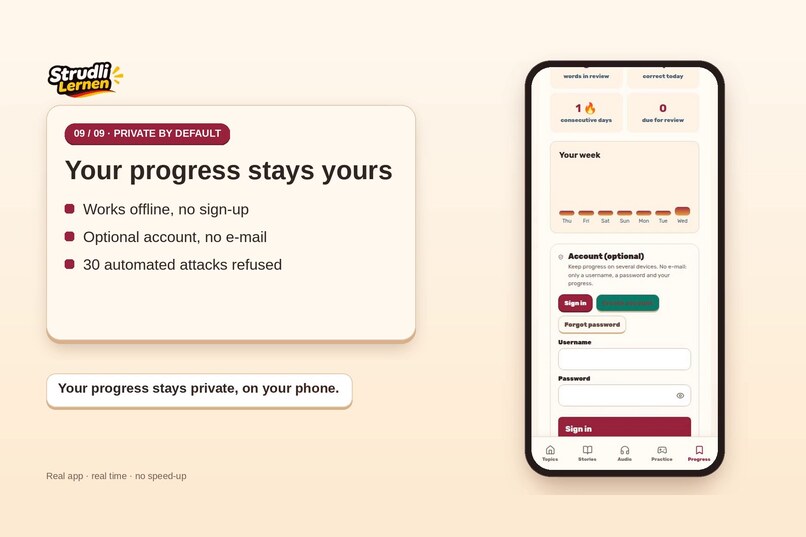
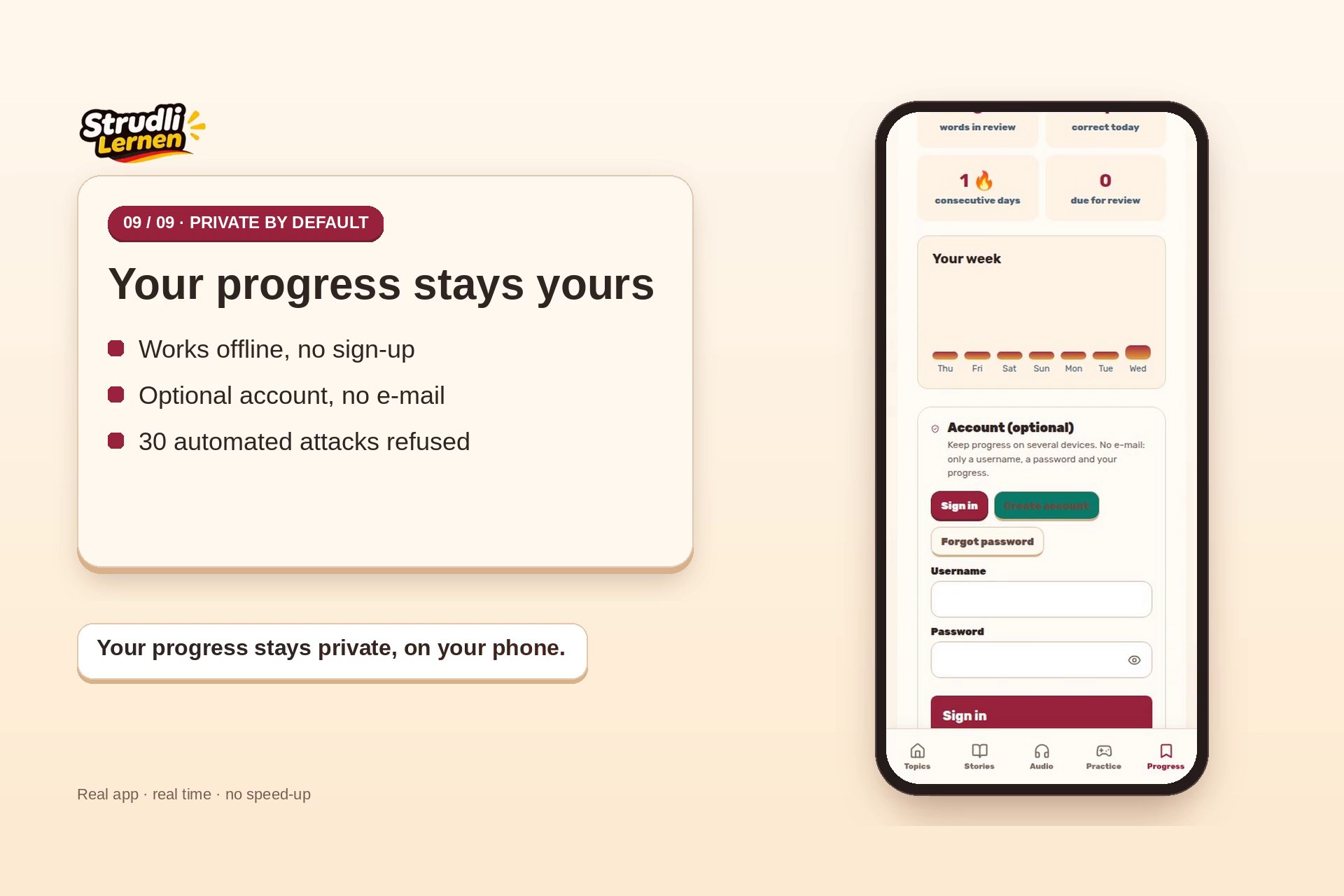
Private by default: progress stays on the phone, optional account without e-mail, automated attack tests.
-
Made by immigrants, for immigrants. Free, in any phone browser, Ukrainian and English today.
-
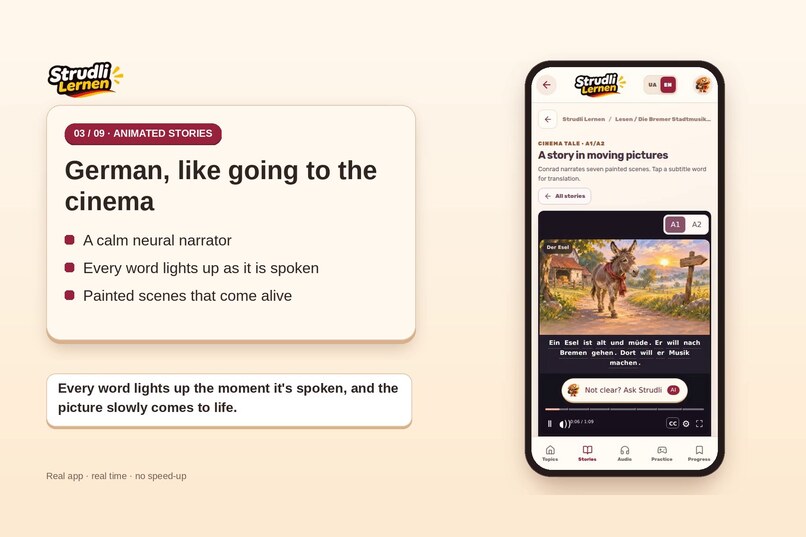
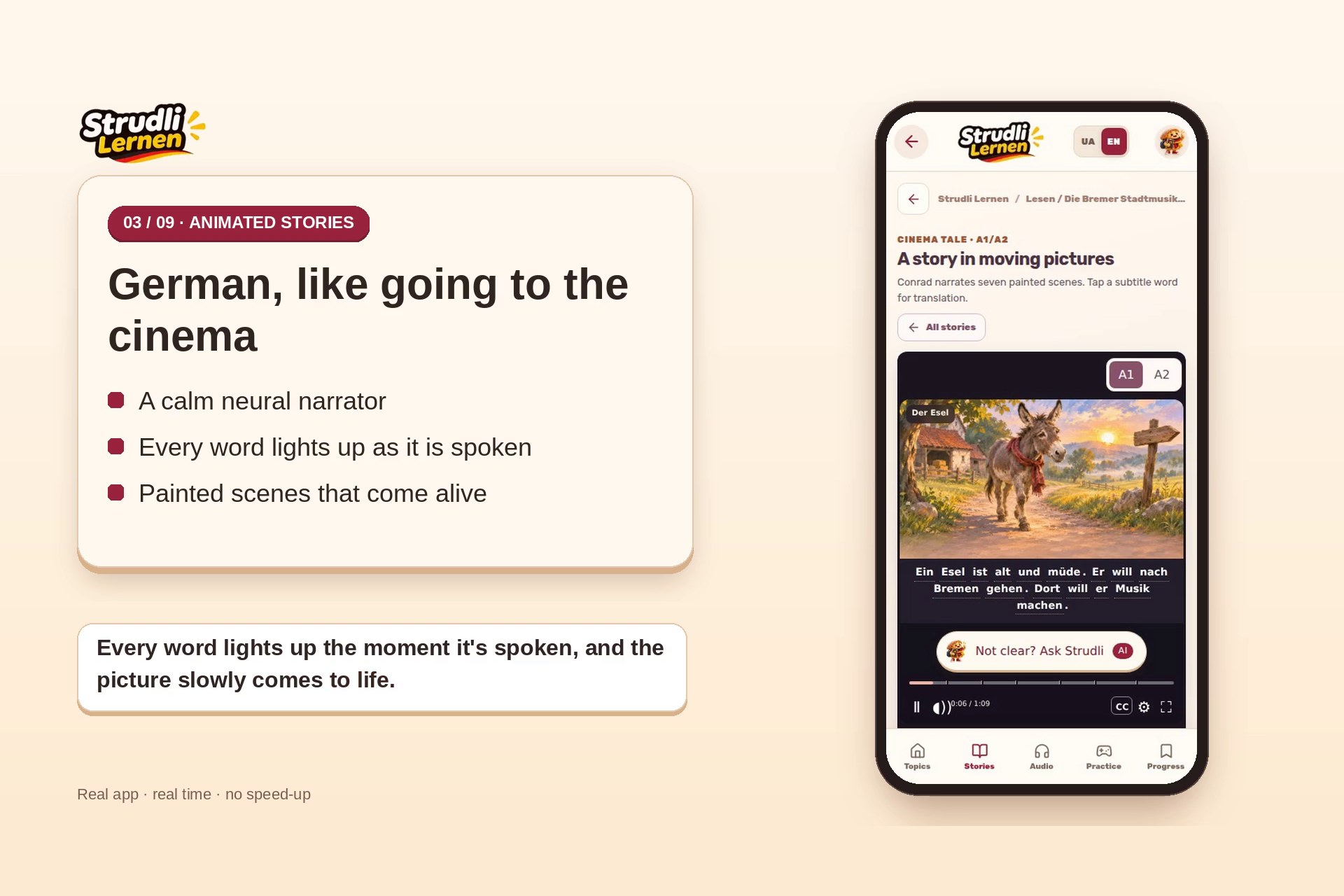
Cinematic stories: a calm narrator, every word lights up as it is spoken, painted scenes come alive.
-
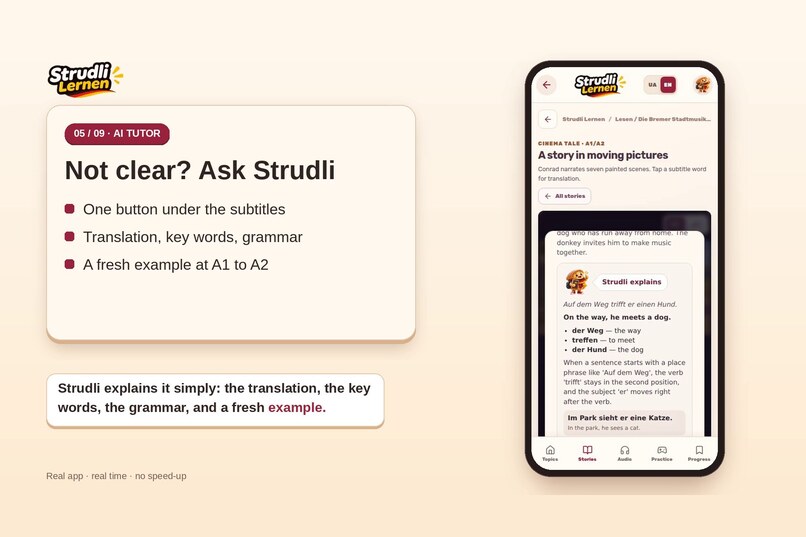
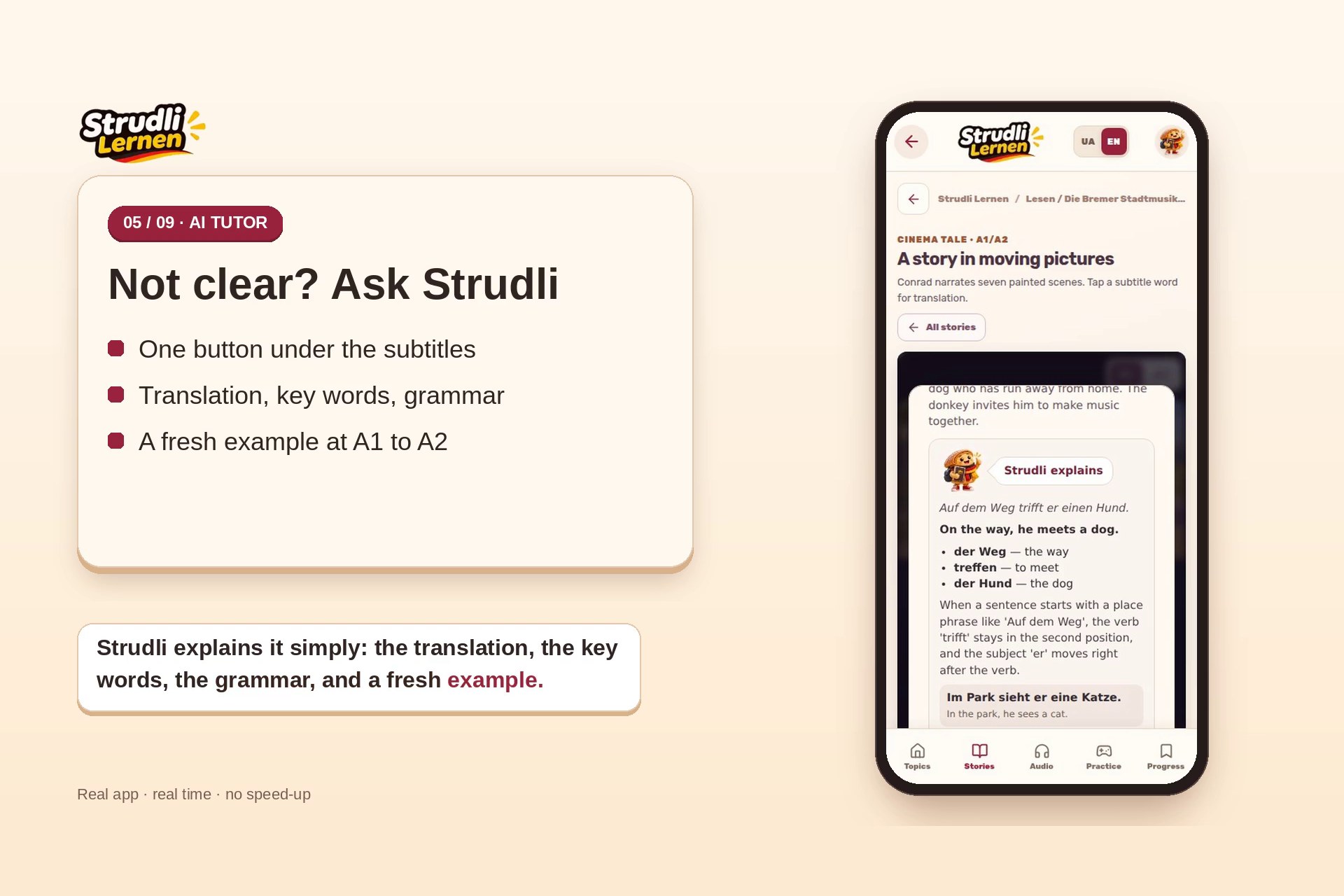
Not clear? Ask Strudli: the AI tutor explains the sentence in Ukrainian or English — translation, key words, grammar.
-
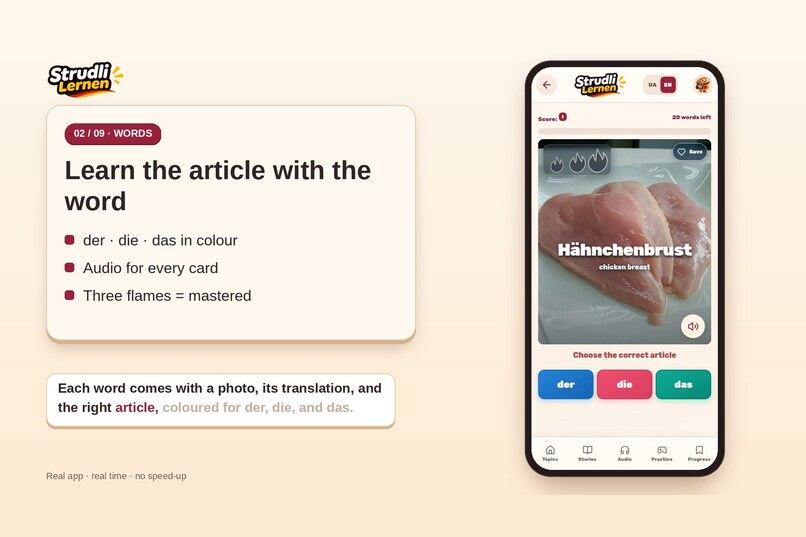
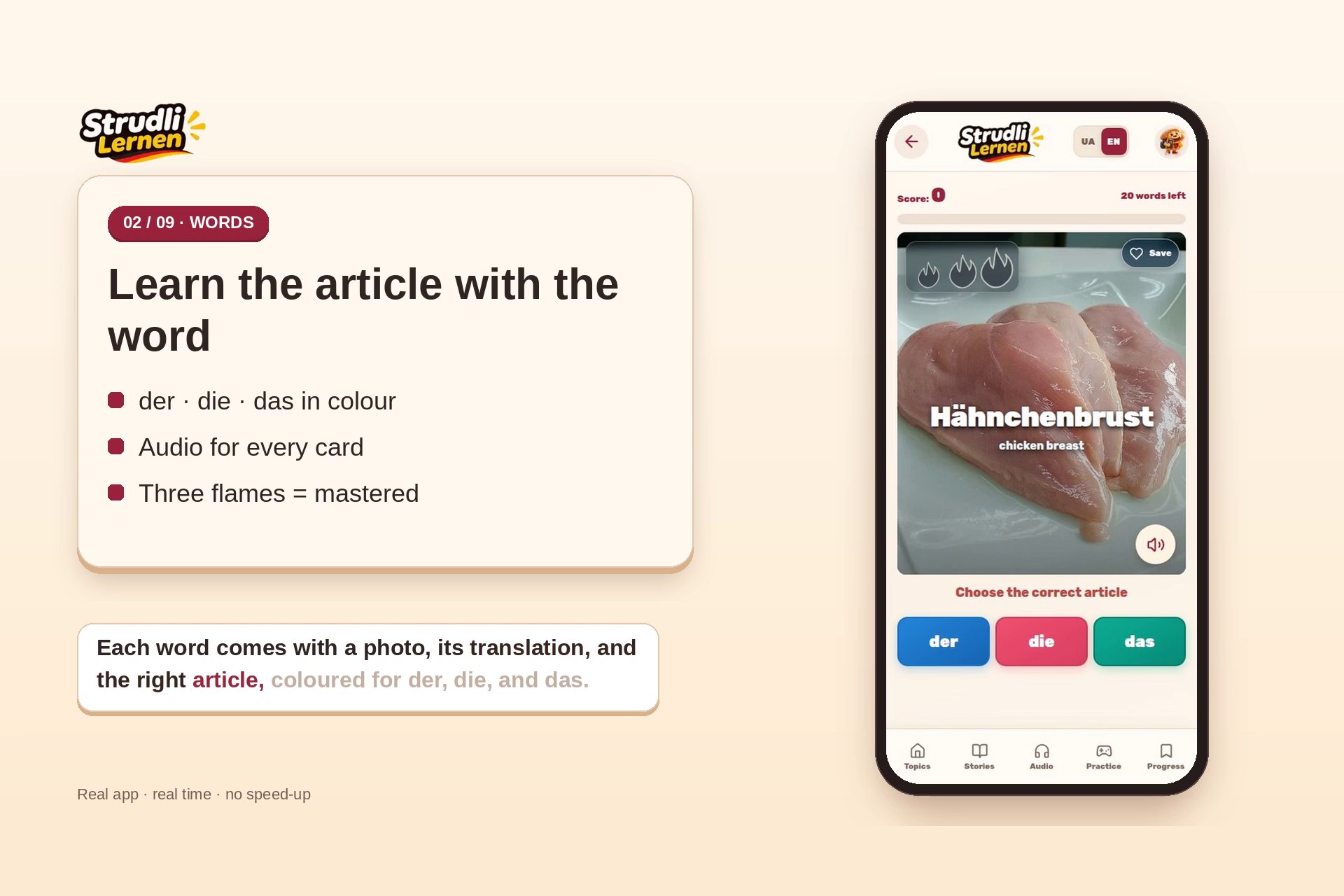
1,177 photo word cards with der/die/das colours, audio and three-flame mastery.
-
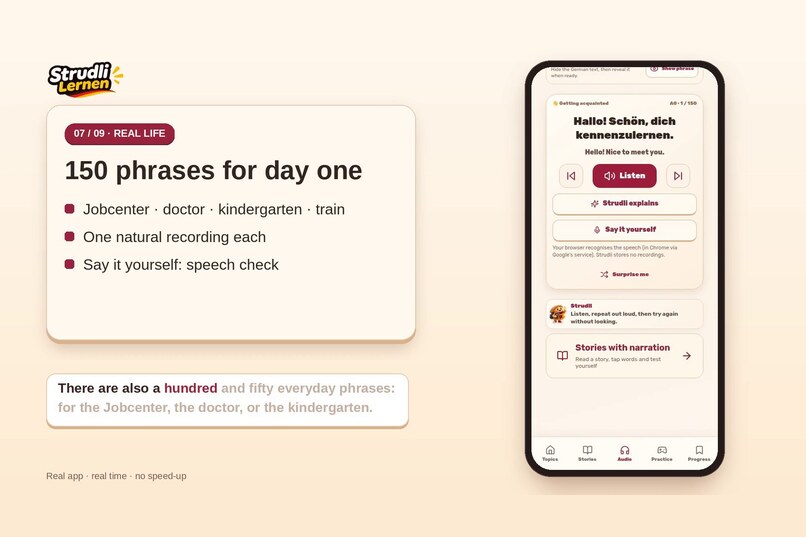
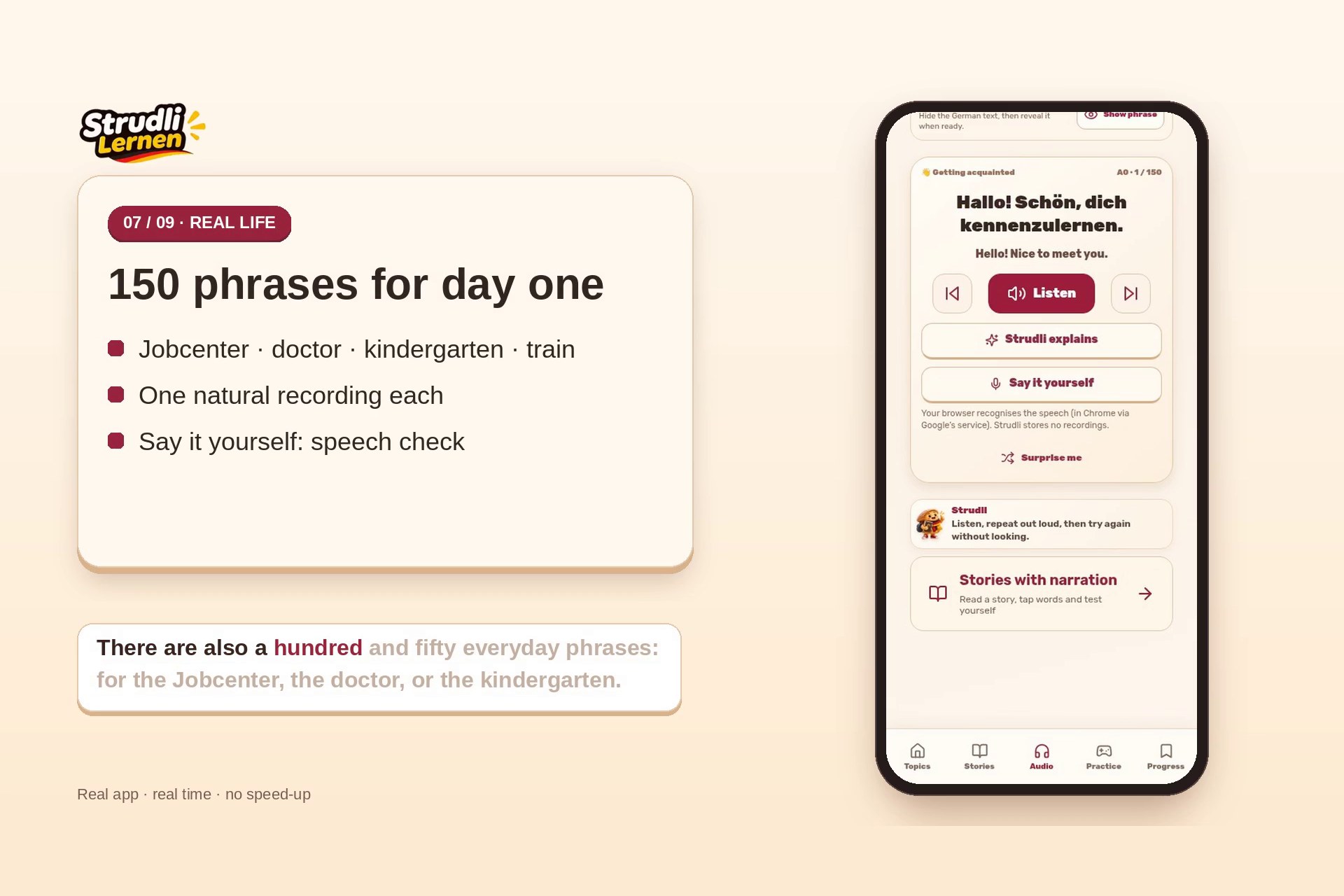
150 everyday phrases for day one (Jobcenter, doctor, kindergarten), recorded as natural speech, with a speech check.
-
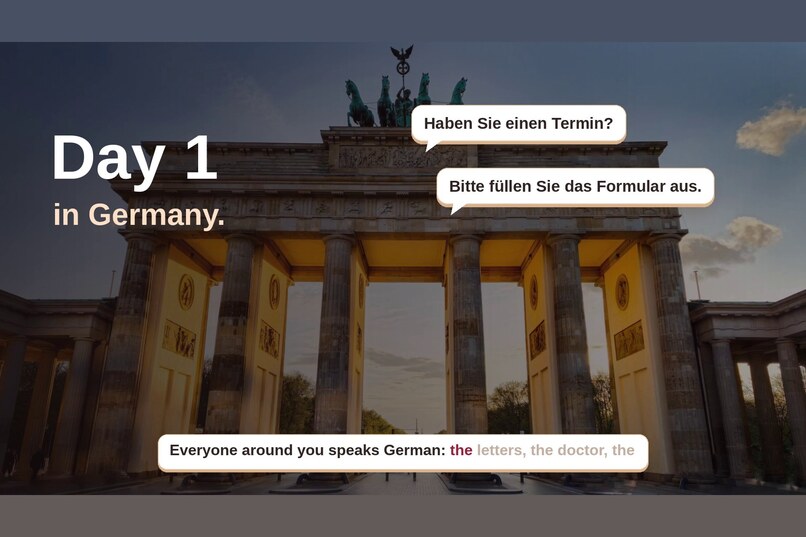
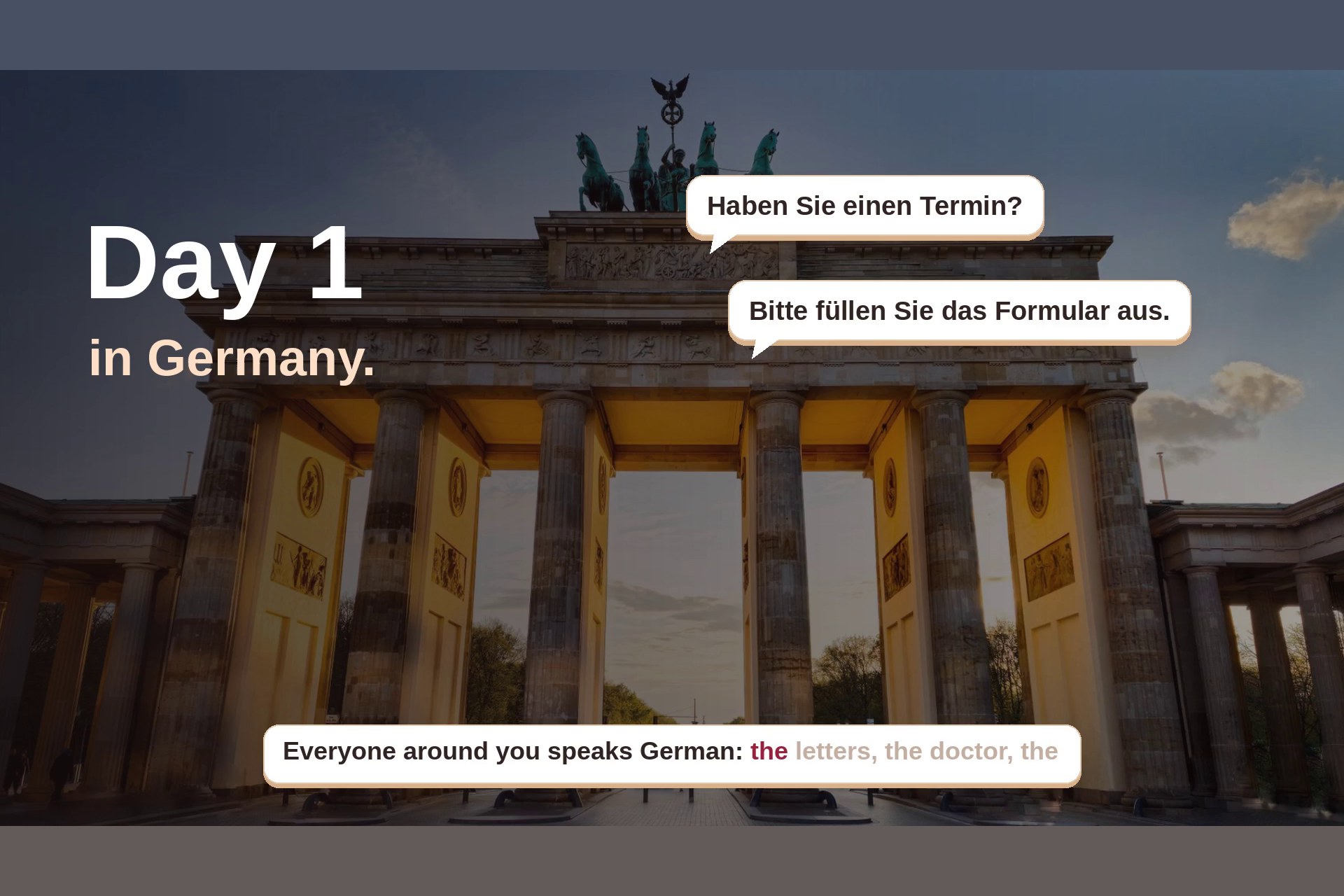
Day 1 in Germany: letters, offices and appointments — everything is in German.
Strudli Lernen — German for newcomers, like going to the cinema. Watch a painted story, tap any word, ask the AI tutor Strudli why the sentence works, then say it yourself. Made by immigrants, for immigrants.
Live app: https://wortwelt-de-ua.vercel.app/ · Code: https://github.com/rostys-fintech/strudli-lernen · Demo video: https://youtu.be/dUiNFmGVbRk
Problem statement
1.42 million people with Ukrainian citizenship (Central Register of Foreigners, May 2026) and 14 million foreign nationals in total (Destatis, end of 2025) live in Germany. From day one, letters, offices, doctors and schools are in German — but a course place is often months away: in 2026 the BAMF first stopped admitting voluntary participants to integration courses (about 129,500 people, roughly 40 % of expected participants) and since August processes them only with lower priority.
Newcomers therefore learn alone, on a phone, and get stuck in three places we know from our own experience as newcomers from Ukraine: phone voices read sentences word by word, the translation is missing exactly at the hard word, and grammar is explained in German or English instead of their own language.
Target users
Adult newcomers in Germany at A0–A2 who have no course place yet — starting with Ukrainian speakers (Ukrainian and English explanations today; Arabic, Turkish and Farsi next). Secondary users: volunteers and teachers in welcome classes who need a free tool to recommend.
Solution overview
A free web app that works in any phone browser, needs no sign-up and keeps progress on the device. It combines cinematic micro-stories, an AI tutor that explains the exact sentence a learner is stuck on in their own language, a speech check, 150 real-life phrases and 1,177 photo word cards — so the first weeks in Germany are covered with the language people actually meet.
Key features
- Cinematic stories — painted scenes that gently animate, a calm neural narrator, every word highlighted exactly when it is spoken, A1/A2 versions, comprehension questions, native fullscreen video on iPhone. Three episodes of Die Bremer Stadtmusikanten (21 scenes).
- Tap any word — meaning in this sentence (sie = she or they by context), separable verbs matched across gaps, IPA, example, save for later.
- Strudli explains (AI tutor) — translation, key words with articles, the grammar point and a new A1–A2 example, in Ukrainian or English; works for story sentences, phrases and lines pasted from real letters.
- Say it yourself — speech recognition marks each spoken word right or wrong.
- 150 phrases for day one — Jobcenter, doctor, kindergarten, train — each recorded as one natural sentence.
- 1,177 photo word cards in 47 topics with der/die/das colours, audio and three-flame mastery.
- Strudli Arena — a 15-second game-show quiz built from saved words.
- Private by default — offline after the first visit, optional account without e-mail.
Technical implementation
Architecture. React 19 + TypeScript + Vite single-page app on Vercel, a service worker for offline use, and two small dependency-free serverless functions: api/strudli-ai.js (AI tutor) and api/account.js (optional account on Upstash Redis).
AI tutor pipeline.
- Provider: Google Gemini through its OpenAI-compatible endpoint (free tier), with an ordered list of fallback Gemini models; Vercel AI Gateway as an alternative provider.
- The system prompt fixes the CEFR level (A1–A2), the explanation language and a strict JSON schema (
translation,keyWords[]with articles,grammar,example). The server validates the shape; on HTTP 404/429/5xx, a timeout or an unusable answer it moves to the next model within a deadline, then returns a checked dictionary fallback. - Guardrails: short German-only input, code and prompt-injection patterns refused, plain-text rendering, a daily request cap.
Speech and timing. Narration and phrase audio are generated with Microsoft neural voices (edge-tts) in GitHub Actions; the voice service's own word-boundary events are stored as timings, giving 98–100 % word-highlight match. Pronunciation is checked with the browser Web Speech API and word-level alignment.
Quality and security. 30+ automated content checks (every subtitle word needs a gloss, every card a translation, example and photo), TypeScript, production build, 28 scripted attacks against the APIs (scrypt passwords, secure cookies, CSRF, brute-force lock-out) and a browser security run with 0 CSP violations. The demo video itself is recorded automatically from the real production build (Playwright + neural narration + ffmpeg).
Technologies used
React, TypeScript, Vite, Vercel (hosting and serverless functions), Google Gemini API, Vercel AI Gateway, Upstash Redis, Web Speech API, Microsoft neural TTS via edge-tts, ffmpeg, Playwright, GitHub Actions; development with Claude (Claude Code) and ChatGPT.
Creativity & innovation
Reading for beginners turned into short films; an AI tutor scoped to the learner's exact sentence and native language instead of a generic chatbot; a mascot guide (Strudli) in every section; game-show practice from words collected in stories.
Real-world impact
Free, no install, no sign-up, offline-capable — built for people without a course place. Results so far: 1,177 cards, 150 recorded phrases, 3 episodes × 2 levels, 0 missing glosses on 1,000+ tappable story words. Next: Arabic, Turkish and Farsi explanations, A2→B1 stories, native mobile apps.
Design & user experience
One consistent visual system (cream background, burgundy accents, der/die/das colours), large tap targets for phones, every button labelled in the app language, and clear fallbacks (AI busy, microphone denied, offline) so nothing breaks.
AI use and pre-existing work (disclosure)
Before 1 Nov 2026 the app (then WortWelt) was a word-card app with exercises and classic reading stories. Built during the challenge: cinematic stories, AI tutor, speech check, Arena, 150 recorded phrases, optional account, 139 new photos and the security hardening (dated pull requests: docs/hackathon/BUILD_HISTORY.md). Claude and ChatGPT wrote most code, scripts and glosses; I reviewed every change on a phone and rejected or fixed AI output where it was wrong (docs/hackathon/AI_DEVELOPMENT_LOG.md).
Team
Rostyslav Honcharenko (solo) — product, content review, testing and development with AI coding assistants.
Built With
- chatgpt
- claude
- edge-tts
- ffmpeg
- github-actions
- google-gemini
- microsoft-neural-tts
- playwright
- react
- typescript
- upstash-redis
- vercel
- vercel-ai-gateway
- vite
- web-speech-api
