


Project Submission: StructureOS
💡 Inspiration
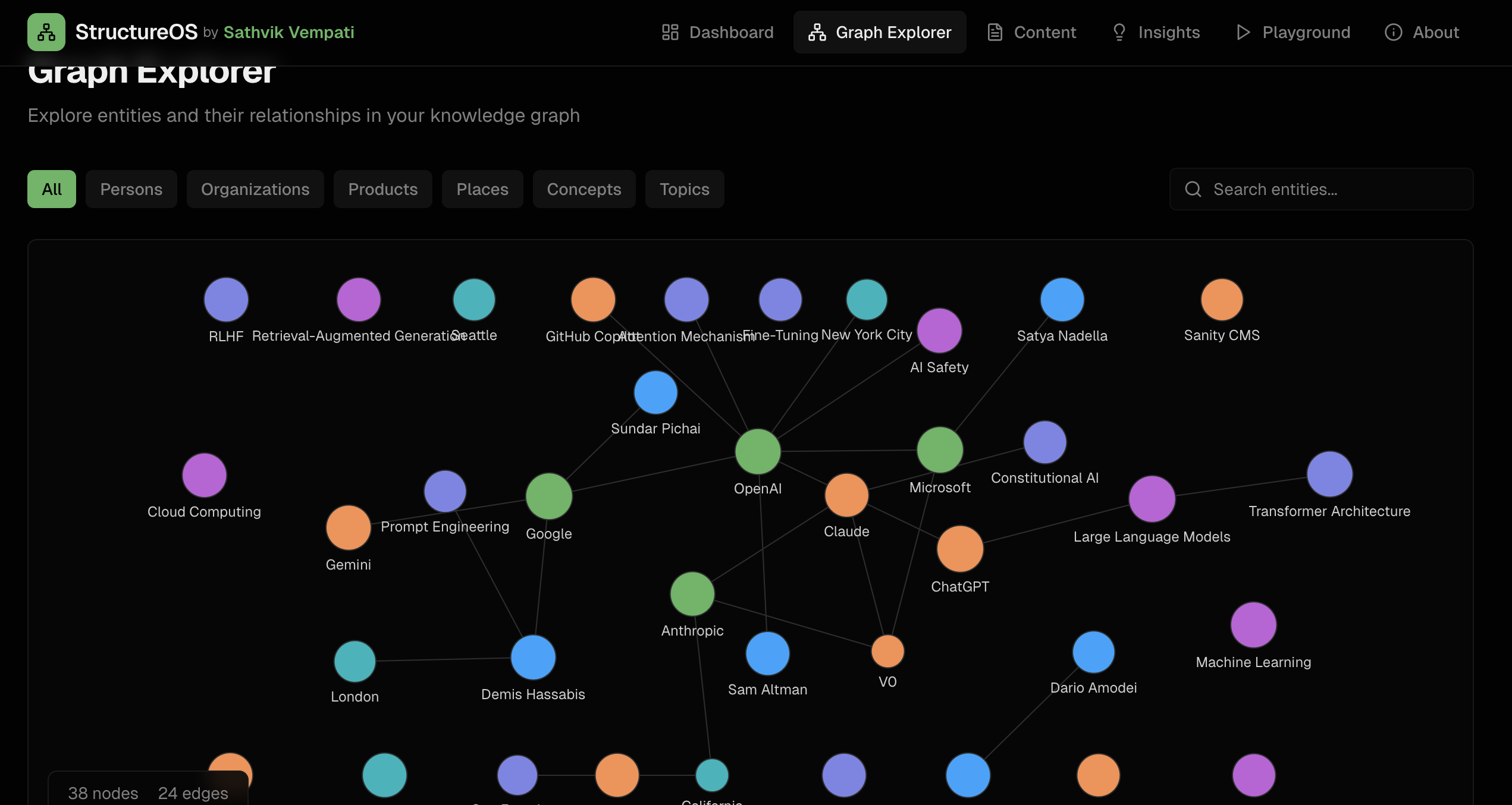
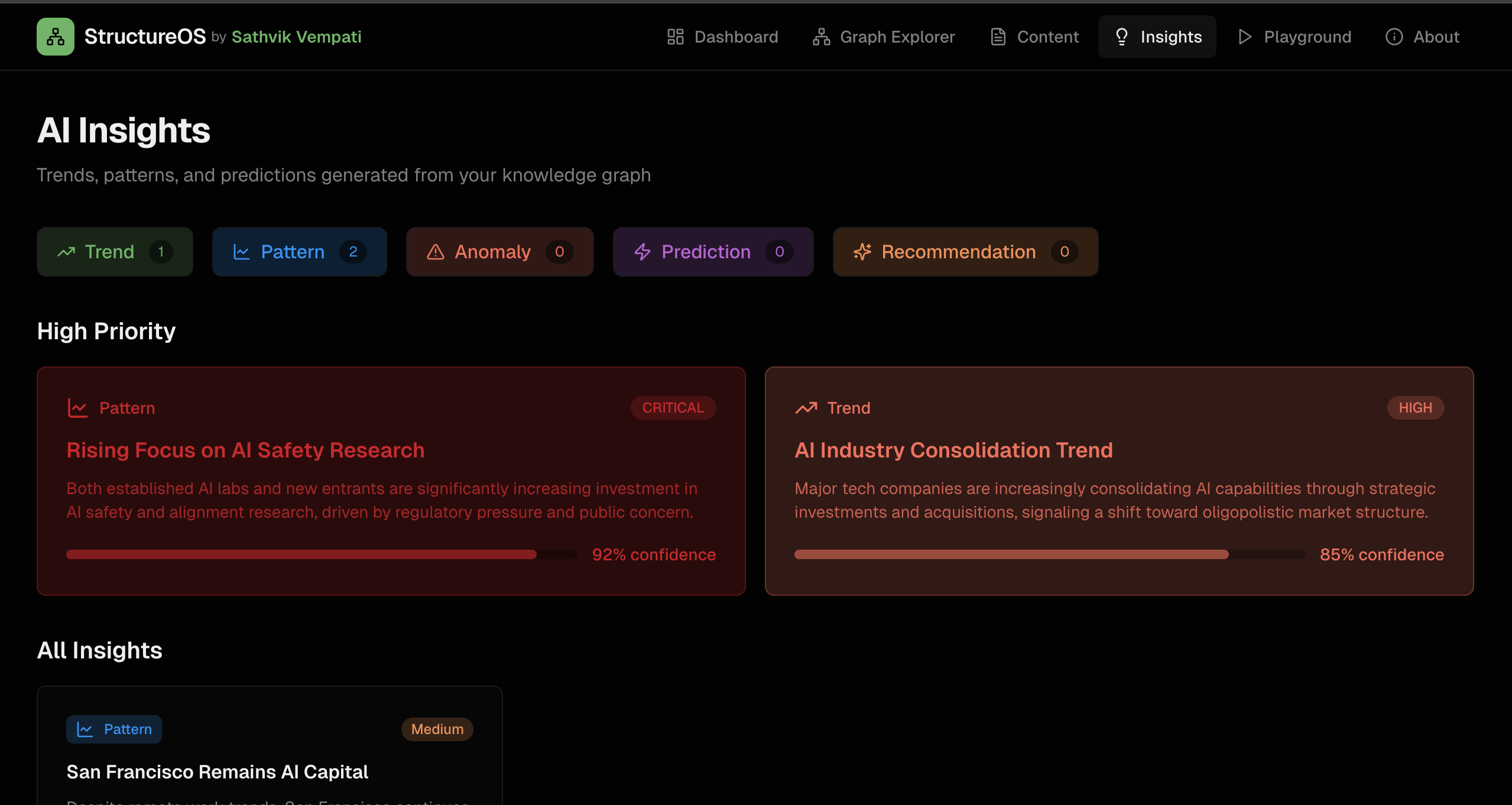
Modern content is "flat", trapped in Markdown files and silos that can’t be queried. Inspired by the potential of Sanity’s structured content, I wanted to build a platform that proves content is actually a web of intelligence. Using Kilo’s versatile developer tools to manage my workflow, I built StructureOS to transform a traditional CMS into a living, breathing Knowledge Graph where every entity is a queryable data point.
What it does
StructureOS is a content intelligence layer built on the belief that structured content is the future of automation.
- Entity Impact Analysis: Powered by Sanity’s
references()function, this instantly maps the "blast radius" of any entity, showing every connected article and insight. - Cross-Entity Discovery: This isn't keyword matching; it’s a structural GROQ join across reference arrays to find articles that share deep thematic nodes.
- Second-Degree Traversal: A visual way to find "hidden" connections (e.g., Company A → Person C → Tech B), made possible by treating relationships as first-class Sanity documents.
- AI Playground: A Groq-powered LLM interface that reasons over the graph. Kilo was very helpful here, providing the environment to rapidly iterate on these AI-driven content queries.
How we built it
The foundation of StructureOS is Sanity and GROQ, supported by Kilo’s developer ecosystem:
- The Brain: Sanity.io serves as the graph database. Every "person," "technology," and "event" is a typed document with bi-directional references.
- The Logic: I wrote 15+ complex GROQ queries to handle everything from reverse-reference lookups to array overlap counting.
- The Workflow: Kilo’s versatile developer tools were essential for managing the project's velocity. Kilo helped automate my schema deployments and kept my environment variables synced across the stack.
- The Interface: A high-performance Next.js 16 (App Router) frontend, with D3.js translating Sanity’s JSON data into an interactive force-directed graph.
- The Integration: We used the Sanity MCP Server via Kilo to explore the schema and scaffold queries through an AI-assisted development cycle.
Challenges we ran into
The biggest challenge was performing multi-hop graph traversals without a native graph database. I had to push GROQ to its limits, using nested projections and array comprehensions. Kilo was very helpful during this phase; I used Kilo’s automation and debugging tools to test these heavy queries against the Sanity API to ensure they remained performant under load.
Accomplishments that we're proud of
- True Graph Architecture: We built a system where content isn't just displayed; it is calculated.
- GROQ Sophistication: Successfully implementing "Shared Entity Ranking," which would be impossible in a traditional "flat" CMS.
- Development Speed: Thanks to Kilo, I was able to move from a blank repo to a fully functional intelligence layer in record time. Kilo ensured that the "boring" parts of dev (config and deployment) were automated, so I could focus on the Sanity schema.
What we learned
The project reinforced that Sanity is more than a CMS—it’s a data engine. I learned how to model complex relationships as typed documents and how to use GROQ to traverse them. Kilo was also very helpful in teaching me how to maintain a high-speed development rhythm, showing me that the right developer tools are just as important as the database itself.
🚀 What's next for StructureOS
- Automated Graph Ingestion: Using Kilo’s versatile automation tools to build a pipeline that scrapes news and auto-populates the Sanity graph.
- Real-Time Relationship Monitoring: Setting up webhooks that alert users when a new "2nd-degree connection" is formed between two critical entities.
- Open Source Framework: Packaging the Sanity + Kilo boilerplate to help other developers build their own content intelligence layers.
Built With
- javascript
- kilocode
- python
- sanity
- v0


Log in or sign up for Devpost to join the conversation.