Inspiration
Multi-step LLM workflows often look strong on a single happy-path demo but break under small realistic variations such as paraphrases, missing context, edge cases, or mild ambiguity. Single-prompt evaluations of the form “Is this workflow reliable?” are incomplete and usually overly optimistic. We wanted a transparent, lightweight way to actually measure that brittleness and get concrete fixes.
What it does
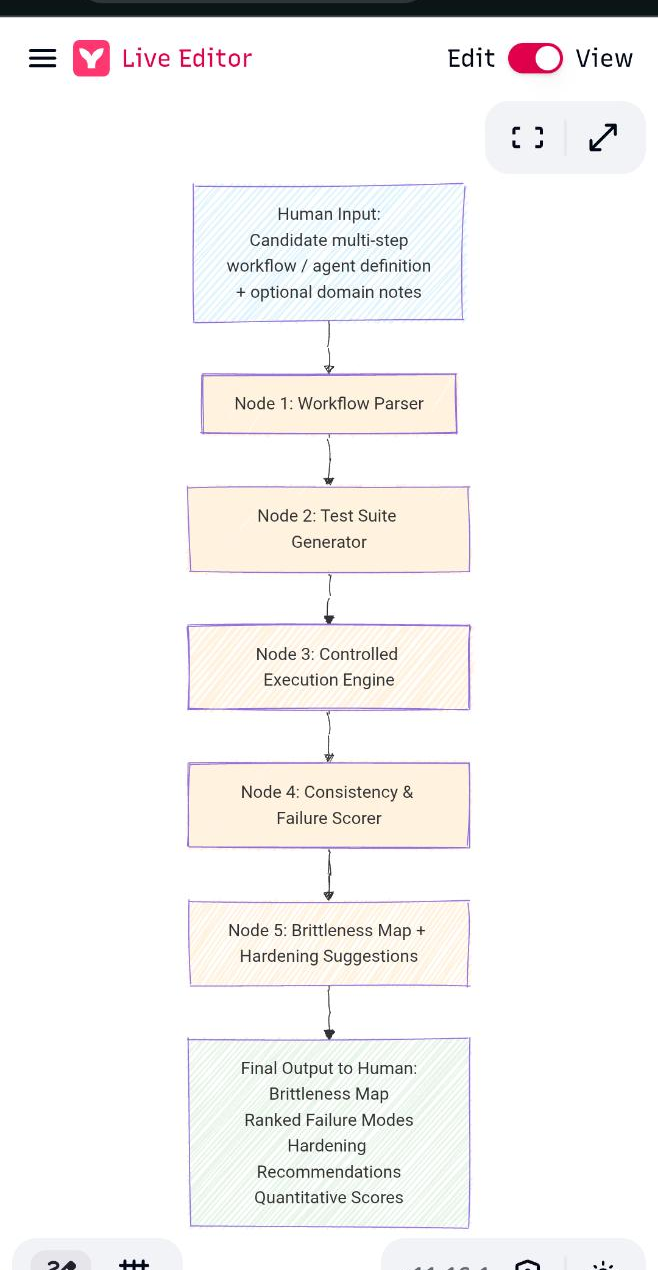
The project is itself a five-node multi-step LLM workflow that acts as a Workflow Reliability Auditor:
- Workflow Parser – extracts a clean structured representation of the candidate multi-step agent.
- Test Suite Generator – creates controlled test cases covering paraphrases, missing context, edge values, order sensitivity, and mild adversarial inputs.
- Controlled Execution Engine – runs the candidate workflow on every test case and logs traces.
- Consistency & Failure Scorer – measures consistency and categorizes failure modes.
- Brittleness Map + Hardening Suggestions – produces a clear report with quantitative scores, ranked failure modes, and specific prompt-level hardening recommendations.
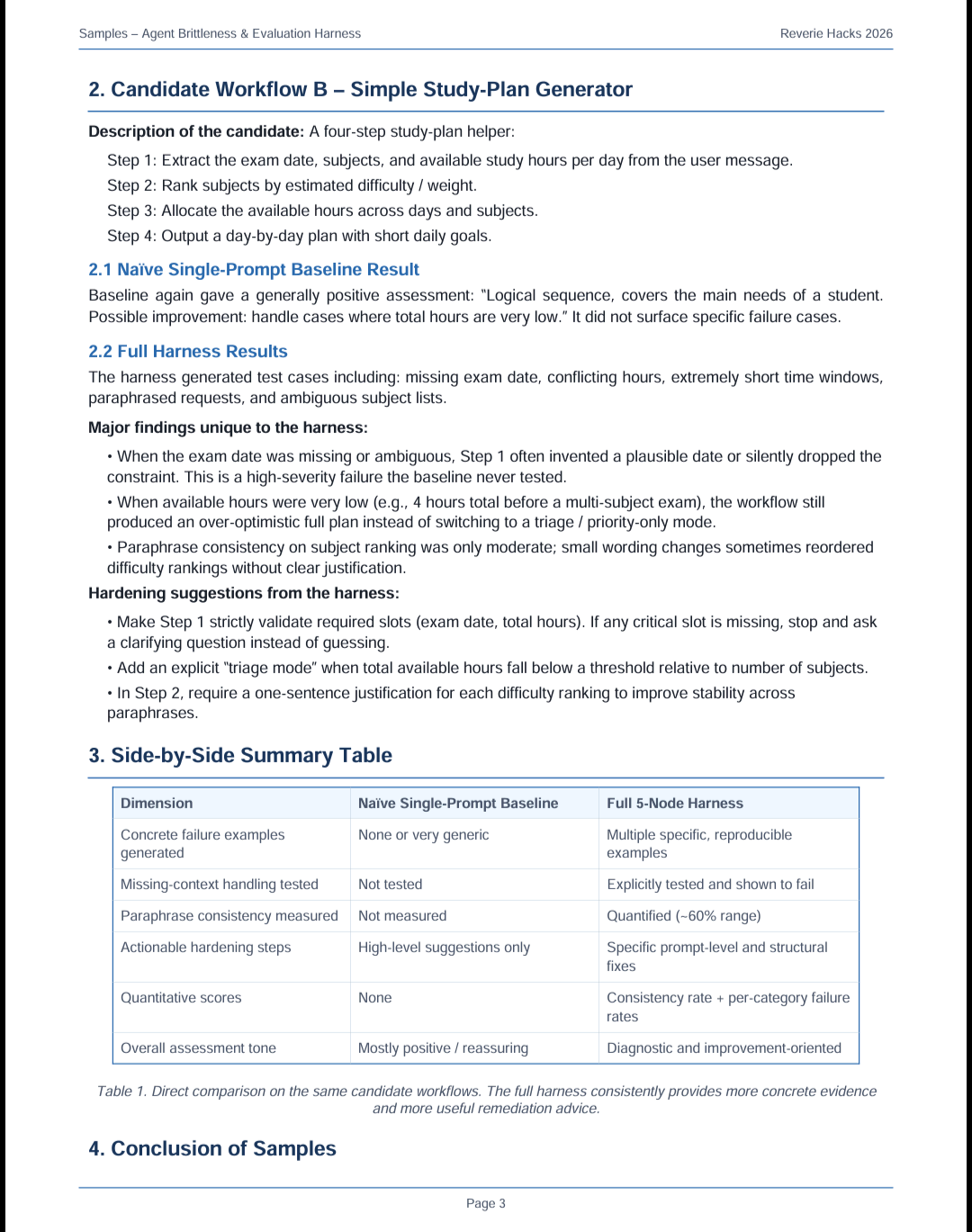
We compare the full harness against a naïve single-prompt baseline on the same candidate workflows. The harness consistently surfaces concrete, reproducible failures and actionable fixes that the baseline misses.
How we built it
Everything is pure structured prompting and orchestration — no fine-tuning or external tools required. The reference implementation uses Claude 3.5 Sonnet (GPT-4o works as a drop-in). The entire system is model-agnostic and fully transparent. Every node is documented with explicit reasoning, limitations, and design trade-offs.
Challenges we ran into
- Keeping the evaluation harness itself from becoming brittle.
- Designing a practical test-suite taxonomy that is still useful for student-scale workflows.
- Making the comparison with the single-prompt baseline fair and easy for judges to verify.
Accomplishments that we're proud of
- Clear, measurable improvement over single-prompt evaluation.
- Concrete failure modes (approximately 62% paraphrase consistency, missing-context collapse) and specific hardening suggestions.
- Fully reproducible and transparent design.
- Complete submission package: flowchart, detailed documentation, and side-by-side samples.
What we learned
Treating evaluation itself as a structured multi-step workflow is more powerful than asking a single prompt to judge reliability. Honesty about limitations increases credibility. Quantitative scores plus concrete examples beat vague qualitative assessments.
What's next
- Automatic generation of a hardened version of the candidate workflow.
- Support for tool-using and simple multi-agent candidates.
- Classroom mode so students can privately stress-test their own workflows.
Built With
- agent-evaluation
- ai-reliability
- claude
- documentation
- gpt-4o
- large-language-models
- multi-step-workflows
- prompt-engineering

Log in or sign up for Devpost to join the conversation.