-
-
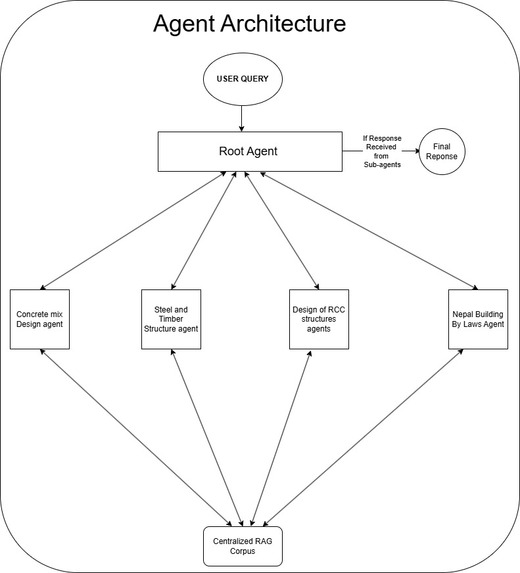
AI Agent Architecture
INSPIRATION
As Structural Engineers, we should strictly adhere to the specifications mentioned in authorized engineering codes and regulations while carrying out initial design and subsequent construction work. The codes are backed by multiple past research findings from scientifically accurate sources, thus ensuring the mathematical and technical reliability of the specifications that engineers must follow. Engineering codes ensure safety and structural stability for the structures and projects that are to be built. Engineering Codes are usually made mandatory by respective countries' governments; thus, the specifications mentioned there must be followed.
Since the facts and figures in the code books must be frequently cross-checked while preparing preliminary designs (before beginning any construction), this process becomes tedious. To address this seemingly hectic process of obtaining facts and figures from the specifications and diagrams provided in engineering codes, a Structural Engineering Code Compliance Expert AI Agent has been prototyped.
Since we primarily utilize Indian Standard Codes and Nepal-based codes here in Nepal, the agent has been specifically localized to these regional standards, enabling it to function as a specialized regional expert with deep knowledge of local engineering requirements.
HOW WE BUILT IT
Used Google's Python Agent Development Kit (ADK) library.
Used Gemini 2.5 Flash as our primary LLM Model.
Implemented RAG Corpus through Google Cloud. The RAG Corpus contained all the necessary Indian Standard (IS) and Nepal-based codes that a structural engineer would need.
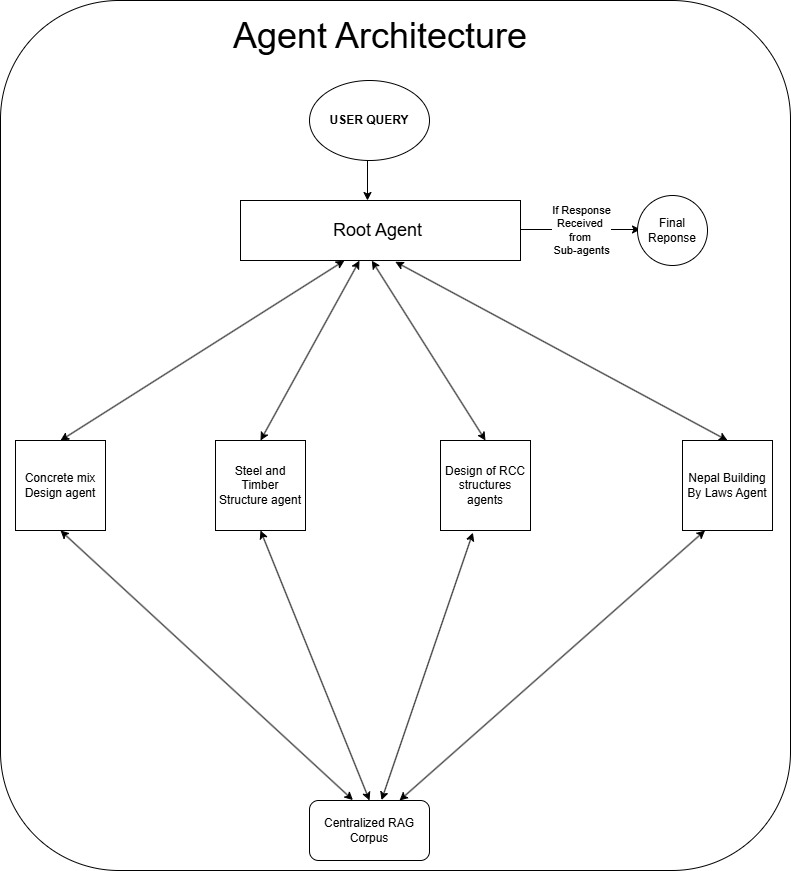
Created a Root Agent that orchestrates the user query among 4 sub-agents and returns responses strictly adhering to the Engineering Codes concerned.
Four sub-agents are: Concrete Mix Design Agent, RCC Structure Agent, Steel Structures Agent, and Nepal Building ByLaws Agent.
Deployed the entire agent architecture on Google VertexAI
CHALLENGES WE FELT
This was our first real dive into working with Large Language Models and AI Agent workflows at this level. Initially, we found it challenging to understand the workflow of AI Agents. There was definitely a steep learning curve as we started figuring out all the components behind an AI Agent.
Since one of us (me) here is not a CS Major undergrad, I was slightly unaware of the backend processes that involved Google Cloud configurations.
We got to know about the Hackathon just a week before the deadline. So, catching up with the basic tools and dependencies needed for AI Agents was a bit hectic.
WHAT WE LEARNED
Learned to use Google's Python ADK.
Learned to configure LLM Models, Google Cloud, and Deployment platform for any AI agents.
Figured out the Art of Crafting Smart Workflow architectures that leverages the true computational potential of an LLM, enabling the development of sophisticated standalone AI agents.
What's next?
- Further empowering the agent by providing it with access to modelling software (like DIANA FEA and ETABS) so that the agent can investigate in real-time whether regulations mentioned in engineering codes are obeyed or not during the preliminary design process.
Built With
- google-agent-development-kit
- google-cloud
- google-vertexai
- python
- rag

Log in or sign up for Devpost to join the conversation.