-
-
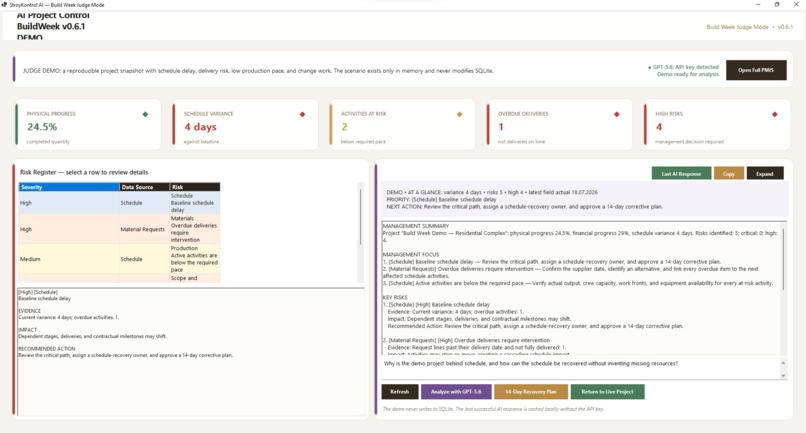
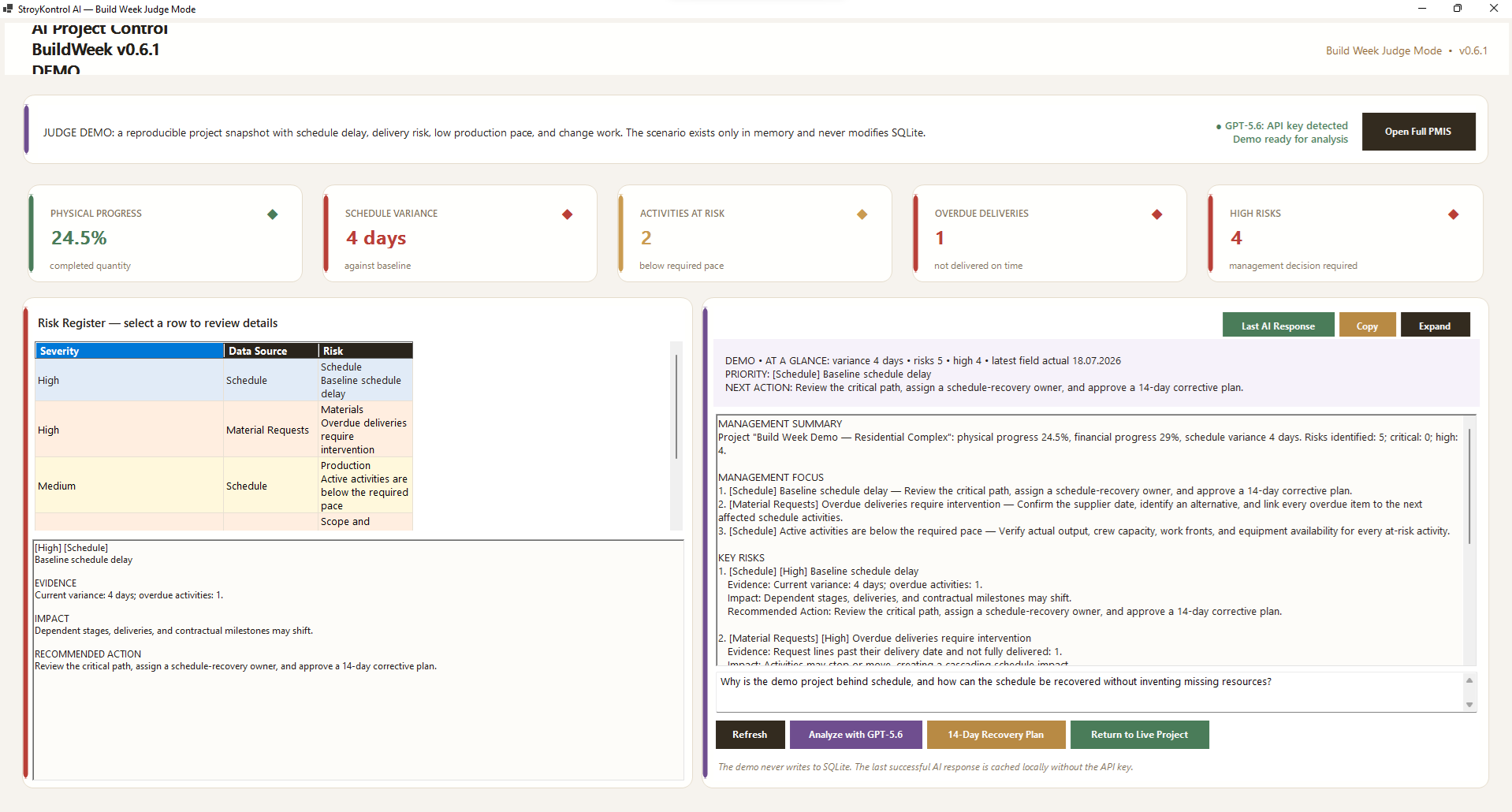
AI Project Control dashboard with a reproducible construction demo, key metrics, traceable risks, and management priorities.
-
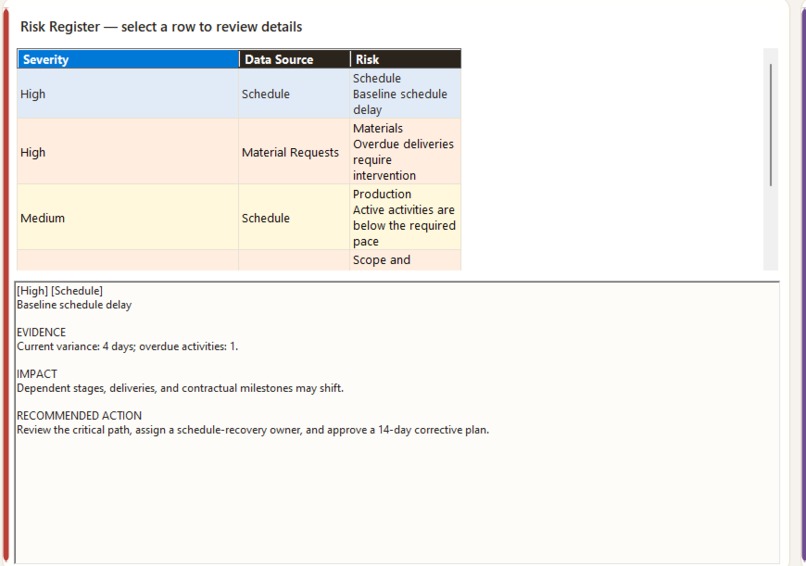
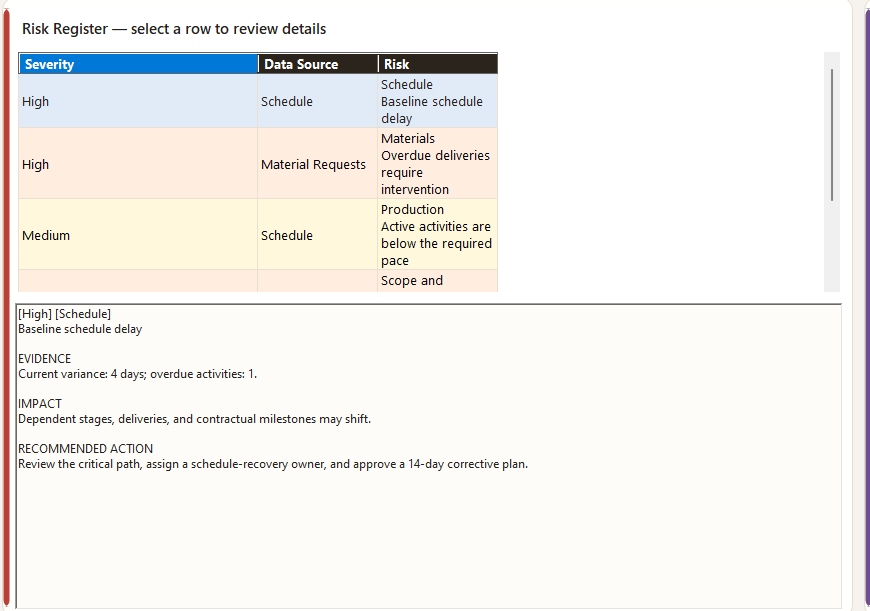
Every detected risk includes its data source, evidence, potential impact, and a recommended management action.
-
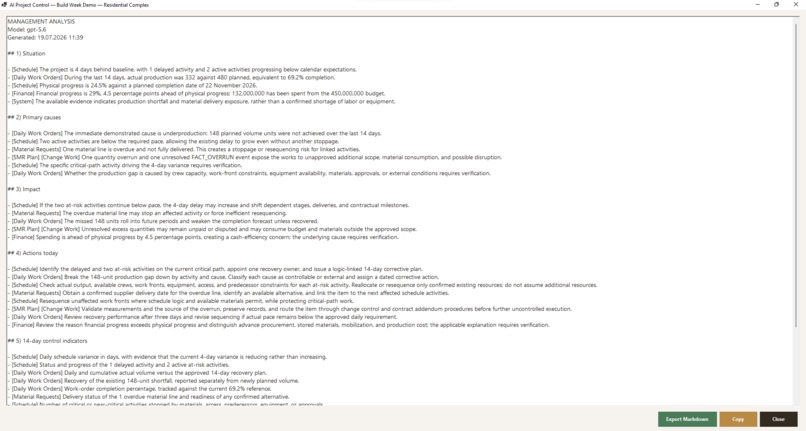
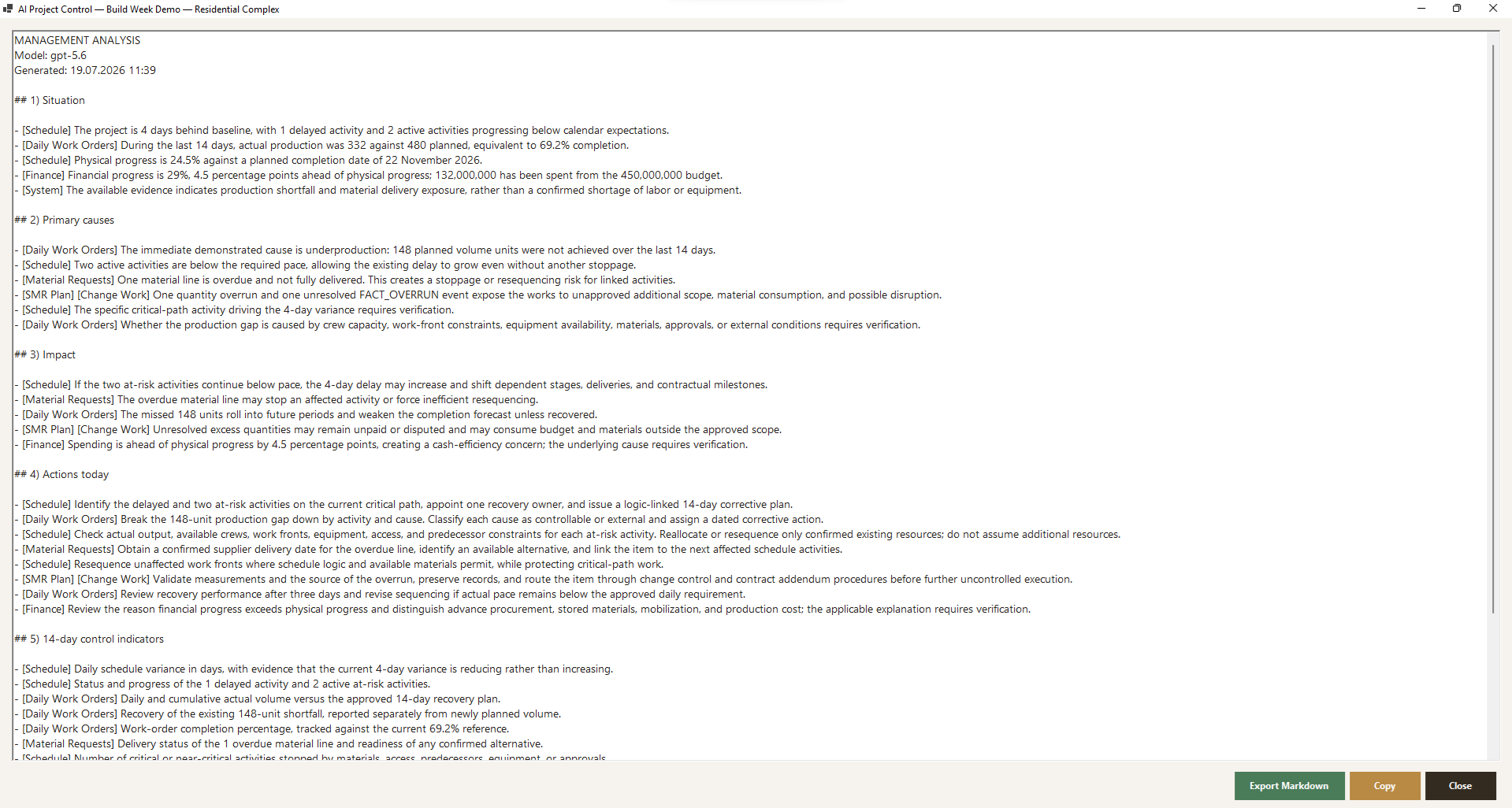
GPT-5.6 analyzes a structured read-only project snapshot, separates facts from assumptions, and recommends actions.
-
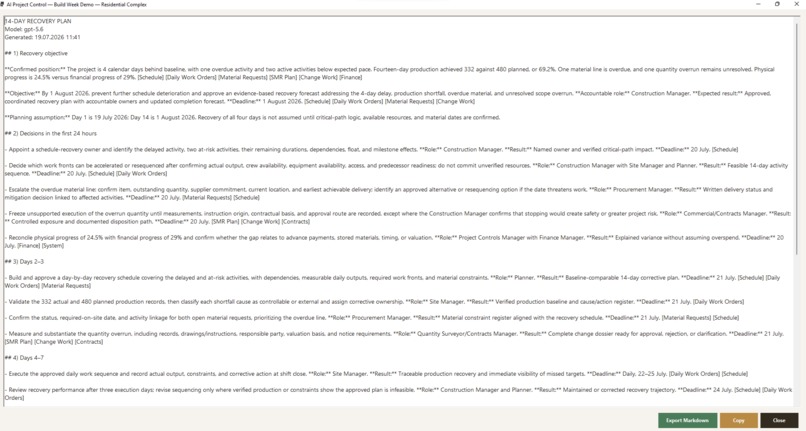
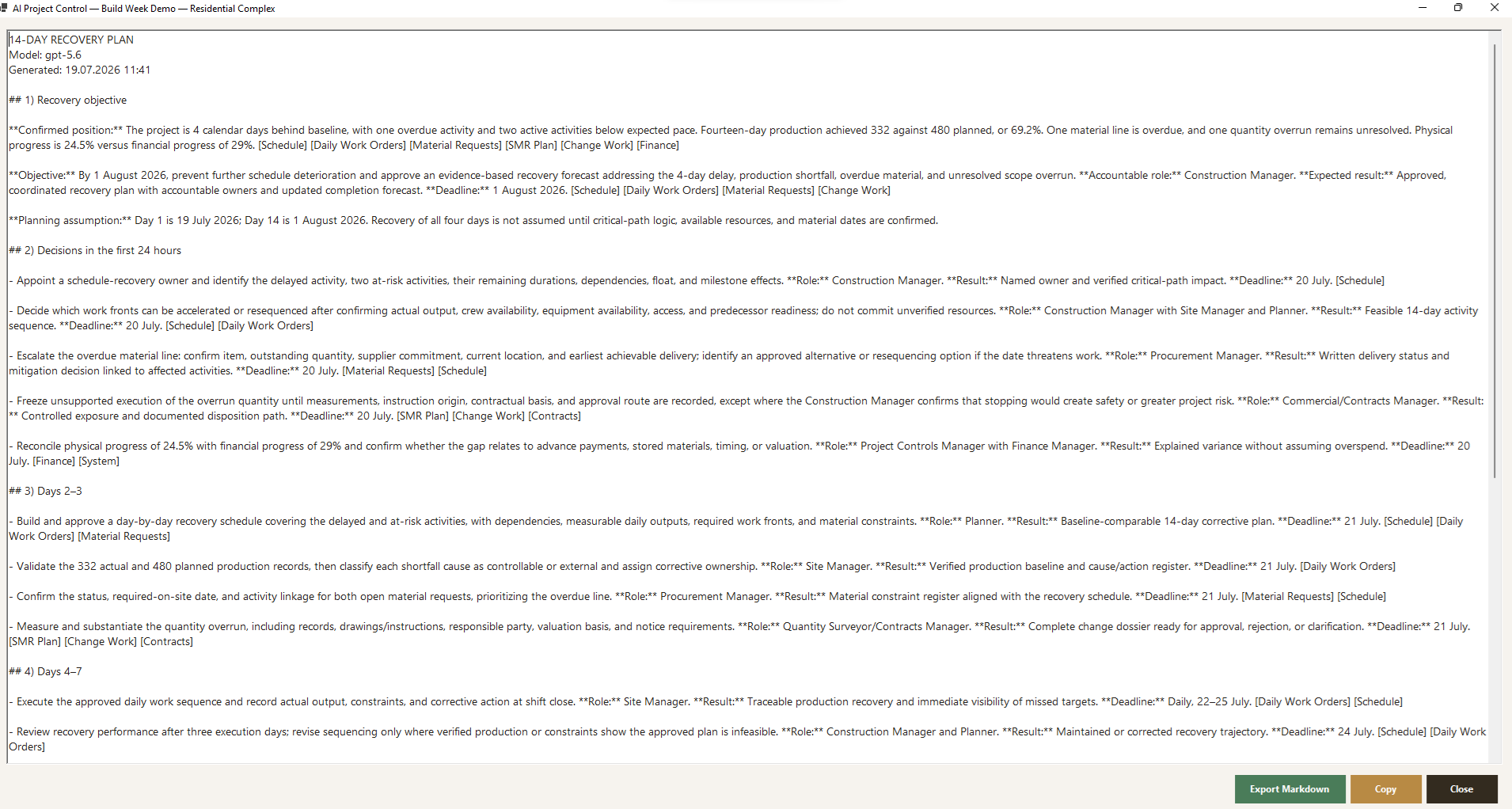
A practical 14-day recovery plan with responsible owners, deadlines, control indicators, and replanning conditions.
Inspiration
Construction projects generate large amounts of operational data: baseline schedules, daily work orders, material requests, completed quantities, change work, contracts, and financial records.
In practice, these signals are often reviewed in separate spreadsheets and modules. A construction manager may see that a project is delayed, but still lack a clear answer to three critical questions:
- What evidence confirms the problem?
- What information is missing or contradictory?
- What actions should be taken today to prevent further delay?
StroyKontrol AI was created to turn fragmented construction data into traceable risks, management recommendations, and an actionable recovery plan.
What it does
StroyKontrol AI is a construction control copilot integrated into a project-management information system.
The AI Project Control module combines signals from:
- the baseline construction schedule;
- the construction work plan;
- daily work orders and actual production;
- material requests and deliveries;
- change work and quantity overruns;
- financial progress;
- contract and project-control data.
A local rules engine first analyzes the project without requiring an internet connection. It detects issues such as:
- schedule variance;
- activities progressing below the required pace;
- overdue deliveries;
- outdated operational reporting;
- inconsistencies between reported work and calculated physical progress;
- unresolved change work;
- missing contractual or financial information.
Every detected risk includes:
- severity;
- data source;
- evidence;
- potential impact;
- recommended management action.
GPT-5.6 then receives a structured, read-only project snapshot and produces:
- a management analysis;
- confirmed facts separated from assumptions;
- likely consequences;
- actions required today;
- control indicators;
- a 14-day schedule recovery plan with responsible owners and review points.
The model is explicitly instructed not to invent missing quantities, resources, causes, delivery dates, or contractual facts.
Reproducible Judge Mode
The English Judge Edition includes a reproducible synthetic construction scenario.
The demo case shows:
- 24.5% physical progress;
- a four-day schedule variance;
- two activities below the required pace;
- one overdue delivery;
- four high-priority risks;
- a production shortfall;
- an unresolved quantity overrun.
The scenario exists only in memory and never changes the SQLite database. This allows every judge to review the same project conditions safely.
The local risk register works without an API connection. When an OpenAI API key is available, live GPT-5.6 management analysis and the 14-day recovery plan can also be generated.
How we built it
The project uses:
- C# and Windows Forms;
- SQLite;
- a modular application architecture;
- the OpenAI Responses API;
- GPT-5.6;
- Codex;
- local rule-based risk detection;
- read-only project-data repositories;
- Markdown export;
- cached-response fallback.
The OpenAI API key is never stored in the source code, SQLite database, cache, or repository. It is read only from the OPENAI_API_KEY environment variable.
AI integration is read-only: the model cannot directly modify the project schedule, work quantities, material requests, financial records, or contracts. Final decisions remain under the control of the responsible construction manager.
What was built during OpenAI Build Week
StroyKontrol existed before Build Week as a broader construction PMIS prototype.
The Build Week work was separated into a dedicated Git branch and focused on the new AI Project Control capability.
During Build Week, we created and refined:
- the AI Project Control module;
- the structured read-only project snapshot;
- local cross-module risk detection;
- traceable risk evidence and data-source labels;
- GPT-5.6 management analysis;
- the 14-day recovery-plan workflow;
- incomplete-response detection and automatic retry;
- cached last-response fallback;
- safe Markdown export;
- the reproducible in-memory Judge Demo;
- the English Build Week Judge Mode;
- responsive risk-register and analysis interfaces;
- release-build and Judge-package automation;
- English judging and testing documentation.
How Codex helped
Codex worked directly with the project repository during the Build Week extension.
It supported:
- architecture and security review;
- implementation of safe Markdown export;
- validation of read-only SQLite access;
- verification that no API keys were embedded;
- improvement of OpenAI API error handling;
- cached-response fallback review;
- automated static checks;
- Git repository initialization;
- Release build execution;
- Judge package generation;
- README and submission-documentation updates.
Codex accelerated implementation and verification, while product requirements, construction logic, risk interpretation, and final engineering decisions remained under human control.
Challenges we faced
Reliable conclusions from incomplete construction data
Construction records are often incomplete, delayed, or inconsistent. The first GPT-5.6 analysis correctly identified that the system could confirm a schedule delay but could not prove its production cause from the available evidence.
Instead of forcing a conclusion, we designed the prompts and interface to clearly distinguish:
- confirmed facts;
- assumptions requiring verification;
- missing information;
- recommended next actions.
Preventing incomplete AI responses
An early response stopped in the middle of the action plan because the output-token limit had been reached.
We added:
- response-status inspection;
- incomplete-response detection;
- a larger output allowance;
- reduced reasoning effort where appropriate;
- automatic retry;
- a required response structure;
- clear UI warnings if a response remains incomplete.
Making the output useful to managers
A long AI response alone is not sufficient for project control. We redesigned the screen around:
- a concise management summary;
- key project indicators;
- a traceable risk register;
- evidence and impact;
- recommended actions;
- a separate 14-day recovery-plan workflow.
Safe and reproducible judging
We needed a judge experience that did not depend on confidential project data or modify the bundled database.
The result is an in-memory demo scenario with repeatable values, safe local analysis, and an optional live GPT-5.6 layer.
Accomplishments that we are proud of
- The system detects risks before calling the language model.
- Every risk is linked to evidence and a project-data source.
- GPT-5.6 refuses to invent an unsupported root cause.
- The same evidence can generate both management analysis and a recovery plan.
- AI access is read-only.
- The demo never writes to SQLite.
- The product remains useful when the API is unavailable.
- A cached successful response can be restored locally without storing the API key.
- Judges can launch a portable English Windows build without Visual Studio.
- The Build Week contribution is separated through Git history, documentation, and a dedicated Judge Edition.
What we learned
We learned that the strongest use of AI in construction control is not simply summarizing records.
The real value comes from combining deterministic project checks with model-based reasoning:
- local logic detects measurable exceptions;
- structured evidence is passed to the model;
- the model explains consequences and identifies missing information;
- the manager receives an actionable plan;
- the responsible person still approves the decision.
We also learned that uncertainty must be treated as a first-class output. In high-impact project management, saying that the available data is insufficient can be more valuable than providing a confident but unsupported answer.
What's next
The next stage is to evolve StroyKontrol AI into a platform accessible from desktop, web, and mobile devices.
Planned development includes:
- critical-path and dependency analysis;
- automated two-week look-ahead planning;
- role-based approvals;
- mobile daily reporting;
- document and photo evidence;
- construction risk forecasting;
- procurement and cash-flow forecasting;
- contract and change-order analysis;
- BIM integration;
- multilingual project interfaces;
- localization for Kazakhstan and other construction markets.
Our long-term goal is a unified construction management platform that connects planning, production, materials, contracts, documentation, and finance — and turns those connections into timely management decisions.

Log in or sign up for Devpost to join the conversation.