-
-
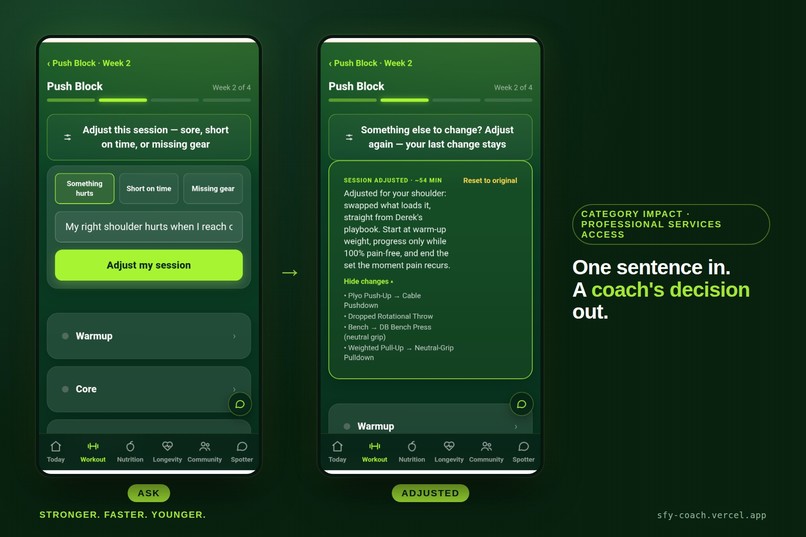
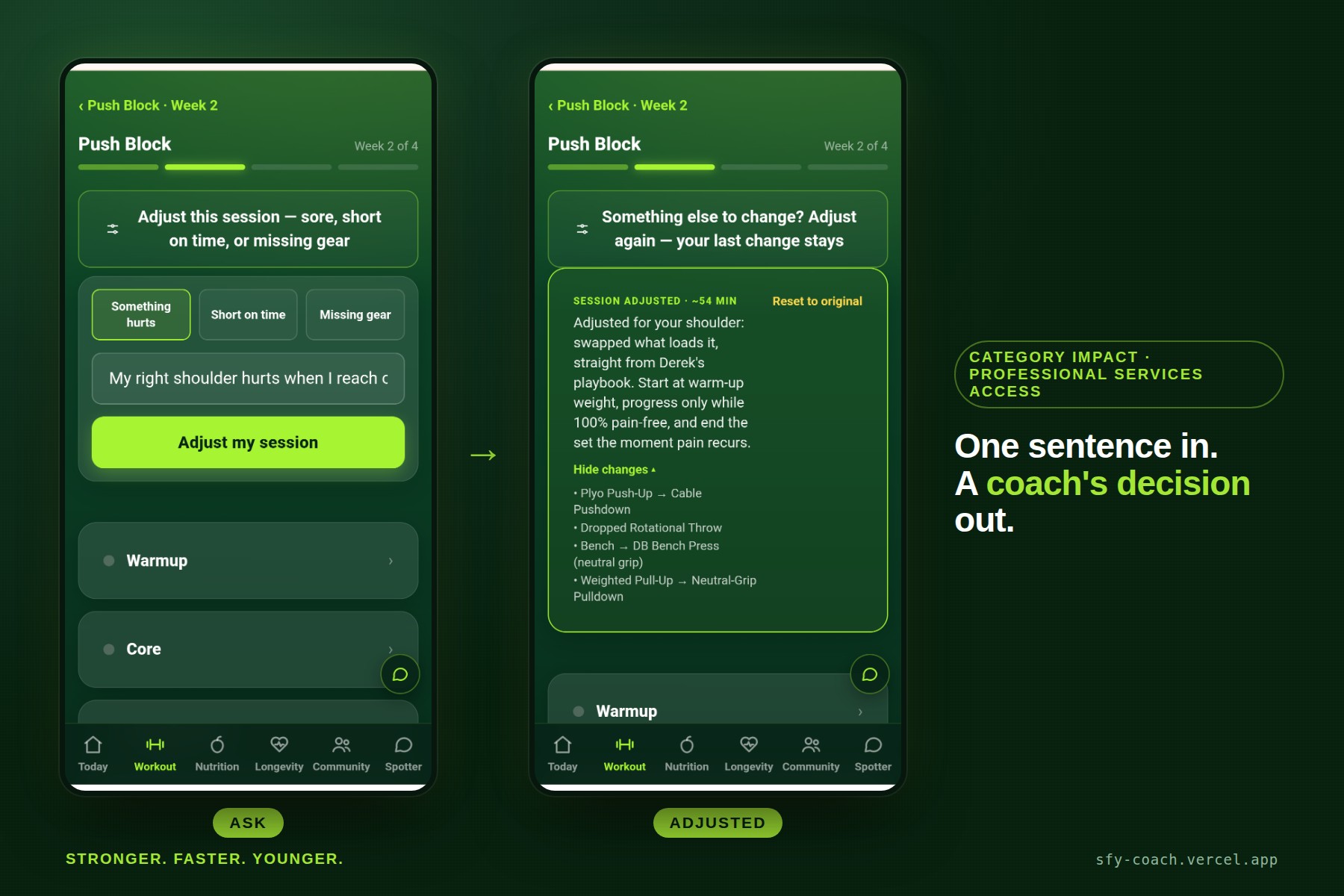
A member typed one sentence about shoulder pain. Gemini rewrote the session: four swaps, a new load rule, one tap to undo.
-
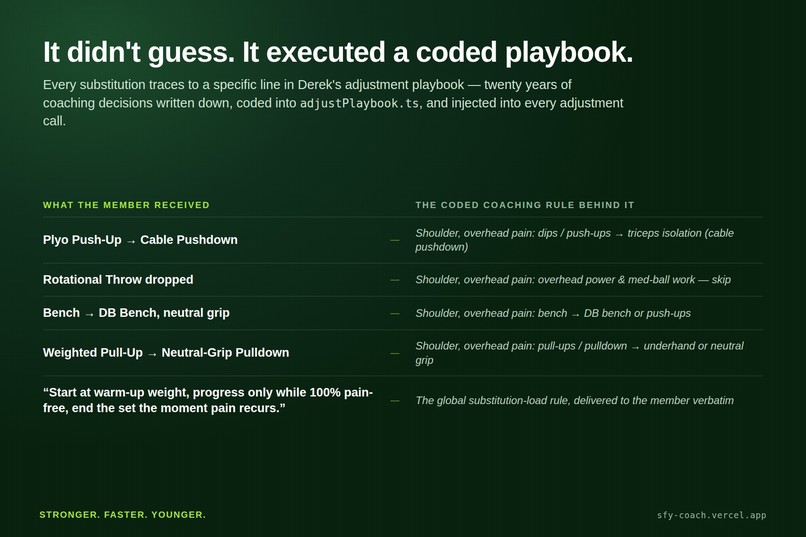
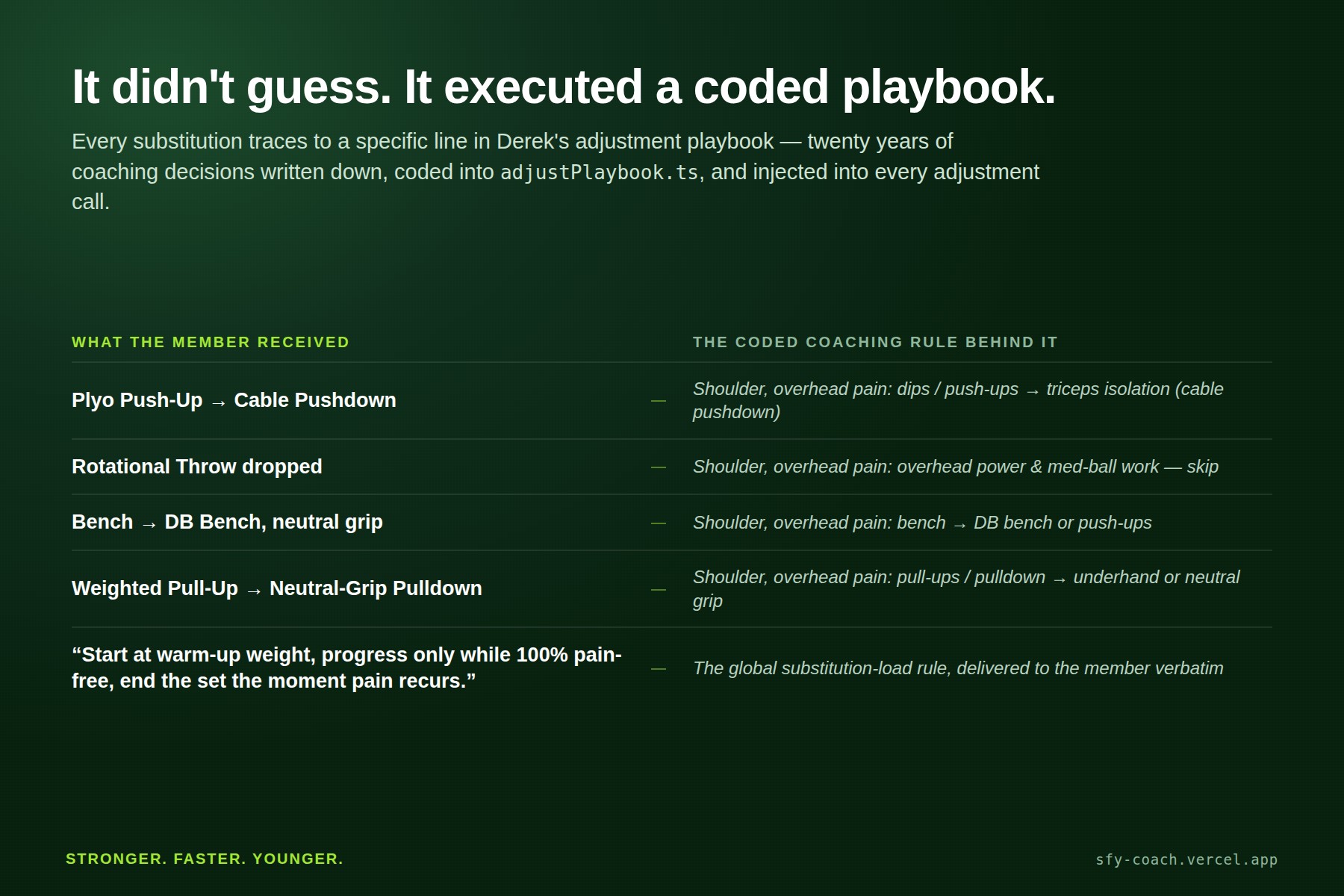
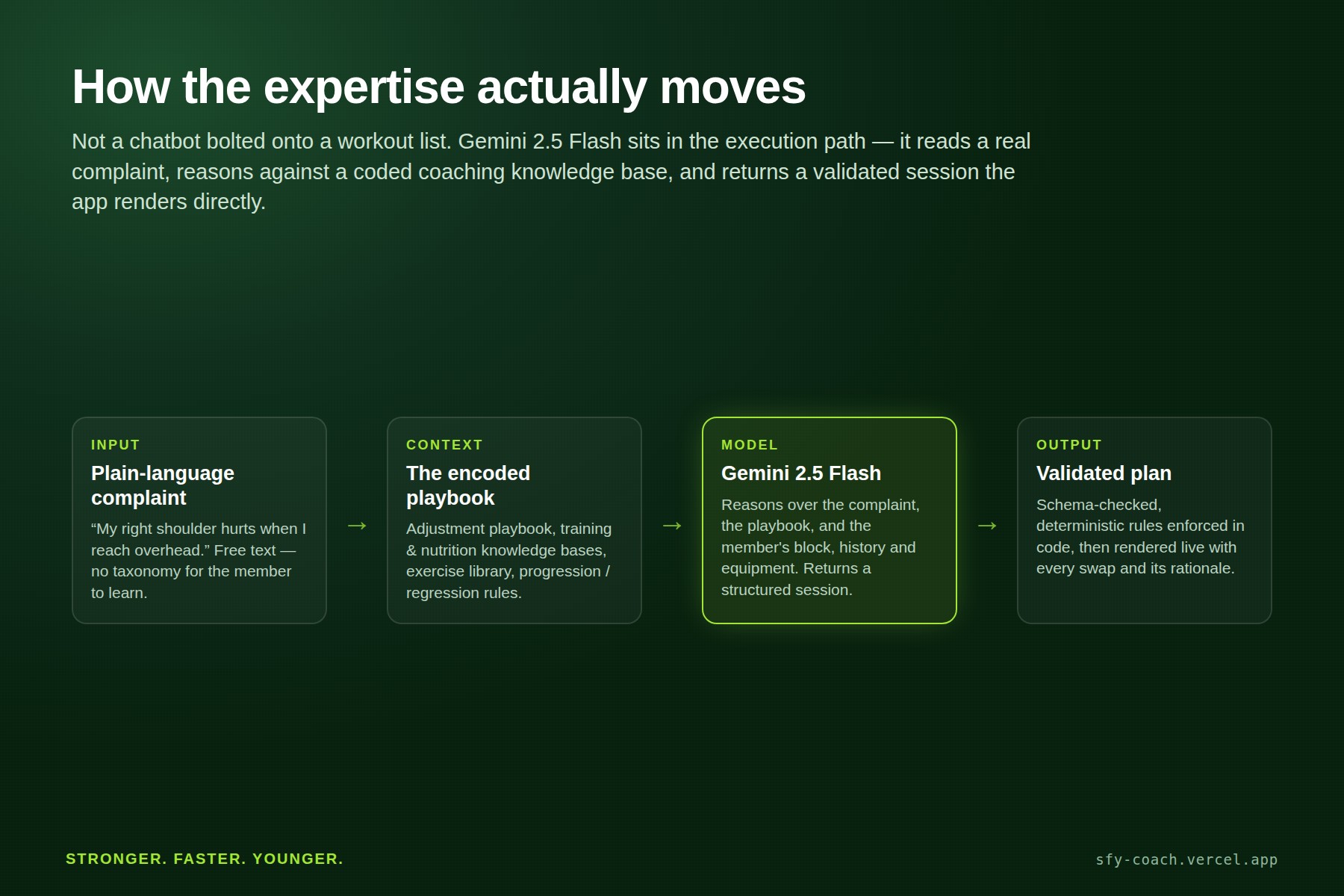
Every swap traces to a line in Derek's adjustment playbook, coded into adjustPlaybook.ts and sent with each request.
-
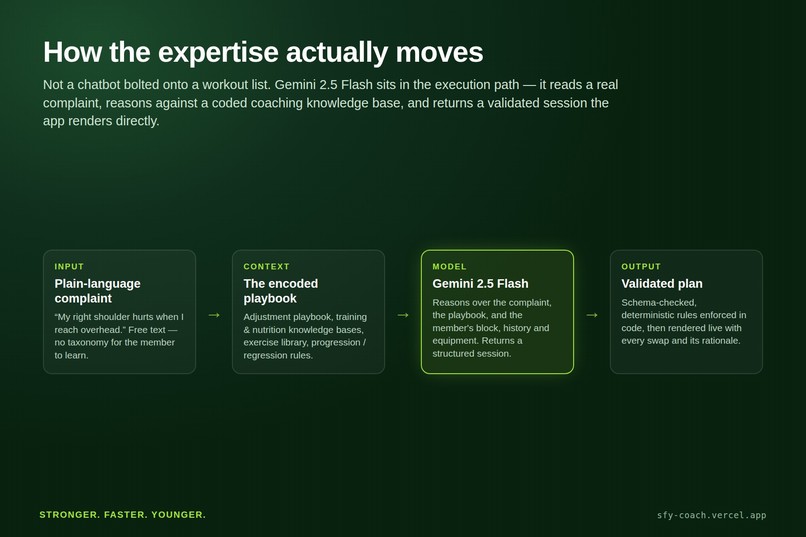
Gemini 2.5 Flash sits in the execution path, not beside it: plain complaint plus coded playbook in, validated session out.
-
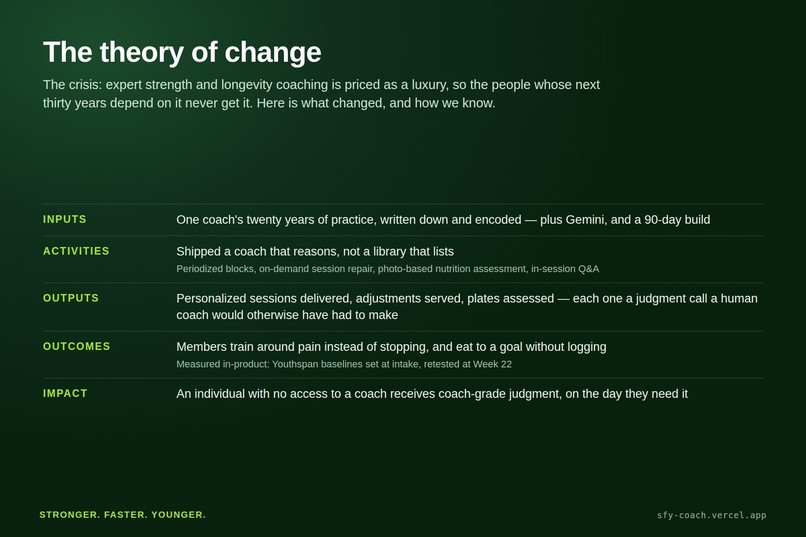
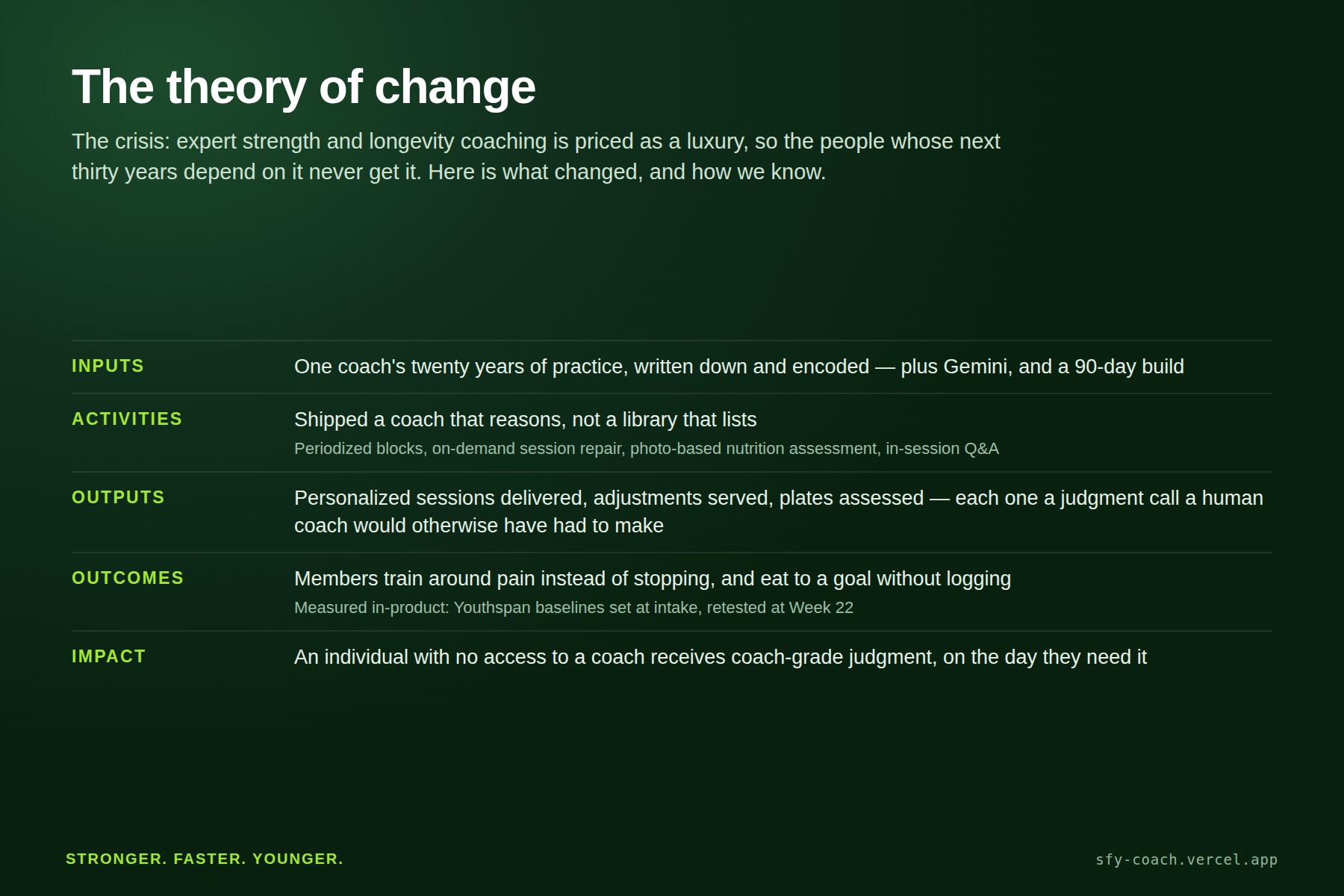
Theory of change for Professional Services Access — inputs, activities, outputs, outcomes, and how we measure impact.
-
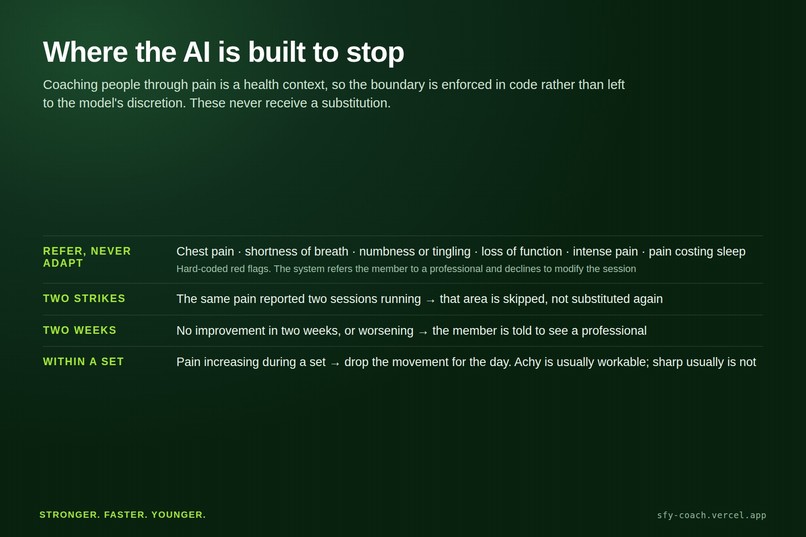
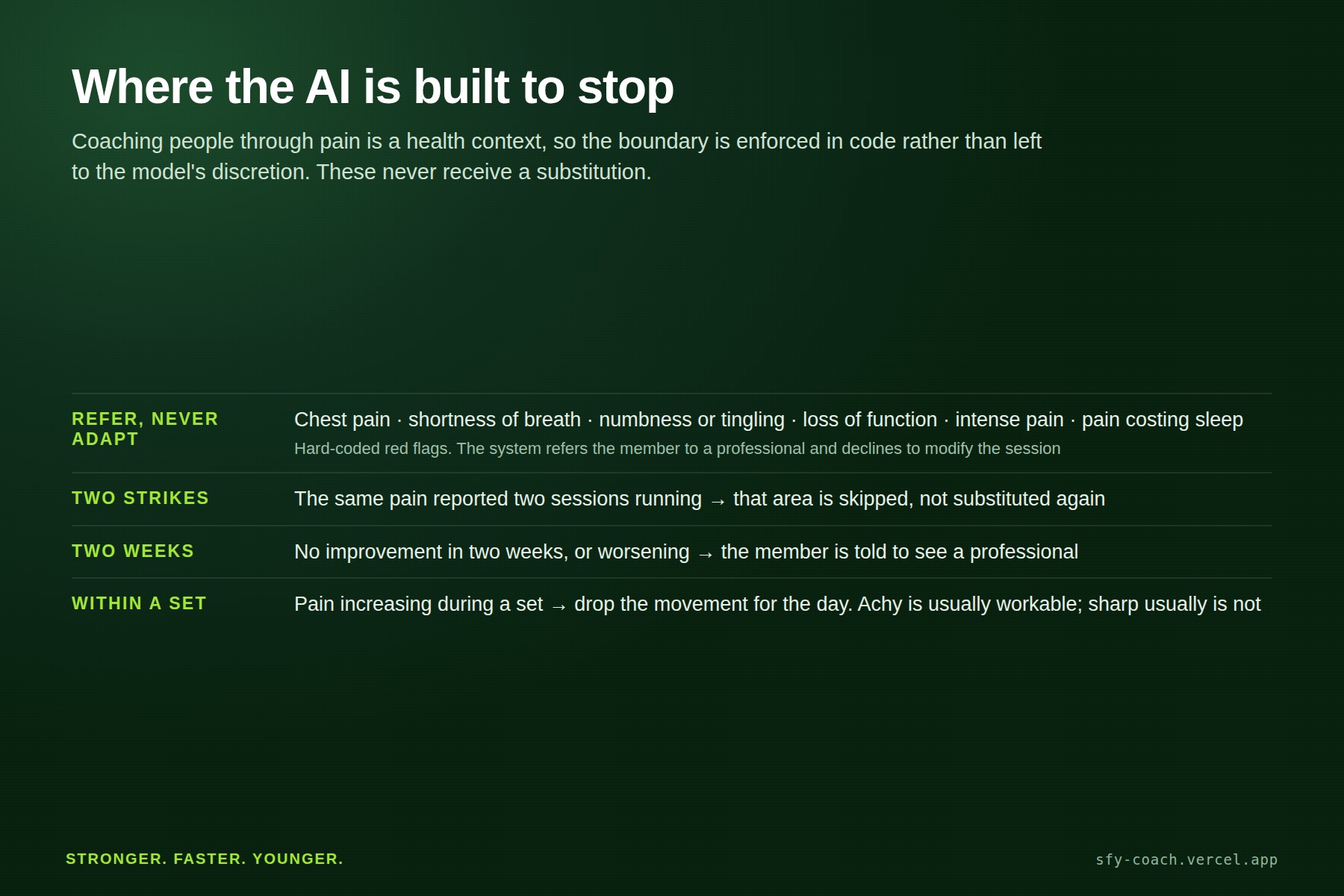
Red flags never get a substitution. Chest pain, numbness, loss of function — the system refers out, enforced in code.
-
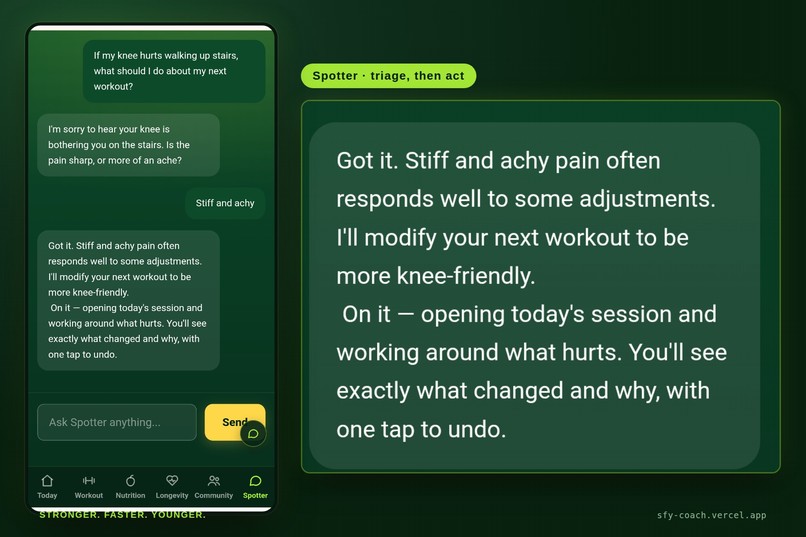
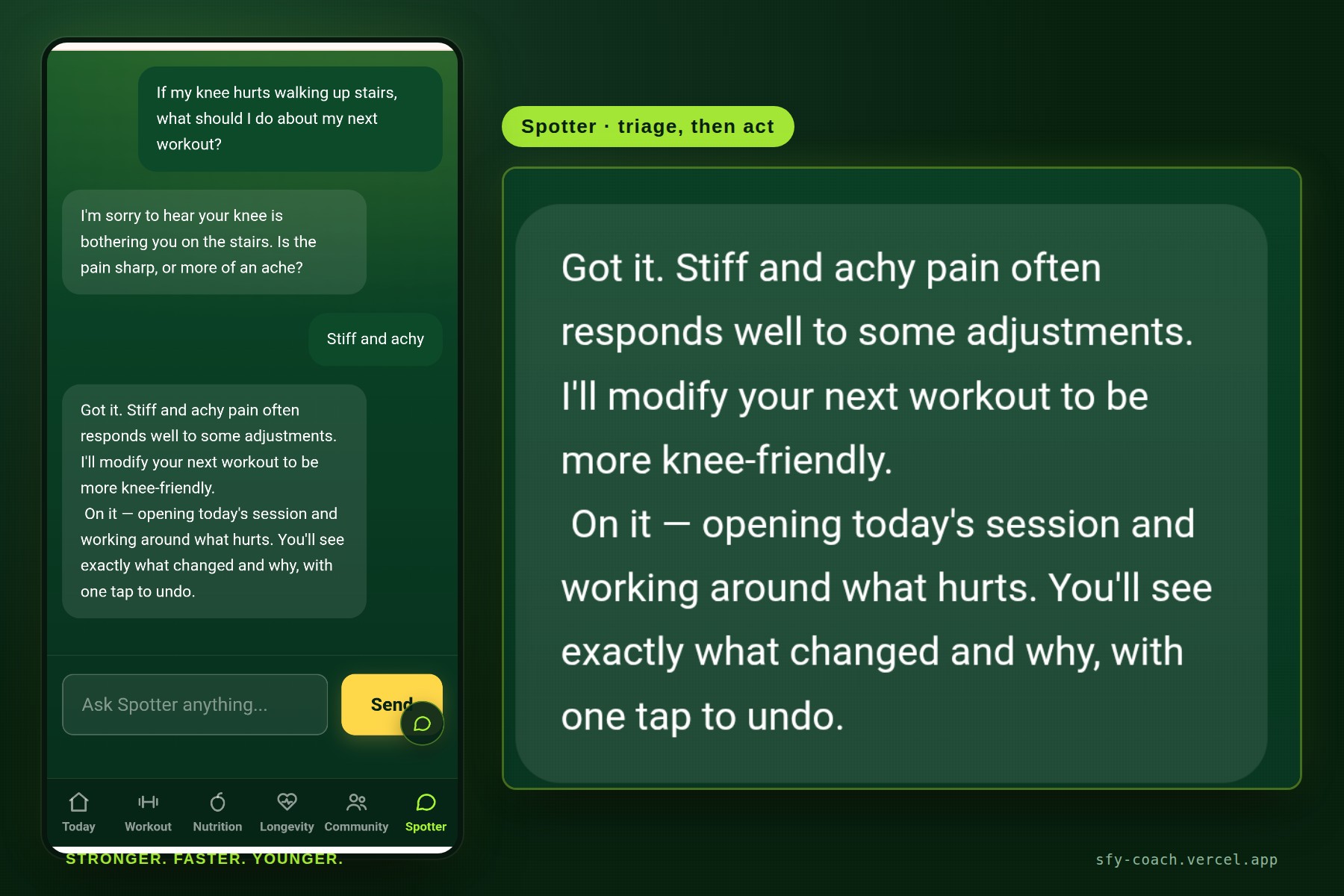
Spotter asked whether the pain was sharp or achy — a coded triage rule — then opened the session and worked around it.
-
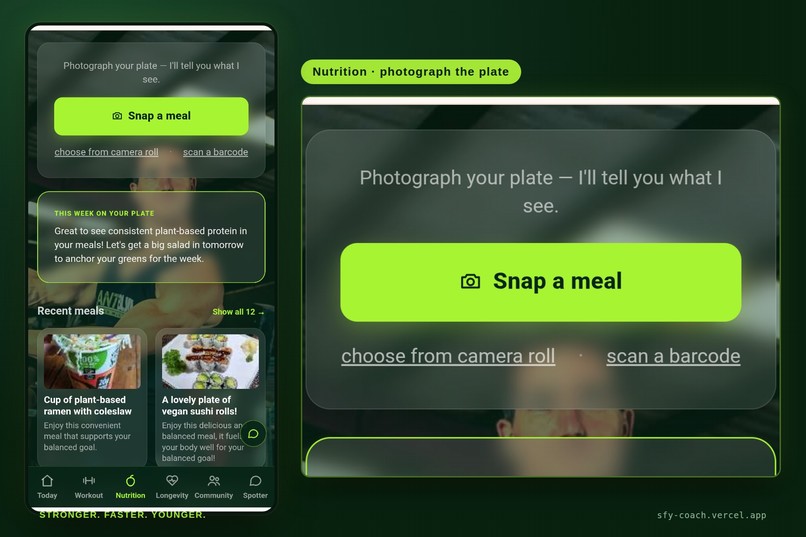
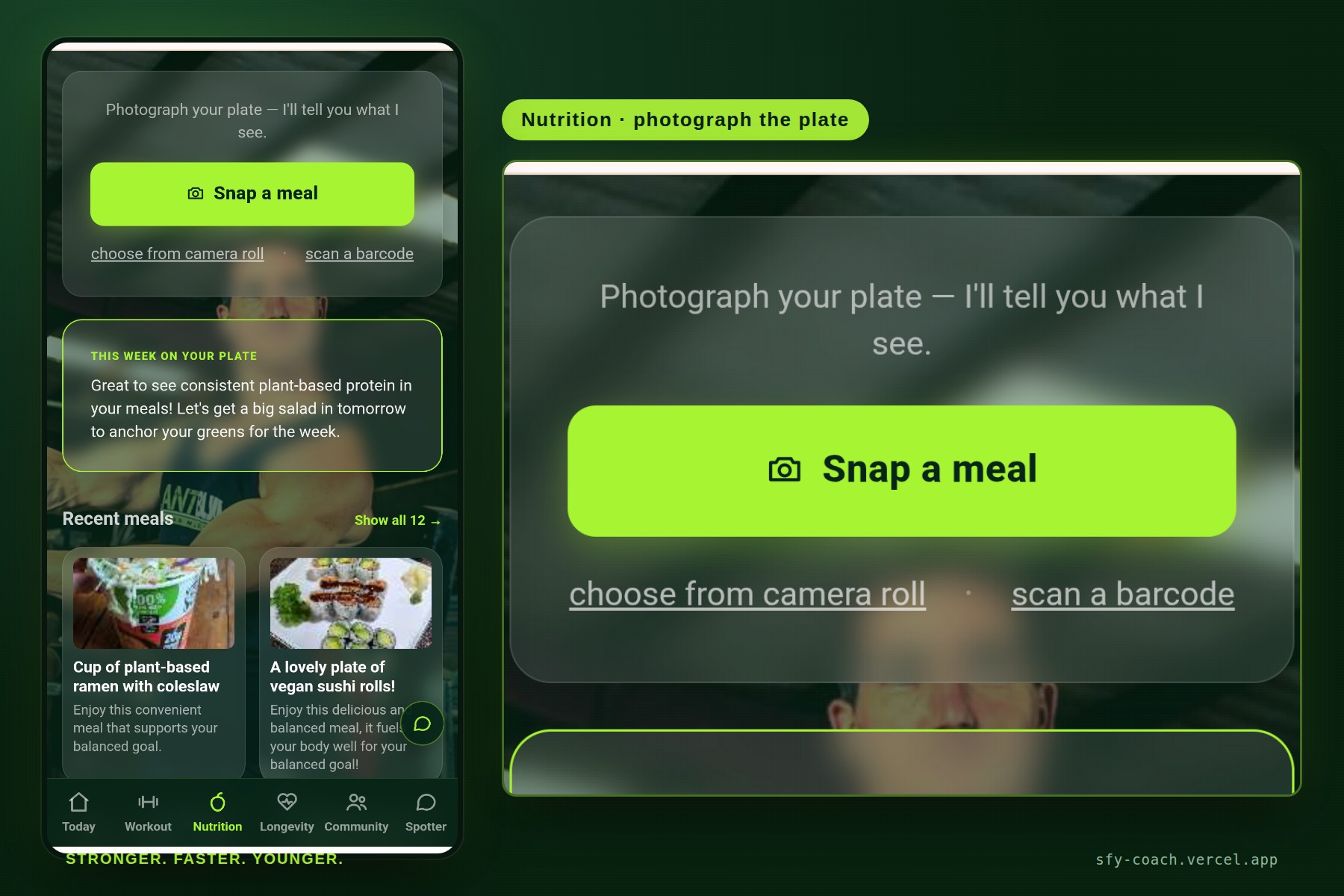
Photograph the plate; that's the whole interface. Gemini reads the meal against your goal.
-
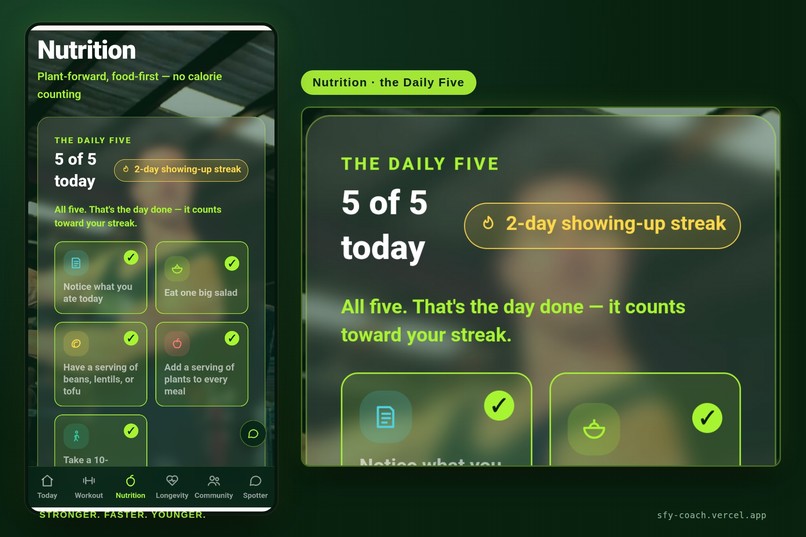
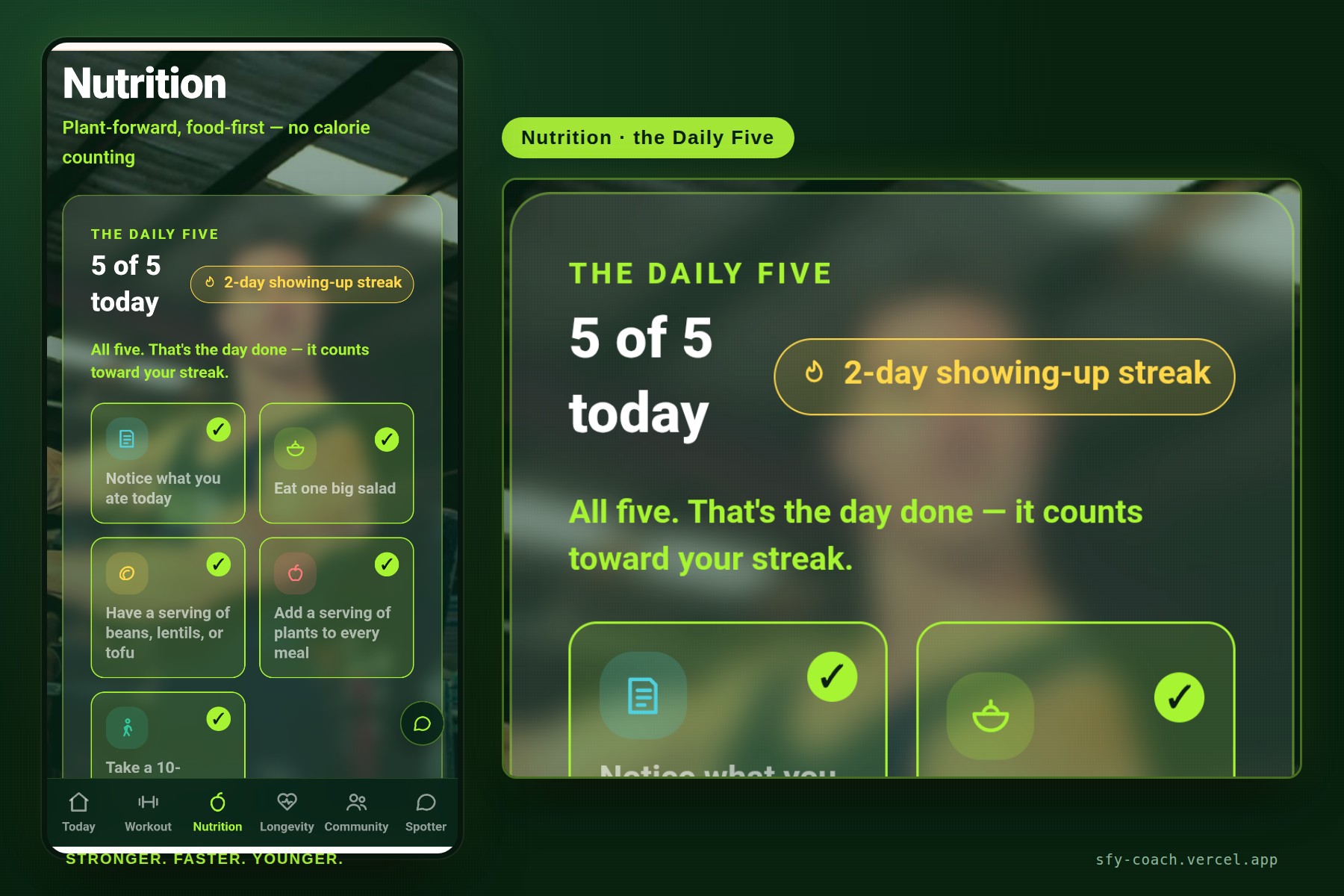
Your meal choice is guided by simple daily habits to keep nutrition accessible and sustainable
-
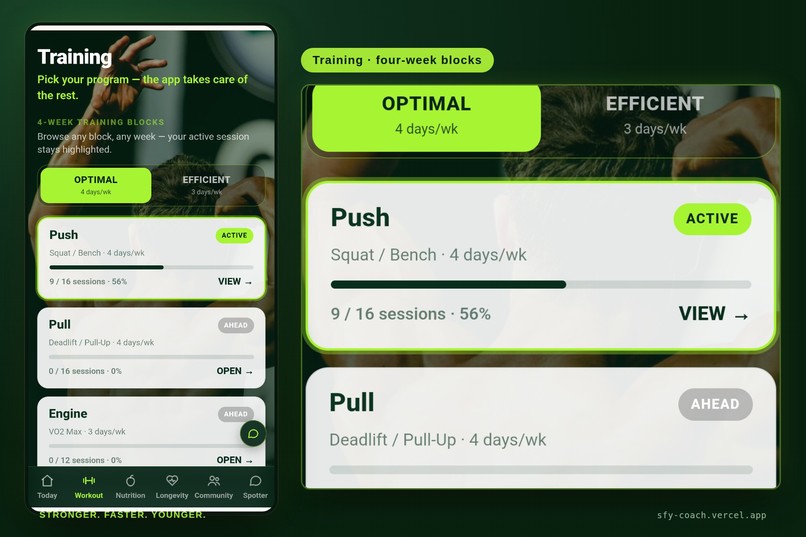
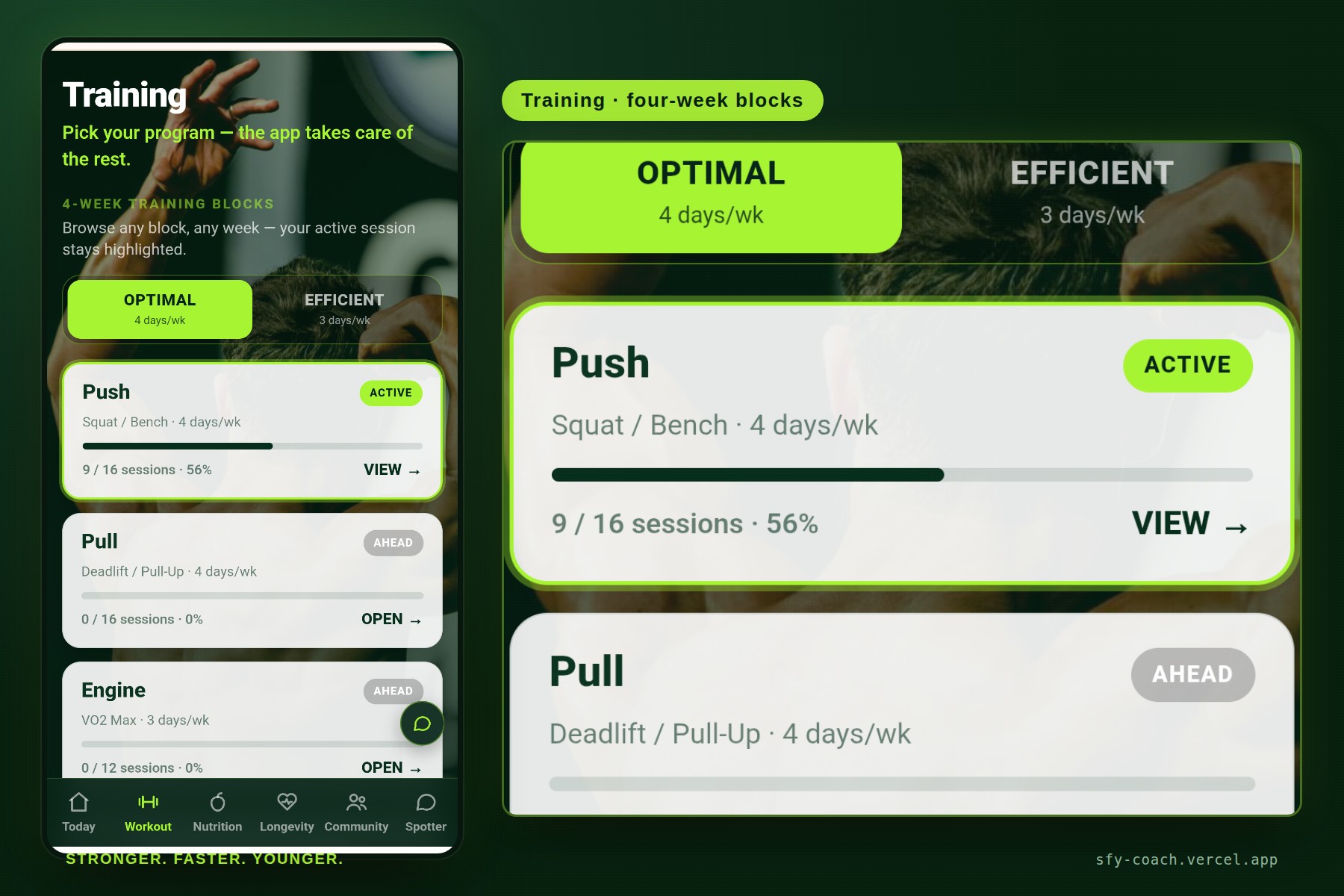
Push, Pull, Engine, Drive and Balance: real four-week periodized blocks that train what deteriorates fastest with age, adjusted to fit life
-
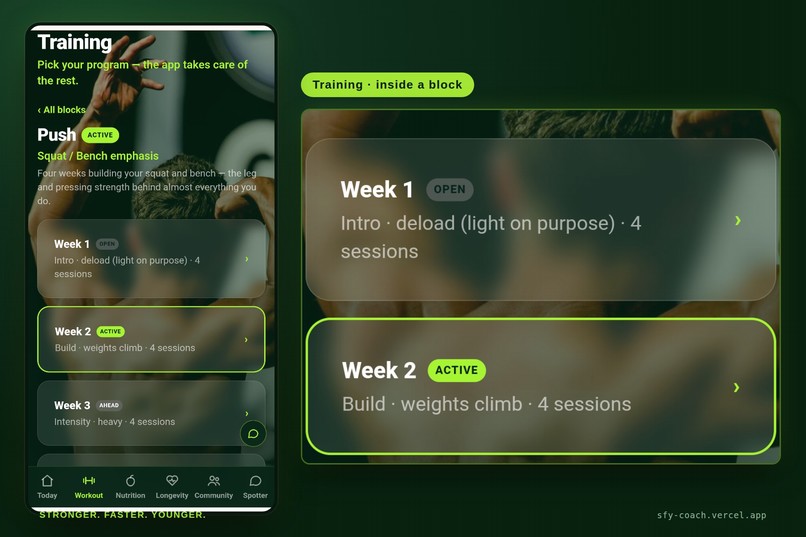
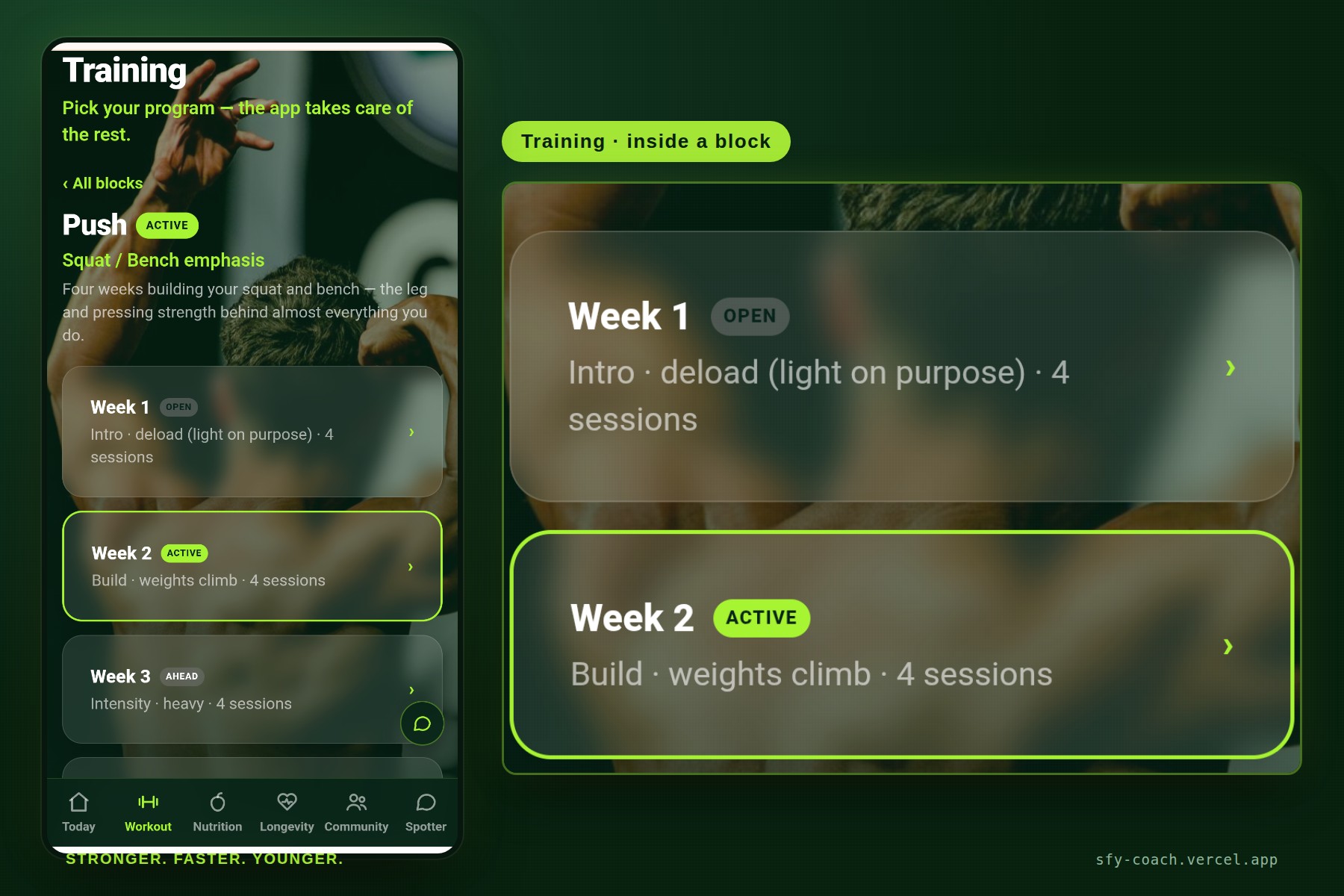
Inside a block — deload, build, intensity, retest. The four-week shape a coach uses to keep things progressive, fresh and interesting
-
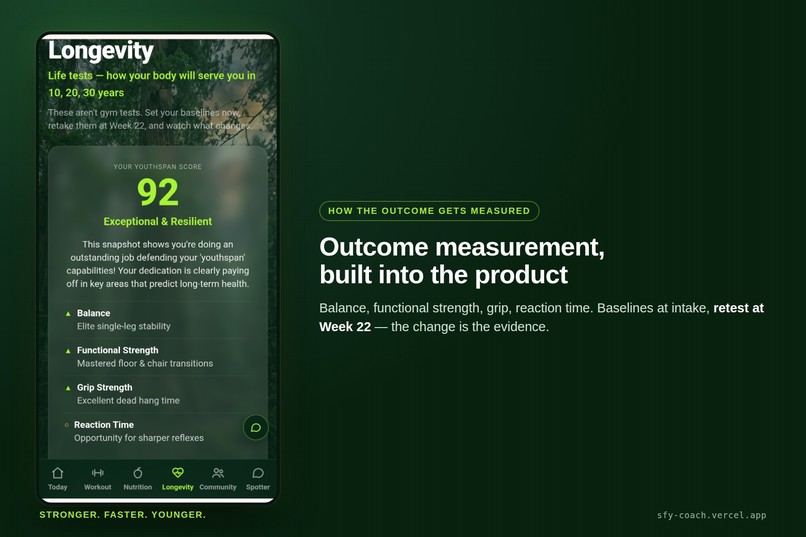
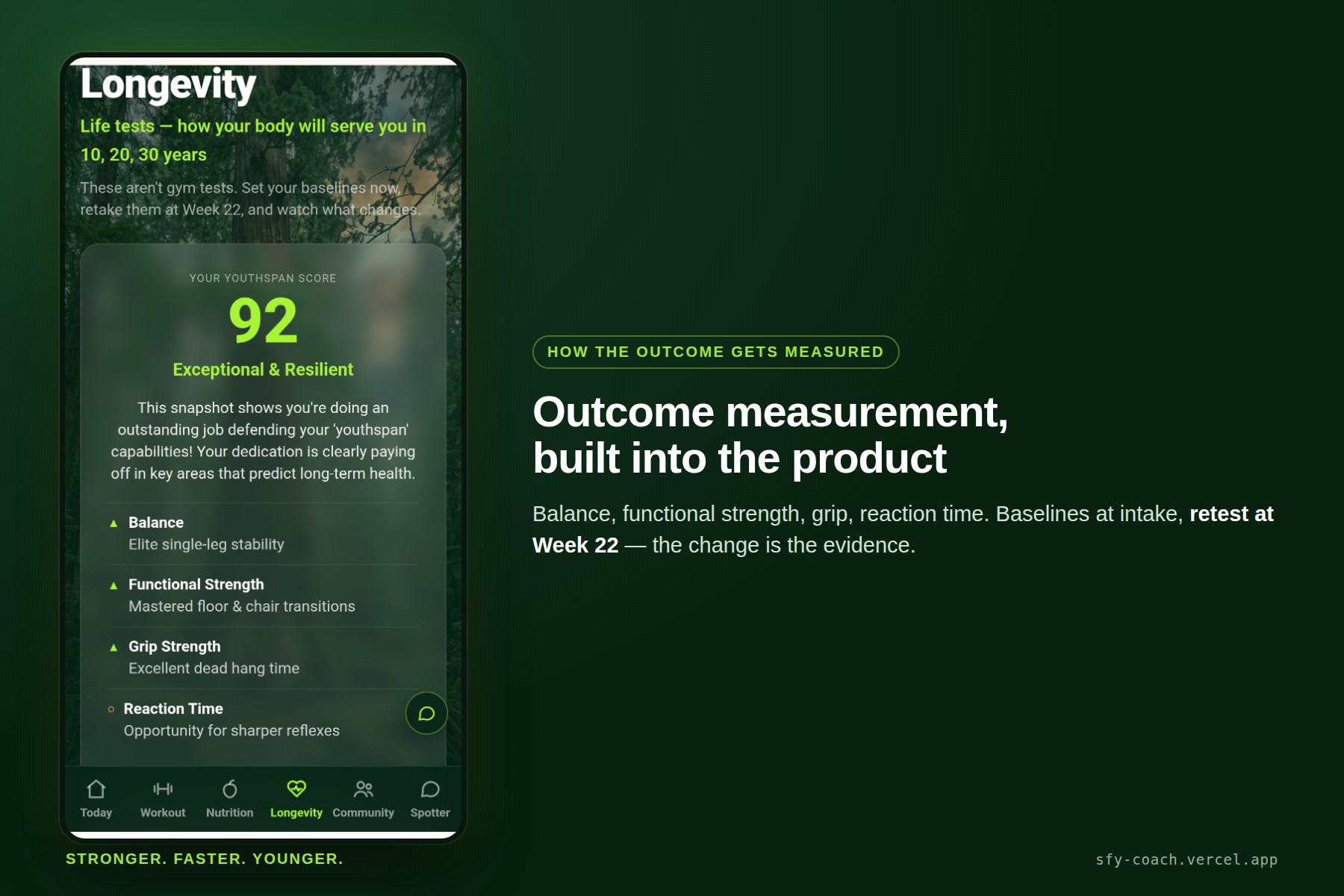
The Youthspan Score: balance, grip, functional strength, reaction time, and power. Baselines at intake, retest at Week 22 for the evidence.
-
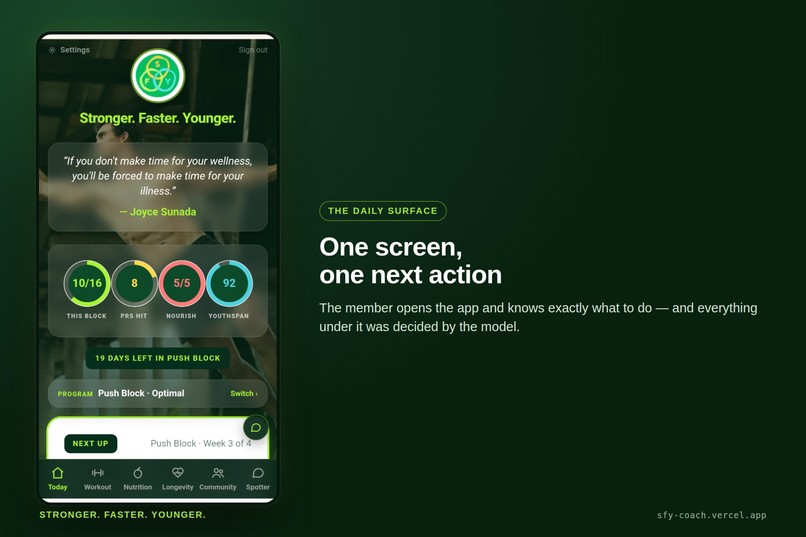
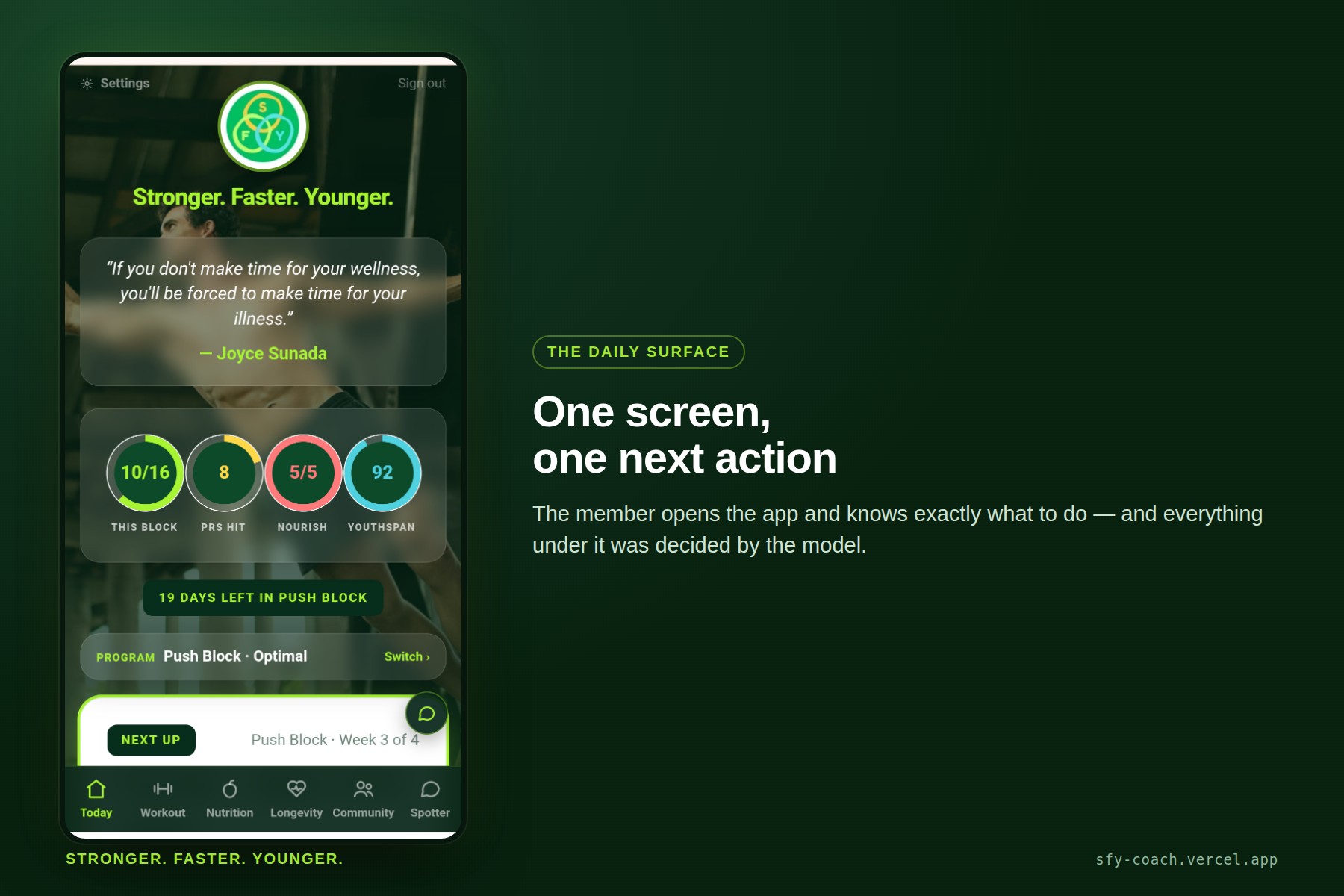
The Home screen determines your next action. Program state, block progress and Youthspan score with suggestions targeted to help you improve
-
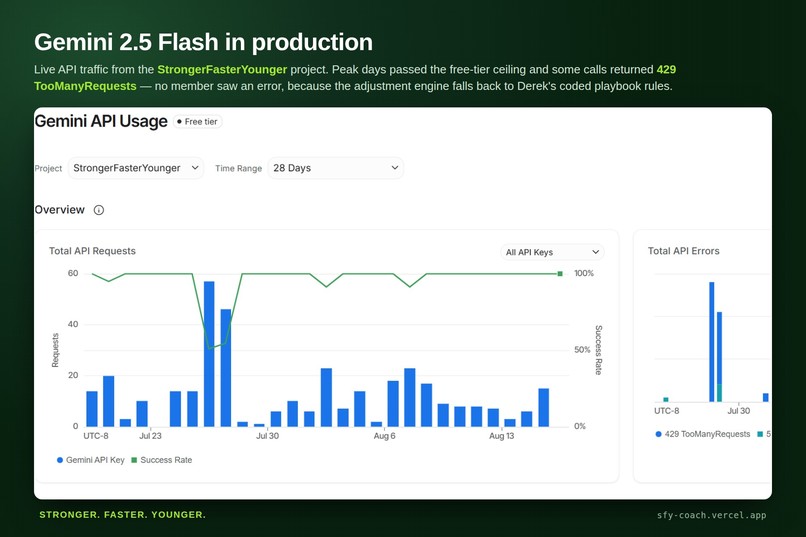
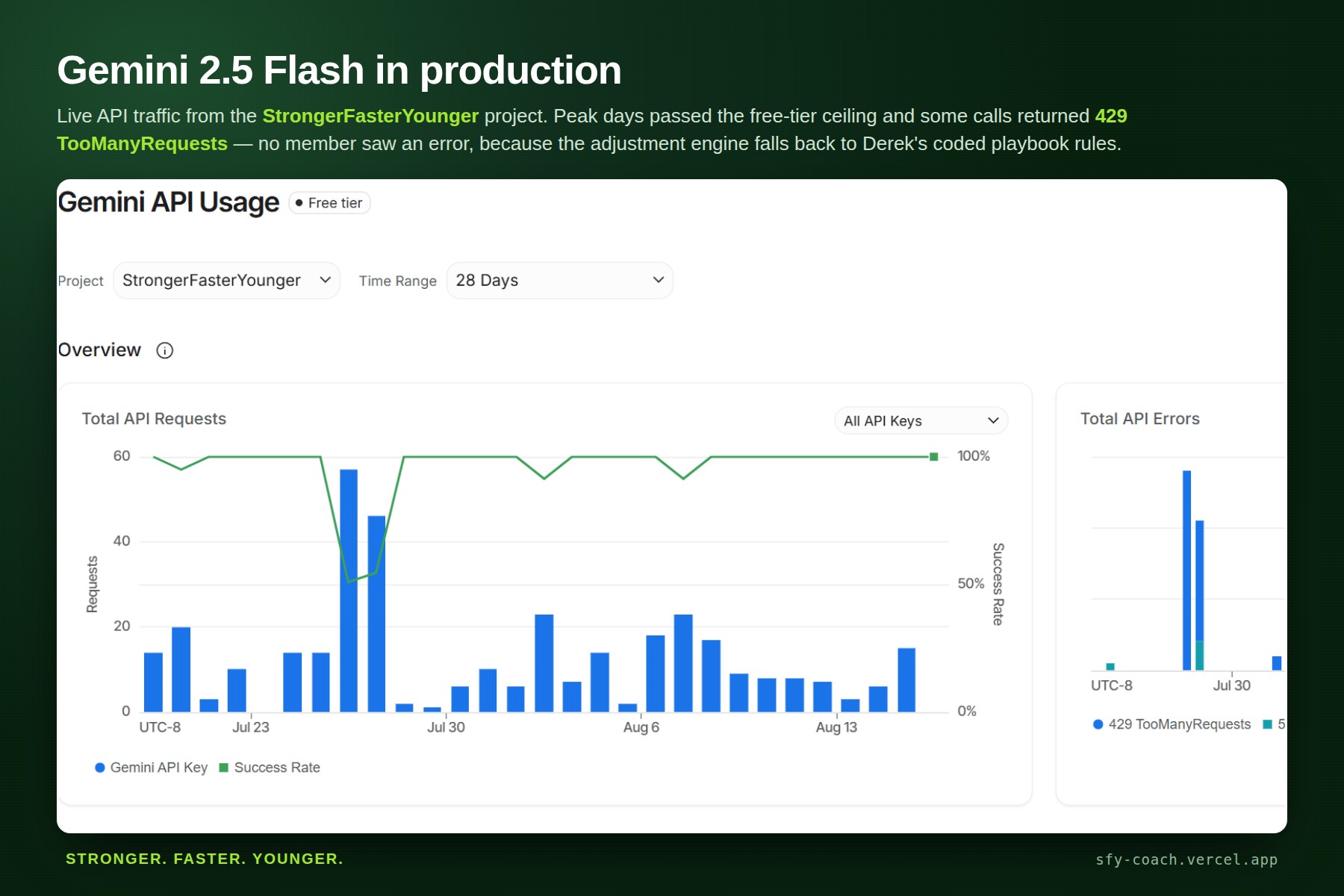
Peak days passed the free-tier ceiling and some calls 429'd. No member saw an error; the coded playbook floor caught them.
-
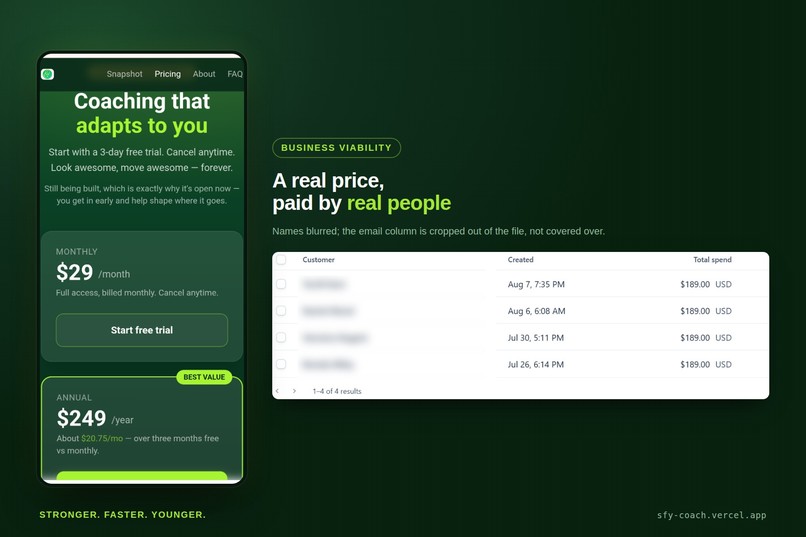
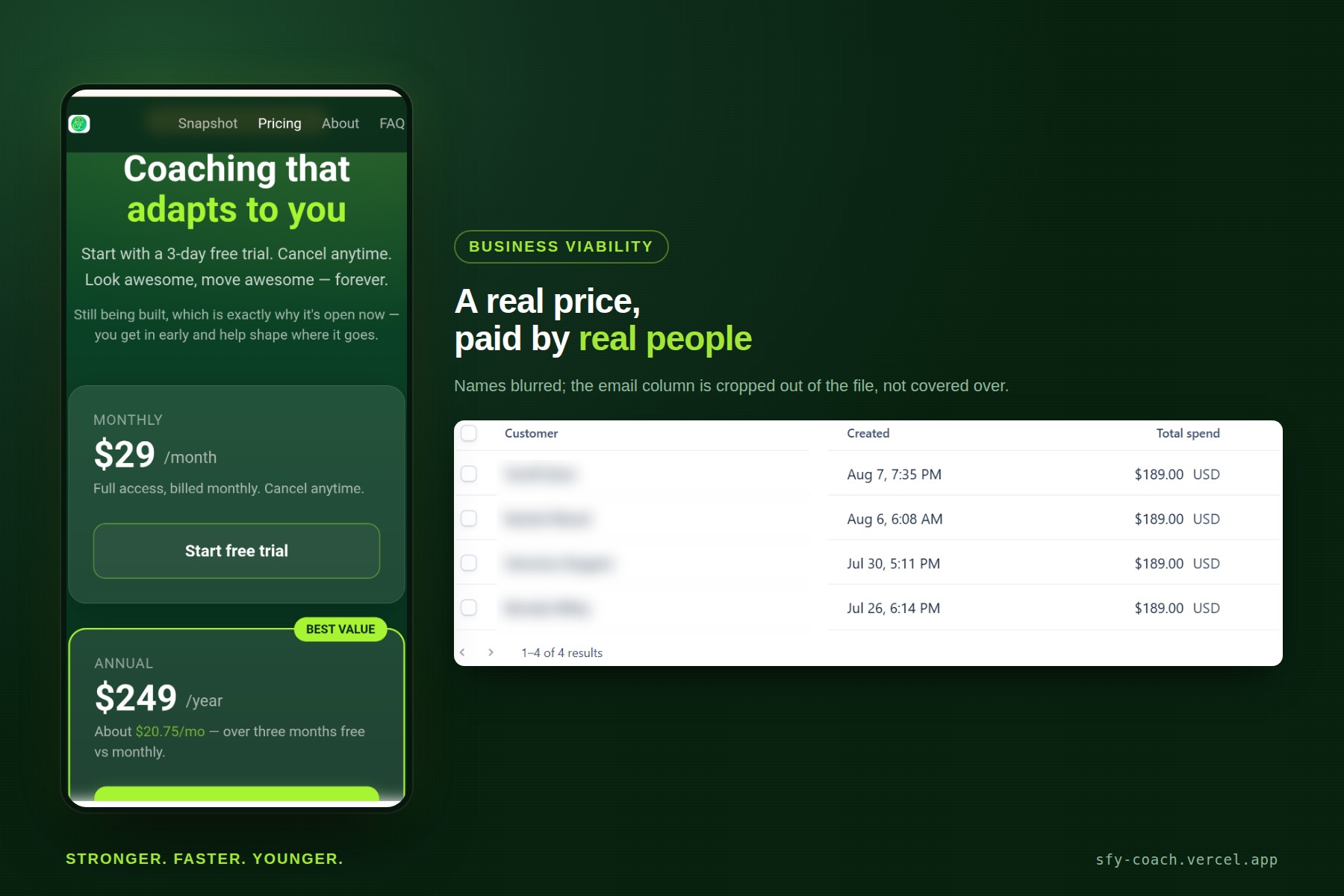
Public pricing and live Stripe checkout — four members paid $189 inside the hackathon window. $756 collected.
Inspiration
Breakthroughs in longevity are coming, but people need to maintain and improve their physical function today in order to be around to enjoy them.
We come at that problem from two angles. Derek is a personal trainer with a degree in biology and twenty years of practice, driven by a lifelong interest in the workings of the human body and how to improve its strength and capability. Marcella is a PhD mathematical biologist and researcher in exercise science and immune function. Between us we have the coaching craft and the evidence base, and we have spent years trying to get both to a wider audience.
We were early adopters of online personal training and published free, evidence-based fitness and nutrition guidance for as long as we could sustain it. Pre-AI, it wasn’t a viable business. So Derek trained a limited number of one-on-one clients at a cost to them of $400 to $900 a month. Many of those clients have been with him for ten to twenty years, aging alongside a program he continuously adapts as new strategies for healthspan improvement emerge. This is the proof that the method works over decades but it is also the bottleneck. Derek’s greatest limitation is the number of appointments that fit in a week and, as his expertise grew, so did the list of people he had to turn away.
What it does
Stronger. Faster. Younger. uses a custom-trained Gemini coach named Spotter to customize workout and nutrition plans to optimize functional healthspan. An onboarding conversation helps Spotter decide what the user’s background, equipment and goals are. An initial functional test based on five scientifically validated performance metrics (single leg balance, reaction time, standing performance, lower body power, and grip strength) users are given a Youthspan score and assigned a program to begin their journey through the 22 week periodized fitness program, after which they retest and celebrate their progress. Spotter is able to modify users' workouts based on their realtime reports of an injury, equipment limitation, skill limitation, or time constraint. The knowledge base is Derek’s overarching longevity-targeted program including workouts and adaptations derived from real experience with a diverse aging population. Spotter then delivers his coaching and adapts it to each person’s sleep, soreness, injuries, time, and available equipment. Similarly, the AI agent distilled hundreds of meal plans we’ve written for clients into a tiered nutrition system so Spotter can answer questions and give feedback on a user’s food, which they can enter with a photo or barcode that Spotter scans. Overall trends can then be recorded so that Spotter can provide intelligent advice to help guide users to better choices for their long term health and exercise goals. The real expertise remains intact but the ceiling is removed.
How we built it
The 22-week system existed in Derek’s brain rather than as software. Encoding it so Gemini could deliver it without being generic was the primary effort. For information storage we used Firebase, Vercel for hosting, Stripe for subscriptions, and Sentry for production monitoring. Every novel exercise demo requires Derek on camera, which is a production budget we don’t have. We developed a Claude-to-Descript workflow that takes raw footage filmed in a single take and yields multiple demos and a weekly content pack. Marcella produces positioning and campaigns with Claude via Mailchimp MCP.
Challenges we ran into
You can see from our outdated websites that neither of us is a web developer. Derek’s first approach was pasting generated code into .ts files and hand-reconciling every change. Shortly after our first user signed up, an update regressed the entire system. Sentry went in immediately after, and over time we adopted an agentic coding workflow, which let us spend our limited time on the product rather than file mechanics.
Accomplishments that we're proud of
The first payment, because it signifies that someone who had used the product decided it was worth paying for. We also built the Skool community that is tied to the app, growing it from 15 to 42 members by seeding it from actual app trial users. It gives users a space for accountability and support. And we did this as a team of two with minimal cost, while we both kept working full time.
What we learned
Marcella’s background is systems modeling, which transferred as process: how to specify a system, iterate on it, and connect it to data, but not as knowledge of the stack. Derek started with none of it: twenty years of fitness expertise but minimal coding and zero design experience. He now is able to effectively use hosting, databases, payment integration, version control, and debugging. The domain knowledge took decades to accumulate, while learning to use the stack took months and that is probably the greatest lesson. Technical fluency is no longer a barrier.
What's next for Stronger. Faster. Younger.
In the short term, polish. Our first users are generating more feedback than we can implement and the app should improve quickly as we work through it. After that, marketing and community. Both have compound returns and feed the same loop: more users make better feedback, which produces a better product, which reaches more users. In the long term, the programming itself gets better. Derek’s method currently reflects twenty years of one-on-one observation. Once we have data across more users through the full 22 weeks, including retest results, we can refine it against outcomes rather than intuition. That could open a second audience: trainers who want a system to deliver to their own clients.
Log in or sign up for Devpost to join the conversation.