-
Stroke Prediction using Machine Learning
Inspiration Stroke is a leading cause of disability and mortality worldwide. Early detection and intervention can save lives and reduce the burden on healthcare systems. This project was inspired by the need for a reliable and efficient solution to predict stroke risks using cutting-edge machine learning and deep learning techniques.
What it does The Stroke Prediction Model analyzes key health parameters to predict the likelihood of a stroke with high accuracy. By leveraging both traditional machine learning models and a Convolutional Neural Network (CNN), the model provides early warnings to patients and healthcare providers, enabling timely preventive measures.
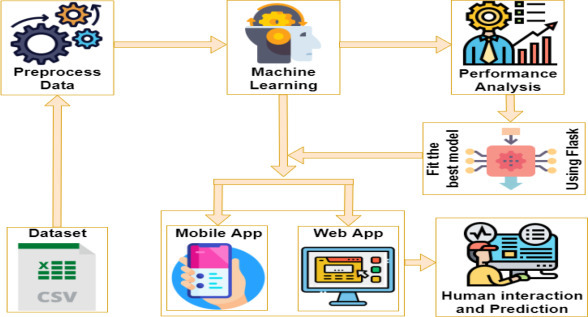
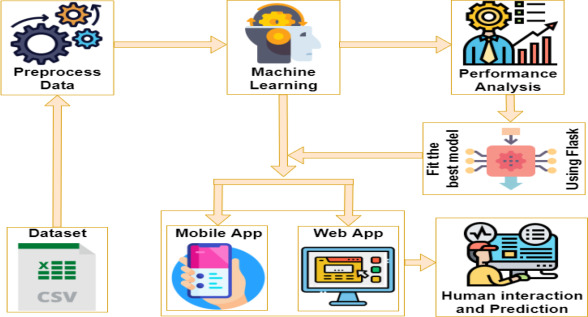
How we built it Data Collection & Preprocessing: We used a publicly available stroke dataset, cleaned it, and performed feature engineering to enhance prediction accuracy. Model Development: Implemented 7 machine learning models, including Logistic Regression, Decision Trees, Random Forest, XGBoost, and SVM, to compare performance. Deep Learning Integration: Designed a CNN model tailored to capture complex patterns in the data. Evaluation: Fine-tuned hyperparameters and evaluated models using metrics like accuracy, precision, recall, and F1 score. The CNN achieved a remarkable 95% accuracy. Tools & Technologies: Python, TensorFlow/Keras, Scikit-learn, Matplotlib, and Pandas were used throughout the development process. Challenges we ran into Data Imbalance: Addressing the imbalance in the dataset between stroke and non-stroke cases to avoid biased predictions. Model Optimization: Tuning multiple models to ensure high performance without overfitting. Computational Costs: Training the CNN required substantial computational resources and time. Feature Selection: Identifying the most critical features while ensuring interpretability of the results. Accomplishments that we're proud of Achieved a high accuracy of 95% with the CNN model, outperforming traditional machine learning approaches. Developed a robust pipeline for preprocessing, training, and evaluation. Successfully tackled data imbalance through advanced techniques like SMOTE and class weighting. Created an interpretable and scalable solution that can be integrated into healthcare systems. What we learned The importance of preprocessing and feature engineering in achieving reliable results. Advanced machine learning and deep learning techniques to handle real-world challenges such as imbalanced datasets. The significance of model evaluation using diverse metrics for a comprehensive performance analysis. Hands-on experience in optimizing CNNs for tabular data problems. What's next for Stroke Prediction Model using Machine Learning Deployment: Integrating the model into a user-friendly web or mobile application for real-time stroke risk prediction. Data Expansion: Incorporating larger, more diverse datasets to improve generalization. Explainability: Enhancing interpretability using SHAP or LIME to provide actionable insights to healthcare professionals. Real-world Testing: Collaborating with healthcare institutions to validate the model in clinical settings. Feature Enhancement: Including additional health indicators such as genetic data and lifestyle factors to further improve accuracy.
Built With
- cnn
- decision-tree
- knn
- logistic-regression
- machine-learning
- svm
- xgboost

Log in or sign up for Devpost to join the conversation.