Here is the full project story in plain text, ready to paste:
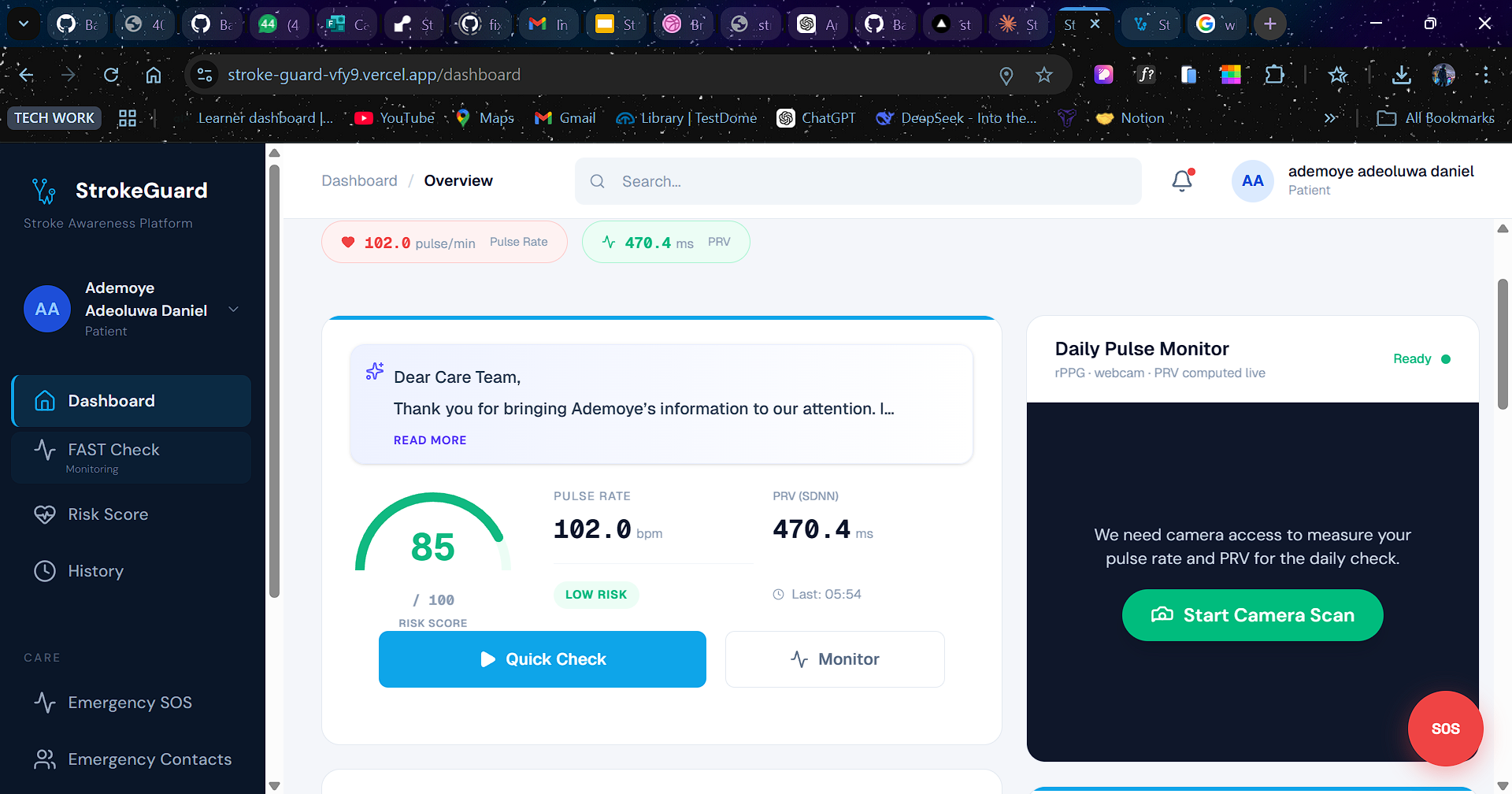
Inspiration Stroke kills someone every 40 seconds. In Nigeria, it is the leading cause of death, driven largely by untreated hypertension and a complete absence of early warning tools built for our reality. Most stroke awareness technology assumes you own a $400 Apple Watch and live near a hospital. We built StrokeGuard for the person who owns a $80 Tecno phone and lives 2 hours from the nearest clinic. The inspiration was simple: 80% of strokes are preventable. The knowledge and tools to prevent them exist. They just have not been built for the people who need them most. What It Does StrokeGuard is a free Progressive Web App with five core functions. First, it predicts your risk with a personalised Stroke Awareness Score out of 100, calculated using the American Heart Association's Life's Essential 8 framework. Users answer 5 questions in under 4 minutes, covering blood pressure, smoking, diabetes, family history, and physical activity. Second, it helps you recognize a stroke through a guided FAST Check using your phone's built-in sensors — the front camera detects facial asymmetry using MediaPipe AI, the accelerometer runs a 10-second arm drift test, and a speech timing module checks for slurring, all processed entirely on the device with nothing transmitted anywhere. Third, it helps you respond with a single SOS button that simultaneously sends an SMS with live GPS to all emergency contacts via Twilio, auto-calls the nearest hospital the user registered during onboarding, and auto-dials 199, Nigeria's national medical emergency line. Fourth, it monitors your pulse using rPPG — Remote Photoplethysmography — measuring pulse rate and Pulse Rate Variability from subtle colour changes in your face through the front camera, no hardware required. Fifth, it educates users with plain-language stroke content, an interactive FAST training module, and Nigeria-specific statistics. How We Built It We built the frontend as a Next.js PWA with a full custom design system. The FAST Check uses MediaPipe Face Mesh for facial symmetry detection, the Web Sensors API for the arm test, and manual speech timing for the speech test. For rPPG we implemented the CHROM algorithm, sampling the green and red channels from the forehead region at 30fps and extracting inter-pulse intervals to compute pulse rate and PRV. For Bluetooth smartwatch support we used the Web Bluetooth API with acceptAllDevices to support Oraimo, itel, Mi Band and any BLE device, bypassing the GATT advertisement limitation that causes most implementations to fail with Nigerian-market watches. The emergency SOS uses Twilio SMS, the Web Geolocation API, and the tel: protocol for auto-dial. The backend is a FastAPI server receiving a vitals payload containing pulse rate history, PRV score, AHA lifestyle score, exercise status, and measurement source for stroke risk prediction. Challenges We Ran Into rPPG accuracy across darker skin tones was our biggest technical challenge. Standard green-channel-only rPPG performs poorly on darker skin. We implemented the CHROM algorithm which uses both red and green channels with a mathematical projection to cancel lighting and motion noise, significantly improving accuracy for our target users. Web Bluetooth with Nigerian-market watches was another major hurdle — Oraimo and itel watches do not broadcast the standard GATT heart rate service UUID, so the standard filter approach returns zero devices. We solved this with acceptAllDevices combined with proprietary service UUIDs. We also had to carefully navigate medical accuracy versus regulatory risk, using AHA-validated frameworks but framing everything as awareness and risk scoring rather than diagnosis, and using PRV rather than HRV because rPPG measures optical pulse not electrical cardiac signal. Accomplishments We Are Proud Of We are proud of building rPPG pulse measurement running entirely in-browser with no hardware dependency, Web Bluetooth pairing that actually works with Oraimo and itel watches out of the box, a 3-target SOS system that fires contacts, nearest hospital, and 199 simultaneously in one tap, and a complete 6-page MVP with over 100 features all built in 24 hours. Most of all we are proud of building something genuinely useful for a population that every existing health tech company has ignored. What We Learned We learned that the hardest problems in health tech are not the algorithms — they are the assumptions baked into existing tools about who has money, what devices they own, and what infrastructure exists around them. Building for Nigeria forced us to question every assumption and find solutions that work with what people actually have. We also learned that using the correct scientific terminology matters deeply when the product touches health — PRV not HRV, pulse rate not heart rate, risk scoring not diagnosis. Precision builds trust. What's Next Our next steps are expanding to Ogun, Rivers, and Kano states, partnering with NHIS and state health ministries for community health worker integration, launching the family plan at 2,000 naira per month, and beginning conversations with HMOs about white-label licensing. Long term we are building toward pan-African expansion, starting with Ghana and Kenya, and alignment with the WHO's global stroke prevention targets for 2030.
Built With
- fastapi
- next.js
- python


Log in or sign up for Devpost to join the conversation.