Inspiration
People with photosensitive epilepsy have been deliberately attacked with strobing images online. In December 2016, a strobing GIF sent to journalist Kurt Eichenwald, who has epilepsy, triggered a seizure, and the sender was criminally charged (CBS News). In November 2019, more than 30 accounts posted strobing images using the Epilepsy Foundation's handle and hashtags (Engadget). About 1 in 4,000 people has photosensitive epilepsy (Epilepsy Action).
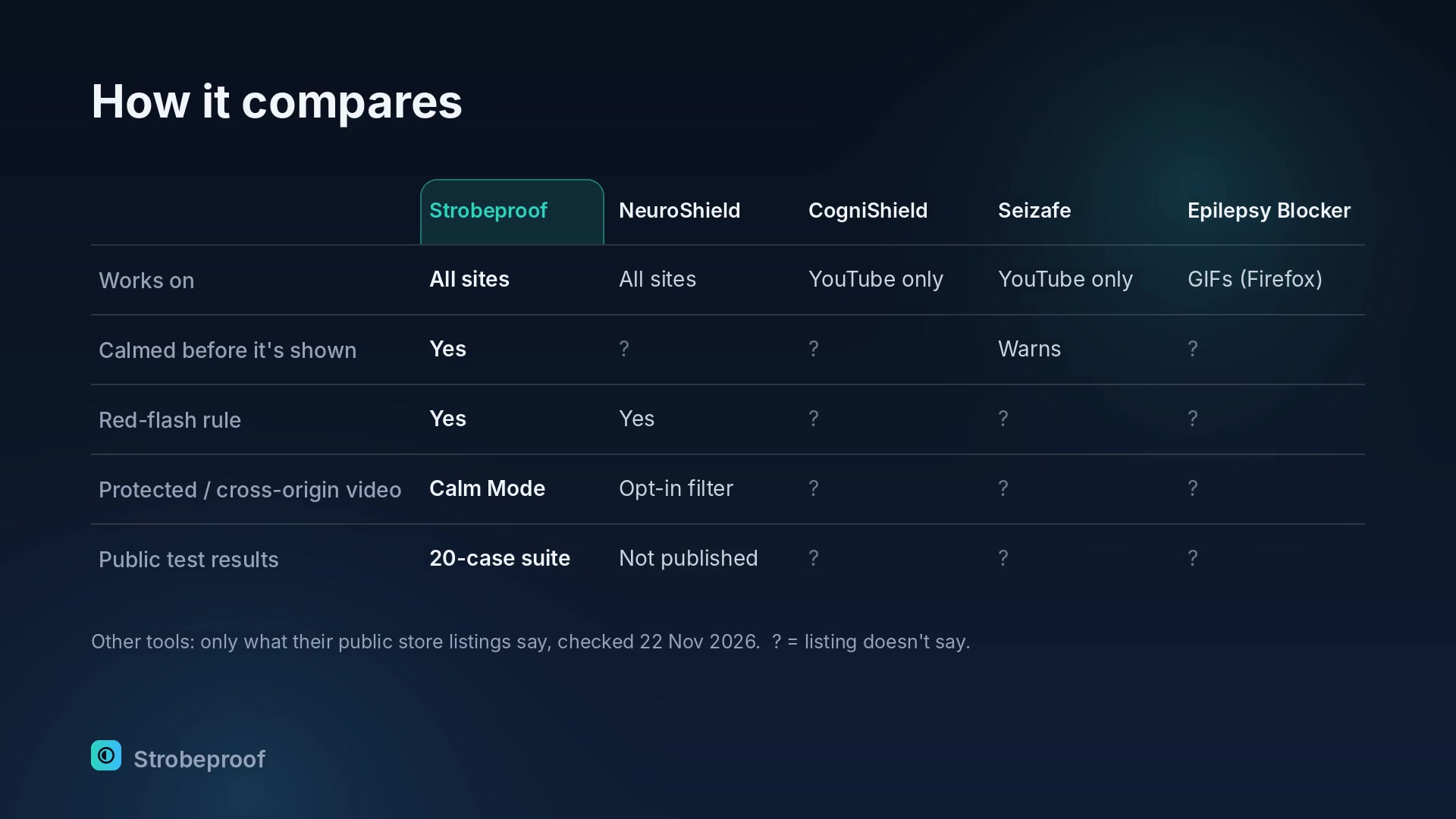
A few browser tools try to block flashing, but none of them show evidence that they work. For a safety tool, "trust me" isn't good enough.
What it does
Strobeproof has two parts that share one detection engine:
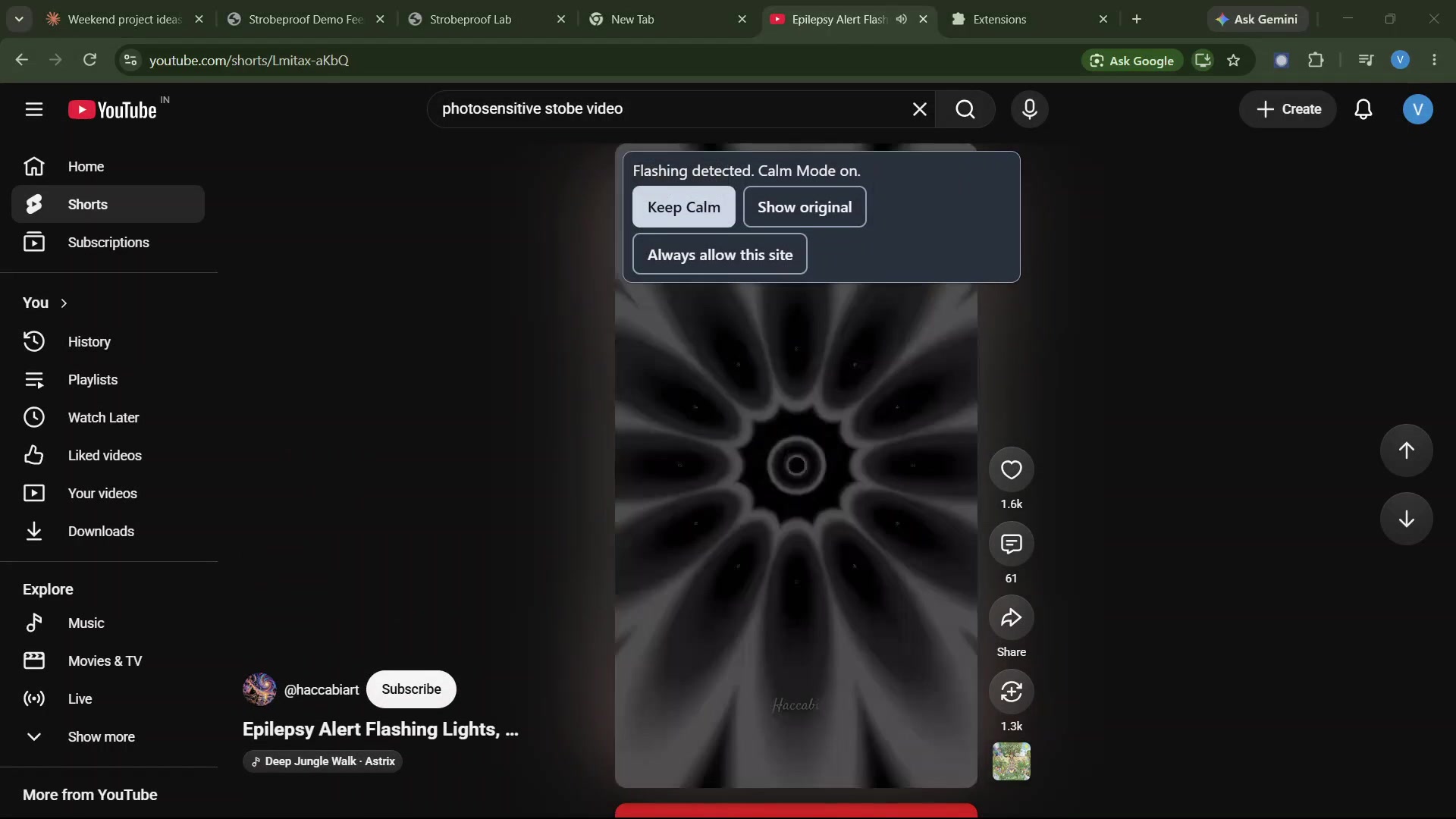
- Browser extension (Chrome, Edge, Brave): watches GIFs, animated WebPs and videos on any site. Anything it hasn't checked yet starts in Calm Mode (greyscale, dimmed), which keeps white below a relative luminance of 0.084. That's under the 0.10 change WCAG counts as a flash, so nothing in Calm Mode can count as a flash. Safe content is released to normal brightness. Live video is checked as it plays and switches to Calm Mode within about one frame when flashing builds up. Every control works by keyboard and screen reader, and nothing in the UI animates.
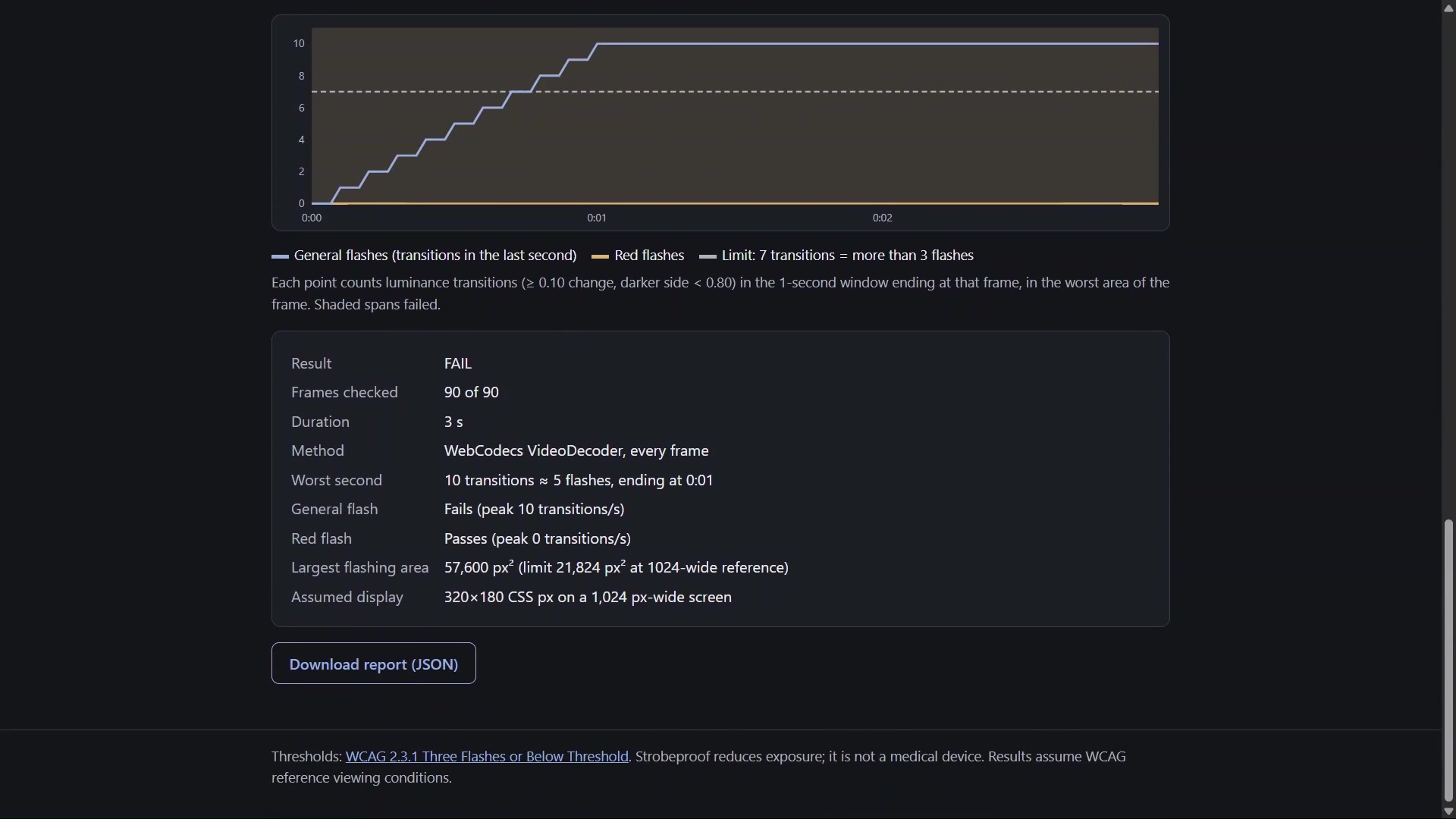
- Lab (no install): drop in any clip and it checks every frame against WCAG 2.3.1, giving a plain answer like "Flashes too fast at 0:00–0:02" with a chart. Useful for creators before they post. "Try a sample" shows a result instantly.
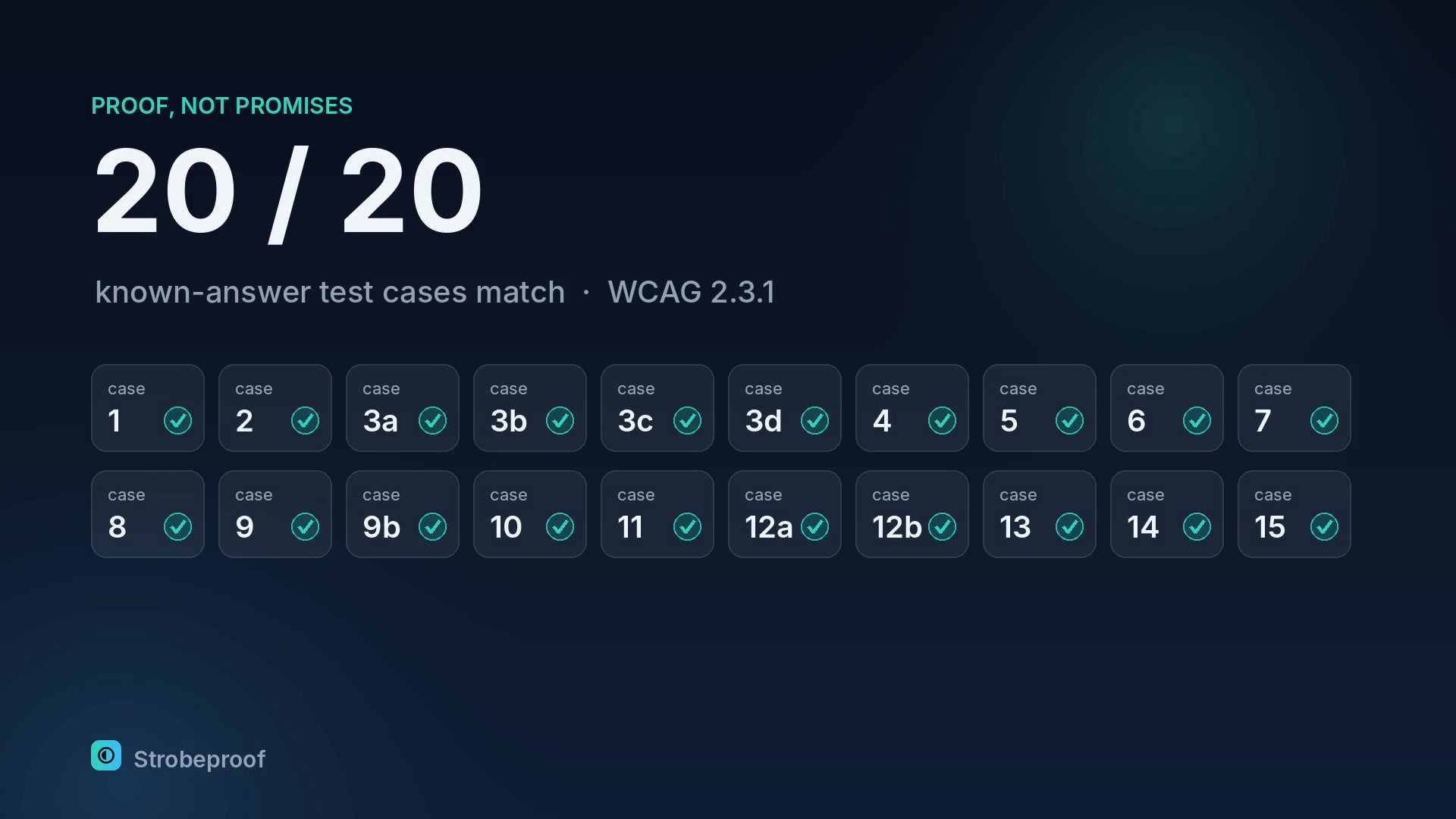
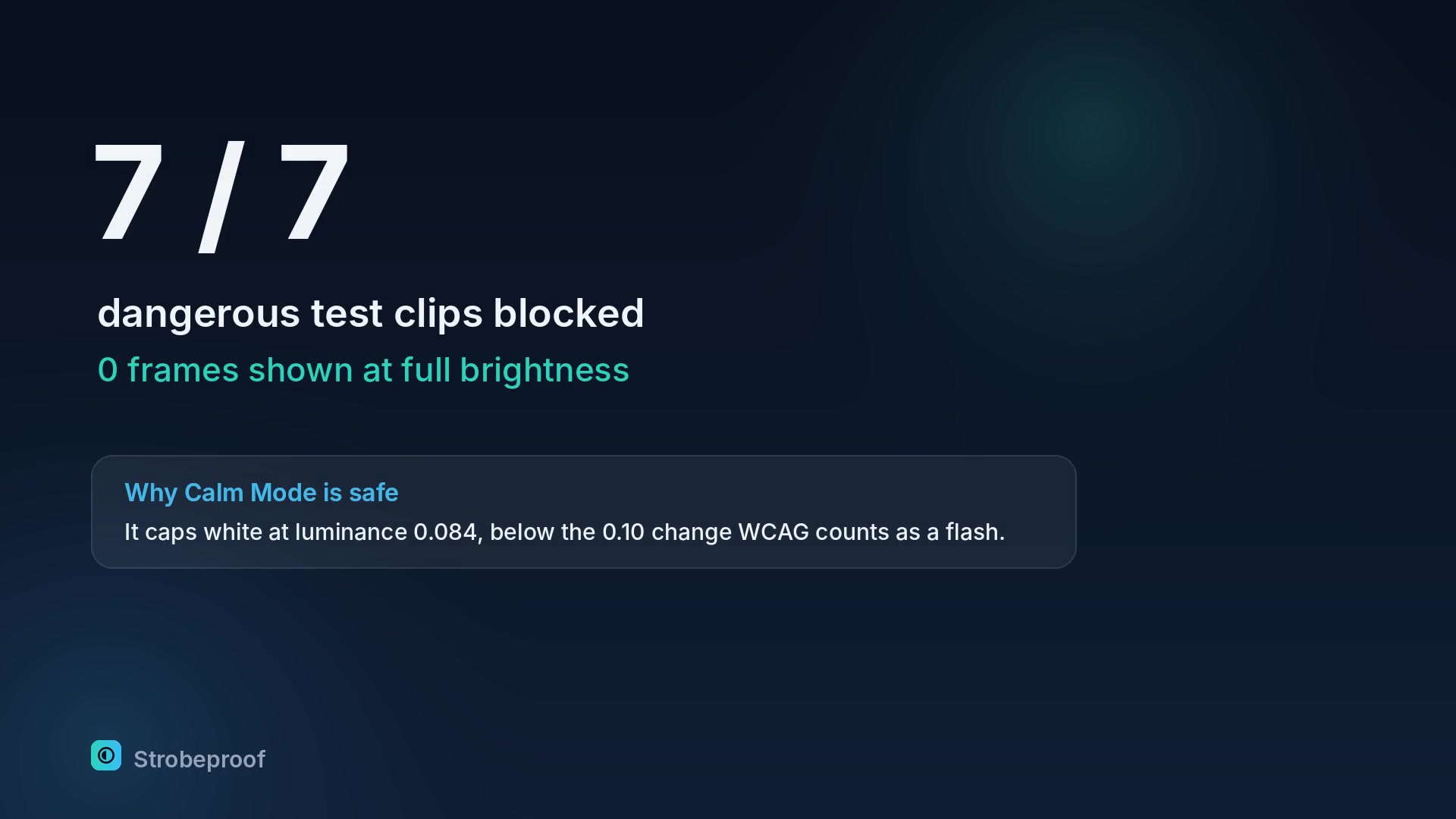
Proof: 20/20 known-answer test cases pass (slow ramps, exact 3 Hz boundaries, small areas, red-only flashes, dropped frames), and all 7 failing benchmark clips were blocked with 0 frames at full brightness.
How we built it
- Started from the WCAG 2.3.1 definitions and wrote the expected answers for 20 test cases before the detector existed.
- The detector splits frames into 32×18 tiles, converts pixels to linear luminance, and counts brightness transitions (≥ 0.10 change, darker side < 0.80) in any 1-second window. 7 or more transitions (more than 3 flashes) over more than 25% of a 10° field of view is a FAIL.
- Every frame is decoded with WebCodecs (no sampling shortcuts), so fast strobes can't slip between samples.
- The extension is Manifest V3, with an offscreen document for pre-scanning GIFs and a worker for live video.
- Tested with Vitest, Playwright end-to-end tests and axe accessibility checks; the Lab runs on GitHub Pages.
Built with AI assistance: I'm a beginner, so I built this with Claude Code as my pair programmer. It wrote the code, including the detection engine, under my direction. I chose the idea and approach, made the design and spec decisions, approved all the test answers, and tested it in real Chrome and on YouTube. I also used Claude (claude.ai) for research, the build plan, and the video's slides, captions and editing. I recorded the screen demos and narration. Full split in AI_LOG.md.
Challenges we ran into
- Detection is reactive: you can only count 4 flashes after 4 flashes have happened. That's why Strobeproof calms content before checking it, and switches live video to Calm Mode early.
- Some video can't be read (DRM like Netflix, some cross-origin video). Instead of pretending, Strobeproof says "Can't check this one" and keeps it in Calm Mode.
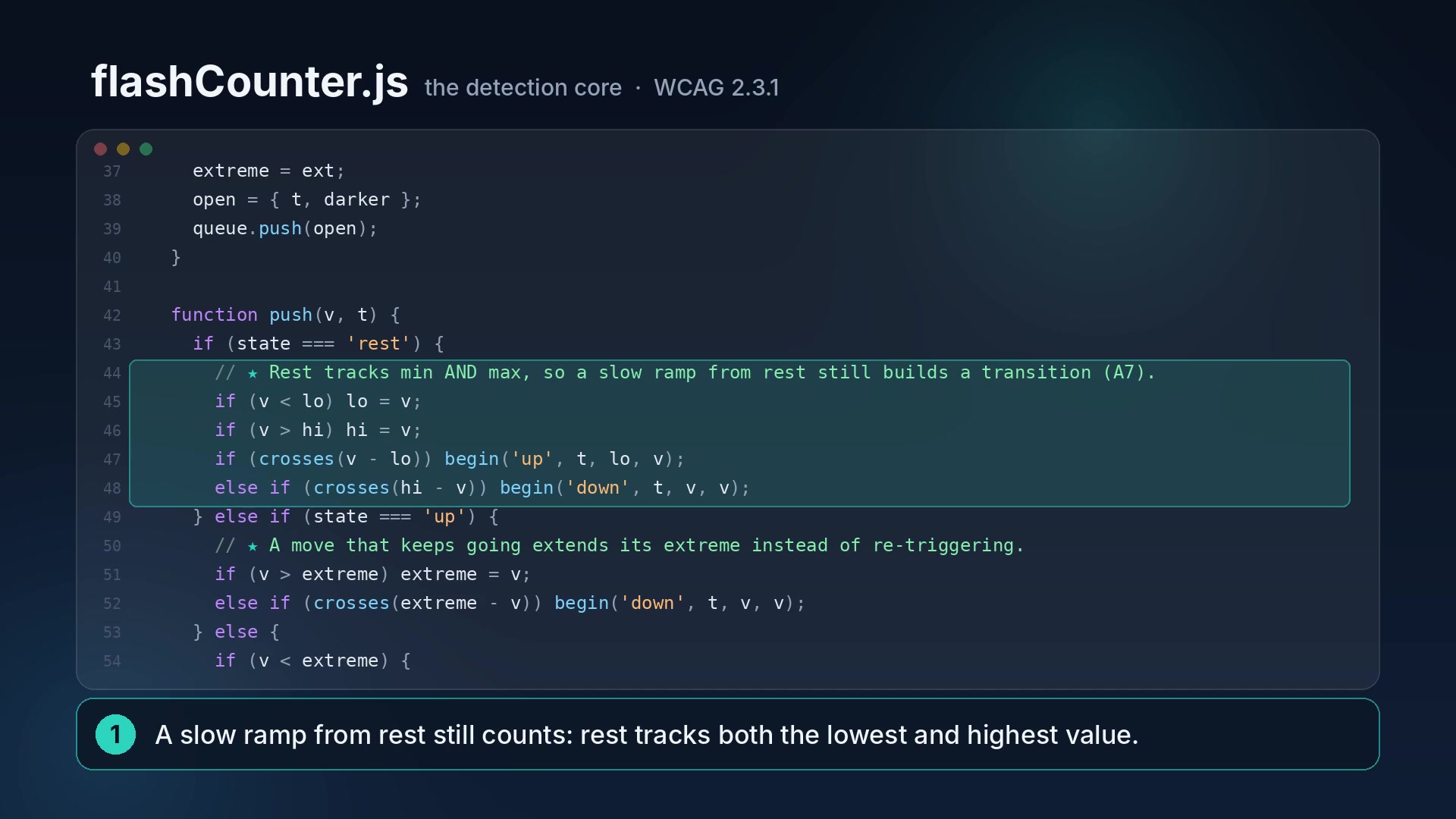
- Easy-to-miss edge cases: a slow ramp that brightens a little each frame, and a fall that only drops below 0.80 partway through. Both needed specific logic and tests.
- Making a demo video about flashing without showing flashing. We checked our own video frame by frame with the same rules.
Accomplishments that we're proud of
- A public, known-answer test suite: 20/20 cases pass, and anyone can run it in the Lab.
- 7/7 dangerous test clips blocked with zero frames at full brightness.
- Calm Mode, which is mathematically below the WCAG flash threshold and works even on video we can't read.
- An accessible UI: keyboard and screen-reader friendly, zero axe violations, and no animations anywhere.
What we learned
Safety software has to be provable, not just plausible, so the test suite came first. I learned how flash detection works frame by frame, how browser extensions are structured, and why accessibility has to be designed in from the start.
What's next for Strobeproof
- Publish to the Chrome Web Store.
- Firefox support.
- Cover CSS/JS animations and canvas content.
- Run the benchmark against other tools by recording them, not just comparing store listings.
- Test with real users through epilepsy organisations, safely and with their guidance.
