Inspiration
Music education is one of the few areas where AI has not fundamentally changed the learning experience. Most music apps generate practice routines, but very few listen, respond, and coach you while you play.
I joined a guitar class, but lessons happened only once a week. Without immediate feedback, I often repeated mistakes until they became habits.
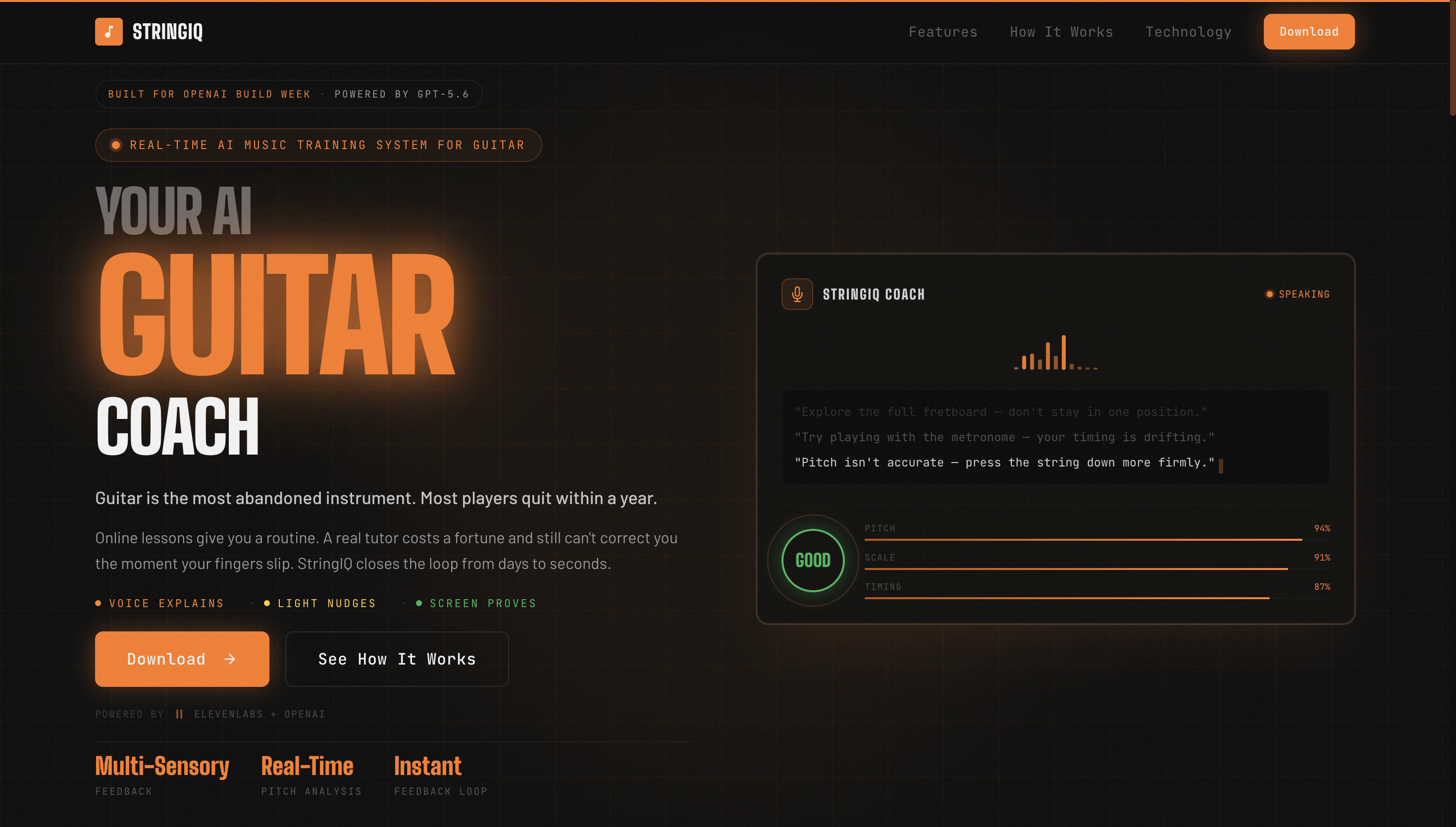
StringIQ is an AI-powered music learning platform that listens while you play, analyzes your performance in real time, and delivers instant voice coaching. Every practice session becomes an interactive lesson instead of practicing alone.
StringIQ is designed for self-directed learners, music schools, and guitarists who want every practice session to be guided, measurable, and engaging.
What it does
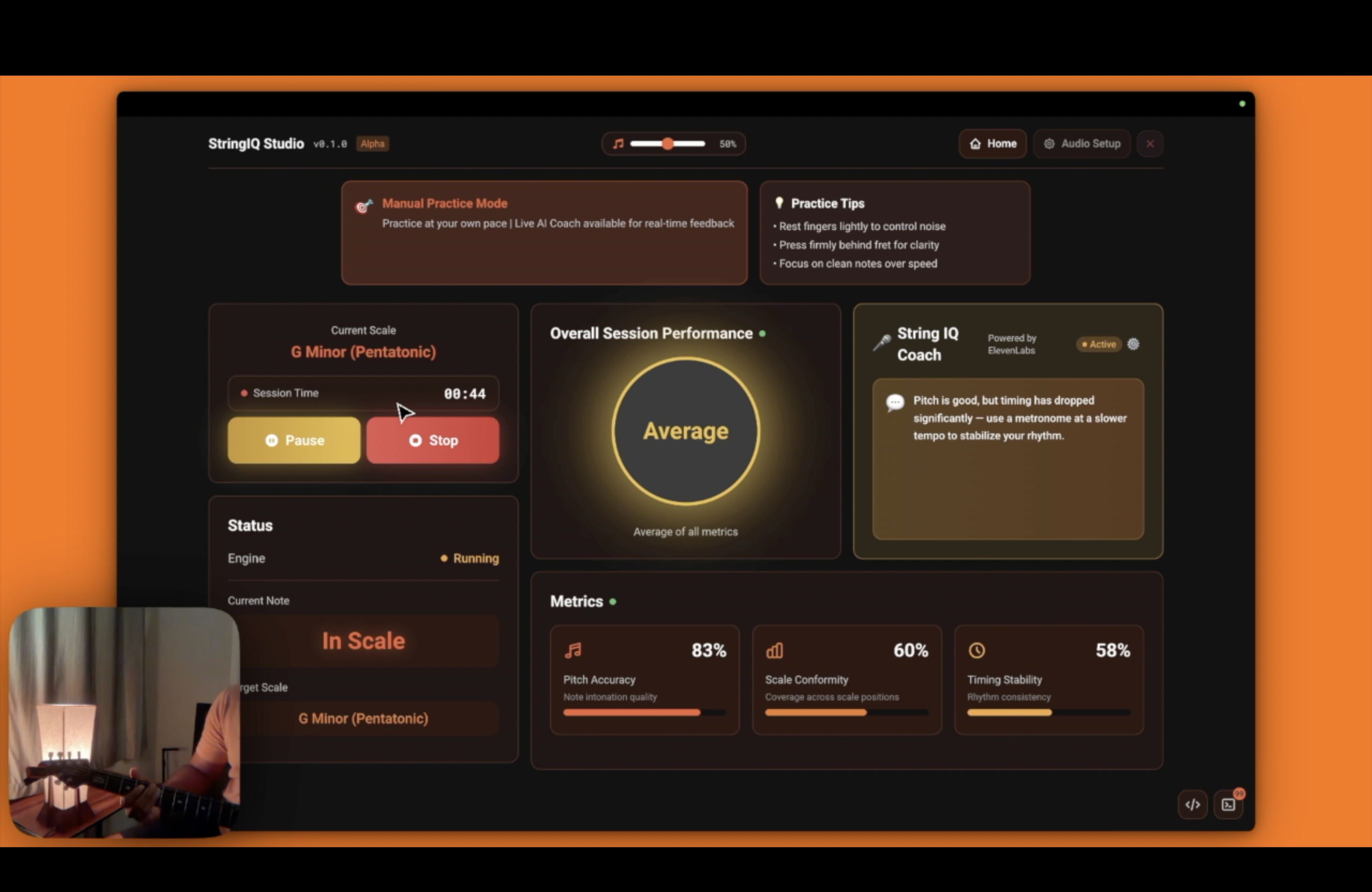
StringIQ listens while you play and provides coaching in real time. It acts like a voice teacher, speaking corrections while displaying live metrics such as pitch accuracy, scale conformity, timing stability, and noise control.
The experience extends beyond the screen. StringIQ can also control ambient lighting during practice. Red indicates something needs correction, while green confirms accurate, confident playing, creating an immersive feedback loop.
How I built it
StringIQ is built with:
- Electron, React, Vite, and Tailwind CSS for the cross-platform desktop Studio application.
- Python and FastAPI for the local backend and real-time API layer.
- librosa, NumPy, and sounddevice for audio capture, pitch detection, timing analysis, scale conformity, and noise analysis.
- OpenAI GPT-5.6 through the Responses API for conversational coaching, AI recommendations, personalized practice plans, and natural language progress insights.
- ElevenLabs for expressive voice synthesis, Conversational AI, Voice Design, and Music API generated backing tracks.
- PostgreSQL on Supabase for session history, performance metrics, and progress tracking.
- Tuya-compatible smart lighting for ambient visual feedback during practice.
- Codex as an engineering collaborator across architecture, implementation, integrations, documentation, and development workflows.
Latency-sensitive audio analysis runs locally to keep the feedback loop responsive. GPT-5.6 focuses on coaching, interpretation, and personalization rather than low-level signal processing.
Challenges I ran into
The biggest challenge was building a responsive audio pipeline. Guitar audio must be captured, analyzed, streamed, visualized, and converted into coaching without introducing noticeable delay.
I also had to coordinate audio hardware, WebSocket streaming, FastAPI services, Electron lifecycle management, voice playback, database persistence, and smart lighting without interrupting the practice experience.
Accomplishments that I'm proud of
I am proud that StringIQ has become an application that genuinely makes me want to pick up my guitar and practice. It transformed practice from a delayed-feedback activity into an interactive experience where I play, hear coaching, watch live metrics, see the environment respond, and improve immediately.
More importantly, it demonstrates that AI can make music education more engaging instead of simply generating another practice routine.
What I learned
Building StringIQ taught me that effective real-time coaching is a systems challenge as much as an AI challenge. The experience depends on fast signal processing, low latency, intuitive interface design, reliable persistence, and meaningful coaching working together.
By combining fast local audio analysis with GPT-5.6, StringIQ delivers coaching that is both responsive and personalized.
What's next for StringIQ
The next step is expanding beyond scales into chords, songs, and additional practice modes before supporting more instruments with instrument-specific frequency models and performance profiles.
I also plan to pilot StringIQ with music schools, gather feedback from teachers and students, and continue improving the coaching experience, accessibility, and reliability.

Log in or sign up for Devpost to join the conversation.