STRIKEIQ — AI-Powered Cricket Vision & Match Intelligence
Inspiration
Cricket analytics has evolved tremendously, but most systems still depend heavily on traditional statistics such as runs, strike rate, wickets, economy, and averages.
We wanted to explore a different question:
What if AI could actually understand what is happening inside a cricket image?
A scoreboard can tell us that a batter scored four runs, but it doesn't necessarily tell us how the shot was played, what type of delivery was bowled, or what the visual context of that moment looked like.
This inspired us to build STRIKEIQ, an AI-powered cricket vision platform designed to bridge the gap between traditional cricket statistics and visual game understanding.
Our goal was to transform a simple cricket image into meaningful cricket intelligence using Computer Vision and Google's Gemini multimodal AI capabilities.
What it does
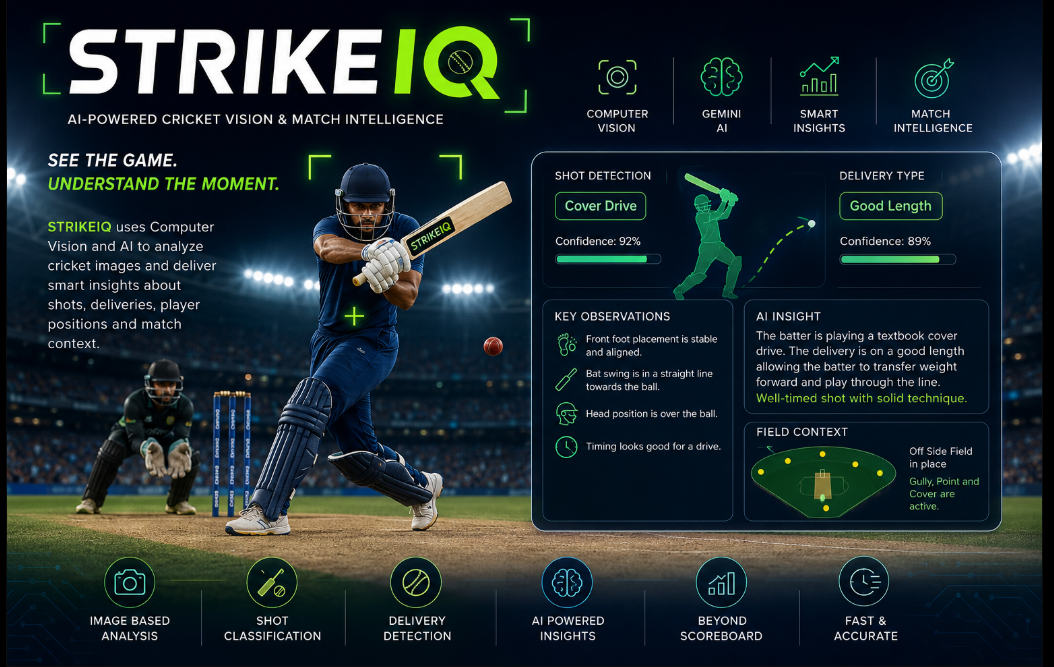
STRIKEIQ analyzes cricket images and generates AI-powered insights about the game.
The system can analyze visual elements of a cricket moment and provide insights such as:
- 🏏 Shot identification — detecting probable shots such as cover drives, pulls, cuts, defensive shots, and drives.
- 🎯 Delivery analysis — identifying characteristics of deliveries such as yorkers, bouncers, full deliveries, and good-length balls.
- 🧍 Player positioning — interpreting the batter's stance, positioning, and body movement visible in the frame.
- 🧠 Contextual cricket intelligence — converting visual observations into understandable cricket analysis.
- 📊 AI-generated insights — providing a human-readable explanation of what may be happening in the image.
Instead of simply asking:
"What happened?"
STRIKEIQ attempts to answer:
"What happened, how did it happen, and what can we understand from the visual evidence?"
How we built it
STRIKEIQ was developed as a Python-based AI application with a lightweight web interface.
Technology Stack
- Python — core application and backend logic
- Google Gemini API — multimodal image understanding and AI reasoning
- OpenCV — computer vision and image processing
- NumPy — numerical and image-data processing
- Pandas — structured data processing
- HTML, CSS & JavaScript — web interface
- Git & GitHub — version control and collaboration
Architecture
The current system follows a simple pipeline:
Cricket Image
      ↓
Image Processing
      ↓
Computer Vision
      ↓
Gemini Multimodal AI
      ↓
Cricket Visual Understanding
      ↓
Structured Analysis
      ↓
AI-Generated Insights
We designed the system so that Gemini acts as the current visual intelligence layer while keeping the architecture flexible enough to introduce dedicated machine-learning models in future versions.
Our current prototype focuses on image-based analysis, allowing users to provide cricket photographs and receive an AI-generated interpretation.
Challenges we ran into
Building an AI system that understands cricket visually came with several challenges.
1. Visual understanding is not the same as object detection
Identifying a person, bat, or cricket ball is relatively straightforward compared with understanding the cricketing action taking place.
For example, recognizing a batter is different from determining whether they are playing a cover drive, pull, cut, or defensive shot.
The challenge is not simply detecting objects but understanding their relationship, positioning, and context.
2. Limited domain-specific training data
High-quality, properly labelled cricket datasets for shot and delivery classification are difficult to obtain.
Images can vary significantly because of:
- Camera angle
- Lighting
- Player position
- Motion blur
- Occlusion
- Different stadium environments
- Different batting and bowling styles
This made it difficult to build a highly specialized computer-vision model within the project timeframe.
3. Balancing Gemini with traditional computer vision
We wanted the project to be more than simply sending an image to an AI model.
This led us to explore how computer vision preprocessing and multimodal AI reasoning could work together.
The current implementation uses Gemini for advanced visual interpretation, while the architecture is designed to support dedicated CV/ML models later.
4. Defining what "correct" cricket intelligence means
A cricket image can sometimes be ambiguous.
For example, a single frame may not contain enough information to confidently determine the exact delivery type or shot outcome.
Therefore, we learned that an AI sports-analysis system should distinguish between:
- What is directly visible
- What is highly probable
- What is uncertain
This is important for building trustworthy AI-powered sports analytics.
Accomplishments that we're proud of
🏏 We built a working cricket vision prototype
We successfully created a system capable of taking cricket imagery and generating meaningful AI-powered cricket analysis.
🧠 We moved beyond traditional statistics
STRIKEIQ focuses on the visual context behind cricket events, rather than only displaying numerical statistics.
🔗 We combined Computer Vision with Generative AI
Instead of treating computer vision and generative AI as separate technologies, we explored how they can complement each other.
Computer vision can provide structured visual information, while Gemini can provide higher-level reasoning and natural-language interpretation.
🚀 We created a foundation for a larger sports intelligence platform
The current image-based MVP is intentionally designed as a starting point.
The architecture can evolve toward:
Images
   ↓
Custom Computer Vision Models
   ↓
Player + Ball Detection
   ↓
Pose Estimation
   ↓
Shot / Delivery Classification
   ↓
Gemini Reasoning
   ↓
Cricket Intelligence
This gives STRIKEIQ a clear path from a hackathon prototype toward a more advanced sports analytics system.
What we learned
This project taught us that building an AI application is not simply about connecting an API and getting a response.
We learned several important lessons.
1. Domain knowledge matters
A generic vision model may recognize cricket objects, but meaningful cricket analysis requires understanding the sport itself.
Terms such as yorker, bouncer, cover drive, pull, field placement, and shot selection require domain-specific reasoning.
2. Multimodal AI opens new possibilities
Text-based AI is powerful, but combining language models with visual inputs creates completely different applications.
Instead of asking an AI to analyze structured data, we can give it the actual visual evidence.
3. Good AI systems need specialized models
Gemini provides a powerful starting point, but our research into the project showed us the importance of developing dedicated models for highly specialized tasks.
A future STRIKEIQ model could be trained specifically for cricket shot and delivery classification.
4. AI predictions should be treated carefully
Visual analysis can involve uncertainty.
Rather than presenting every prediction as absolute truth, future versions should provide confidence scores and clearly distinguish between observations and predictions.
5. Start with an MVP and build toward the bigger vision
We initially focused on image analysis because it allowed us to validate the core concept quickly.
That gave us a foundation for eventually moving toward video analysis and real-time cricket intelligence.
What's next for STRIKEIQ
The current version of STRIKEIQ is only the beginning.
🔬 1. Custom Cricket Vision Model
Our biggest next step is to develop and train our own machine-learning model for cricket-specific visual classification.
The model would focus on categories such as:
- Cover Drive
- Pull Shot
- Cut Shot
- Straight Drive
- Sweep
- Defensive Shot
- Lofted Shot
We aim to build a properly labelled dataset and evaluate the model using standard classification metrics such as accuracy, precision, recall, and F1-score.
🎯 2. Ball and Player Detection
We plan to introduce dedicated object-detection models to locate:
- Batter
- Bowler
- Cricket ball
- Bat
- Stumps
- Fielders
This would provide more structured information to the intelligence layer.
🧍 3. Pose Estimation
Pose estimation could help STRIKEIQ understand:
- Foot positioning
- Bat angle
- Body alignment
- Head position
- Follow-through
- Player movement
This would allow the system to move from simply identifying a shot toward analyzing how the shot was technically executed.
🎥 4. Video-Based Analysis
The next major evolution is moving from individual images to complete cricket deliveries.
Video
  ↓
Frame Extraction
  ↓
Player + Ball Tracking
  ↓
Motion Analysis
  ↓
Shot Detection
  ↓
Delivery Classification
  ↓
AI Reasoning
  ↓
Complete Delivery Analysis
🤖 5. Hybrid AI Intelligence
We eventually want STRIKEIQ to combine a specialized computer-vision model with Gemini.
For example:
[ Final\ Intelligence = CV\ Prediction + Gemini\ Reasoning + Match\ Context ]
The custom model would provide specialized visual predictions, while Gemini would provide contextual reasoning and natural-language explanations.
📊 6. Advanced Cricket Analytics
Future versions could include:
- Player heatmaps
- Shot maps
- Wagon-wheel generation
- Player technique analysis
- Bowling-pattern analysis
- Predictive analytics
- Automated AI commentary
- Performance trends
- Tactical recommendations
🌐 7. Live Cricket Intelligence
Our long-term vision is to transform STRIKEIQ from an image-analysis prototype into a real-time cricket intelligence platform capable of understanding live match footage.
About the Project
STRIKEIQ is our attempt to explore what happens when Computer Vision, Generative AI, and cricket domain knowledge come together.
We started with a simple idea:
A cricket match contains far more information than a scoreboard can capture.
With STRIKEIQ, we are building toward a future where AI can watch, understand, and explain the game — one frame at a time.
STRIKEIQ — See the game. Understand the moment.

Log in or sign up for Devpost to join the conversation.