-
-
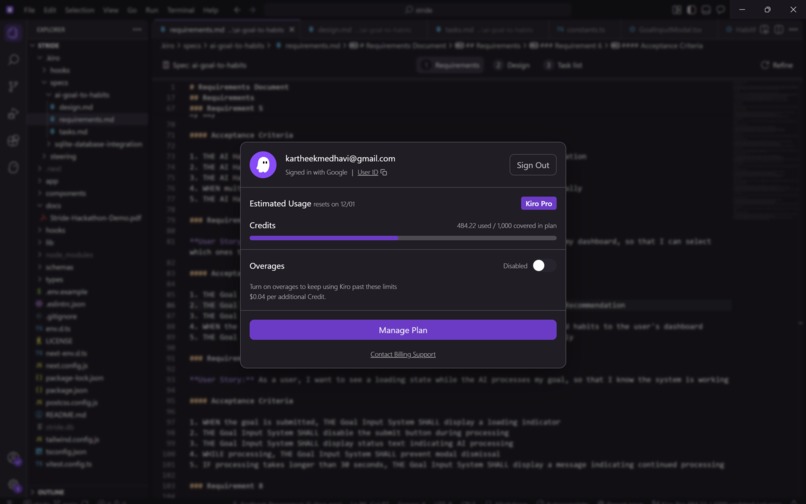
Built with Amazon Kiro Pro. Fun fact: We maxed out our Free plan credits :)
-
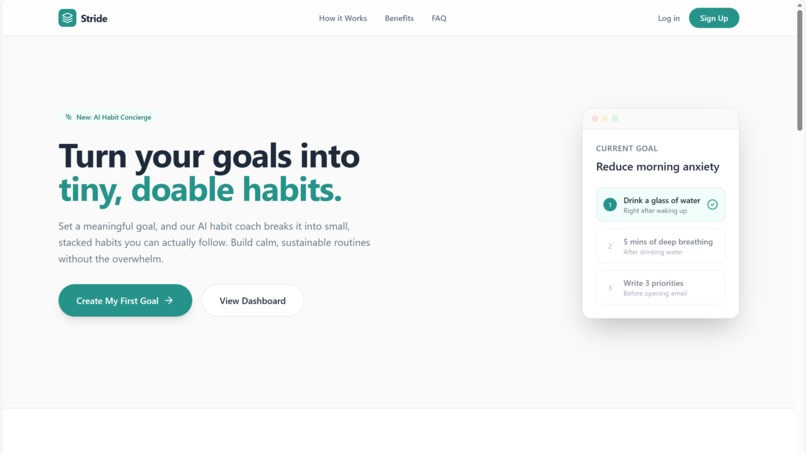
Landing Page "Here's our landing page. Set a goal, and our AI breaks it into tiny, doable habits you can actually follow."
-
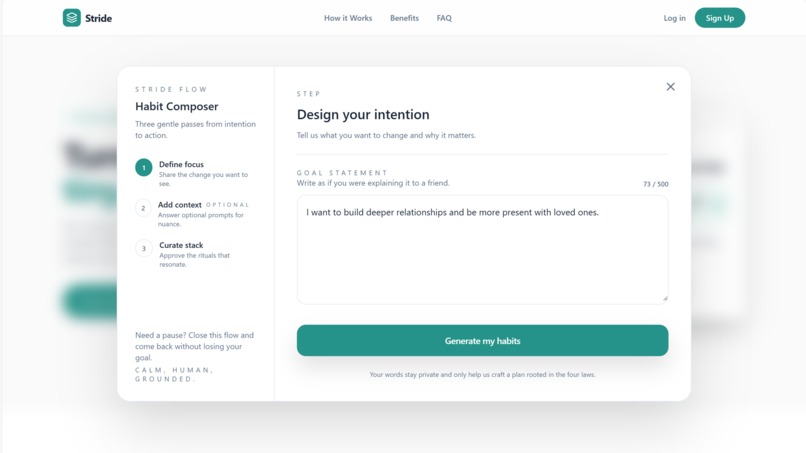
Design Intention "Users start by defining their intention - like building deeper relationships. Simple, conversational input."
-
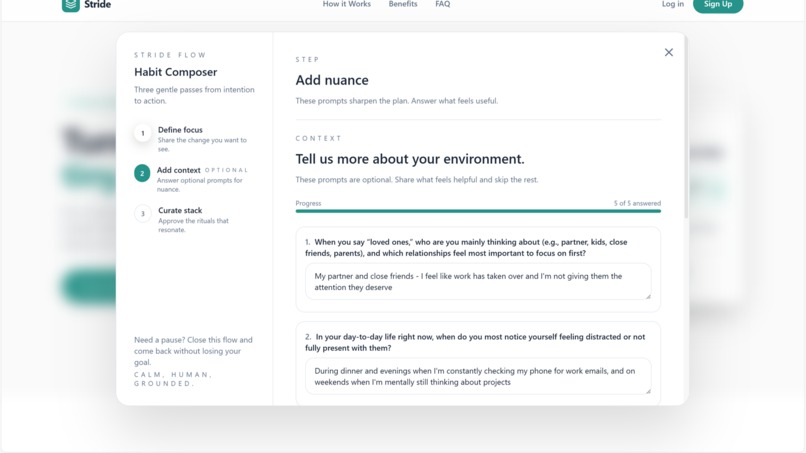
Add Nuance "The AI asks clarifying questions to personalize the plan - who are your loved ones, when do you feel distracted?"
-
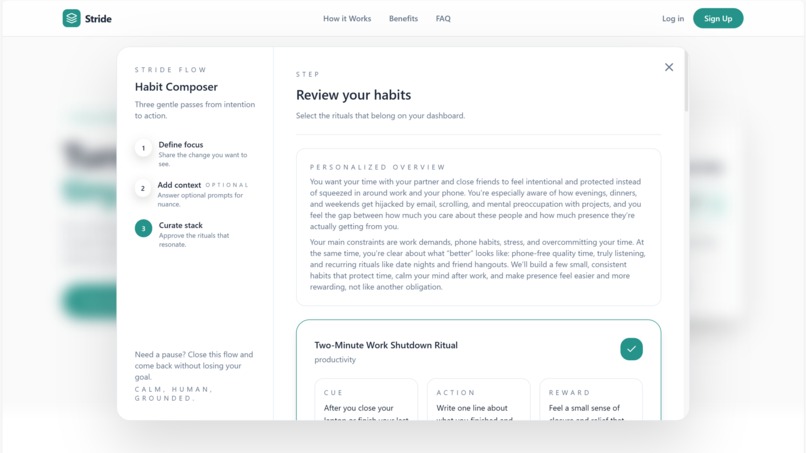
Review Habits "Then it generates a personalized overview and specific habits with cues, actions, and rewards."
-
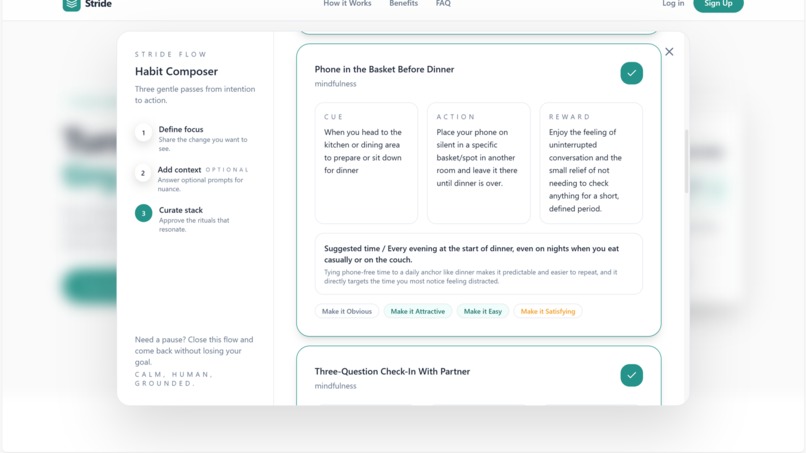
Habit Detail "Each habit follows the four laws - make it obvious, attractive, easy, and satisfying. Like putting your phone away at dinner."
-
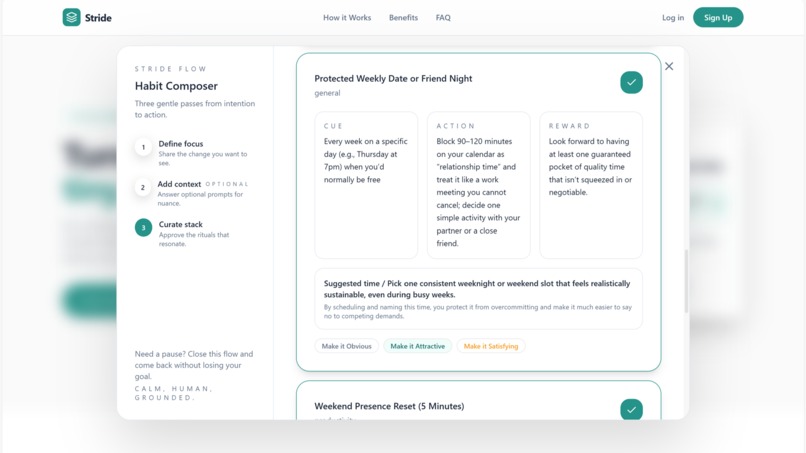
Weekly Date Night "Another example - scheduling protected relationship time with specific cues and actions."
-
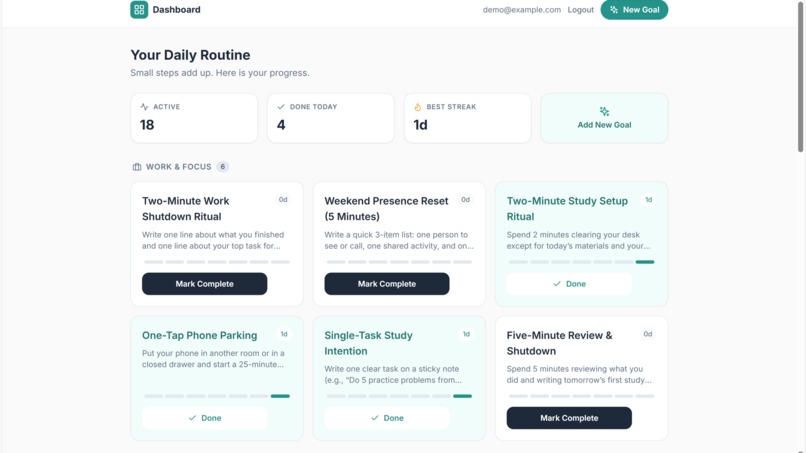
Dashboard View 1 "The dashboard shows your daily routine - active habits, completions, and streaks. One-tap tracking."
-
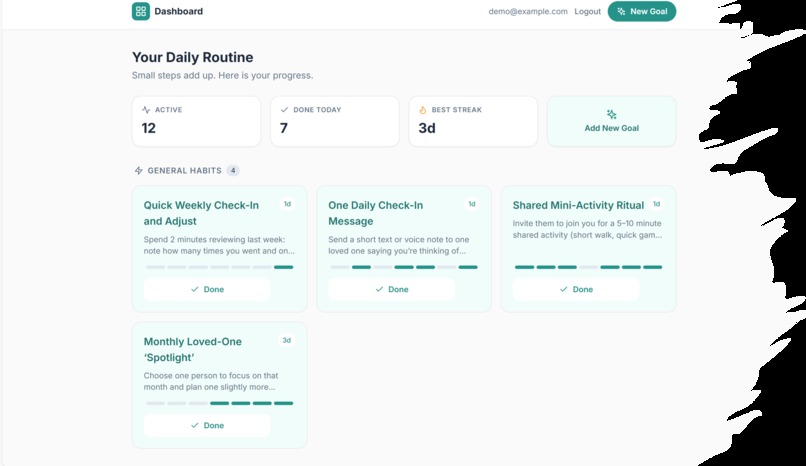
Dashboard View 2 "Habits are organized by category with progress visualization and easy completion buttons."
-
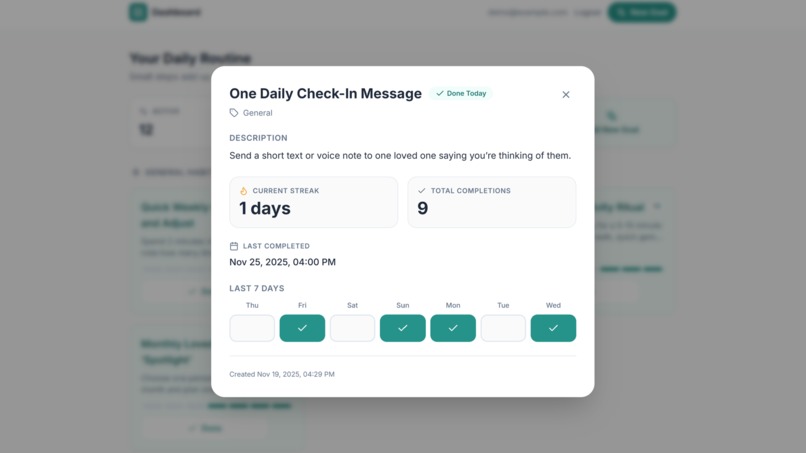
Habit Detail Modal "Drill into any habit to see your streak, total completions, and weekly history at a glance."
-
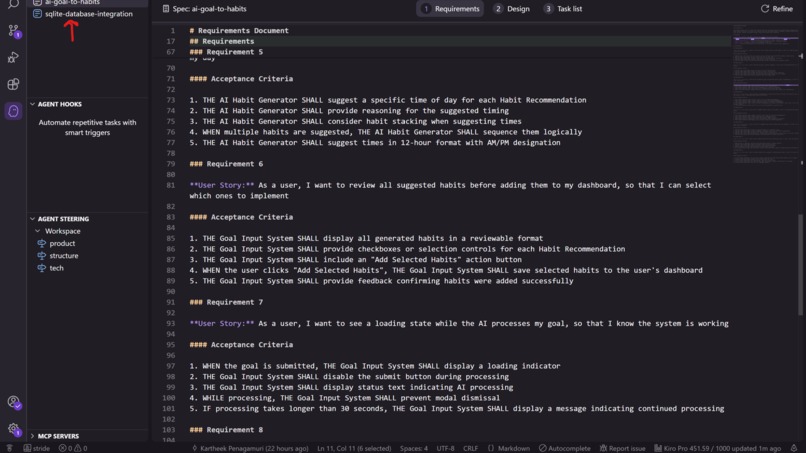
Kiro Spec-Driven Development "How did we build this? Kiro's spec system - requirements, design, and tasks - gave us a clear roadmap"
-
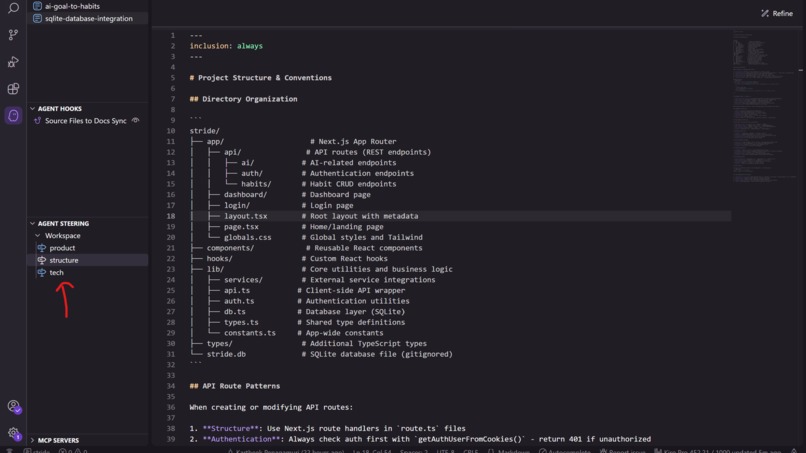
Steering Documents "Kiro created three steering documents - tech stack, code structure, and product principles - ensuring consistency"
-
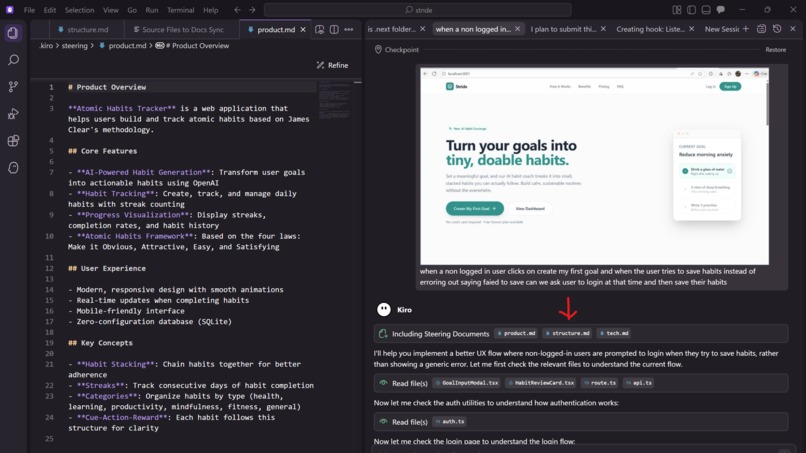
Product Screenshot "Kiro references these steering docs automatically when making changes."
-
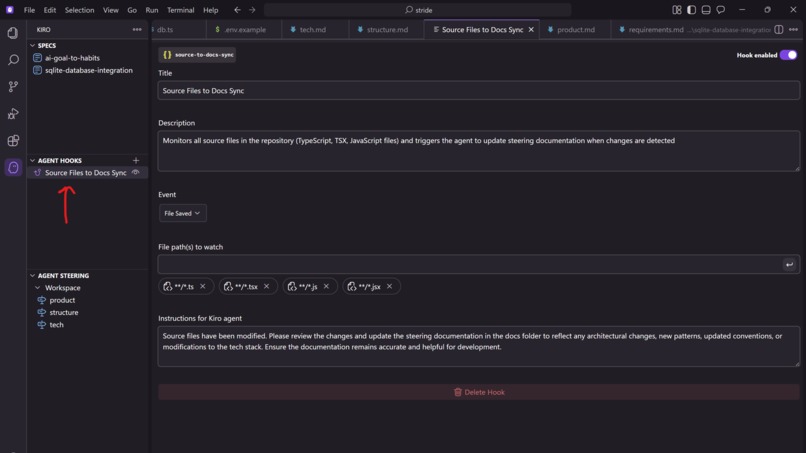
Kiro's Agent Hooks "Hooks auto-update documentation when source files change."
-
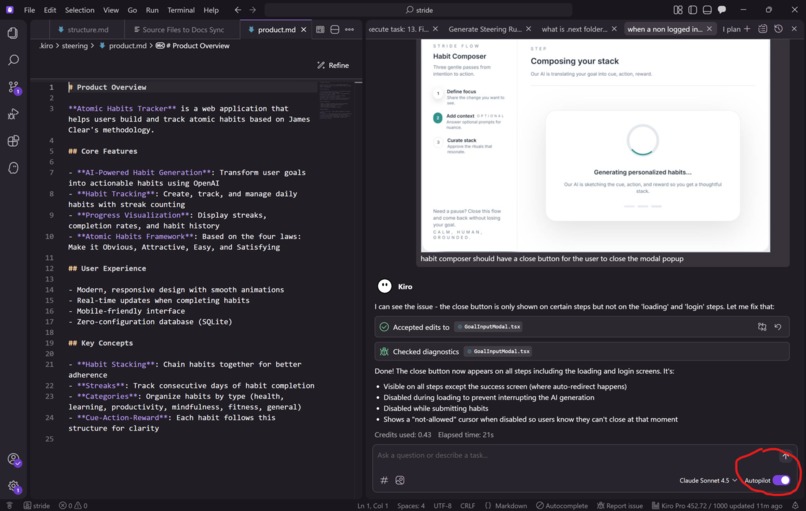
"Kiro's Autopilot remembers approved commands, reads specs, generates code, fix issues and run tests - faster than traditional development."
-
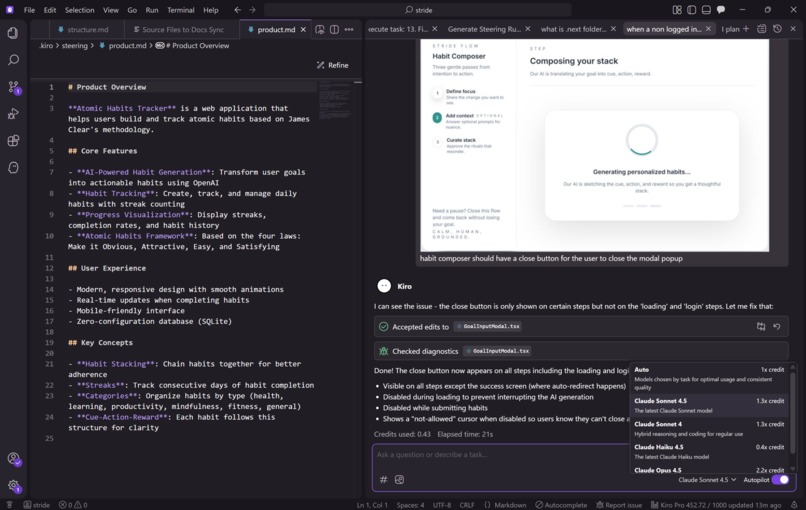
Model Selection "Kiro lets you pick the right AI model for each task."


Inspiration
82% of people fail their New Year's resolutions by February. Why? Goals are vague ("get healthier"), there's no clear action plan, no tracking system, and it's overwhelming to start.
We realized that small daily actions compound into massive results, but most people don't know HOW to build effective habits. Existing apps fall into two extremes - either too simple (basic checkboxes) or too complex (gamification overload).
Inspired by James Clear's Atomic Habits framework, we set out to build something different: an AI-powered habit builder that transforms any goal into tiny, actionable habits you can actually follow.
What it does
Stride is an AI-powered habit tracker that:
- Transforms vague goals into personalized atomic habits
- Generates habit stacks with specific cues, actions, and rewards
- Follows the four laws: Make it Obvious, Attractive, Easy, and Satisfying
- Asks clarifying questions to deeply personalize each habit plan
- Provides zero-friction tracking with streak visualization
- Organizes habits by categories (health, productivity, mindfulness, relationships)
Users simply describe their goal conversationally (e.g., "I want to build deeper relationships"), and Stride's AI generates a complete habit system tailored to their lifestyle, constraints, and preferences.
How we built it
We leveraged Kiro's spec-driven development approach, which fundamentally changed how we tackled this hackathon.
Spec-Driven Development: Instead of jumping into code, we started with clarity using Kiro's spec system - requirements.md (what we're building), design.md (how it works), and tasks.md (step-by-step plan).
Steering Documents: Kiro created three steering documents that became our project DNA - tech.md for stack decisions (Next.js 14, SQLite, OpenAI API), structure.md for code organization patterns, and product.md for user experience principles. This ensured consistency across 50+ files.
Autopilot Mode: Kiro's Autopilot read specs, generated code, ran tests, and fixed issues automatically. We estimate this was 10x faster than traditional development.
Agent Hoooks: Setup Kiro's agent hooks to auto-update documentation when source files change.
Tech Stack: Next.js 14, TypeScript, Tailwind CSS, SQLite with 15+ database operations, OpenAI API, cookie-based authentication, and tests.
Fun fact: Built with Amazon Kiro Pro. We maxed out our Free plan credits :). Screenshot attached in media section.
Challenges we ran into
- The biggest challenge was shifting our mindset from writing code to writing specifications.
As developers, our instinct is to dive into code immediately using Kiro's Vibe coding feature. But Kiro's spec-driven approach required us to think differently - to articulate requirements, acceptance criteria, and design decisions upfront before any code was written.
The rapid pace of code generation also made us realize the human review process could become a bottleneck. When Kiro generates hundreds of lines of code in seconds, how do you maintain confidence in quality?
Inspired by Anthropic's "Vibe Coding in Prod" talk, we relied on test coverage as the signal to confidently proceed with development. Instead of manually reviewing every line, we trusted our test suite to catch issues. This allowed us to maintain velocity while ensuring code quality.
- Achieving a clean UI required iteration. Kiro's initial designs were text-heavy with flashy styles. We guided the AI toward simplicity, reducing text, clarifying call-to-actions, removing clutter. This taught us that "less is more" doesn't come naturally to AI. Through deliberate prompting, we refined the interface to feel calm and focused, aligning with our philosophy of making habit-building simple.
Accomplishments that we're proud of
- Zero runtime errors in production build
- 50+ files and 2,000+ lines of production code generated in 100 hours
- Full-stack application with AI habit generation, SQLite database (15+ operations), authentication, and streak tracking
- Seamless user experience - from goal input to personalized habit stack in under 30 seconds
- Spec-driven workflow that produced consistent, maintainable code across the entire codebase
- Property-based testing suite that gave us confidence to ship AI-generated code rapidly
- Real Users, Real Feedback - encouraging feedback from the users. Early validation proves that people want guidance, not just tracking.
What we learned
- Specs are not overhead - They're an investment that pays dividends in code quality and consistency
- AI-assisted development requires new workflows - The bottleneck shifts from writing code to reviewing and testing
- Steering documents create consistency - When AI references the same context, output quality improves dramatically
- Trust the tests - With proper test coverage, you can confidently accept AI-generated code at scale
- Start with clarity, not code - The upfront thinking in specs prevented countless bugs and rework
Results:
- We asked friends and family to try Stride. The feedback was encouraging. Kiro made this possible
What's next for Stride - AI-Powered Atomic Habits Tracker
AI Agent Evaluations:
- Implement eval frameworks to measure habit recommendation quality (relevance, actionability, personalization accuracy)
- A/B test different prompting strategies to optimize habit generation
- Track habit completion rates as a feedback signal to continuously improve AI recommendations
- Build regression tests for AI outputs to ensure consistent quality across model updates
Hyper-Personalization:
- Contextual awareness - Integrate calendar, location, and time-of-day data to suggest perfectly-timed habits
- Adaptive difficulty - AI adjusts habit complexity based on user's success rate and energy levels
- Learning from behavior - Analyze completion patterns to recommend optimal habit timing and sequencing
- Personality-based customization - Tailor motivation styles, reward types, and cue formats to individual preferences
- Life event adaptation - Automatically adjust habits during travel, illness, or major life changes
Built With
- claude
- css
- kiro
- nextjs
- npm
- openai
- sonnet4.5
- spec-driven
- sqlite
- tailwind
- typescript
- vercel

Log in or sign up for Devpost to join the conversation.