-
-
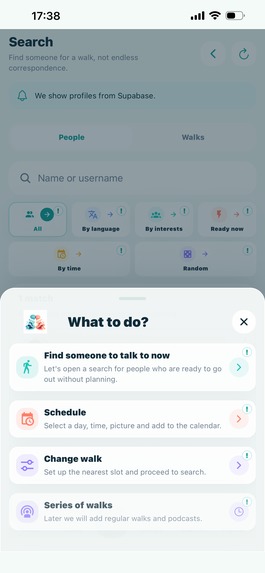
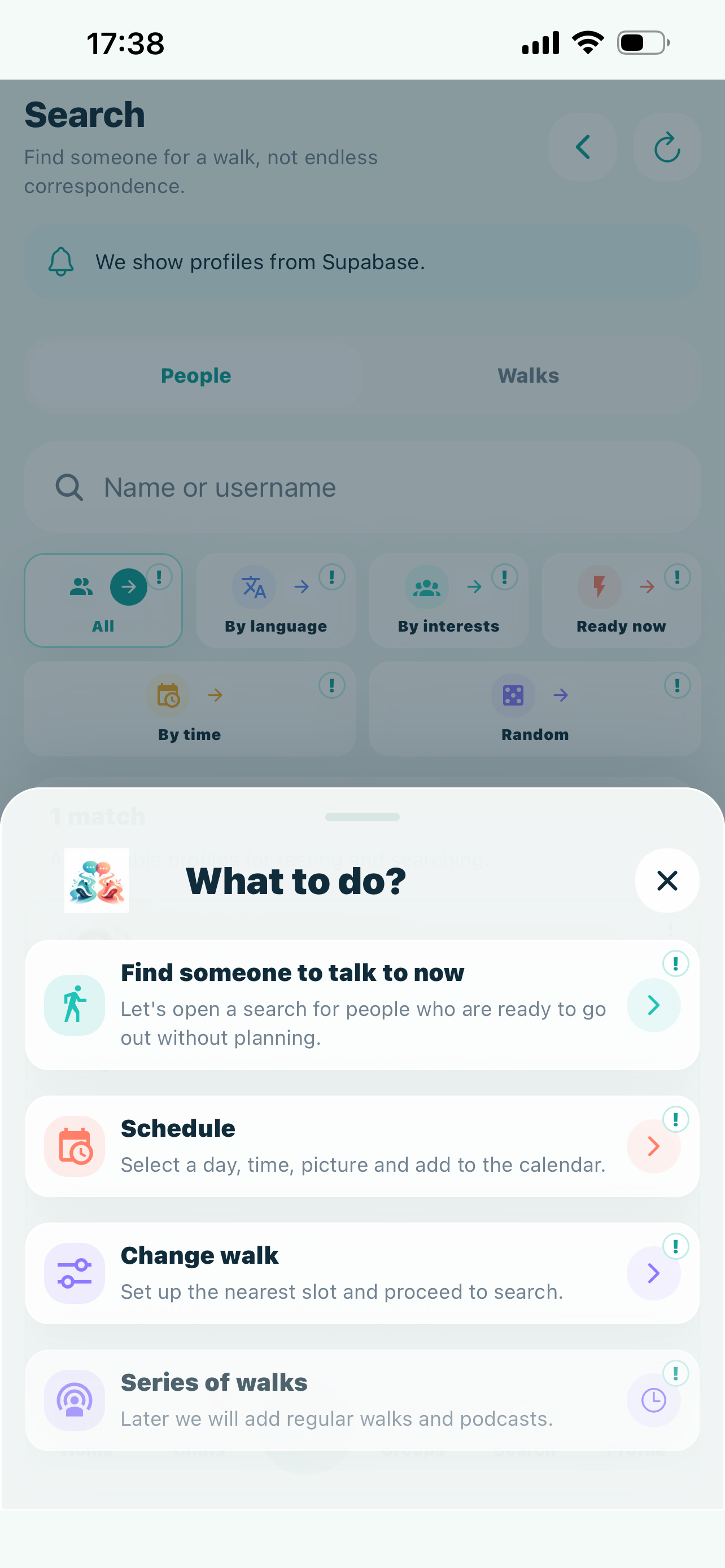
Start immediately, schedule for later, change a walk, or prepare a recurring series.
-
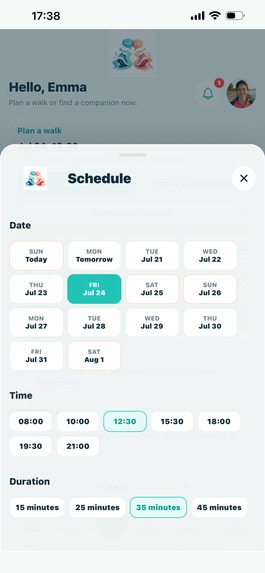
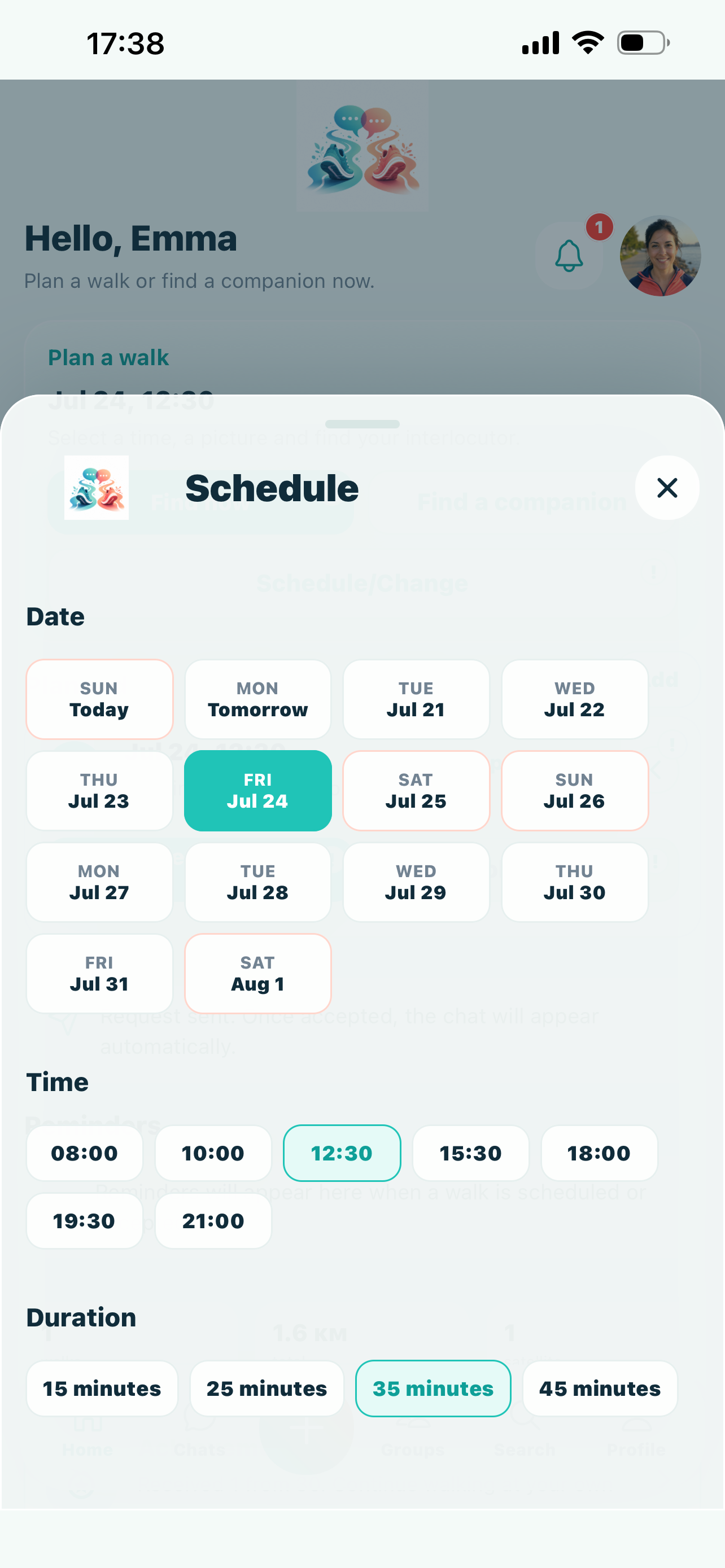
Schedule a walk by choosing a date, start time, and duration that fits your day.
-
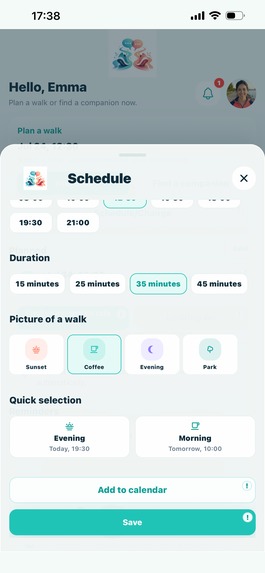
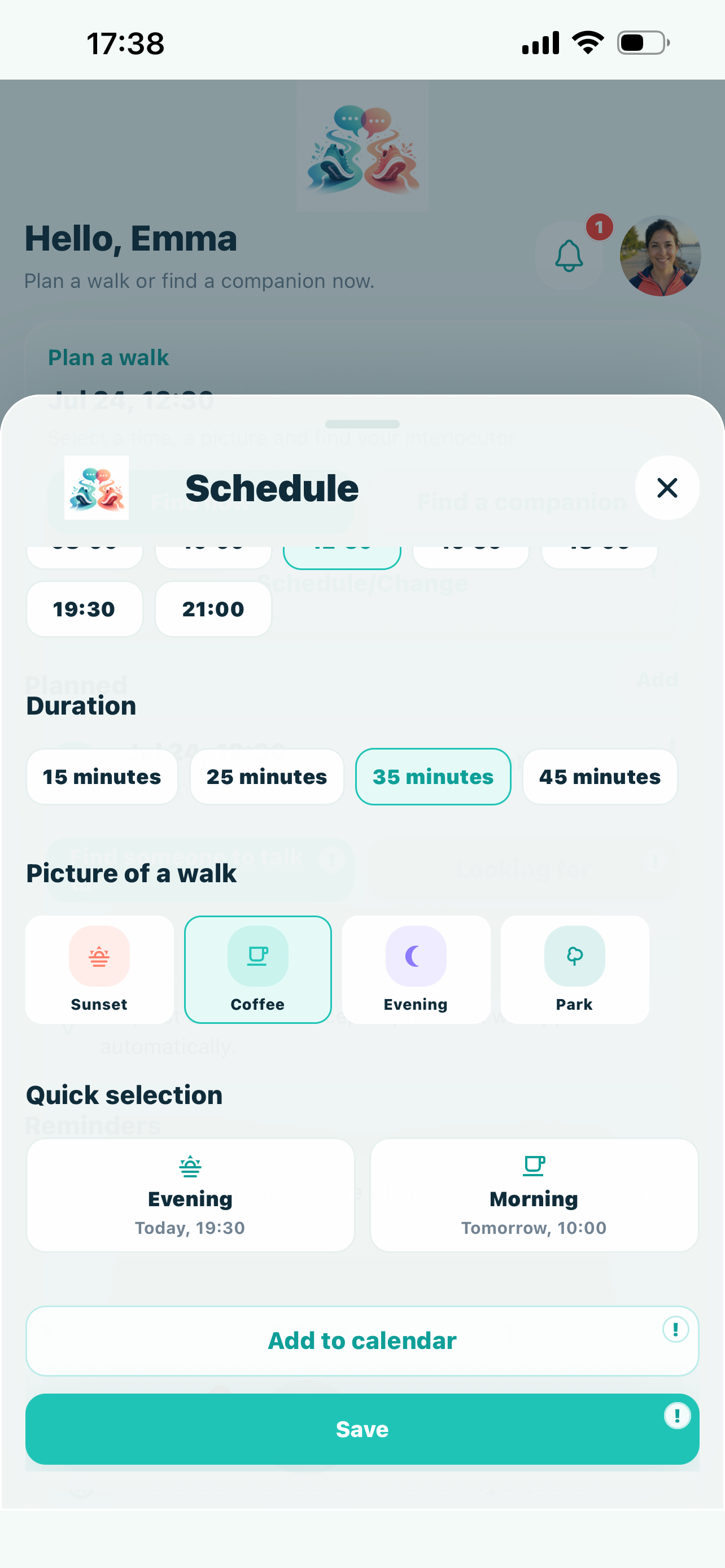
Personalize the walk with its duration and mood, then save it or add it to your calendar.
-
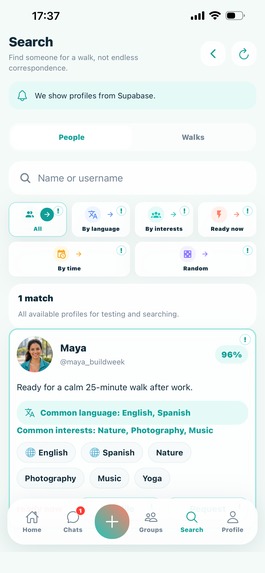
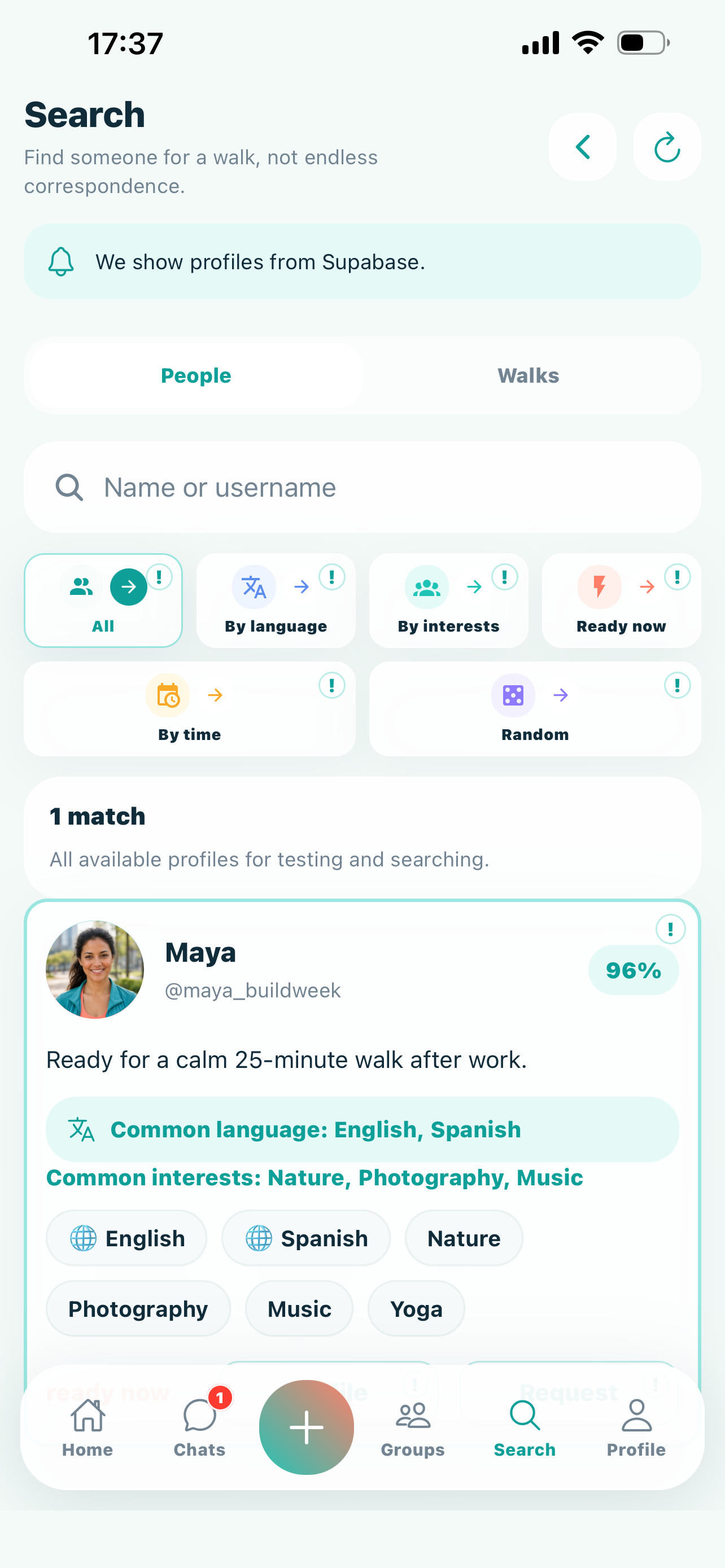
Language-aware matching finds Maya with a 96% score, shared languages, and common interests.
-
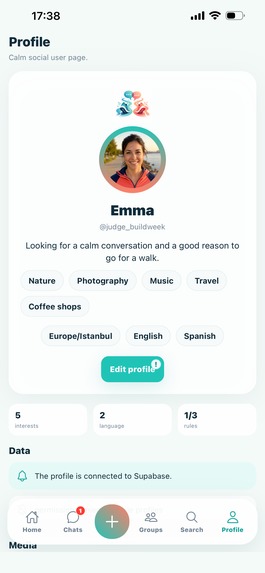
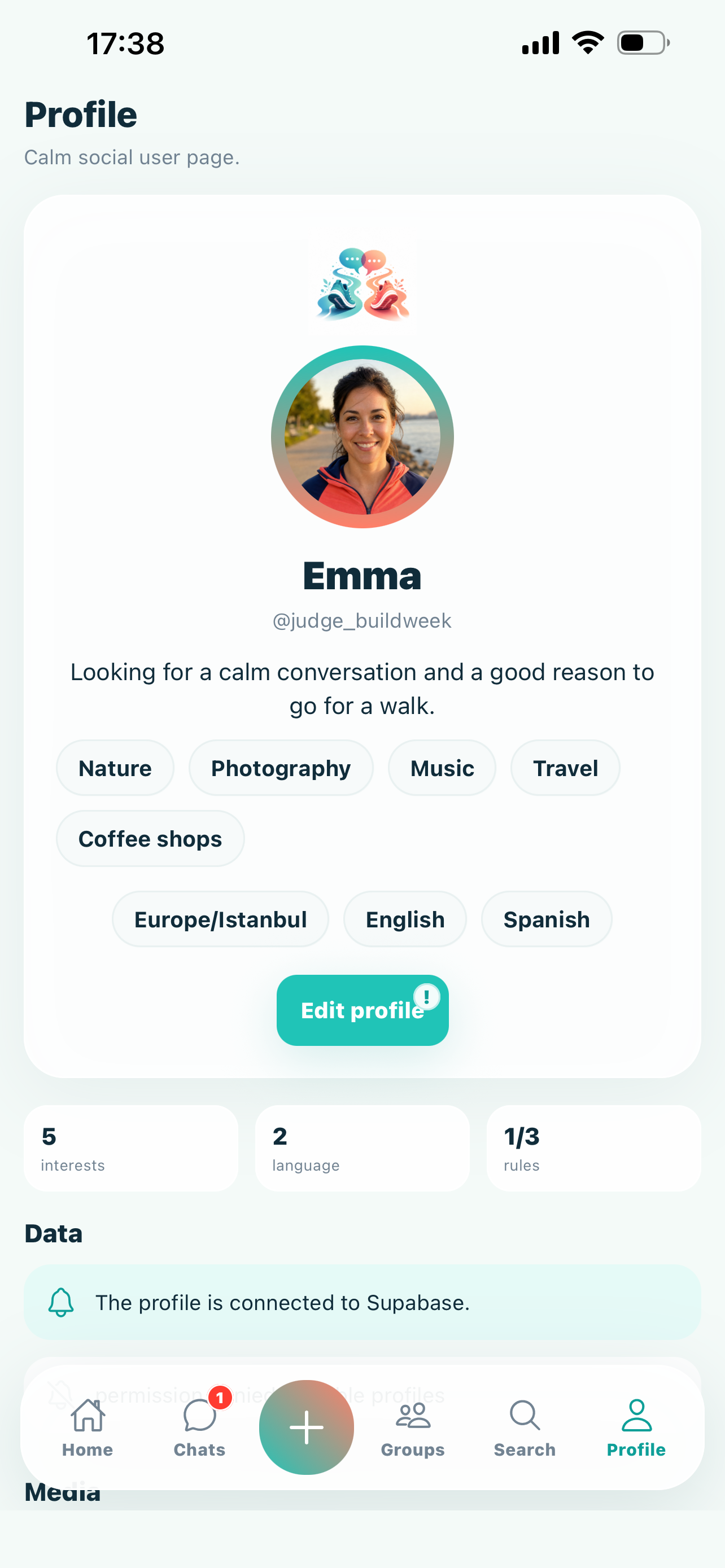
Emma’s Supabase-connected profile shows her interests, conversation languages, and time zone.
-
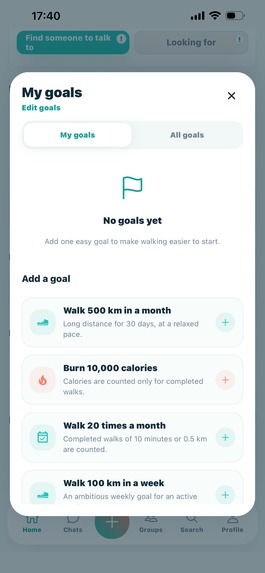
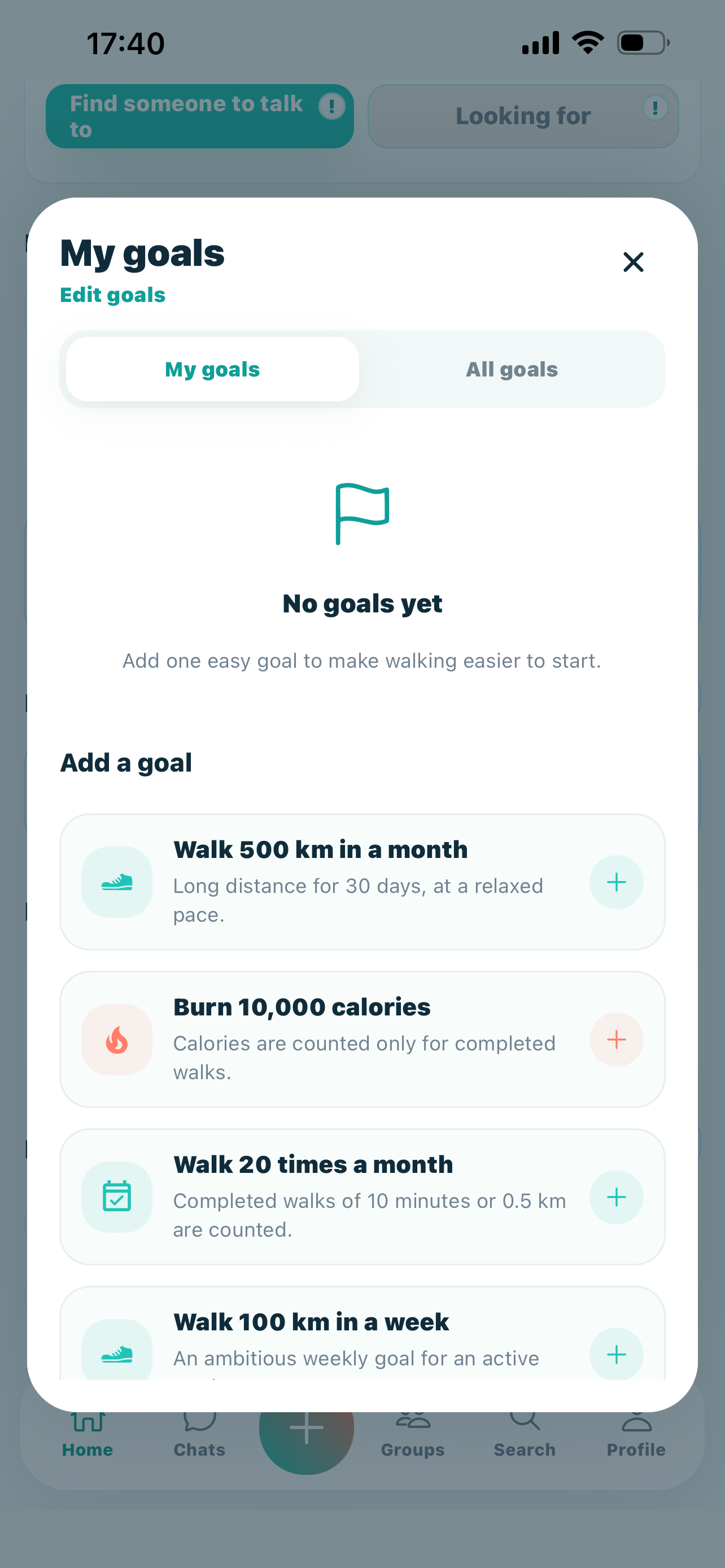
Choose motivating walking goals based on distance, completed walks, or estimated calories.
-
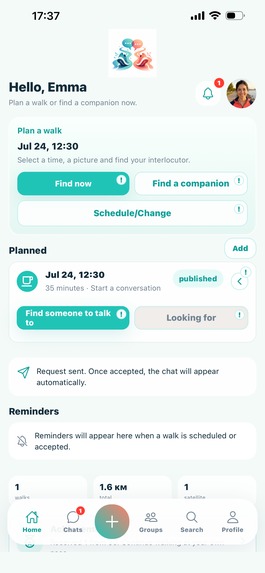
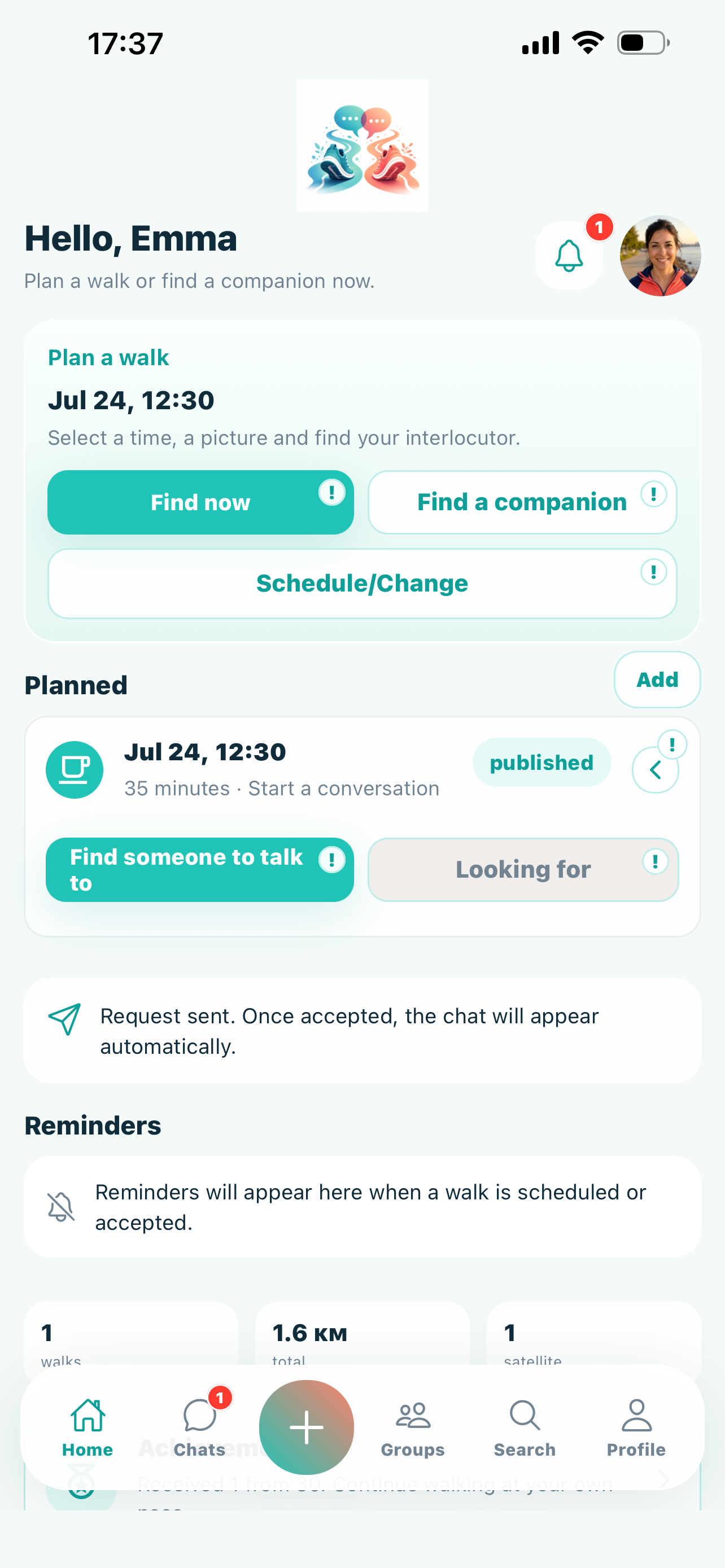
The home screen brings planned walks, requests, reminders, and activity progress together.
-
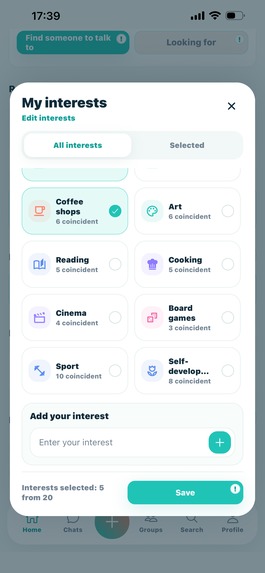
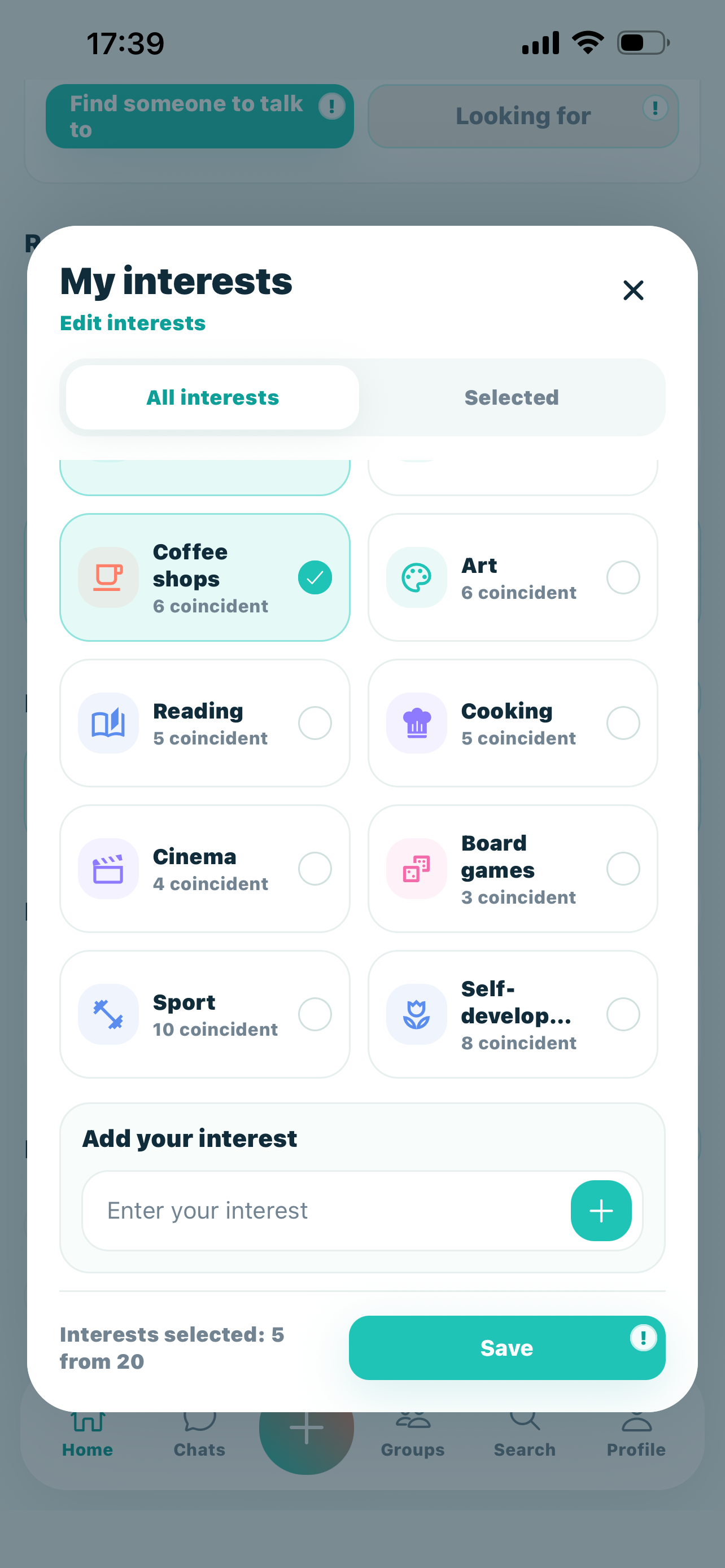
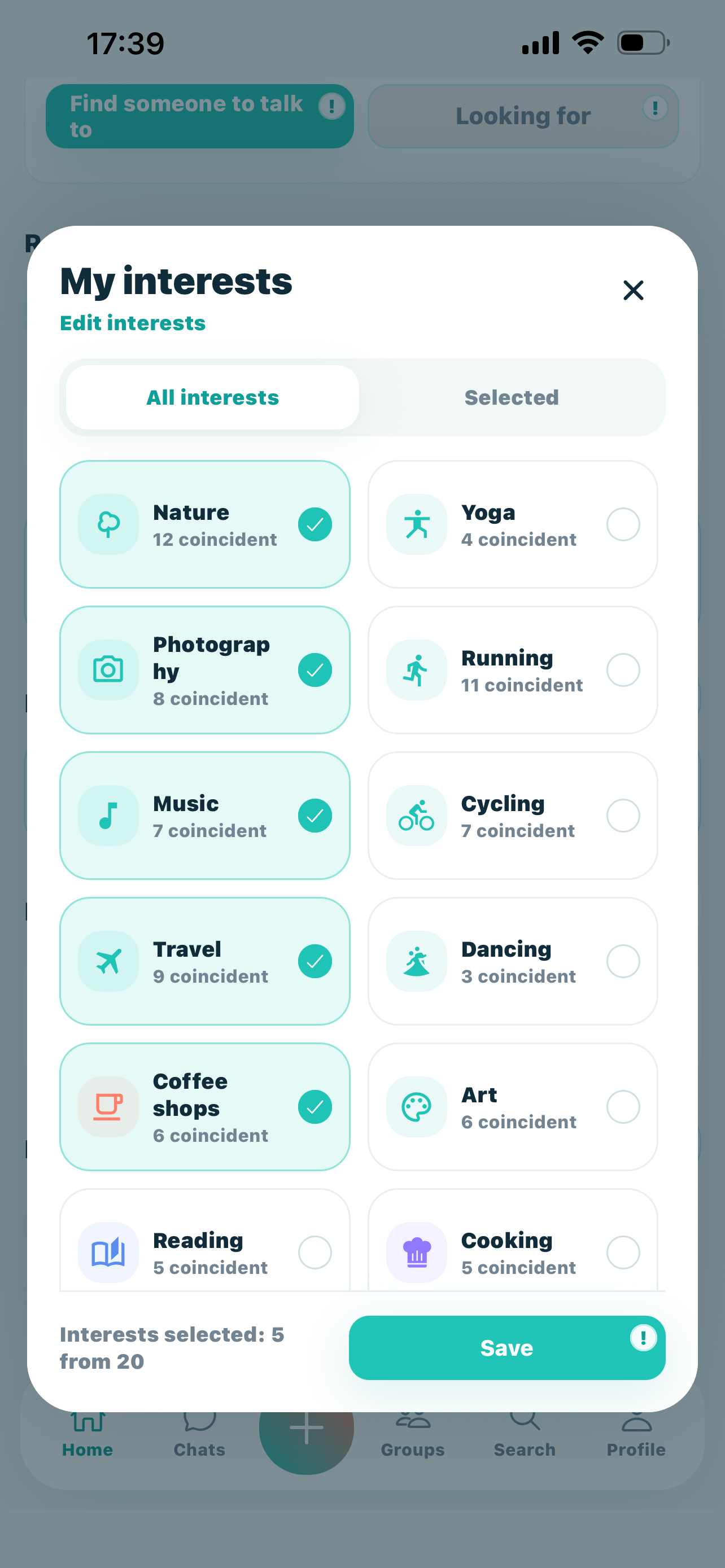
Select interests such as nature, photography, music, travel, and coffee to improve matching.
-
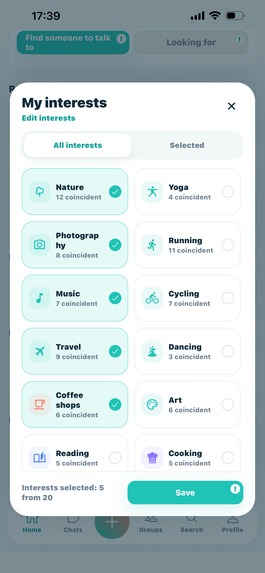
Explore interests and see how many potential companions share each one before updating your profile.
Inspiration
Reaching a daily step goal is good for an active lifestyle, but a long walk alone can feel slow and repetitive. A meaningful conversation changes the experience: time passes more naturally, people stay engaged, and completing a movement goal becomes more enjoyable.
STRIDAMI turns a solo walk into a shared experience. Two people can walk in different locations while talking to each other, and GPT-5.6 gives them a personalized conversation route without listening to or analyzing their call.
What it does
STRIDAMI is a bilingual social fitness app for finding a compatible walking companion and completing movement goals together.
A user can:
- choose English or Russian before signing in;
- create a profile with conversation languages, interests, availability, and walking pace;
- set personal step and cardio goals;
- find people using shared language and interests;
- send and accept a real walk request;
- open a private chat after the request is accepted;
- generate an AI Walk Route before the walk;
- join an audio-only walk from two different locations;
- track progress, goals, and achievements;
- report or block another user if necessary.
The AI Walk Route is generated by GPT-5.6 from a small amount of user-selected context: the shared conversation language, shared interests, and planned walk duration. It returns five progressive prompts designed to help the conversation begin naturally and continue throughout the walk.
The prompts are optional guides, not a script. STRIDAMI does not send voice audio to OpenAI and does not record, transcribe, or analyze the conversation.
What was built during OpenAI Build Week
STRIDAMI existed before the submission period as a broader mobile product prototype. Its pre-existing functionality included authentication, profiles, interests, walk requests, chats, notifications, moderation controls, goals, achievements, media messages, and the architecture for audio rooms.
During OpenAI Build Week, I meaningfully extended the project with Codex and GPT-5.6 by building:
- language data integration for real Supabase profiles;
- search filtering by conversation language;
- language-aware compatibility scoring;
- shared-language badges on profiles and search results;
- an authenticated Supabase Edge Function for AI route generation;
- OpenAI Responses API integration using GPT-5.6;
- Structured Outputs for reliable route responses;
- a privacy-preserving AI Walk Route based on shared interests, language, and duration;
- a safe curated fallback route for temporary API or network failures;
- the complete pre-walk route-generation interface;
- English and Russian product localization with a language selector before authentication;
- database permission hardening to prevent unauthorized role escalation;
- two fictional, authenticated demo people for end-to-end testing;
- production-readiness and two-device verification scripts;
- Build Week setup, testing, documentation, and demo materials.
This separation between the original product and the Build Week extension is also documented in the repository README and commit history.
How I built it
The mobile app is built with React Native and Expo for iOS and Android.
Supabase provides authentication, PostgreSQL, Row Level Security, Realtime data, Storage, and Edge Functions. The native audio-room architecture uses Voximplant.
The AI Walk Route is created by an authenticated Supabase Edge Function. The mobile client sends only the minimum matching context required for the route. The OpenAI API key remains on the server and is never exposed to the application. The function calls the OpenAI Responses API with GPT-5.6, requests a structured response, and uses store: false.
The generated route contains a title and five conversation prompts in the walkers’ shared language. Safety instructions prevent prompts that request addresses, contact details, financial information, diagnoses, forced disclosure of traumatic experiences, sexual content, or dangerous advice.
How I used Codex
Codex acted as an engineering and product collaborator throughout the Build Week extension.
It helped me:
- inspect and understand the existing React Native and Supabase architecture;
- identify that stored profile languages were not connected to live search;
- design the language-aware matching flow;
- design a useful AI feature that does not require analyzing private conversations;
- implement the GPT-5.6 Edge Function and structured response handling;
- connect the AI route to the mobile pre-walk experience;
- build the bilingual localization system;
- review database permissions and strengthen access controls;
- create readiness checks and two-device demo verification;
- document setup, architecture, privacy decisions, and the Build Week development boundary.
Codex accelerated architecture analysis, implementation, debugging, security review, and documentation. The product purpose, walking format, audience, design direction, safety boundaries, and final feature decisions remained my decisions.
Challenges
One challenge was adding an AI feature that improved the walk without making users feel monitored. Instead of recording or transcribing the call, I designed the route to use only context the users had already chosen for matching.
Another challenge was connecting language preferences to real search behavior. Language information already existed in the product, but it had to become part of filtering, compatibility scoring, profile presentation, and prompt generation.
The project also required coordinating authentication, database permissions, two-device state changes, native audio infrastructure, localization, and server-side AI generation while keeping the OpenAI key out of the mobile application.
Finally, because the core product existed before Build Week, it was important to document the original baseline and the new Codex/GPT-5.6 work transparently.
What I learned
I learned that AI can improve a social experience without becoming the center of it. In STRIDAMI, GPT-5.6 does not replace the conversation—it helps two people begin one.
I also learned that privacy and safety decisions work best when they are part of the architecture from the beginning. Minimizing the data sent to the model made the feature both simpler and more respectful.
Working with Codex showed me how quickly an existing product can be analyzed and meaningfully extended when product decisions, implementation, verification, and documentation are treated as one connected workflow.
Potential impact
STRIDAMI is designed for people who want to move more but struggle to stay motivated during long solo walks. It combines movement, remote companionship, language-aware matching, and AI-guided conversation in one coherent experience.
Unlike a traditional fitness tracker, STRIDAMI does not only count activity after it happens. It helps create a reason to begin the walk and makes the time spent moving feel more social and engaging.
What’s next
Next steps include expanding localization beyond English and Russian, improving matching recommendations, completing broader two-device voice testing, adding more accessibility options, and evaluating whether AI conversation routes help users complete walks more consistently over time.
Built With
- ai
- android
- codex
- expo.io
- gpt-5.6
- ios
- javascript
- openai
- openaiapi
- postgresql
- reactnative
- responsesapi
- structuredoutputs
- supabase
- supabaseedgefunctions
- supabaserealtime
- typescript

Log in or sign up for Devpost to join the conversation.