-
-
Stretchy-Cover
-
Stretchy-2
-
Stretchy-3
Stretchy — Keeping Movement Alive in a Digital World
Inspiration
Children today spend more time interacting with digital devices than ever before. While screens provide valuable opportunities for learning and creativity, they also encourage long periods of stillness and fixed visual attention.
During our research, we began asking a simple question:
What happens to our spatial awareness when our bodies remain still while our eyes stay locked on a screen?
Human spatial balance relies on the vestibular system, which activates when we move, tilt, and change orientation. However, modern screen use often minimizes these natural movements.
Stretchy was inspired by the idea that technology could gently reintroduce moments of movement and spatial awareness during screen time rather than simply limiting it.
What it does
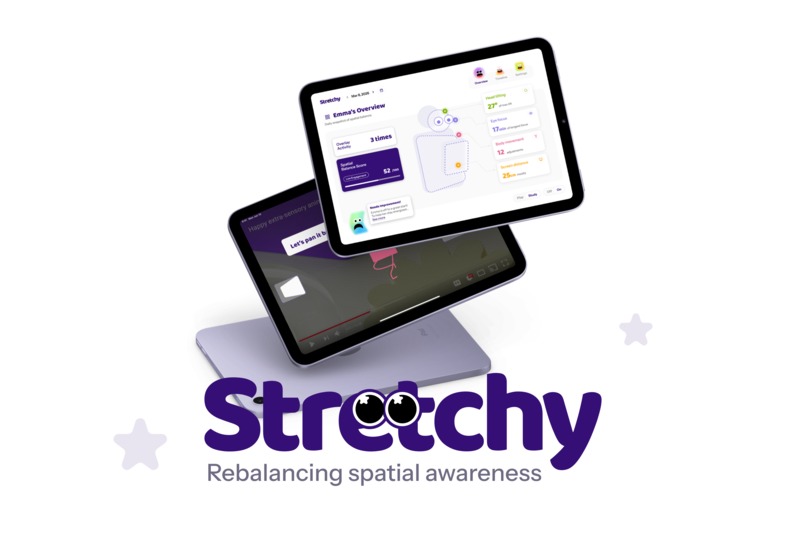
Stretchy is a spatial awareness companion designed to help children stay physically engaged while using digital devices.
Instead of correcting posture, Stretchy introduces subtle prompts that encourage:
- body tilting
- head orientation changes
- eye exploration
- spatial engagement
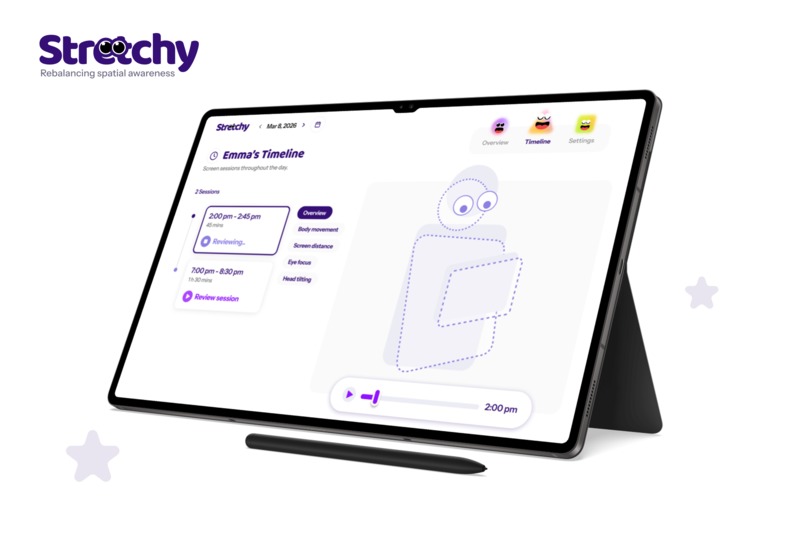
The system observes simple behavioral signals such as:
- head tilt
- upper body movement
- eye focus duration
- screen distance
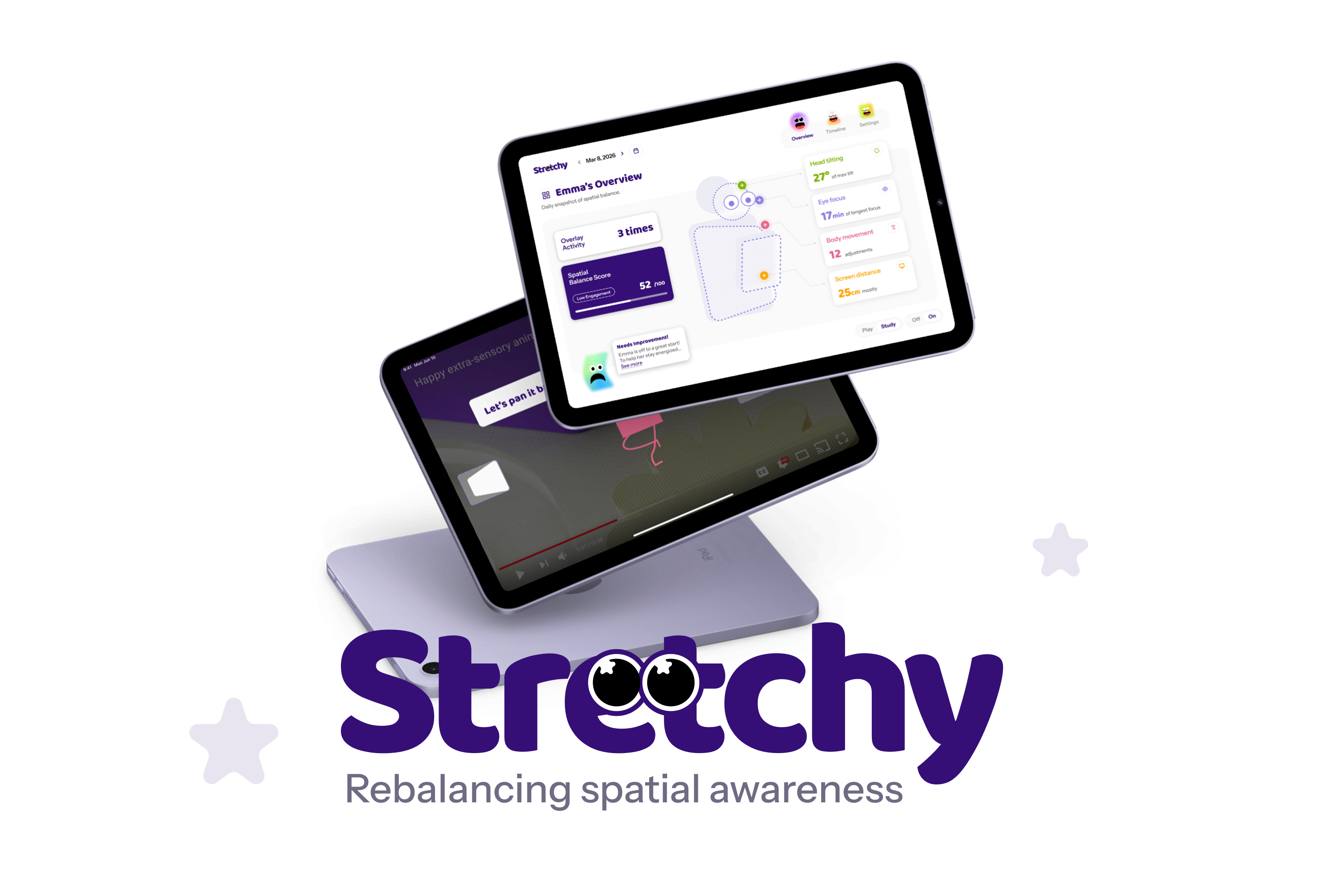
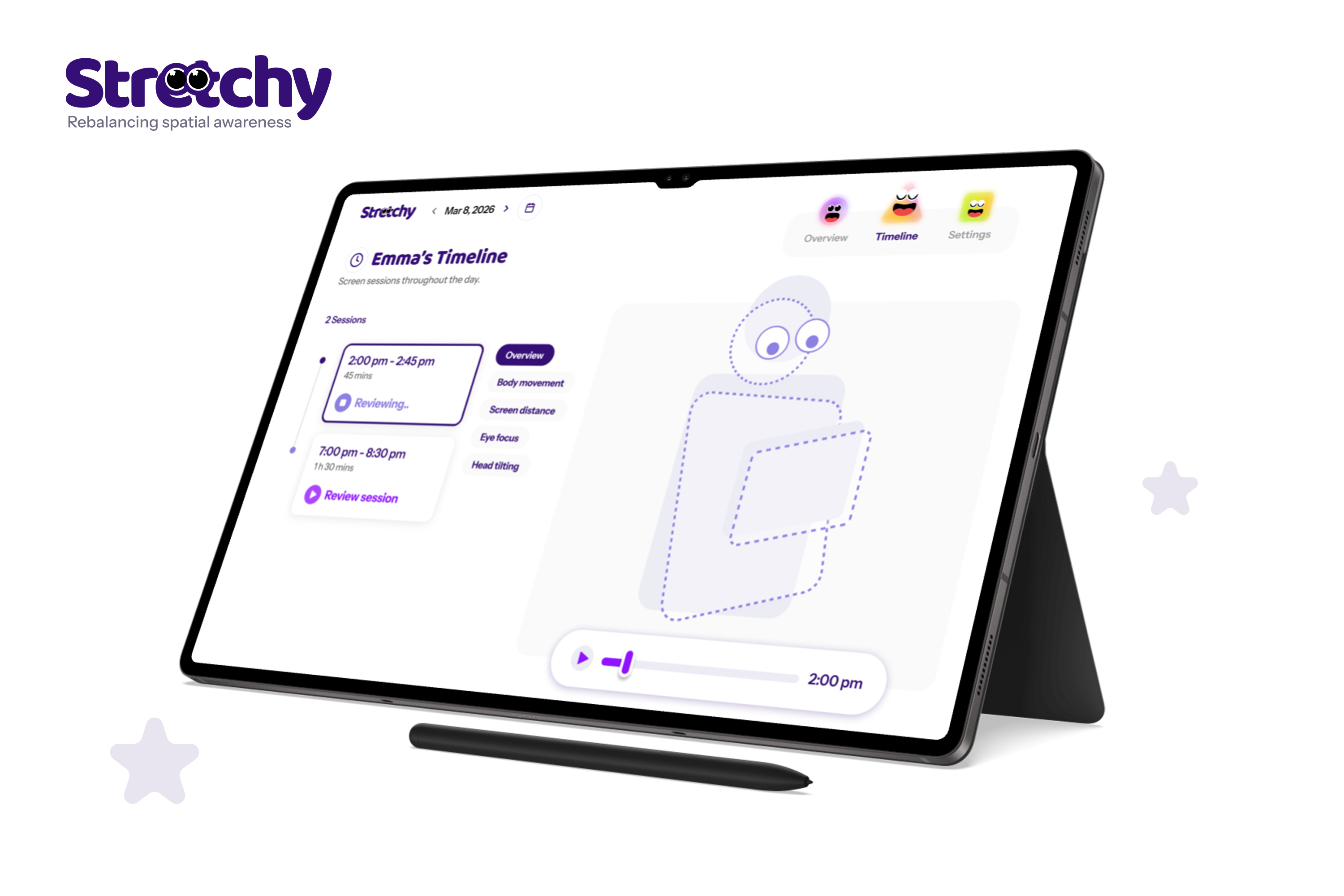
These signals are translated into a Spatial Balance Score, helping parents understand how actively their child’s body interacted with space during screen use.
The goal is not to restrict screen time, but to bring spatial balance back into digital experiences.
How we built it
Stretchy was developed as a speculative interaction design project exploring how spatial balance could become part of the quantified self movement.
We explored how existing sensing capabilities in modern devices could estimate spatial engagement through observable signals.
The Spatial Balance Score can conceptually be derived from multiple behavioral inputs:
$$ S = w_1H + w_2B + w_3E + w_4D $$
Where:
- $S$ = Spatial Balance Score
- $H$ = head orientation change
- $B$ = body movement frequency
- $E$ = eye focus variation
- $D$ = screen distance stability
- $w_i$ = weighting factors for each signal
These signals are translated into a dashboard interface that visualizes spatial activity across sessions.
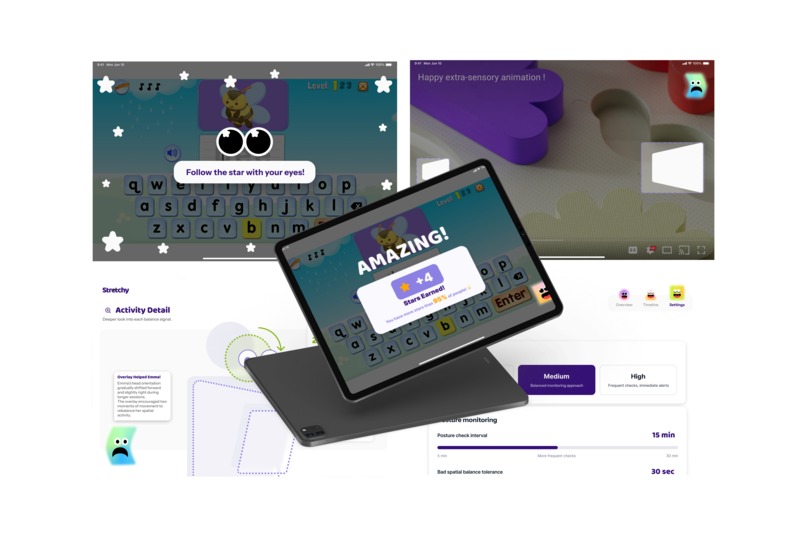
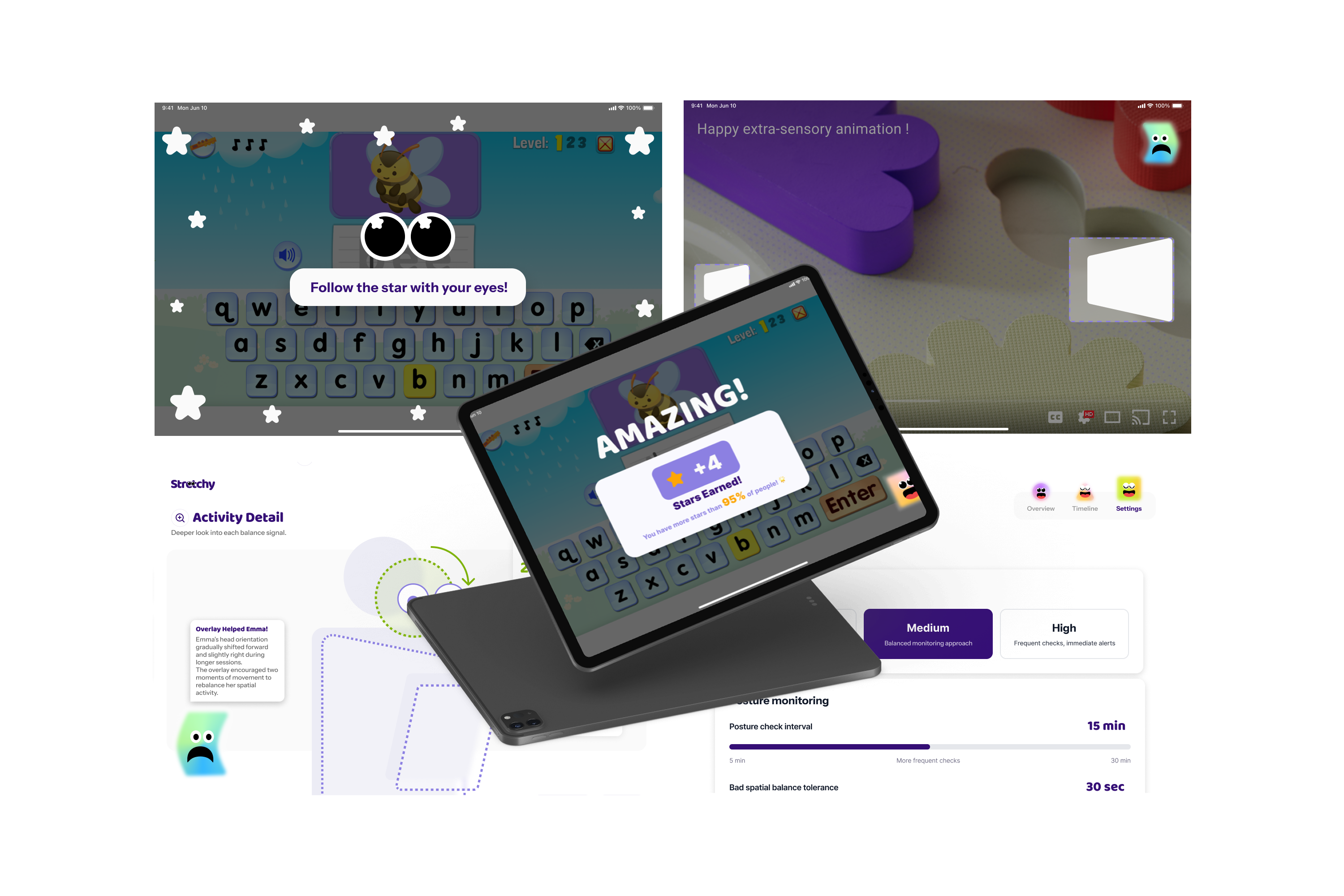
Stretchy also introduces movement prompts and visual exploration exercises as overlays during screen use.
Challenges we ran into
One of the biggest challenges was deciding how to represent spatial activity without overwhelming users with technical data.
Signals like head orientation and vestibular engagement are complex, so we focused on translating them into simple behaviors that parents can easily understand.
Another challenge was avoiding the feeling that Stretchy was a posture correction tool. Instead, we reframed the experience around spatial awareness and balance.
We also had to consider edge cases such as:
- children ignoring prompts
- shared device usage
- privacy concerns related to sensing technologies
Accomplishments that we're proud of
We are proud that Stretchy reframes the conversation around screen time.
Instead of restricting digital experiences, Stretchy explores how technology can support healthy physical awareness within digital environments.
We also developed a body-centered visualization system that helps parents intuitively understand spatial activity.
Most importantly, Stretchy introduces the idea that spatial balance could become a new category of digital wellbeing tools.
What we learned
This project taught us how difficult it can be to translate invisible sensory systems into meaningful user experiences.
Designing around spatial awareness required balancing:
- scientific concepts
- simple visual explanations
- child-friendly interactions
We also learned that language matters. Framing the system as spatial awareness rather than posture correction significantly changed how people perceived the product.
What's next for Stretchy
Future versions of Stretchy could expand the sensing system to include richer signals such as device motion, environmental context, and adaptive learning models.
Machine learning could personalize prompts based on each child's movement patterns.
Stretchy could also extend beyond tablets to other devices such as laptops, televisions, and mixed-reality environments.
Ultimately, Stretchy explores a simple idea:
keeping movement alive in a digital world.
Built With
- adobeillustrator
- adobephotoshop
- adobepremierepro
- figma
- figmamakeai
- midjourney


Log in or sign up for Devpost to join the conversation.