-
30-second analysis
-
Stress detected w/ notification


Inspiration
No matter how old or what job you have, stress will always play a factor in everyone’s lives. As high students, our form of stress comes from school and studying. Stress has such a huge impact on society especially amongst students in school today. To help alleviate this problem, we have created a mobile application, STREST, that will help students being stressed out. We believe that our application has a social, health and economic impact in our society. This application gives the community an opportunity to solve a common issue, detect and attempts to reduce stress for the user as well as create jobs for coders and app developers.
What it does
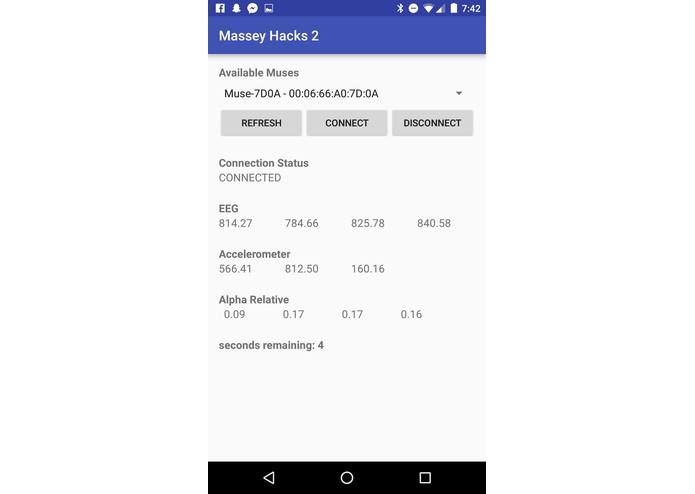
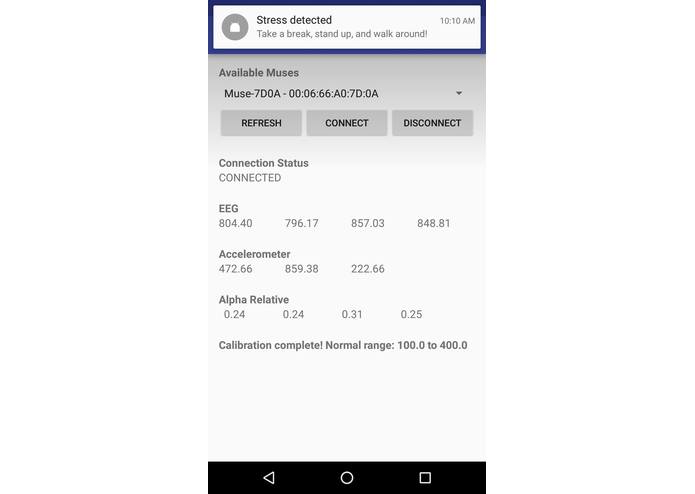
STREST, is an Android application works in conjunction with the Muse headband. The Muse headband is a wearable technology that has the ability to detect live brain wave signals. The Muse detects 4 sections of the brain (labeled TP9, AF7, AF8, and TP10) and uses these sections to generate 4 EEG values. Upon starting the app, the user will be instructed that the app will do a quick 30-second analysis. An average range will be derived from this short analysis by our algorithm. The app will still continue to take in the EEG values from the Muse. If the EEG values is higher than the range originally detected, a notification will be presented on the phone. This will let the user know that they are stressed and should take a break.
How we built it
In order to build this mobile app, we used Android Studio. In addition, we also downloaded the developer’s kit for Muse headbands to access certain features of the wearable tech. We first started off the project by downloading their sample source code. From that point, we made changes and continued to build on from there. However, due to the limitations of this event some assumptions had to be made while making the application. Such assumptions include:
- The user was calm during the 30-second analysis
- Only one Muse Headband was paired
- Assumed that a higher EEG would be a sign of stress
- The main user of the app will be high school and university students
Challenges we ran into
Throughout the challenge, there were many challenges that we faced. Some of the challenges include understanding the confusing free open source code, getting values with no units from the Muse, writing an app based off the open source code and understanding the functions of the Muse SDK.
Accomplishments that we're proud of
Some accomplishments that we are proud of are getting the Muse Headband to work as well as getting the basic application running and working.
What we learned
Some things that we have learned from developing STREST is to always be always be adaptable to the situation and to always create a backup plan. In the event that the project deviates from the intended goal, a backup plan will be helpful in bringing us back on track.
What's next for STREST
If given the opportunity to work on STREST in the future, some ideas that we would further incorporate would be to develop an application for smartwatches, get the application to run in the background, graph user data as well as to develop a more accurate way of detecting stress.

Log in or sign up for Devpost to join the conversation.