-
-
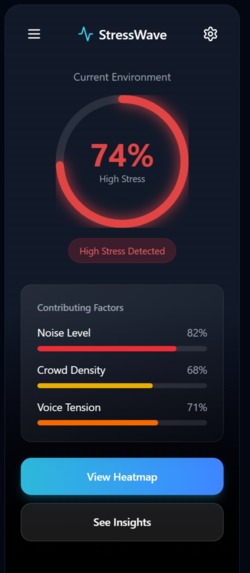
Dashbaord
-
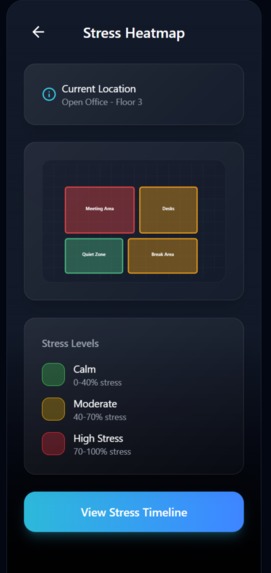
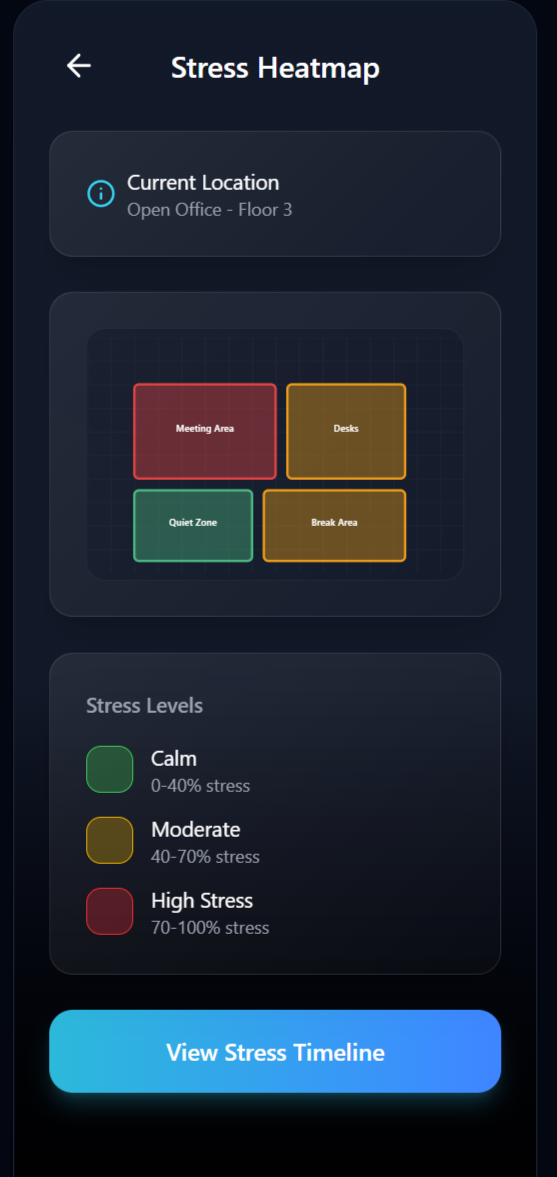
Stress Heatmap
-
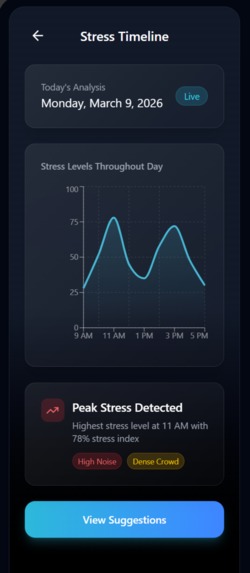
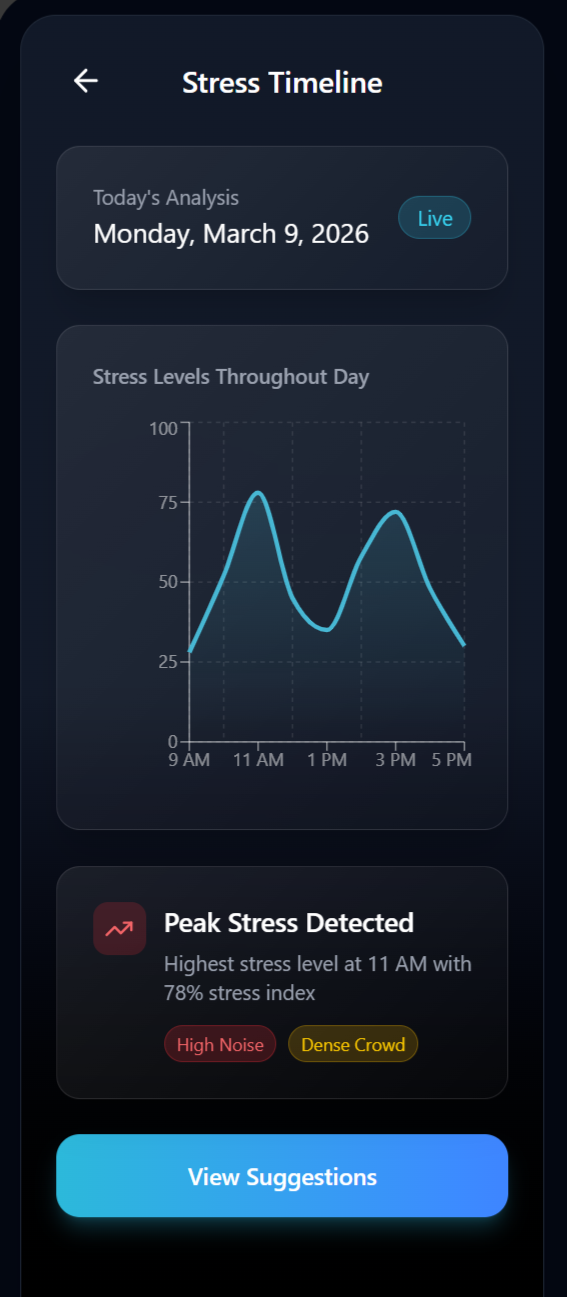
Stress TImeline
-
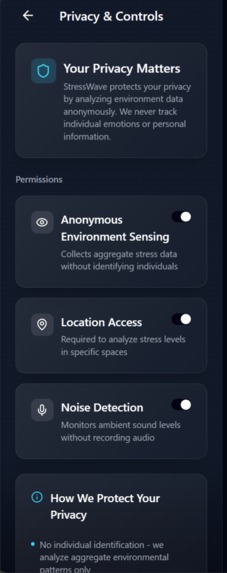
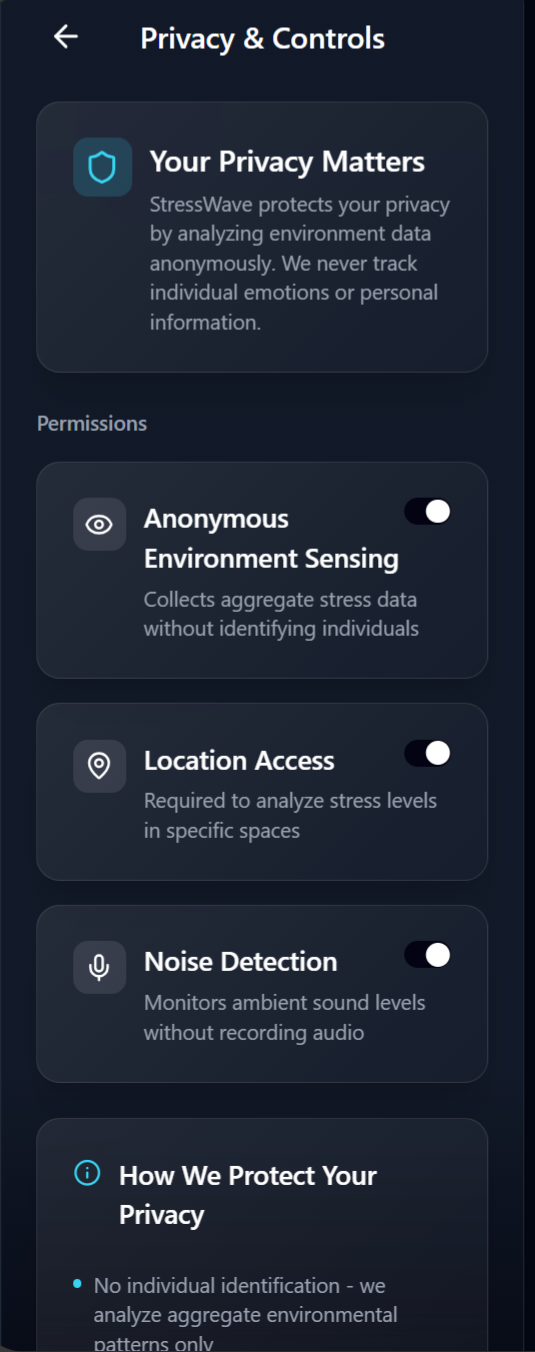
Privacy Controls
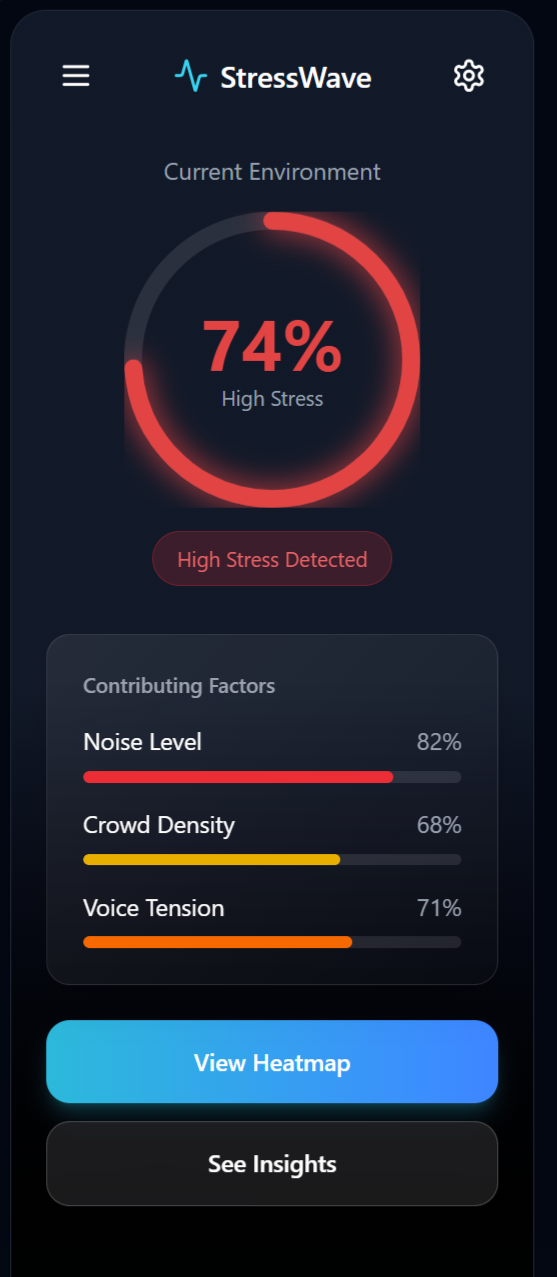
StressWave Inspiration Stress is a common part of daily life, but it is often invisible until it becomes a serious problem. In classrooms, students feel exam pressure. In workplaces, meetings can become tense. In crowded public spaces, stress can lead to panic or conflict. While modern technology allows us to track many aspects of personal health such as heart rate, sleep, and activity levels, we still lack tools to understand the collective emotional state of environments. StressWave was inspired by the idea of giving humans a new sense — the ability to perceive the stress level of shared spaces. By making invisible emotional signals visible, people can respond earlier and create healthier environments.
What it does StressWave is a speculative tool that detects and visualizes environmental stress levels in real time. The system analyzes signals from the environment such as:
- noise levels
- voice tone patterns
- movement and crowd behavior
- environmental activity patterns Using AI analysis, StressWave calculates a Stress Index that represents the stress level of a space.
The interface then displays:
- a real-time stress dashboard
- a stress heatmap of the environment
- actionable recommendations to reduce stress The goal is to help individuals and organizations become aware of hidden tension and take steps to improve wellbeing.
How we built it StressWave was designed as a future-forward speculative concept focusing on user experience and interaction design. The project was built using: Figma Make to design the user interface and application prototype Figma Slides to present the concept, system design, and use cases AI-assisted design tools to explore futuristic UI concepts and visualizations The interface includes a Stress Index dashboard, environmental heatmaps, and scenario-based recommendations. The design focuses on making complex emotional data simple, visual, and actionable.
Challenges we ran into One of the biggest challenges was designing a system that measures something intangible and currently unmeasurable. Stress is complex and influenced by many factors, so translating that concept into a clear visual system required careful design thinking. Another challenge was avoiding information overload. Since environmental data could become overwhelming, we focused on presenting only the most important insights through a simple Stress Index and visual heatmaps. Designing safeguards around privacy and ethical use was also an important part of the process.
Accomplishments that we're proud of We are proud of designing a concept that introduces a completely new type of sensory awareness. StressWave transforms invisible emotional signals into clear, understandable insights. The project also explores how future technology could support emotional wellbeing, better communication, and healthier shared spaces. The interface design successfully communicates complex data through simple and intuitive visualizations.
What we learned Through this project we learned: how speculative design can explore future possibilities how to translate abstract ideas like stress into measurable signals how important ethical considerations are when designing sensing technologies how user experience design can simplify complex information This process helped us think beyond current technology and focus on human needs and wellbeing.
What's next for StressWave In the future, StressWave could evolve into a system that integrates with smart environments and wearable sensors. Possible next steps include: integrating with smart building sensors developing real-time environmental stress heatmaps expanding to support schools, workplaces, and public spaces improving AI models to better understand emotional patterns in environments
Ultimately, StressWave could help create calmer, safer, and more supportive environments by giving people the ability to sense and respond to stress before it escalates.
Built With
- figma
- figma-make
- figma-slides
- lovable-ai
- loveart


Log in or sign up for Devpost to join the conversation.