-
-
1
-
2
About the Project --Inspiration When I started this project, I was struck by a simple statistic: 87% of students experience stress regularly, yet most suffer in silence. In my own circle, I watched friends struggle with anxiety, sleep problems, and overwhelming academic pressure, but they felt too embarrassed to seek help or didn't even know where to start.
I realized that the problem wasn't a lack of resources; it was accessibility and stigma. Mental health support felt clinical, expensive, and hard to access. What if we could use AI to make stress detection feel like a conversation, not a clinical evaluation? What if students could understand their emotional state in seconds, with zero judgment?
That's when I got the idea for StressSense AI, an application that uses artificial intelligence to meet students exactly where they are: in their journal entries, their honest thoughts, their late-night worries.
The inspiration deepened when I discovered this aligns with UN Sustainable Development Goal 3 (Good Health and Well-Being). By 2030, mental health crises among youth are projected to be a leading cause of disability. We have a responsibility to act now.
--What I Learned Building StressSense AI taught me far more than just technical skills:
On Natural Language Processing: How sentiment analysis works (VADER's compound scoring system) Why pre-trained models like NLTK VADER are powerful, they understand context, slang, and emojis The importance of choosing the right tool for the job (why VADER over expensive APIs)
On Design & User Experience: That mental health apps need to feel welcoming, not clinical How color psychology affects emotional responses (purple conveys calm, safety, femininity) That educational sidebars can reduce anxiety by providing context and support The power of small details: emojis, animations, confirmation messages
On Product Development: Input validation prevents errors AND makes users feel heard Personalization matters, different stress levels need different recommendations Privacy-first architecture builds trust Open-source solutions democratize technology globally
On Mental Health: That technology can't replace professionals, but it CAN be a bridge to help How AI can reduce stigma by making mental health data-driven and normal That hope and support can be designed into code
--How I Built It Phase 1: Planning & Research (Days 1-2) Researched existing solutions (Woebot, Headspace, clinical tools) Analyzed why they fell short Selected NLTK VADER as the core AI engine Designed the 3-tier stress classification system Sketched out the user journey
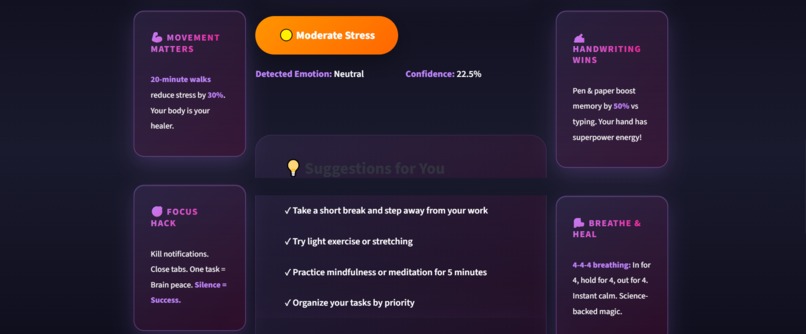
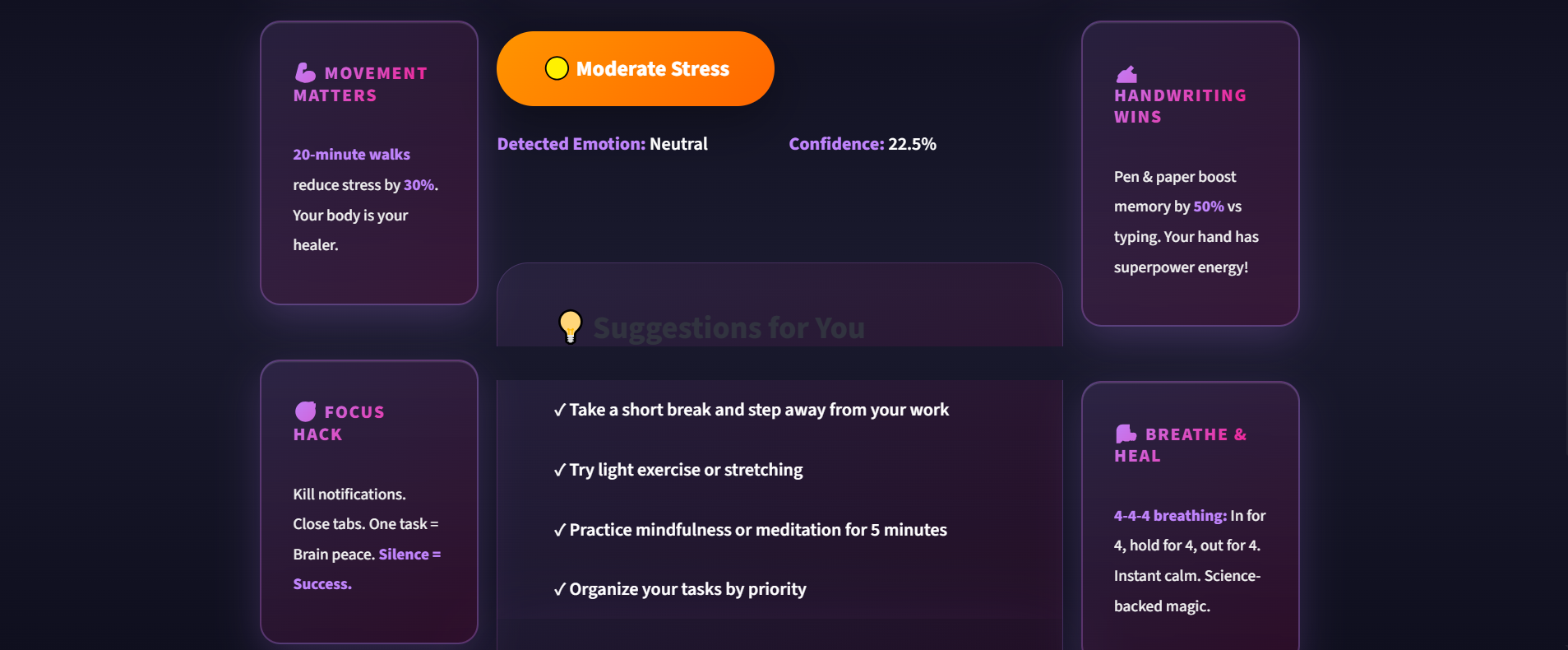
Phase 2: Core Development (Days 3-5) Built the Streamlit framework Implemented NLTK VADER sentiment analysis Created the stress classification algorithm: Compound score ≥ 0.3 → Low Stress (🟢) -0.3 < Score < 0.3 → Moderate Stress (🟡) Compound score ≤ -0.3 → High Stress (🔴) Developed context-aware recommendation engine Implemented input validation (10-5000 characters, sanitization)
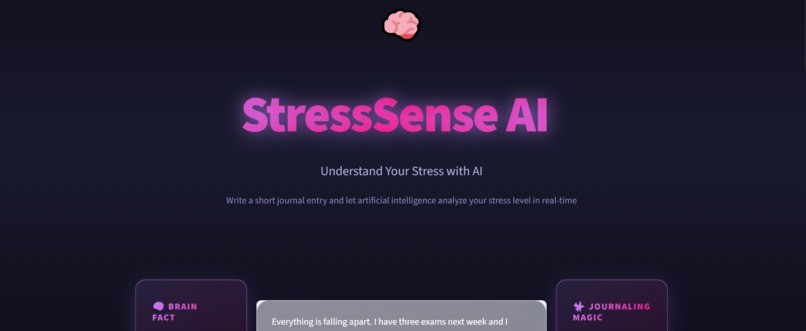
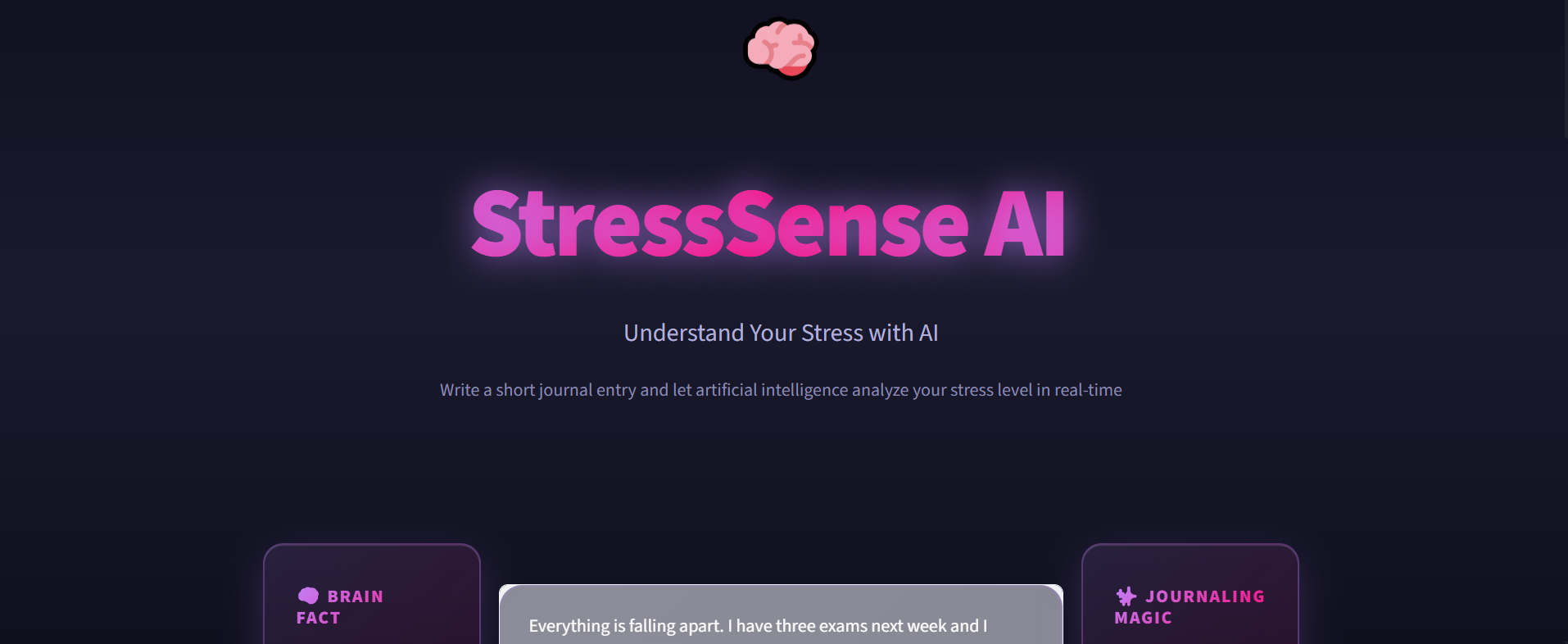
Phase 3: UI/UX Design (Days 6-10) Created dark theme with purple (#c084fc) and hot pink (#ff006e) gradient Built glassmorphic cards with animations Designed responsive 3-column layout: Left: 5 stress facts & study tips Center: Journal input + analysis + recommendations Right: 5 journaling benefits & mental health resources Added smooth animations (fade-in, slide-up, glow effects) Implemented interactive hover effects
Phase 4: Testing & Refinement (Days 11-12) Tested all three stress scenarios Debugged text visibility issues Optimized response time (achieved <1 second) Created comprehensive README and documentation
Phase 5: Deployment & Submission (Days 13-14) Pushed to GitHub (https://github.com/FatimaIsmailHere/StressSenseAi) Created demo script for 2-minute video Wrote technical report documenting architecture Prepared submission materials
Technology Used: Frontend → Streamlit (Python web framework) → Custom CSS/HTML (900+ lines)
NLP Engine → NLTK VADER Sentiment Analyzer → Real-time processing
Backend → Pure Python (no database needed) → Session state for results tracking
Design → Glassmorphic cards → Gradient overlays → CSS animations Challenges Faced Challenge 1: Choosing the Right NLP Engine Problem: Initially considered Hugging Face Transformers, but they required too much compute Solution: Switched to NLTK VADER, lightweight, pre-trained on social media (perfect for student language), and accurate Learning: Sometimes simpler is better. VADER's 85-92% accuracy proved sufficient
Challenge 2: Text Visibility Issues Problem: Early versions had light purple text on dark backgrounds, nearly invisible Solution: Changed all text to bright white (#ffffff) with !important flags for Streamlit CSS override Learning: Accessibility isn't optional; it's essential
Challenge 3: UI Layout Responsiveness Problem: Information cards were rendering as empty rectangles Solution: Rewrote HTML structure, removed wrapper divs, used proper CSS targeting Learning: Streamlit has specific CSS expectations; understand the framework deeply
Challenge 4: Color Theme Migration Problem: Decided to switch from neon green to purple for "girlish touch"—required 24+ color replacements Solution: Systematically updated all gradient colors, shadows, and accents Learning: Plan color schemes early; refactoring is tedious
Challenge 5: Balancing AI with Human Touch Problem: Pure AI analysis felt cold and clinical Solution: Added 10 educational sidebars with facts, tips, and encouragement Learning: Technology should enhance human connection, not replace it
Challenge 6: Ethical Concerns Problem: How do we ensure the app doesn't give false confidence or replace professional help? Solution: Added prominent disclaimers, encouraged professional support, designed for early intervention not diagnosis Learning: With AI comes responsibility; ethics isn't an afterthought
The Result StressSense AI is now a production-ready web application that:
✅ Analyzes stress in <1 second ✅ Provides personalized recommendations ✅ Educates about mental health techniques ✅ Runs completely free and open-source ✅ Respects user privacy (zero data storage) ✅ Aligns with UN SDG Goal 3 More importantly, it demonstrates that AI can be kind, accessible, and empowering

Log in or sign up for Devpost to join the conversation.