-
-
StreamSideKick AI
Inspiration
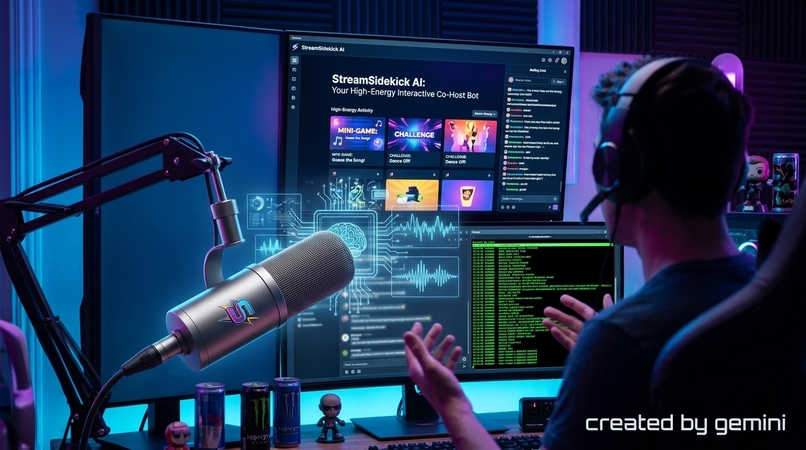
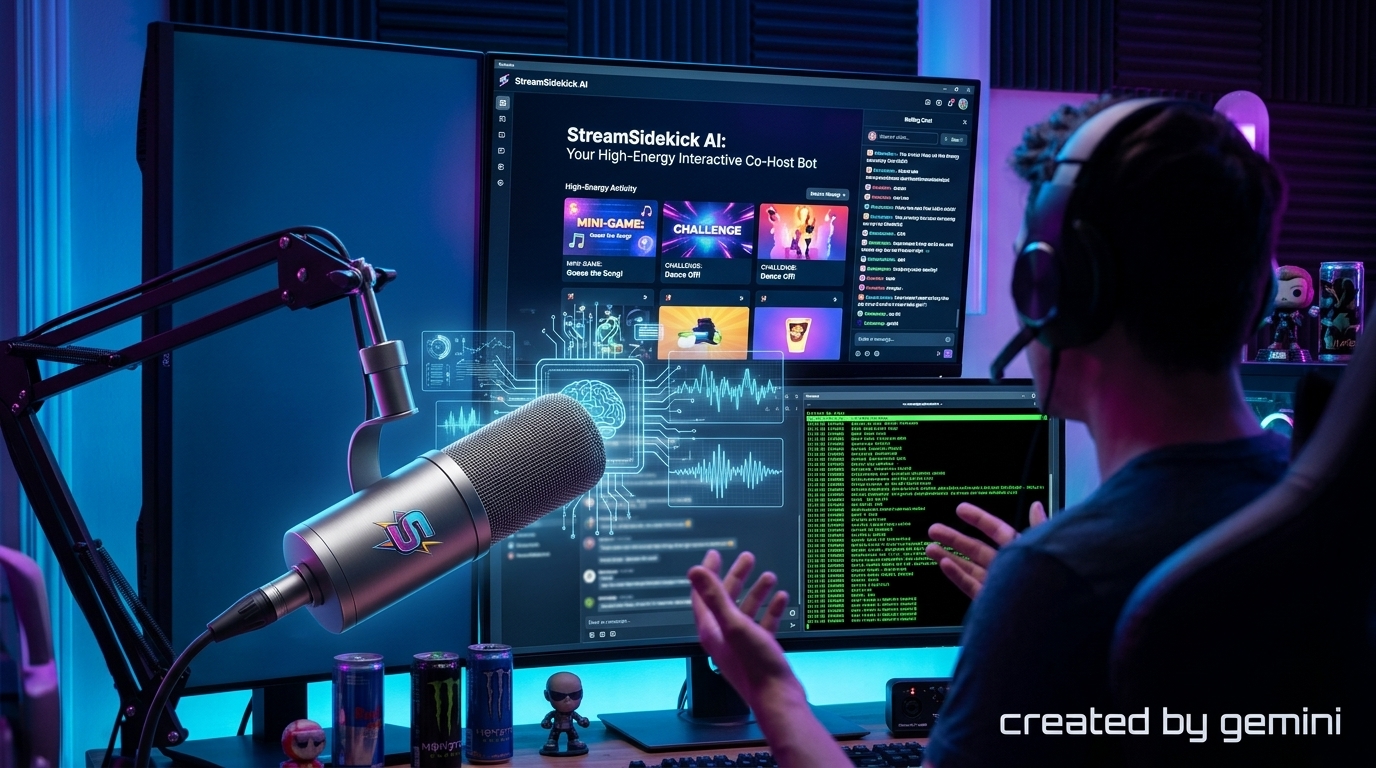
Live streaming is fast-paced, unpredictable, and highly demanding. Streamers often face "creator burnout" or moment-to-moment quiet spots when trying to continuously invent fun content, poll their viewers, and manage chat interactions in real time. We wanted to build StreamSidekick AI—a high-energy, real-time interactive Twitch co-host that acts as a dynamic co-pilot for live content creators. By combining zero-cost local AI compute with bulletproof cloud fallback resilience, StreamSidekick keeps live chat engaged, handles audience activity requests, and suggests live stream ideas on the fly without ever disrupting the streamer's technical setup.
What it does
StreamSidekick AI connects directly into Twitch live streams via WebSockets to act as an automated, high-octane co-host:
Interactive Stream Activity Generation: Responds instantly to !sidekick commands from viewers, outputting 3 actionable, engaging stream activities under Twitch's 350-character limit.
Proactive Empty-Prompt Handling: When viewers send just !sidekick without query text, the bot automatically steps in with fresh mini-games, polls, or chat challenges.
Dual-Endpoint Resilience: Leverages local GPU compute as its primary engine, but seamlessly routes queries to cloud infrastructure if local hardware is offline or times out.
Twitch-Safe Output: Automatically strips Markdown formatting, structural headers, and chat-breaking meta-tokens to output pristine, human-like chat messages.
How we built it
Primary Local Inference Engine: Deployed open-source Qwen/Qwen2.5-VL-7B-Instruct inside a Dockerized vLLM container hosted locally on an NVIDIA DGX Spark desktop supercomputer (bound to host port 8001).Cloud Fallback Layer: Built an automatic failover module using the OpenAI API (gpt-4o-mini) configured with a strict 3-second connection timeout. Non-Blocking Chat Pipeline: Developed with Python 3.11+ and twitchio 2.10.0. To ensure heavy LLM generation never blocks the Twitch WebSocket event loop, we wrapped synchronous model completions in Python's asyncio.to_thread.AI-Assisted Engineering Workflow: Utilized OpenAI Codex CLI as an autonomous developer agent to rapidly generate boilerplate, refactor async event-loop handling, configure strict timeouts, and enforce chat output sanitization.
Challenges we ran into
Preventing Twitch Event Loop Freezes: Running synchronous LLM calls directly inside TwitchIO command handlers initially risked delaying WebSocket ping/pong heartbeats under heavy chatter. Resolving this required offloading API calls to background threads using asyncio.to_thread.
Docker Port Binding & Local Routing: Configuring host-to-container port mapping (-p 8001:8000) correctly so that the host's twitchio application could communicate with the isolated vLLM Docker container without fallback triggers misfiring.
Strict Timeout Controls: Fine-tuning the fallback mechanism so that network drops or local engine shutdowns immediately fail over to the cloud endpoint in under 3 seconds without dropping viewer messages or generating duplicates.
Accomplishments that we're proud of
Zero-Downtime Resilience: Verified 100% uptime through 5 distinct live test cases:
Standard Co-Host Query: Fast, contextual stream advice on demand.
Proactive Empty Triggers: Instant fallback to structured default activity prompts.
Complex String & Punctuation Safety: Clean output parsing despite noisy chat inputs.
Concurrency Stress Test: Handled rapid back-to-back !sidekick viewer triggers simultaneously without WebSocket drops or event-loop blocking.
Live Cloud Failover: Verified instant failover to gpt-4o-mini when the local vLLM container was brought offline.
Ultra-Low Latency: Achieved sub-500ms response times for local inference on NVIDIA DGX hardware.
What we learned
How to effectively structure multi-tier hybrid AI architectures that balance local open-source compute (vLLM) with cloud resilience APIs. Advanced async pattern design in Python to safely integrate long-running LLM calls into real-time WebSocket protocol runners like TwitchIO. Best practices for prompting Codex CLI as an autonomous developer tool to refactor code, write error-handling harnesses, and rapidly document project repositories.
What's next for StreamSidekick AI
Multimodal Vision Features: Leveraging Qwen2.5-VL's native visual processing to analyze live stream video frames (e.g., detecting gameplay states, inventory screens, or streamer expressions) for context-aware chat commentary. Custom Channel Personalities: Allowing streamers to customize their Sidekick's persona, tone, and moderation rules via an intuitive web dashboard. OBS Studio Integration: Triggering dynamic visual overlays and audio soundbites directly on-stream whenever the bot suggests a mini-game or channel event.
