-
-
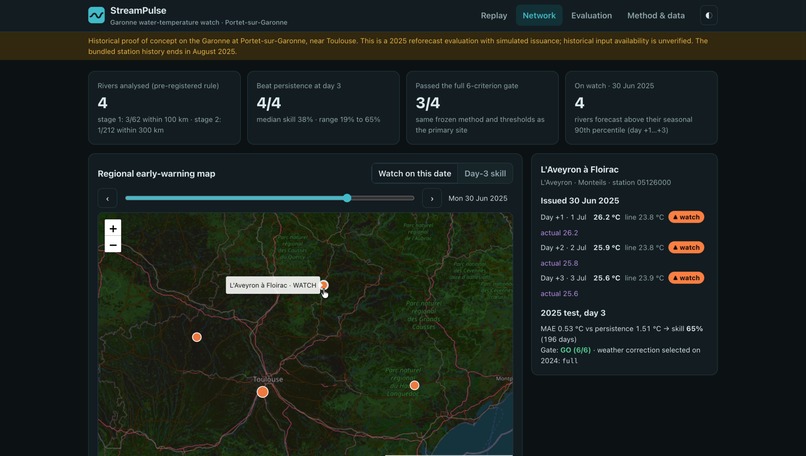
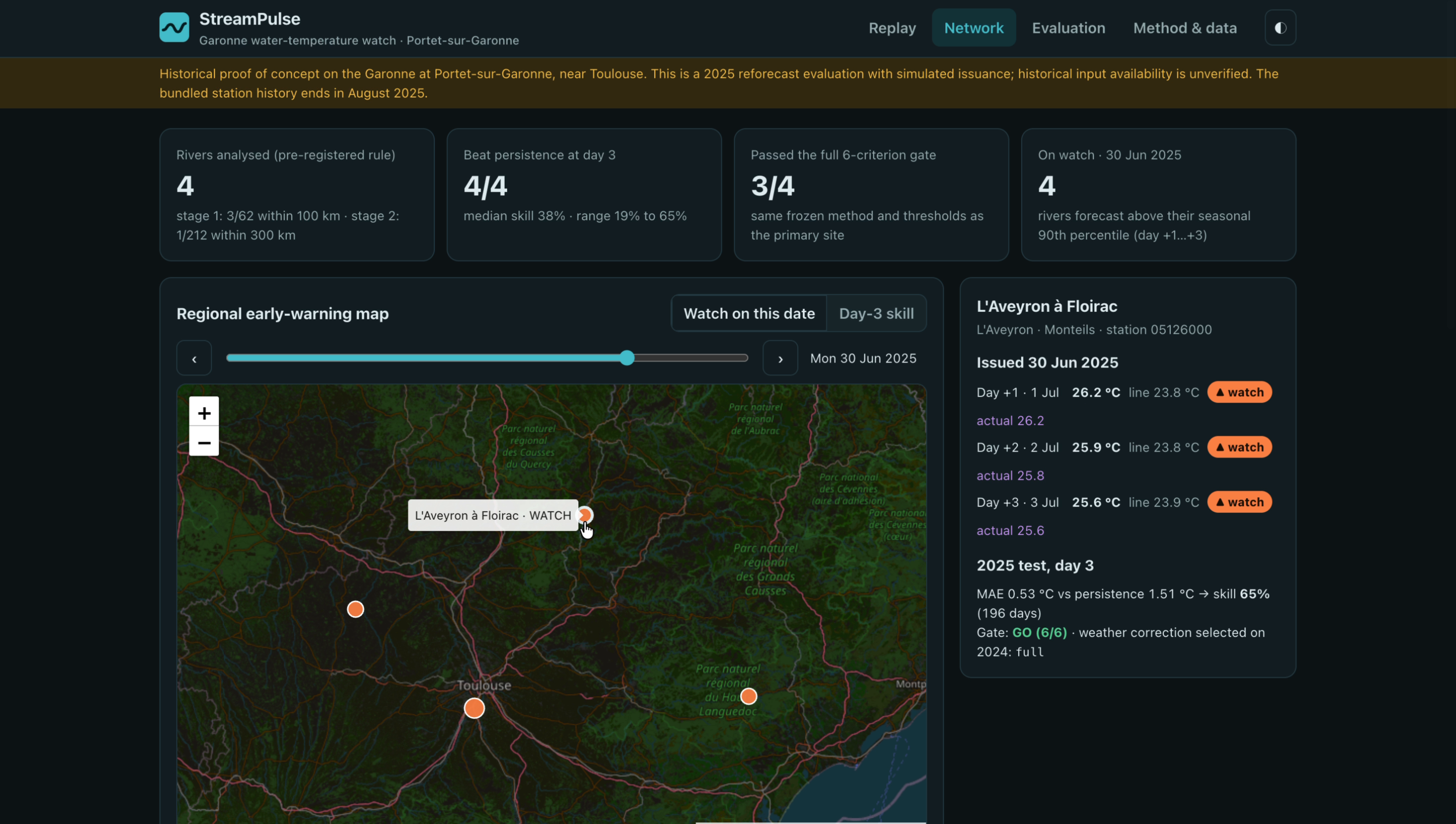
Regional early-warning map, 30 June 2025 heatwave: all four pre-registered rivers on watch.
-
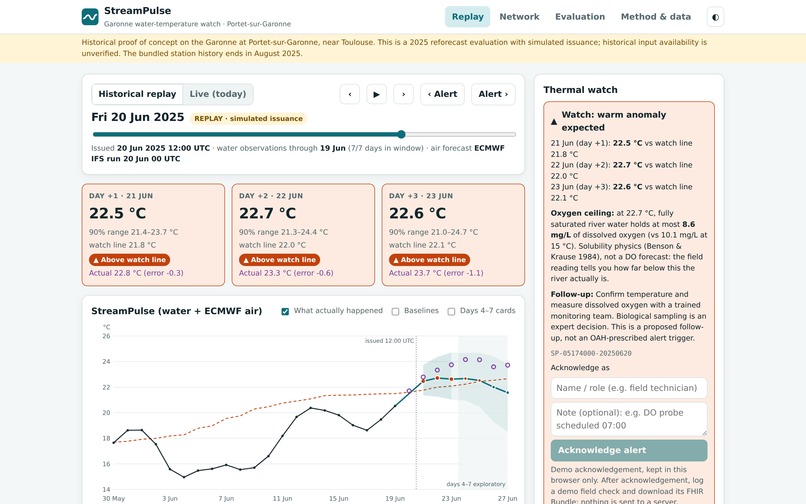
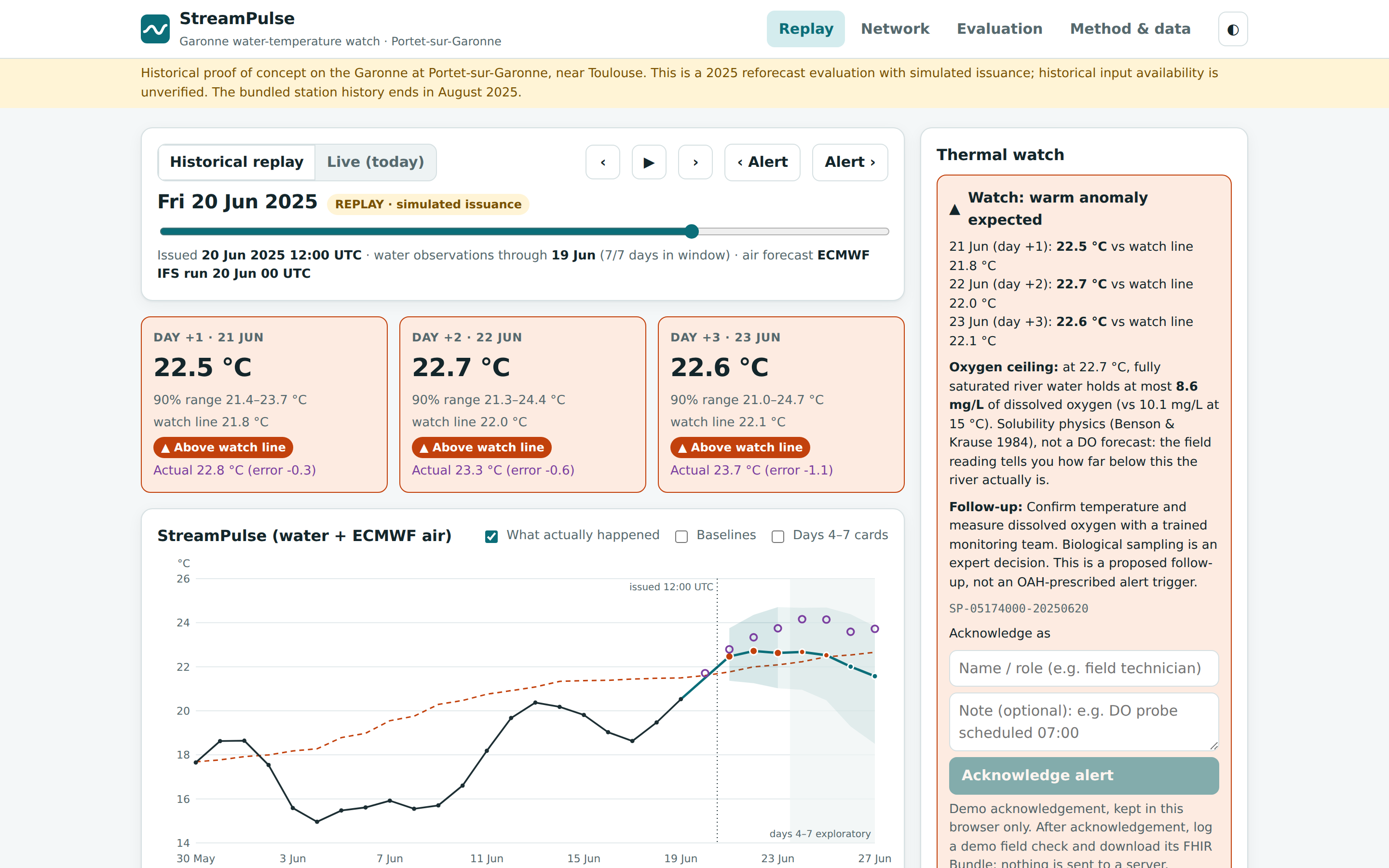
20 June 2025 replay: 3-day forecast crosses the seasonal 90th-percentile watch line; outcome revealed.
-
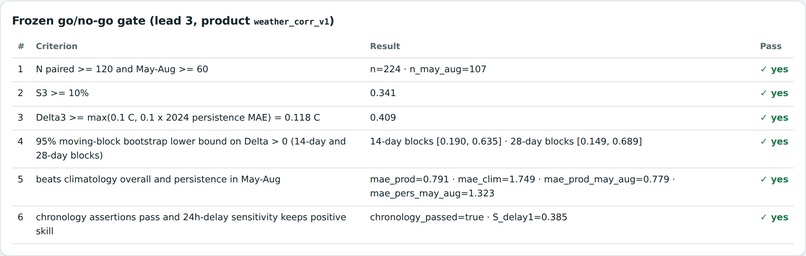
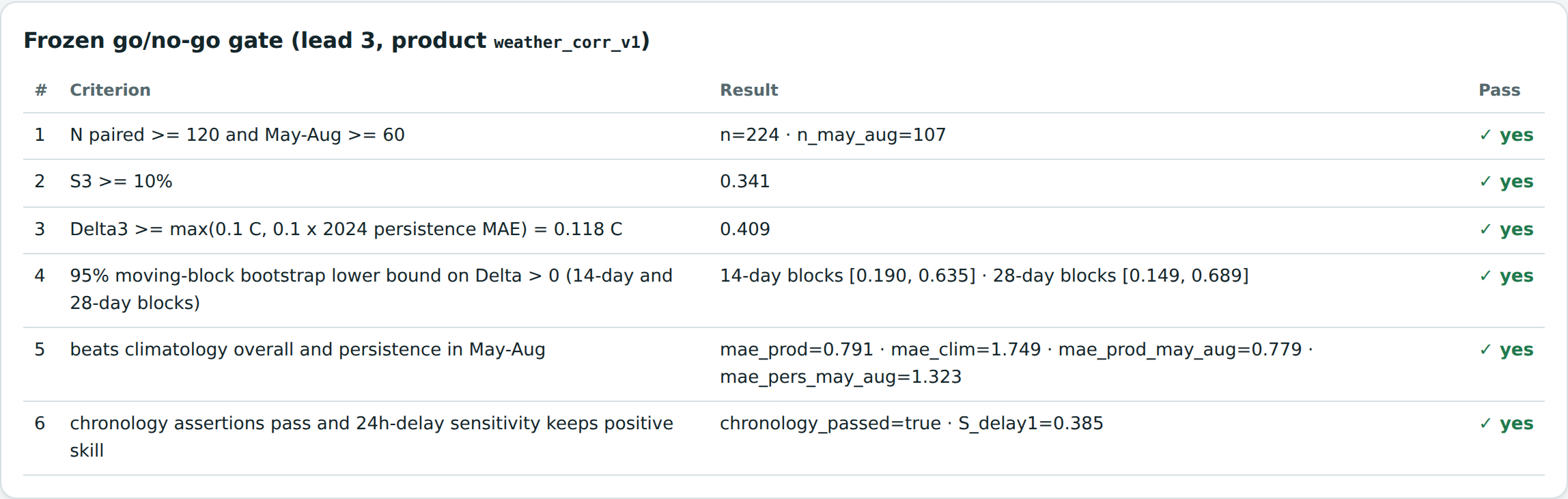
Frozen 2025 test: day-3 MAE 0.79 °C vs 1.20 °C persistence (34% skill); all six pre-registered gate criteria pass.
-
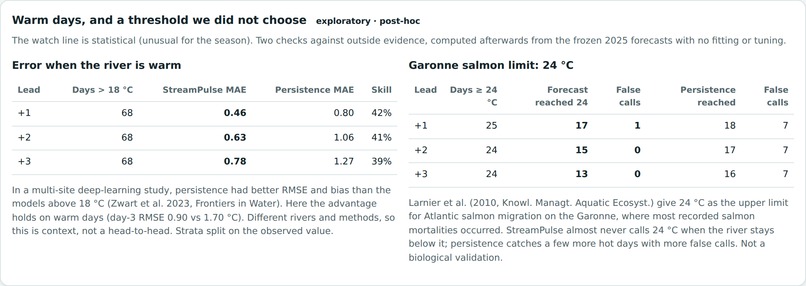
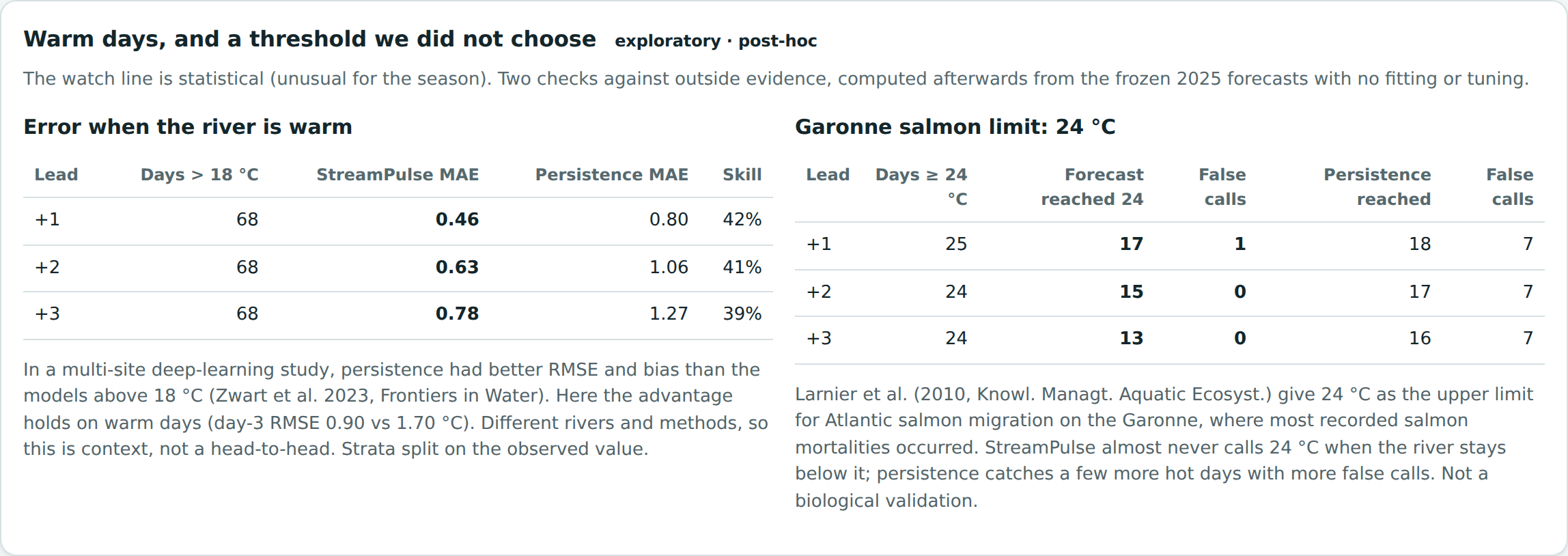
Exploratory: warm-day skill and the Garonne 24 °C salmon limit, 13 of 24 hot days called with zero false calls.
-
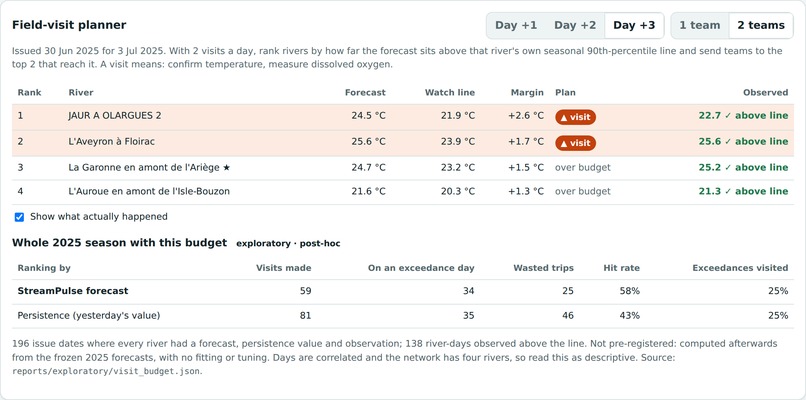
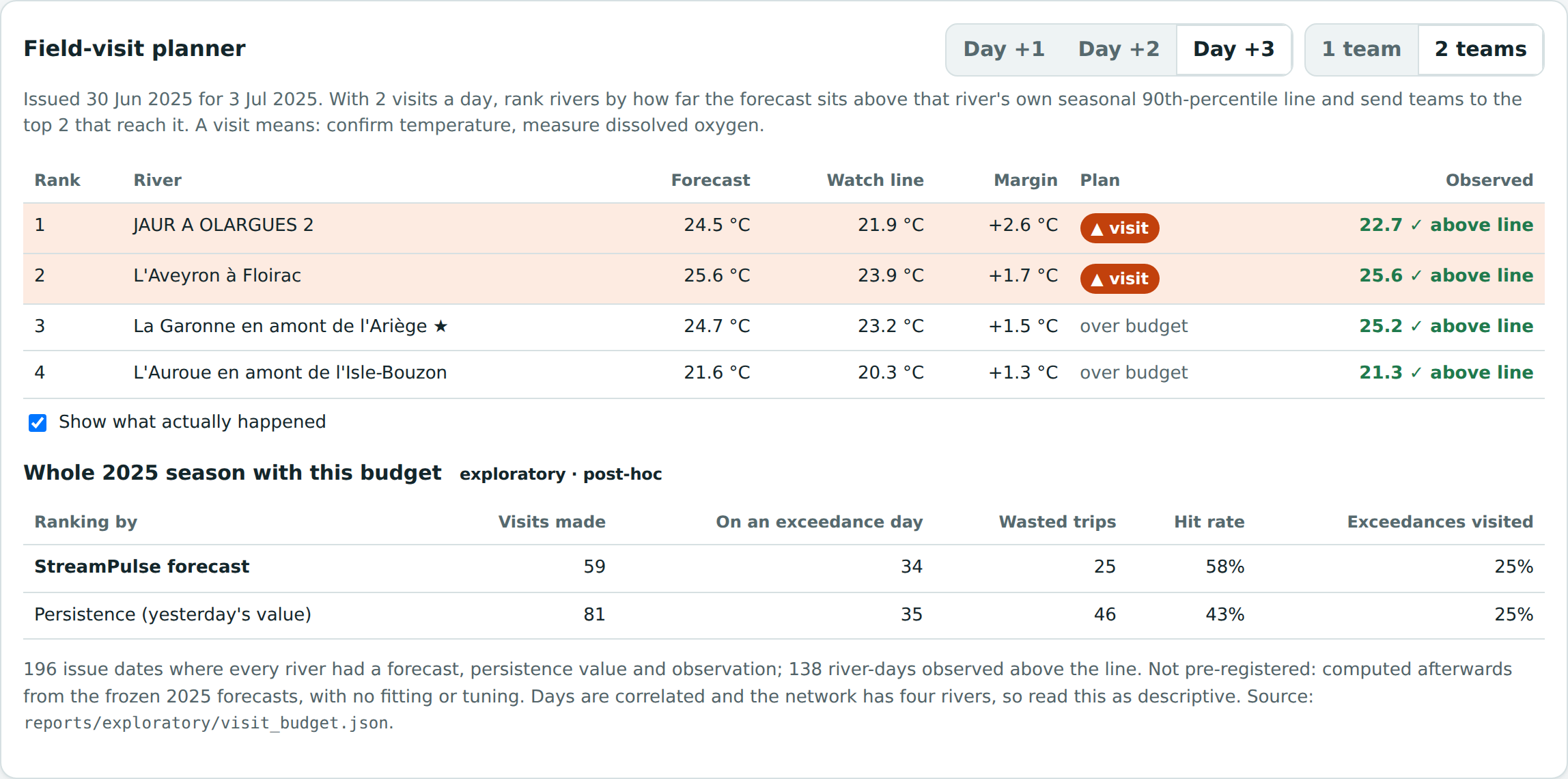
Field-visit planner, 2 teams, day 3: about as many exceedances visited as persistence, 25 vs 46 wasted trips.
-
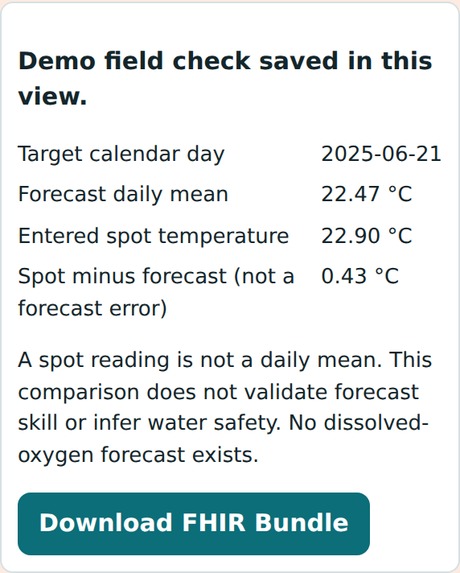
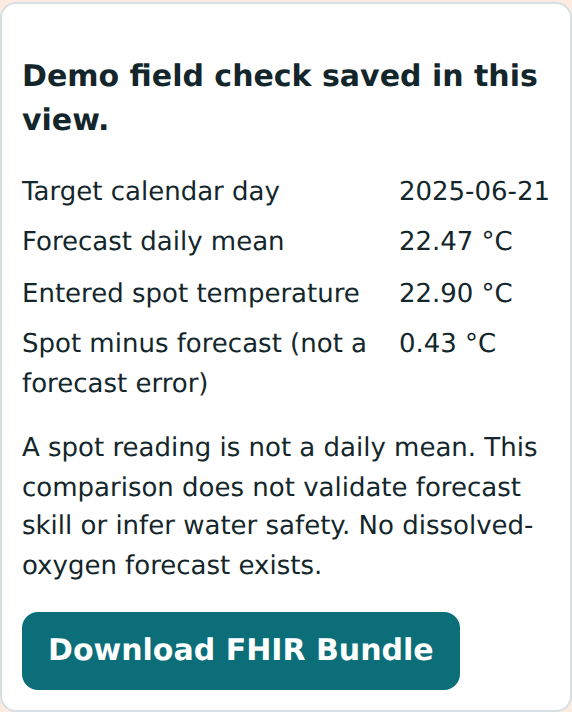
Field check: demo temperature and dissolved-oxygen readings saved and exported as a linked FHIR R4 Bundle.
-
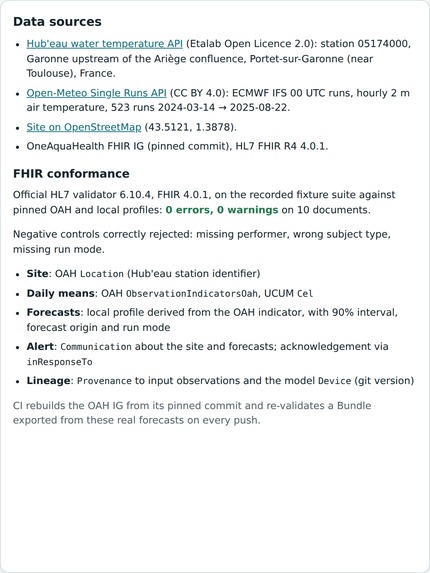
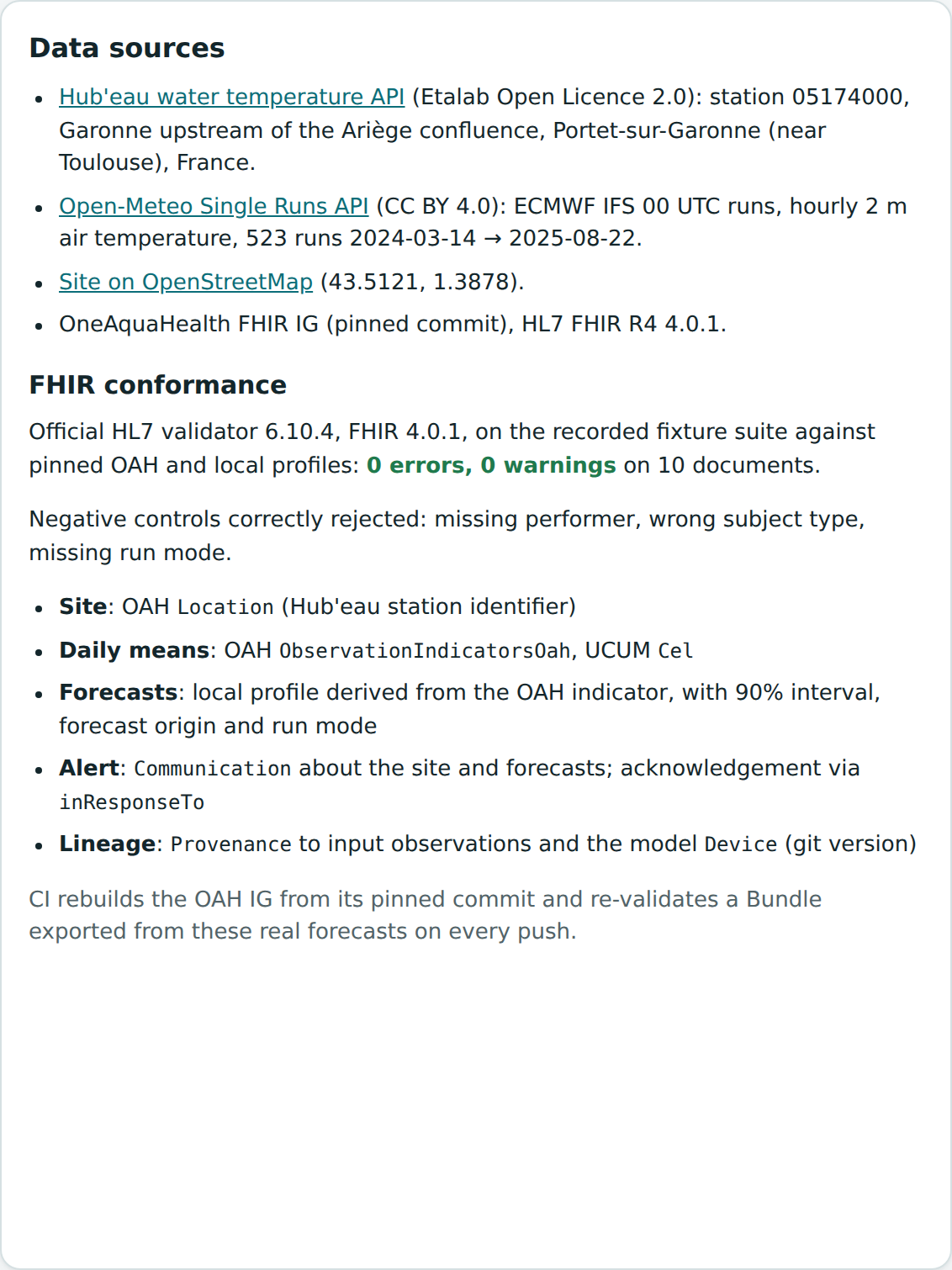
FHIR conformance: HL7 validator 6.10.4, 0 errors and 0 warnings; broken examples correctly rejected.
Track alignment: Track 6 Resilience Informatics (primary): predictive early-warning dashboard and alerts. Track 7 Digital Health Standards (secondary): OneAquaHealth-profiled FHIR R4 records, validated with the official HL7 validator.
For judges: evidence by criterion
- Impact & Alignment: Toulouse is an OAH research city. Each watch becomes one field task (confirm temperature, measure dissolved oxygen) with the oxygen ceiling at the forecast temperature. Against the Garonne's published 24 °C salmon limit, the day-3 forecast reached 24 °C on 13 of 24 such days with 0 false calls (persistence: 16, with 7 false calls).
- Innovation & Creativity: Pre-registered, 2-stage regional replication (station rules committed to GitHub before any data download). Warm-day skill holds (39% at day 3 above 18 °C); for context, a published deep-learning study reported persistence had better RMSE and bias on warm days. Different rivers, not a head-to-head. A field-visit planner turns forecasts into "which river gets today's team".
- Architecture: Frozen six-criterion gate, gap-aware block bootstrap, chronology assertions, 61 Python and 5 Node tests, and four CI workflows (tests, official HL7 FHIR validation, browser and axe accessibility, Pages).
- UX: Replay with the outcome hidden until revealed, missing-weather and stale-feed states, regional map with date slider, planner, field-check form that downloads a FHIR Bundle, and axe WCAG 2 AA checks in CI.
- Scale: 274 candidate stations were screened under a pre-registered rule; the same frozen method ran on the 4 that qualified, with one config change per site. FHIR R4 with OAH profiles for the site and measurements (forecasts use a local derived profile), with an official sandbox round-trip. Honest blocker: the public temperature archive lags by more than a year, so a pilot needs a producer feed.
Inspiration
A river monitoring team has limited time for field visits. Temperature can help prioritise a follow-up, but it cannot establish low dissolved oxygen, biological damage or health risk. StreamPulse asks when unusual warmth might justify a trained team's temperature and oxygen check. This proposed decision rule draws on the measurements supported by the OAH Health Assessment Framework; it is not a prescribed OAH alert threshold.
What it does
StreamPulse replays 1–3 day daily-mean water-temperature forecasts on the Garonne at Portet-sur-Garonne, near Toulouse. It shows nominal 90% prediction intervals, compares a forecast to a seasonal 90th-percentile watch line, and lets a reviewer reveal the observed outcome and compare baselines.
This is a large-river proof of concept near an OAH research city. Official OAH sampling-site membership is UNVERIFIED. A watch represents unusual warmth, not unsafe water.
The 2025 replay uses simulated 12:00 UTC issuance and enforces date-based chronology. Historical input publication times remain UNVERIFIED. Archived weather runs may include reprocessed hindcasts, so we call this a reforecast evaluation. The static Live view withholds a current forecast because the bundled history ends on 2025-08-21; it is not a continuously polling service.
The Network tab replays a regional watch map across four rivers and includes a field-visit planner that ranks rivers for a fixed daily number of visits. Acknowledgements are browser-local demonstrations. After acknowledgement, a field-check form accepts demonstration temperature, dissolved oxygen, optional saturation and a UTC measurement time. It downloads a FHIR collection Bundle linking the alert, acknowledgement, original forecasts, measurement Observations and provenance. Nothing is sent to field staff or a server; unsaved measurements leave memory when the view closes. A spot measurement versus daily-mean prediction is descriptive, not a new forecast-skill result. The browser-generated examples and missing-unit negative control are checked by the official HL7 validator in CI.
How we built it
The water model is trained on 2010–2022, tuned on 2023, and refitted through 2023. A fitted air-temperature correction is selected through expanding-window 2024 validation. The selected model is frozen before the recorded 2025 test opening. All methods are scored on paired eligible days within each lead. Quality control quarantines conflicting duplicates and does not interpolate gaps.
The source history has 4,527 eligible days and 523 archived ECMWF air-temperature runs. The dashboard uses React and TypeScript on GitHub Pages. It includes missing-weather fallback, stale inputs, baseline comparisons and explicit failure examples.
FHIR export uses OAH Location and indicator Observation profiles, a locally derived forecast profile, Communication, Device and Provenance. The recorded HL7 validator 6.10.4 fixture suite has 0 errors and 0 warnings on 10 documents, with three negative controls rejected as intended. CI separately validates a real replay Bundle. Official sandbox evidence records transaction and read-back outcomes. Transport success does not mean OAH certification or field deployment.
Results and their limits
Primary site (Garonne at Portet-sur-Garonne):
- Day-3 MAE: 0.79 °C, versus 1.20 °C for persistence and 1.75 °C for climatology: 34% skill on 224 paired days. The frozen gate passed all 6 criteria.
- Day-1 and day-2 skill: 28% and 31%, on 226 and 225 paired days respectively.
- Day-3 watch: 80% precision, 43% recall. Persistence gives 59% precision, 54% recall: the model's higher precision comes with lower recall. Improved MAE does not establish improved field decisions.
- Validation skill: 13.6% on the expanding-window 2024 assessment. This and the test result do not bound future performance.
- Nominal 90% intervals covered 95–98%. Only 10 observed exceedance episodes underpin the watch rates.
Network replication (pre-registered, 2-stage):
The same frozen method — no re-design, no re-tuning — was applied to every Hub'eau river station within 300 km of Toulouse that met the pre-registered data-quality rule. Station selection was committed to the repository (config/network.toml for stage 1, config/network_stage2.toml for stage 2) before any network data was downloaded, with the commit timestamps on GitHub as evidence. Of 274 candidate stations (62 within 100 km, 212 within 100–300 km), 4 met the rule, including the primary site. At day 3, all 4 beat persistence on the 2025 test: median skill 38%, range 19–65%. 3 of 4 passed the full six-criterion frozen gate; the fourth (Jaur à Olargues, 06185900) beats persistence overall but is reported as NO-GO: it failed gate criterion 5 (beat climatology overall and persistence in May–August). Four stations is a small network: this shows the frozen method transfers within this region, not that it transfers everywhere. The Network tab shows per-station results and a regional watch map replayed across every 2025 date. Source: network_summary.json.
Field-visit planner (exploratory, post-hoc, not pre-registered): with a fixed number of visits per day across the four rivers, ranking rivers by forecast margin above each river's watch line visits about as many real exceedances as ranking by persistence, with fewer wasted trips. At day 3 with two visits a day: 34 exceedance visits from 59 trips (25 wasted) versus 35 from 81 (46 wasted). At day 1 with one visit a day: 35 from 51 (16 wasted) versus 33 from 55 (22 wasted). Computed afterwards from the frozen 2025 forecasts, with no fitting or tuning; days are correlated and four rivers is small, so this is descriptive. Source: visit_budget.json.
Warm days and an outside threshold (exploratory, post-hoc): on days above 18 °C, day-3 MAE is 0.78 °C versus 1.27 °C for persistence (39% skill, 68 days; RMSE 0.90 versus 1.70 °C). A multi-site deep-learning study reported that persistence had better RMSE and bias than its models above 18 °C (Zwart et al. 2023); different rivers and methods, so this is context, not a head-to-head. For the Garonne, Larnier et al. 2010 give 24 °C as the upper limit for Atlantic salmon migration. On the 24 target days that reached it, the day-3 forecast also reached 24 °C on 13 with 0 false calls on cooler days; persistence reached it on 16 with 7 false calls. Strata split on the observed value; not a biological validation. Source: context.json.
Sources: test_metrics.json, gate.json, frozen_selection.json, qc_summary.json, and the FHIR summary. Exact keys are in CLAIM_EVIDENCE.md.
Challenges and lessons
Feed latency is the operational blocker. When checked on 2026-09-30, the public Hub'eau temperature API still ended on 2025-08-21 for the primary station, and the network stations also stop in August 2025. A live early-warning service therefore needs a direct producer feed, not only the public archive.
Daylight-saving-shaped anomalies suggest a civil-time convention, but source timezone and publication delay remain UNVERIFIED. Date chronology is tested; historical availability at the exact simulated issuance is not proven. Local hashes and timestamps record the frozen selection and test opening; they are not independent preregistration.
Weather gaps expose an operational weakness: a labelled water-only fallback produces no product alert. The complete-case skill result does not measure the consequences of that outage. The demo also shows a missed cooling event; discharge is not an input, and its role in that particular miss is UNVERIFIED.
Citizen science hook — proposed integration, not built
A coordinator could review a watch and route a site-specific check to a trained volunteer through an agreed adapter to the OAH Citizen Science App. The volunteer would record observations and, where trained, equipped and authorised, confirm temperature and dissolved oxygen. An expert would review the evidence and decide whether biological sampling is warranted.
The adapter would link site, alert, assignment and returned evidence. App APIs, task routing, identity mapping, consent and write-back support are UNVERIFIED. No app connection, delivered notification or completed field sampling is claimed.
What's next
Secure a direct fresh feed from the producer (the public archive lags by more than a year), establish a supervised fresh-feed pilot, and measure whether alerts improve visit decisions at a fixed sampling budget. Extend to low-cost loggers on small urban streams only after sensor QA, sufficient local history, site-specific calibration and new validation. Environmental or health benefits and cross-site skill remain UNVERIFIED.
Built With
- ecmwf
- github-actions
- hl7-fhir
- hub'eau
- leaflet.js
- numpy
- open-meteo
- pandas
- python
- react
- sushi
- svg
- typescript
- vite

Log in or sign up for Devpost to join the conversation.