-
-
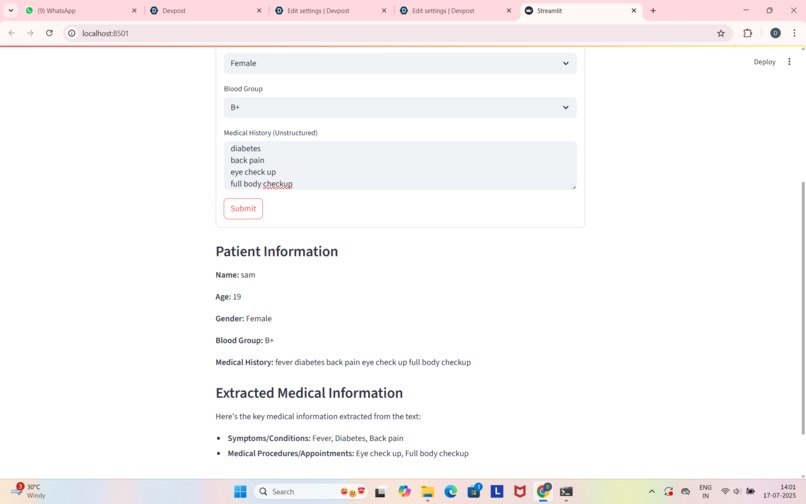
This is the work done

Inspiration
We were inspired to build a solution for analyzing medical records because of the growing need for faster, more accurate healthcare decisions. Doctors and healthcare workers deal with a massive amount of unstructured data like patient notes, reports, and prescriptions. We wanted to use Al to simplify this data and provide insights to assist in diagnosis and treatment planning.
What it does
Our project reads medical records (in text form) and uses Al to extract important health information like symptoms, diagnoses, medications, and test results. It then summarizes and highlights key points to support clinical decisions. This helps doctors save time and reduce errors by giving them quick insights
How we built it
We built our project using a simple Python script run through the Command Prompt (CMD). The script reads unstructured medical text from a file, sends it to an Al model for processing, and extracts key details like symptoms, medications, and test results. We used CMD to execute the script quickly using a command like python analyze-record.py record.txt, making it easy to test and run without a complex setup. This allowed us to process records efficiently and view or save the Al-generated summaries directly from the terminal.
Challenges we ran into
Giving a correct prompt and getting code and sometimes while running it in notepad it was little hard for us to find out the errors
Accomplishments that we're proud of
One of the key accomplishments we're proud of is successfully building an interactive and user-friendly medical records analysis tool using Streamlit, which enabled us to visualize and interpret complex patient data easily. We efficiently handled large volumes of data through Command Prompt (CMD) automation, making data preprocessing and management faster and smoother. Combining Streamlit's intuitive interface with CMD's backend power helped us streamline the entire process-from uploading medical records to displaying insights-without relying on heavy or complex tools. This project demonstrated our ability to integrate simple tools for powerful real-world healthcare applications.
What we learned
Through this project, we learned how to build lightweight data analysis tools using simple yet powerful technologies like Streamlit and CMD. We gained hands-on experience in processing medical data, automating tasks via command line, and designing interactive dashboards for better data interpretation. We also understood the importance of data cleaning, visualization, and how user Interface simplicity can make technical tools accessible to non-technical users, especially in the healthcare domain.
What's next for STREAMLIT
Next, we plan to expand Streamlit's capabilities by integrating it with more advanced Al models and databases to handle real-time medical data and provide predictive insights. We also aim to deploy the app online for broader access, enhance user authentication, and explore streamlit components for more interactive features like charts, filters, and form inputs. As Streamlit continues to evolve, its potential in healthcare analytics, especially for low-code Al solutions, is becoming even more powerful and impactful.
Built With
- cmd
- notepad

Log in or sign up for Devpost to join the conversation.