-
-

Cover Image
-
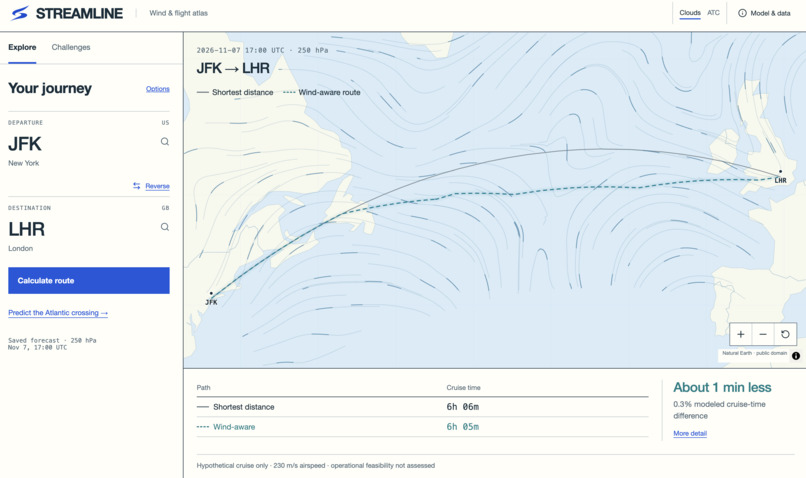
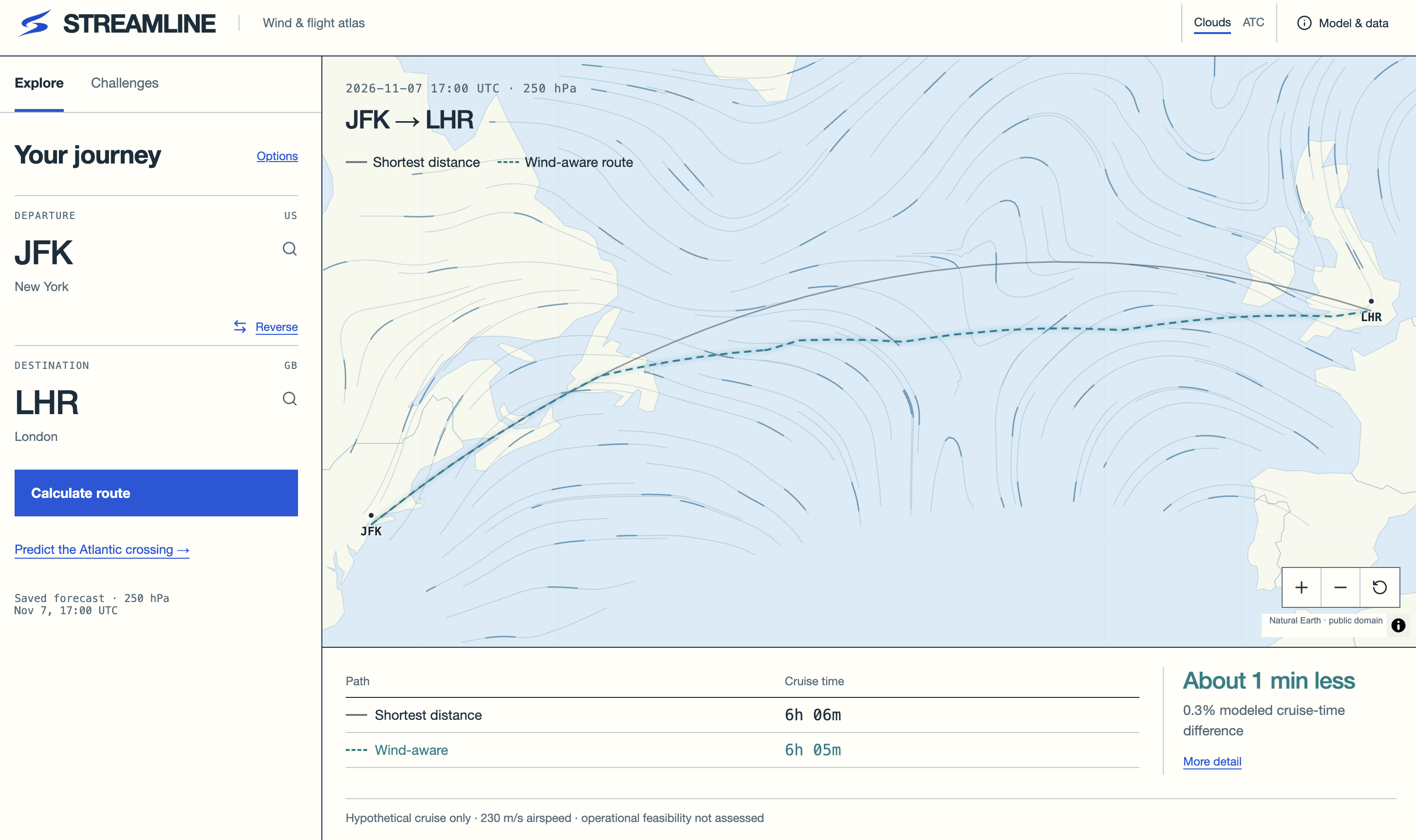
Main Dashboard
-
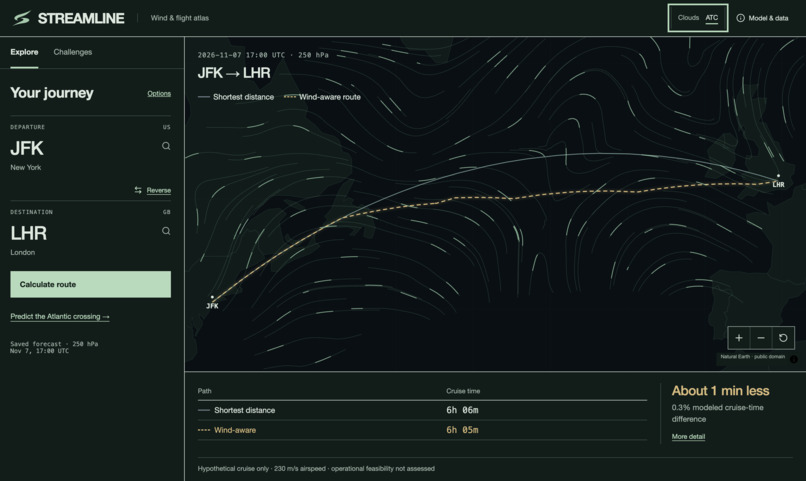
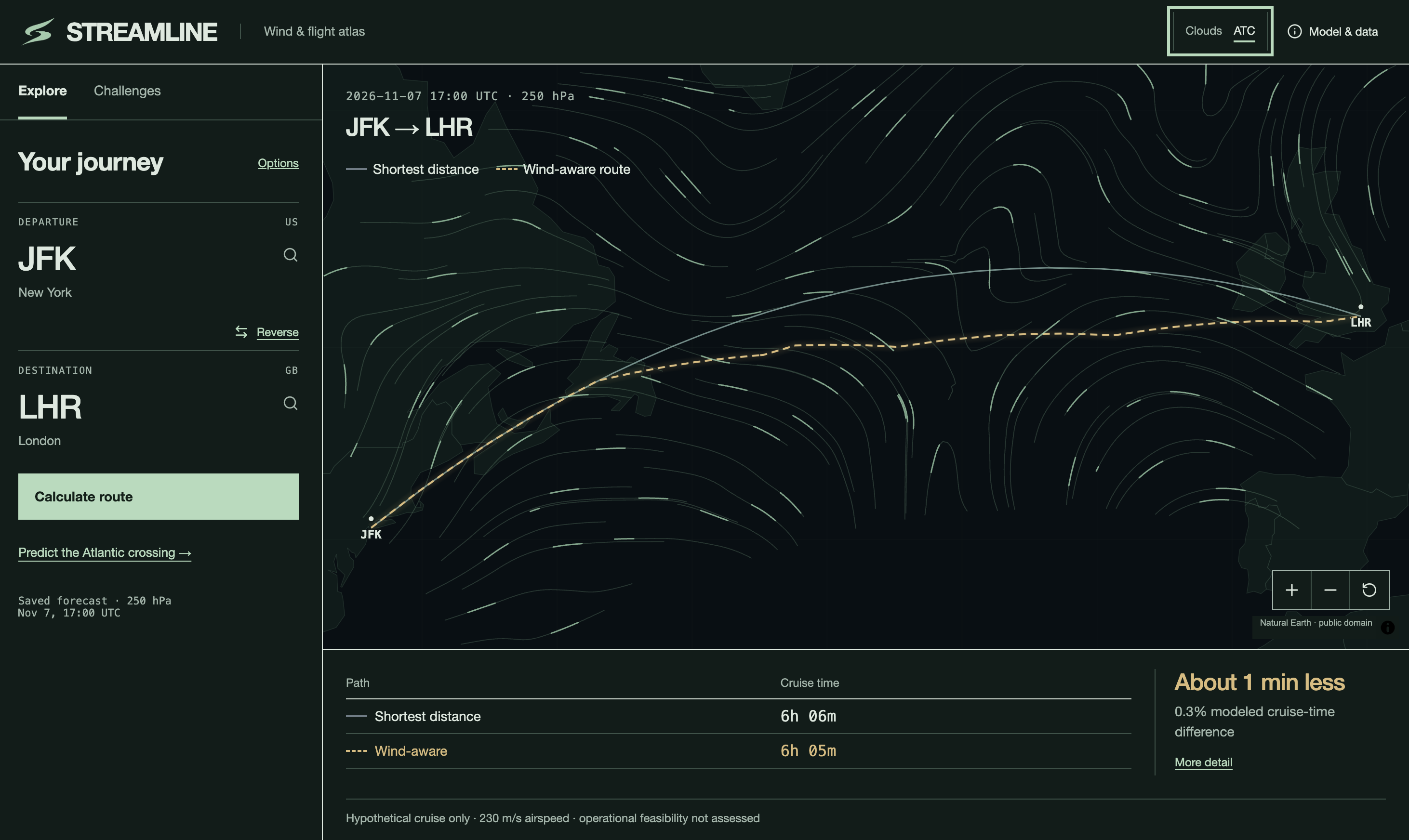
Dark Mode (Inspired by Air Traffic Control)
-
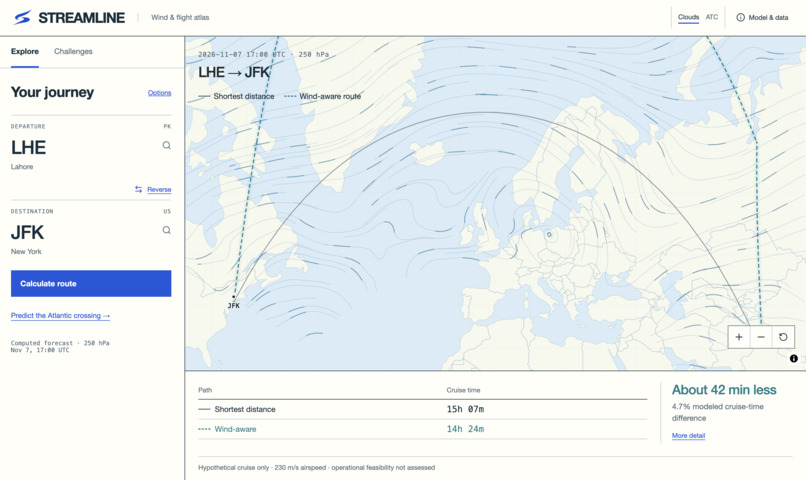
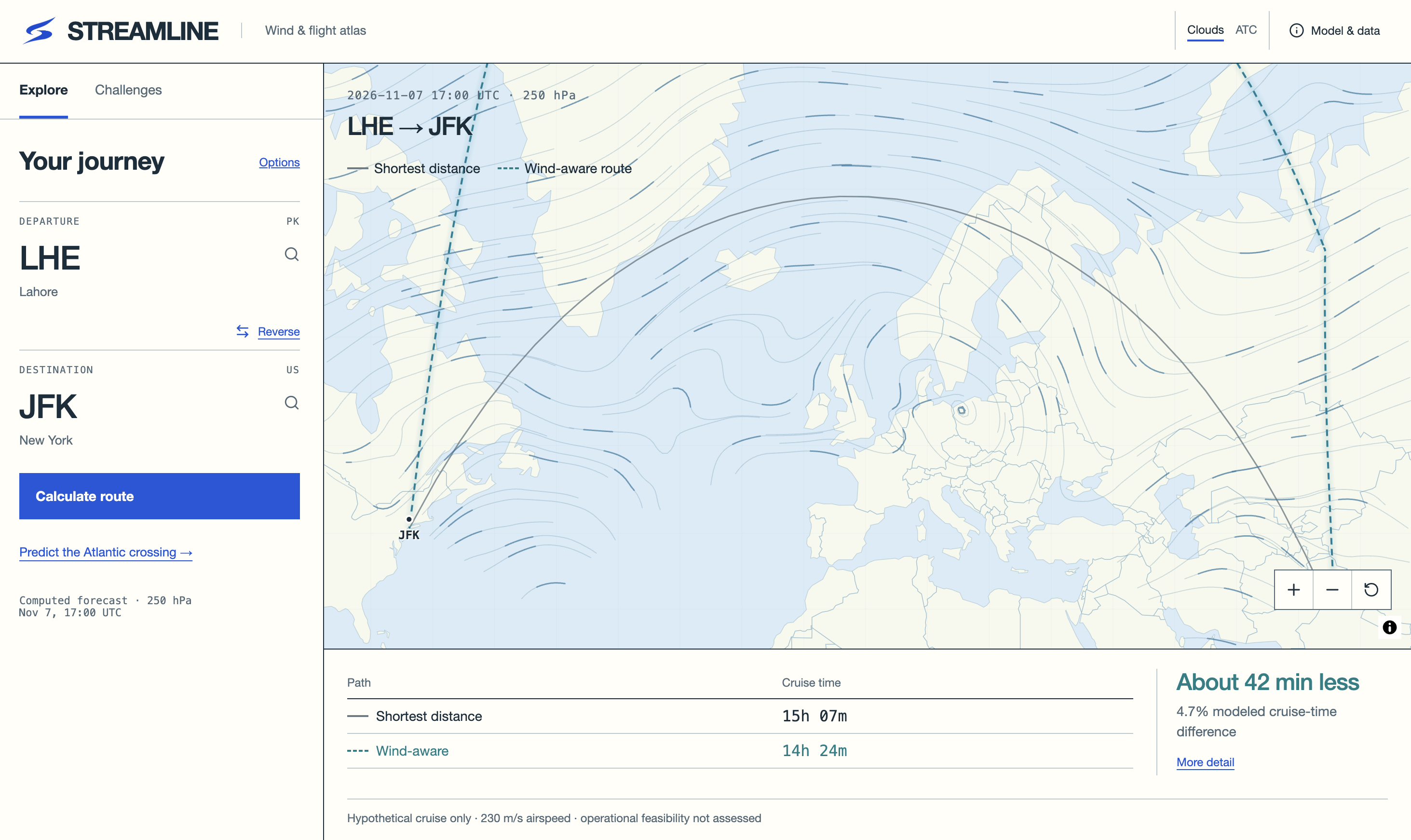
Example with over 30 min difference and drastically different path
-
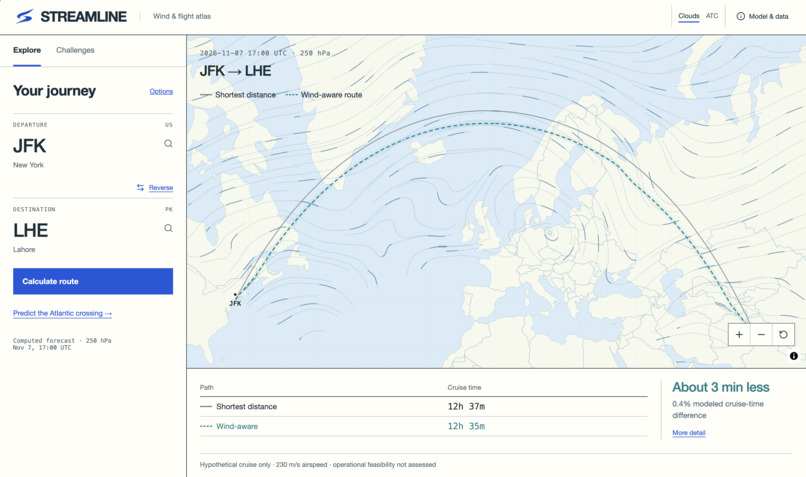
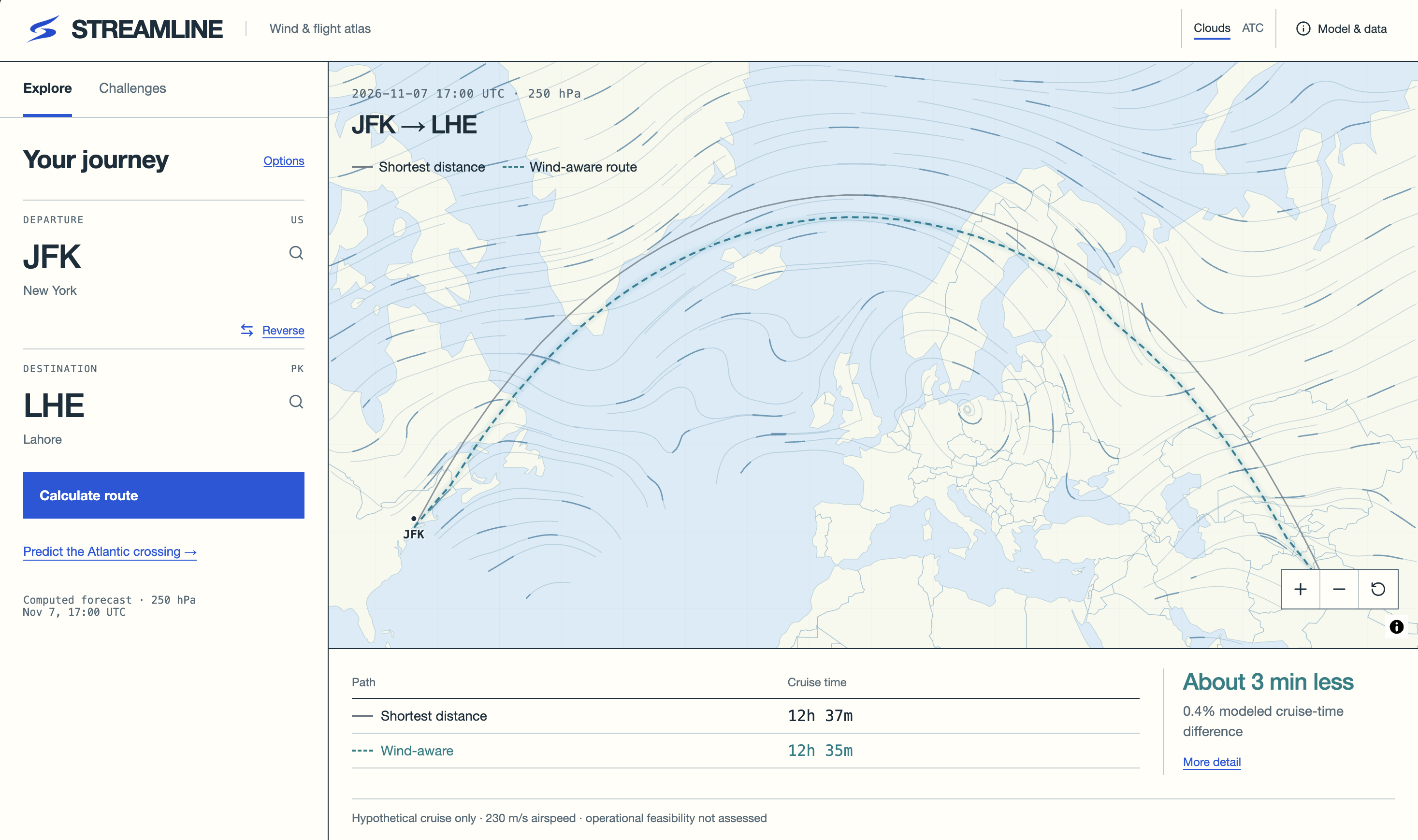
Example of reverse path with little to no difference
-
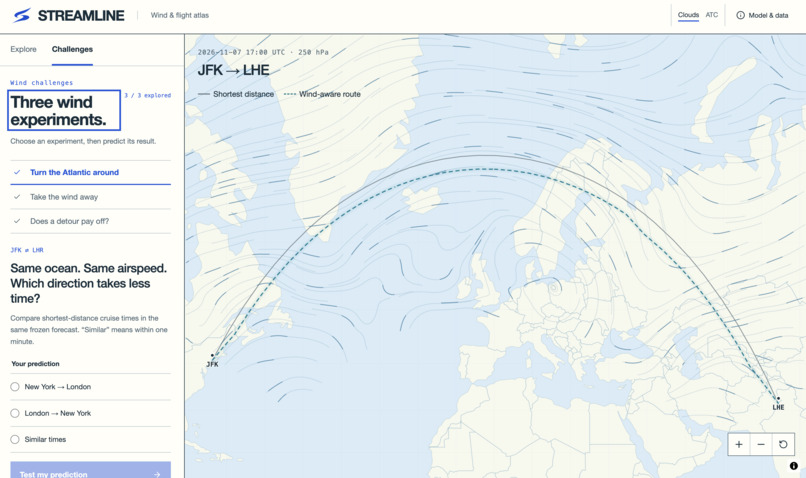
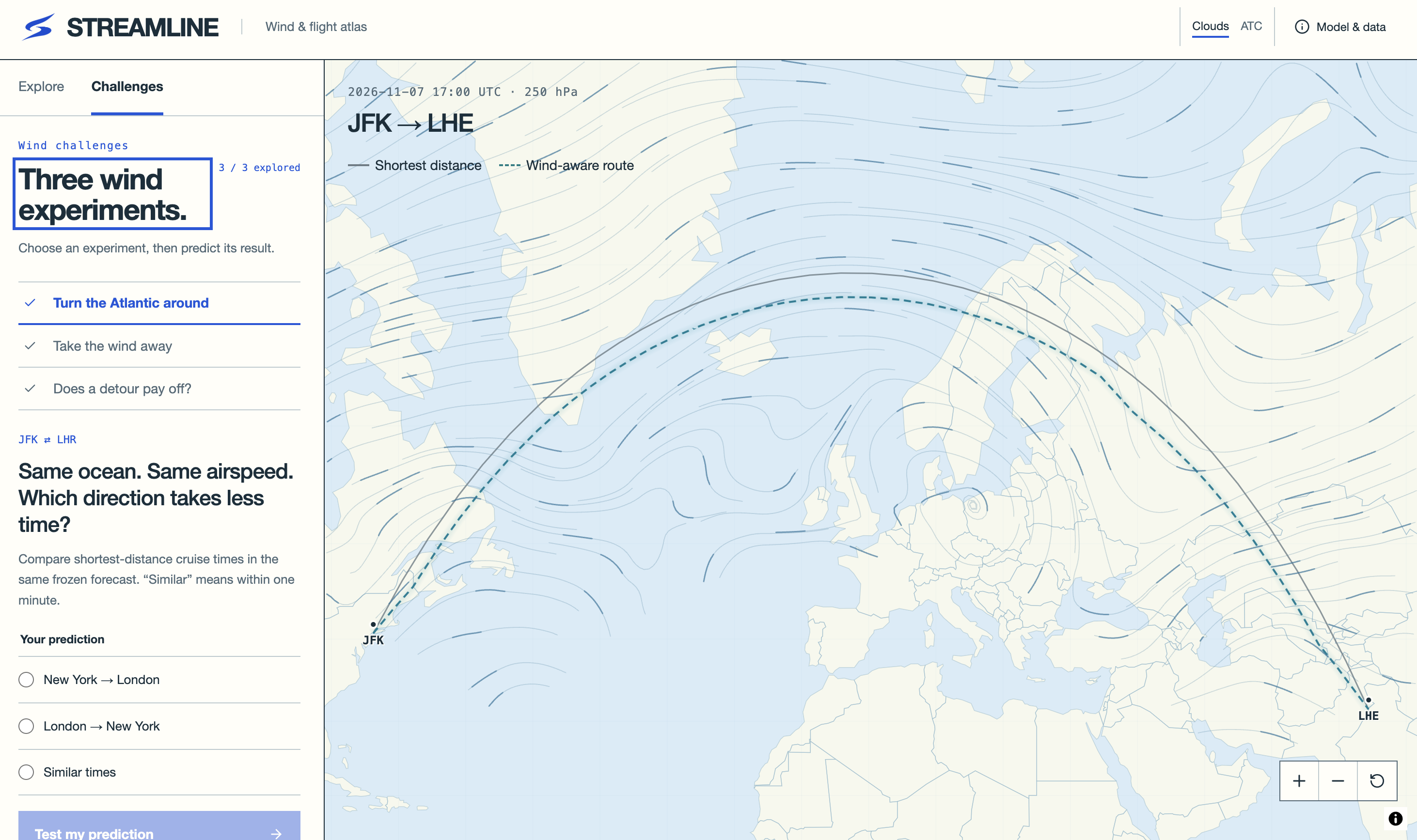
"Challenges" Portion
-
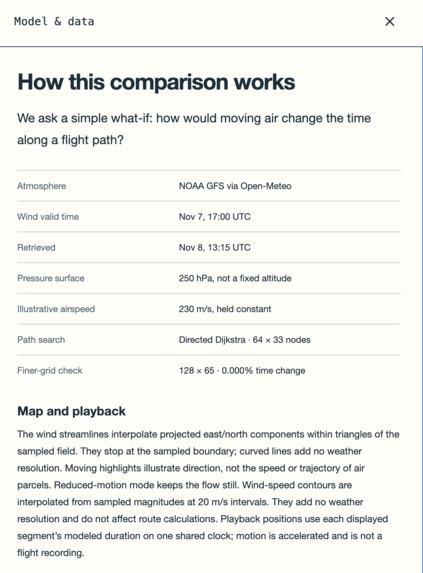
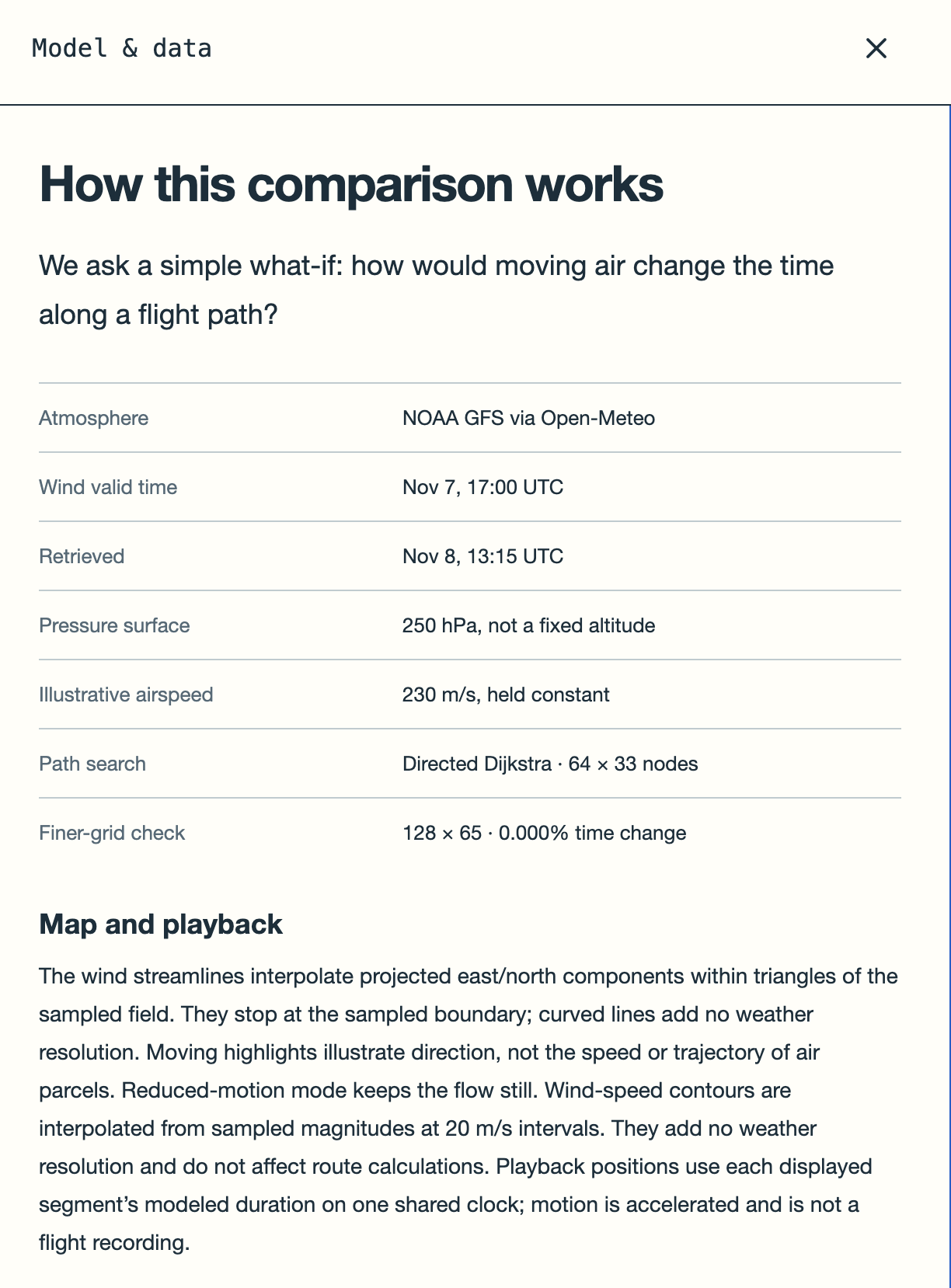
"Model + Data" Section

Inspiration
Why does a flight across the Atlantic take longer in one direction than the other? The airports and ocean stay the same, but the atmosphere moves.
For HackRPI’s “In the Clouds” theme, I built Streamline to make that invisible influence something people can explore. It is an interactive atmospheric flight lab: choose a journey, make a prediction, reveal the wind, and see what changes when you reverse direction.
What it does
Streamline lets visitors search airports worldwide and compare the shortest-distance path with a hypothetical wind-aware alternative. A map shows upper-atmosphere wind flow alongside both routes, while the comparison explains their modeled cruise times.
Three prediction experiments invite visitors to reverse an Atlantic crossing, remove the wind, and investigate whether a detour pays off.
The saved Atlantic example reveals two different effects: about 82 minutes between eastbound and westbound shortest-distance cruise times, and about five minutes of route improvement within the westbound journey. Streamline keeps those comparisons separate.
How I built it
The frontend uses React, TypeScript, Vite, and MapLibre GL JS. A Python/FastAPI backend acquires NOAA GFS winds through Open-Meteo and runs bounded route calculations.
A directed Dijkstra solver searches a spherical routing graph. Both paths use the same evaluator, which accounts for along-route wind and the airspeed needed to counter crosswind. The shortest-distance baseline is included in the graph, and a finer-grid comparison checks whether the result is sensitive to routing resolution.
Saved scenarios remain available when the API or weather provider is unavailable. Forecast timestamps, source information, and payload hashes make the inputs traceable.
The application is deployed on a Vultr Ubuntu instance using Docker Compose and Caddy.
Challenges I faced
The geometry needed to work across the antimeridian and at high latitudes. Wind also makes travel costs directional: reversing a route requires a new evaluation.
Another challenge was separating weather resolution from routing resolution. Adding graph nodes can improve the search, but it does not create more detailed atmospheric data.
The interface took several iterations. I moved secondary controls out of the default view, made the map the focus, and used optional prediction experiments to give visitors a clear reason to interact.
What I learned
This project made the distinction between the shortest path and the quickest path concrete. It also showed why an optimization needs a shared baseline, consistent assumptions, and checks for numerical sensitivity.
Communicating the result was as important as calculating it. A small modeled improvement needs careful wording, and an attractive route on a map should never imply operational feasibility.
Accomplishments
Streamline combines real forecast inputs, worldwide airport search, interactive wind visualization, reverse-direction and still-air experiments, and reproducible saved examples.
The release passed 12 frontend tests and 25 backend tests, along with production-build and container checks. Public deployment checks covered saved routes, reversal, still air, and a new weather-backed calculation.
Limitations and next steps
Streamline is an educational cruise model, not an operational flight planner. It uses one frozen forecast at 250 hPa and an illustrative airspeed of 230 m/s. It does not assess airways, traffic, storms, climb and descent, or aircraft-specific performance. No absolute fuel or emissions savings are claimed.
Next steps include testing comprehension with people without aviation expertise and addressing the confusion they encounter. Participant testing has not yet been conducted, so no measured learning benefit is claimed.
Attribution
Weather: Open-Meteo / NOAA GFS. Airport data: OurAirports. Geography: Natural Earth.
AI coding assistance and image generation were used during development. Route calculations use deterministic physics and graph algorithms.
