-
-
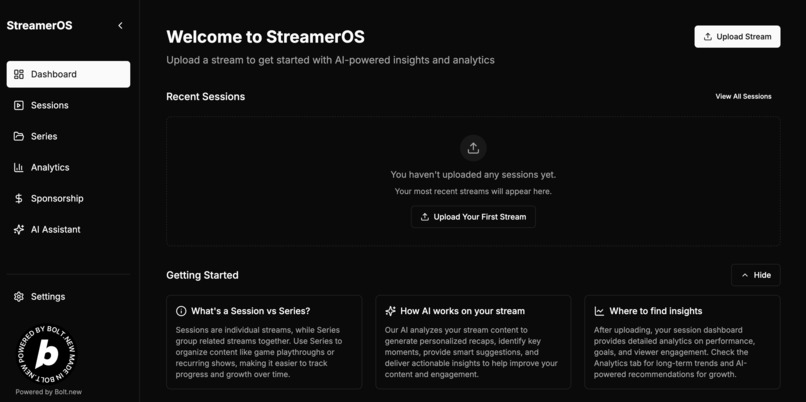
StreamerOS
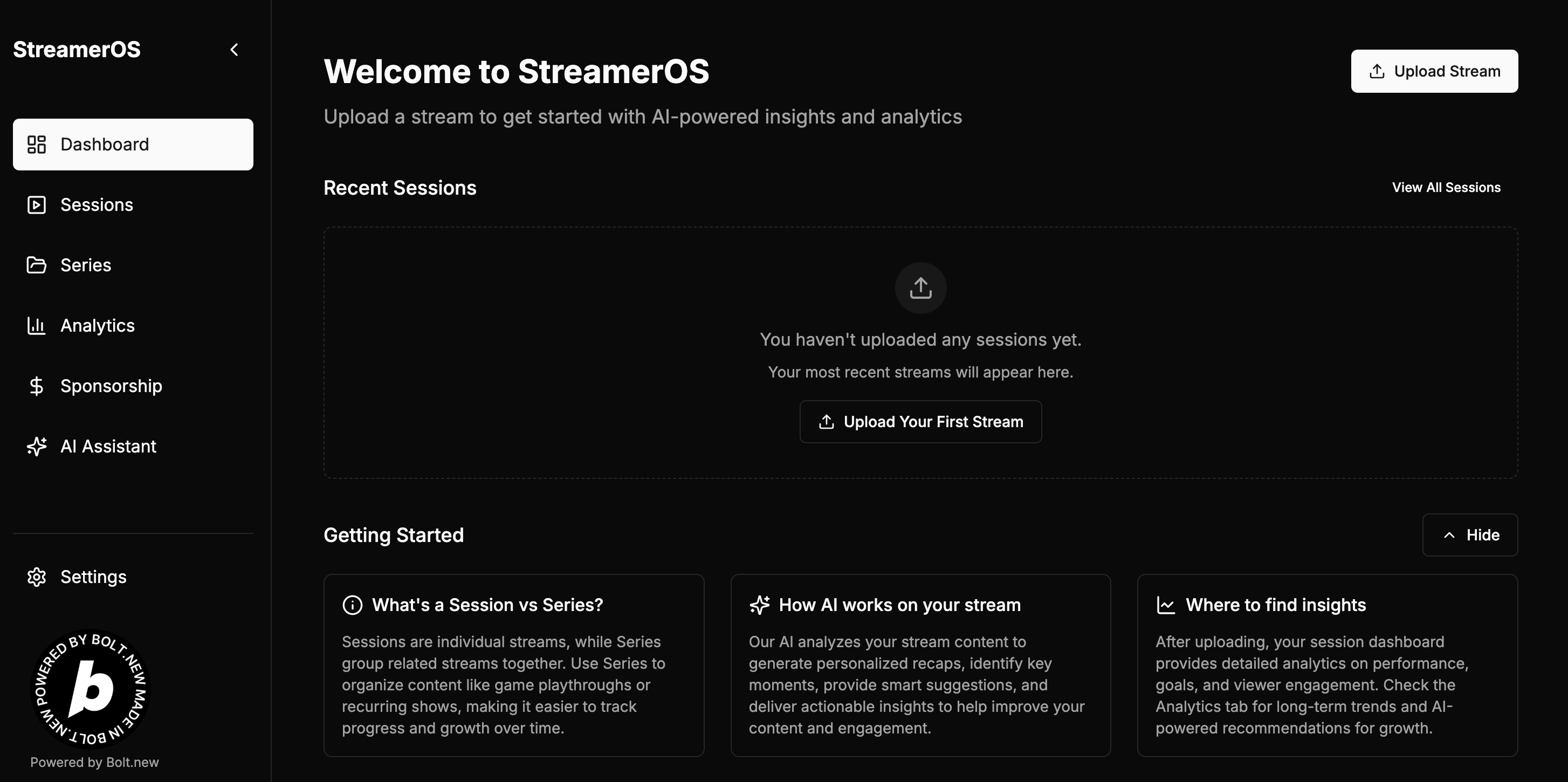
🚀 About the Project: StreamerOS
🎮 What inspired me
As someone deeply embedded in both the gaming and creator economy spaces, I’ve seen firsthand how much effort goes into building a community, keeping streams entertaining, and trying to grow — all while juggling multiple platforms and tools. But something always stuck out to me: once the stream ends, most creators are left with nothing but a VOD and vibes.
There’s no easy way to know:
- Which moments actually resonated?
- Where did viewers drop off or stick around?
- What’s helping me grow — and what’s not?
Streamers often rely on intuition, scattered dashboards, or third-party tools that don’t talk to each other. Growth feels like guesswork.
So I asked myself: What would it look like if streamers had a real operating system? Something built with creators in mind, that pulls in their session data, analyzes it, and turns it into a growth strategy — automatically. That idea became StreamerOS.
This project started as a hackathon build, but the deeper I got into it, the more I realized: this needs to exist. Creators deserve better tools. Period.
🧠 What I learned
StreamerOS pushed me to grow across multiple dimensions — not just as a builder, but as a strategist, designer, and product leader. Here’s what stood out:
Product Discipline: I learned how to ruthlessly scope and prioritize features to hit MVP, resisting the urge to build every good idea at once. This was essential for moving fast without sacrificing polish.
AI Prompt Engineering: I dug deep into how to build effective prompt flows that generate recap summaries using minimal inputs — experimenting with prompt chaining, injected context, fallback modes, and metadata conditioning to get useful and readable results.
UX for Real Users: I spent time understanding the workflow of a typical creator — what they care about post-stream, how they make decisions, and how to reduce friction. The result was a cleaner upload/edit modal experience and smarter recap logic.
System Thinking: I approached the product as a platform, not a point solution. From the beginning, I designed everything — sessions, series, AI assistant, brand tab — to work together. This allows for deep insights later and opens the door to future AI copilots for creator businesses.
Performance vs. Vision: I learned how to build something that looks great and feels powerful today, while laying the foundation for the more ambitious features I plan to launch post-hackathon (like platform integrations, automated sponsorship reports, and customizable dashboards).
🛠️ How I built it
StreamerOS was built solo using modern tools, a modular architecture, and a deliberate focus on user value. Here's how I brought it to life:
🧱 Stack & Development
- Frontend: Built in Bolt.new, leveraging its AI-native environment to iterate quickly and test UI/UX ideas in real-time.
- AI Capabilities: Integrated with OpenAI to summarize sessions, pull highlights, and lay the groundwork for deeper analysis. All prompts are injected with custom metadata (viewer counts, tags, stream type, etc.).
- UI Structure: Features a two-panel layout — left nav for fast switching, right panel for rich interaction — optimized for clarity and scale.
- Forms & Inputs: Stream upload and edit modals support dynamic fields like:
- Viewer counts (peak & avg)
- Tags and game categories
- Co-streamers or guests
- Manual highlights and chat sentiment
- Assistant Mode (Phase 2+): Designed a full Assistant tab powered by AI to support recap rewrites, sponsor prep, and guided recommendations.
- Brand Management Tab (Phase 2+): Auto-generates professional, data-driven PDF decks tailored for sponsor outreach — customizable with creator input.
- No mock data: Every feature works with real input. Creators can manually enter details or later sync with Twitch/YouTube integrations in future phases.
⚠️ The challenges I faced
StreamerOS wasn’t a straightforward build — it came with some real challenges that tested my ability to adapt and lead:
🔧 Technical Challenges
No backend support: Originally, I planned to co-build this with a backend dev. But when they lost access to Bolt, I had to carry the entire frontend, product design, and AI integration myself. It forced me to simplify while still delivering a functional, impressive MVP.
AI Reliability: Summarizing content with limited context is tough. Since I didn’t use full transcripts in MVP1, I had to engineer a system that still feels personalized and useful, using structured inputs, metadata tagging, and prompt tuning.
State Management & UI Flow: Uploading and editing streams involves a lot of conditional UI (e.g., platform-specific logic, conditional fields like "Game" if a tag includes Gaming, recap triggering behavior). Making that seamless required several iterations.
Avoiding Overdesign: When you're building for creators, it's easy to go heavy on visuals. I had to resist that and focus on clarity, speed, and utility.
💡 Strategic Challenges
- Scoping for a hackathon, building for the long term: This was the hardest part. I knew where I wanted StreamerOS to go, but I had to isolate the right entry point: post-stream intelligence. I designed Phase 1 to stand on its own while setting up the infrastructure for future growth (sponsorship tools, aggregated analytics, and custom dashboards).
💡 Final thoughts
StreamerOS isn’t just a tool — it’s a mission.
I built it for creators who treat their streams like a career. Who want to grow with clarity, not just vibes. And who deserve better than spreadsheets and guesswork.
The result is a fast, modern, and intelligent platform built entirely around the post-stream experience. From smart recaps to brand prep, every feature was designed with intention and tested by me, as a streamer, creator, and product builder.
This is just the beginning. I have full plans to continue developing StreamerOS beyond the hackathon — including platform integrations, real-time analytics, and a fully AI-guided assistant.
I didn’t build this to be a project. I built it to be the future of how creators grow.
Thanks for reading, and thank you for the opportunity to share what I’ve built.
— Cameron Bolton
Built With
- bolt.new
- custom-ai-prompt-injection-framework
- firebase-(planned)
- framer-motion
- javascript
- lucide-react
- manual-input-system
- markdown
- netlify
- next.js
- openai-api-(gpt-4o)
- pdf-generation-logic-(planned)
- planetscale
- react-(via-bolt.new)
- shadcn/ui
- supabase-(planned)
- tailwind-css
- twitch-api-(planned)
- typescript
- vercel
- youtube-data-api-(planned)
- zod

Log in or sign up for Devpost to join the conversation.