Track 3: AI-Supported Assessment
Inspiration
Streams are essential to healthy ecosystems, wildlife, and communities, but many waterways are monitored too infrequently to detect problems quickly. Volunteers can collect far more stream data than any agency, but scientists and city planners hesitate to use it because of the differences in terminology, completeness, and reliability of each observation. We were inspired by the idea of treating a stream like a patient. Just as a doctor combines symptoms, tests, and professional judgment, StreamDoctor combines community observations, photos, AI assistance, and data-quality checks to create a clearer picture of stream health.
What it does
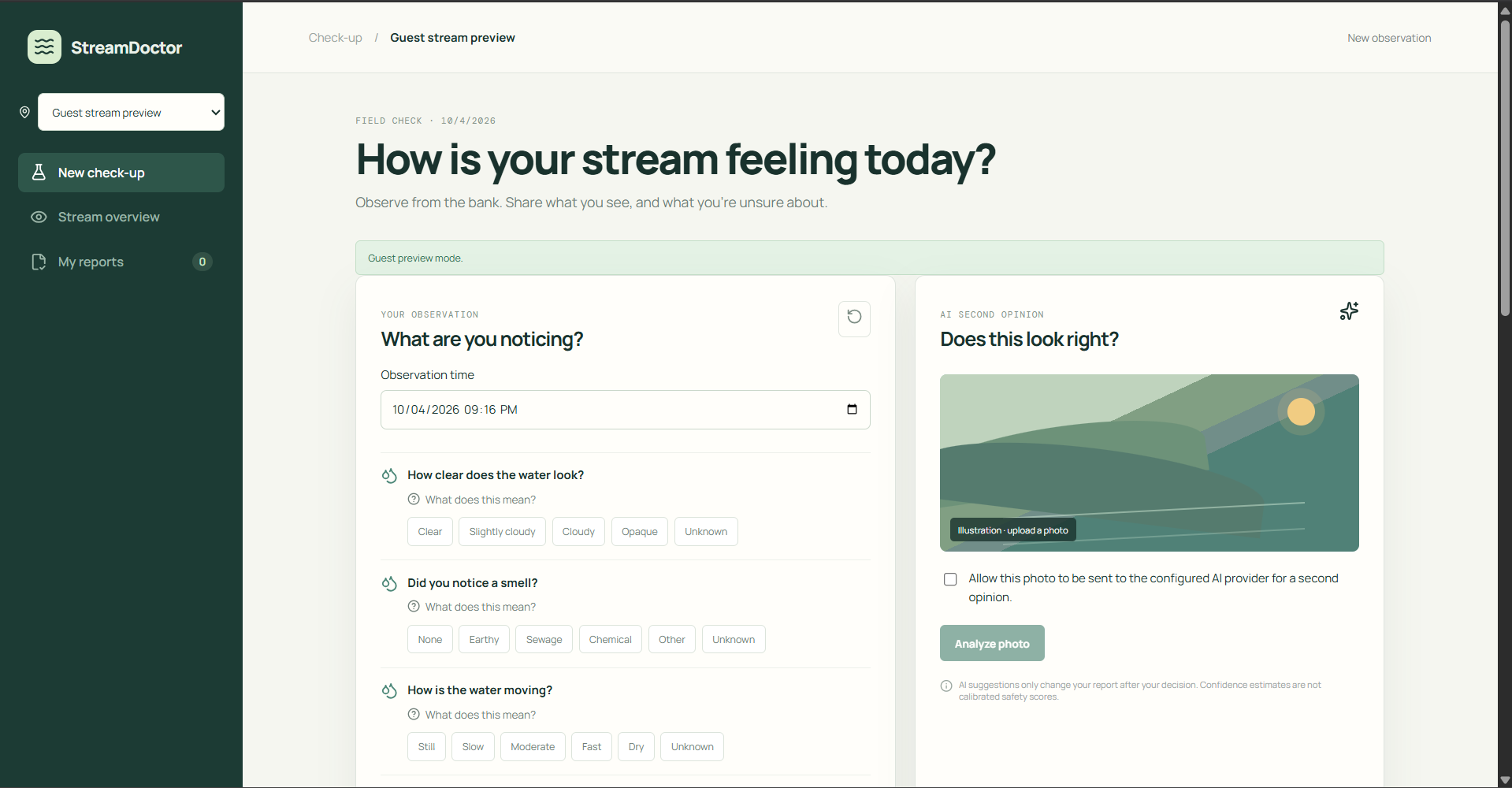
StreamDoctor is an AI-supported stream-health assessment tool that turns community observations into understandable, trust-aware insights. It treats a stream like a patient: volunteers report its symptoms, AI provides a second opinion, and the system explains how healthy the stream appears and how much its data can be trusted.
StreamDoctor addresses the gap between volunteer and agency observations by:
- guiding contributors through clear, plain-language observations
- checking reports for plausibility and internal consistency
- making AI suggestions reviewable rather than allowing AI to decide alone
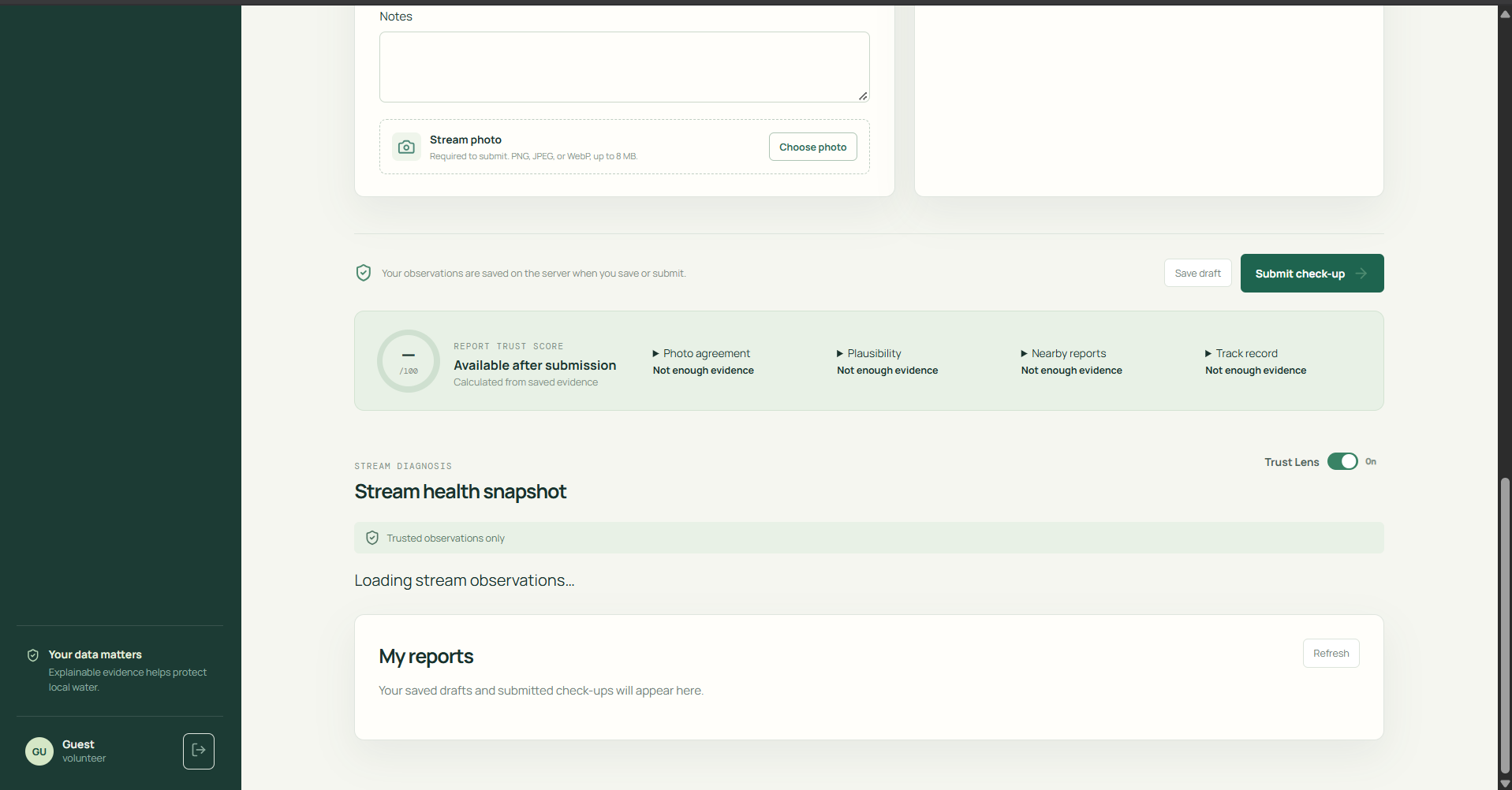
- showing why each report is trusted or flagged
- translating trusted observations into practical stream-health guidance
How we built it
We designed StreamDoctor around a simple, accessible reporting flow based on the observation fields used by the OneAquaHealth Citizen Science App.
The project combines:
- plain-language, guided data collection
- photo-based AI suggestions with confidence and explanations
- rule-based plausibility and consistency checks
- a multi-signal, explainable trust score
- a Trust Lens that shows how filtering changes the stream-health result
- audience-specific diagnosis cards
- FHIR-compatible representations of verified environmental observations
The system is designed to make uncertainty visible. Reports with lower trust are not simply discarded; they can be directed toward further review.
Challenges we ran into
We wanted to balance simplicity for volunteers with the detail needed by researchers and water managers. Environmental observations can involve unfamiliar terminology, so the reporting experience must be easy to understand without oversimplifying important information.
We also had to decide how to use AI responsibly. Image-based suggestions can be helpful, but they can also be uncertain or inconsistent. We addressed this by making the AI’s role a reviewable second opinion and by combining it with plausibility checks, nearby observations, and contributor history.
Accomplishments that we're proud of
We are proud to have created a concept that connects citizen science, explainable AI, environmental monitoring, and public health.
StreamDoctor does more than collect reports. It helps users understand:
- what was observed
- what the AI detected
- how consistent the report is
- why the information is considered more or less trustworthy
- what the result may mean for people and the environment
We are especially proud of the Trust Lens, which makes the effect of data quality visible, and the FHIR integration concept, which connects stream observations to the broader One Health perspective.
What we learned
We learned that AI-supported assessment should focus not only on prediction, but also on transparency, reviewability, and uncertainty. We also learned that data quality needs to be treated as part of the product experience. If users cannot understand why a report is trusted, flagged, or sent for review, the score is much less useful.
Finally, we learned that environmental health and human health are closely connected. Water quality affects wildlife, pets, recreation, communities, and public health decisions, so environmental observations should be designed to communicate across these different audiences.
What's next for StreamDoctor
We want to expand StreamDoctor’s validation with more diverse stream conditions, seasons, locations, and image types. We also want to improve the AI’s explanations, strengthen expert-review workflows, and support additional integrations with environmental and public health data systems.
We could also provide more targeted follow-up requests when the system identifies coverage gaps, such as requesting observations after a storm or from an under-monitored location. We also hope to support educators and community groups with classroom and local watershed activities.
Built With
- fastapi
- javascript
- python

Log in or sign up for Devpost to join the conversation.