-
-
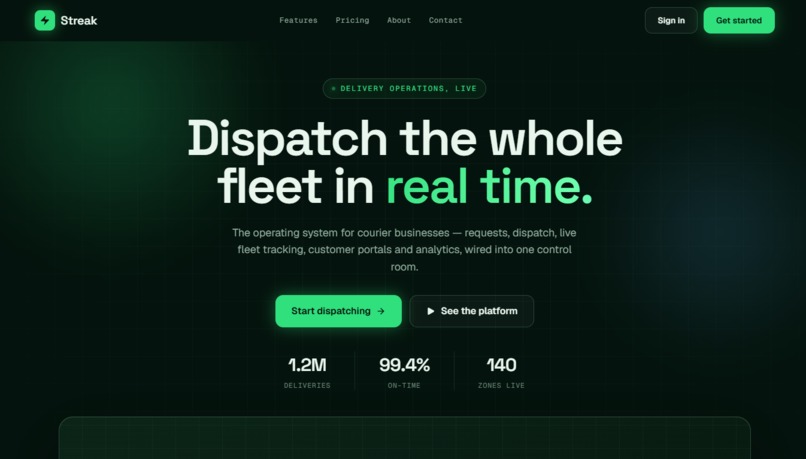
Streak Landing Page
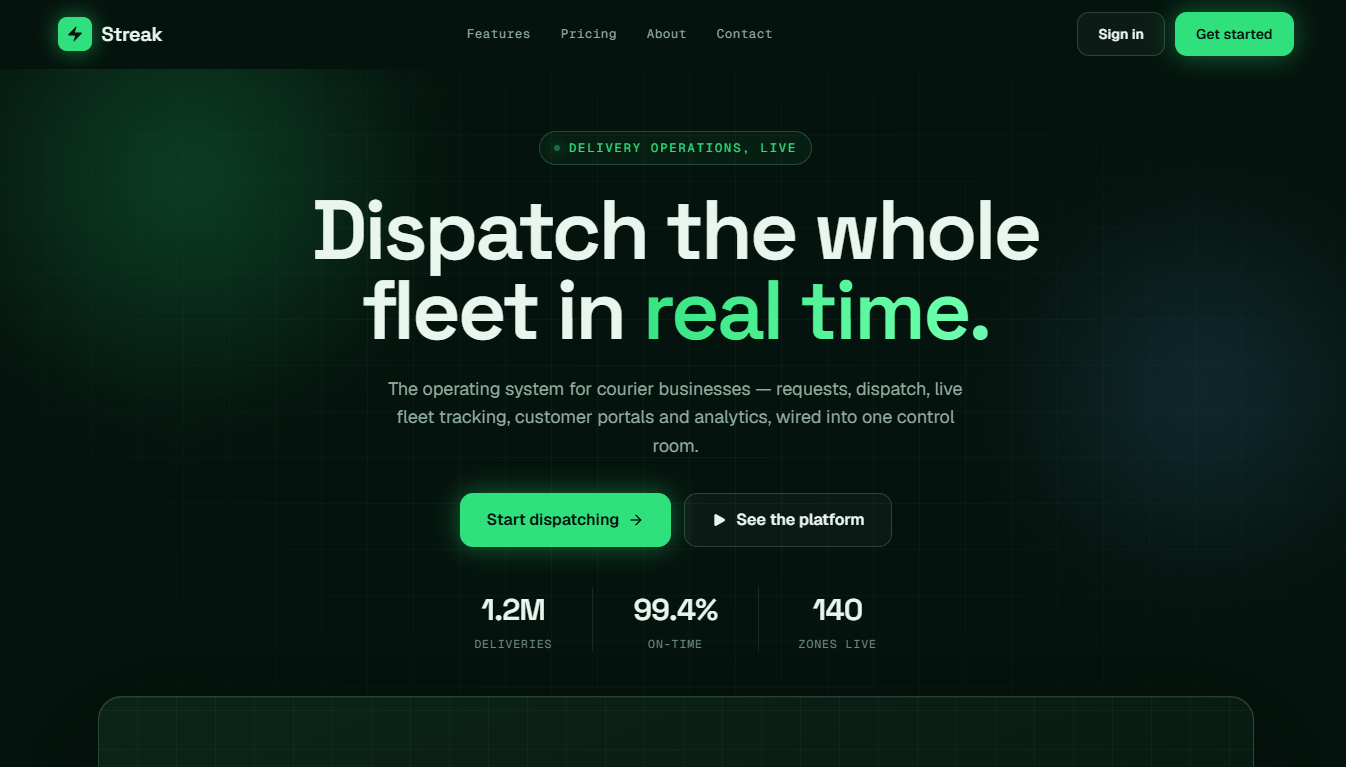
Streak: The Operating System for African Last-Mile Delivery
Inspiration
Africa's last-mile delivery market is worth $5.15 billion today, projected to reach $8.93 billion by 2031. The e-commerce market powering that demand reached $317 billion in 2024 and is on track to cross $1 trillion by 2033. Food delivery in Nigeria alone grew at a staggering CAGR of $187\%$ between 2021 and 2024, according to Paystack.
The demand is real. The riders are real. The problem is the layer in between.
Thousands of local couriers and dispatch businesses operate across African cities. They know their neighborhoods, they have motorcycles, and they are ready to work. But they are running entirely on WhatsApp messages and phone calls. No order management system. No tracking. No website. No API.
This is not a rider shortage problem. It is a software problem, and nobody has solved it at the courier layer.
The numbers show exactly how broken things are:
- Transport costs in sub-Saharan Africa are 50% to 75% higher than in other developing regions, partly because the fragmented courier layer cannot be coordinated efficiently
- Last-mile delivery costs in rural and peri-urban areas run up to 300% higher than in urban centers (World Bank)
- 87% of African logistics companies focus exclusively on B2B, leaving the consumer-facing delivery layer almost entirely unserved
- Nigeria's delivery platforms, despite rapid growth, serve at most 1 million active customers in a country of 220 million people
We built Streak because the infrastructure layer that would connect local couriers to the digital economy simply does not exist yet, and Africa cannot wait for it.
What it does
Streak is a two-sided platform that digitizes local courier businesses and aggregates them into a single programmable delivery network.
For Couriers (Supply Side)
Every courier business that joins Streak gets:
A branded website where their customers can request deliveries, get quotes, and track orders in real time. A local courier in Abuja or Accra now looks and operates like a professional logistics company.
An order and fleet management dashboard to receive, assign, dispatch, and monitor every delivery from one place, replacing the WhatsApp threads and phone calls they rely on today.
A rider app so individual riders can receive job assignments, navigate to pickups and drop-offs, confirm deliveries, and capture proof of delivery at the ground level.
An API endpoint that makes them machine-readable. Their availability, capacity, and tracking data become accessible to any third-party service, without any custom integration work on their side.
For Businesses (Demand Side / B2B)
Through the Streak API, any application integrates once and gains access to the entire network of Streak-powered couriers. A restaurant platform does not need to negotiate separately with ten local courier businesses across ten cities. An e-commerce app does not need to build its own logistics layer. They send a request to Streak and the right local courier fulfills it.
$$\text{1 API integration} \rightarrow \text{N courier businesses} \rightarrow \text{continent-wide coverage}$$
Streak sits at the infrastructure layer. We do not own riders or vehicles. We make existing couriers powerful enough to compete, and then connect them to demand they could never reach alone.
How we built it
Streak is built as a multi-surface platform with four interconnected components sharing a single backend:
- Courier dashboard (web): order management, fleet management, analytics, and API key management for courier business owners
- Branded courier website (web): auto-generated per courier, customer-facing, handles delivery requests and live order tracking
- Rider app (mobile): job assignment, navigation, delivery confirmation, and proof of delivery capture for individual riders
- Streak API: RESTful API that exposes courier availability, delivery creation, and tracking webhooks to B2B integrators
The stack is designed to be lightweight and mobile-first, built for low-bandwidth environments and affordable Android devices, which represent the majority of devices across our target markets.
Challenges we ran into
The address problem is Africa's most underappreciated logistics challenge. African cities largely lack standardized street addresses. Informal settlements have no named streets at all, and even formal neighborhoods rely on landmark-based navigation. Building a delivery request flow that works without a structured address required rethinking how location is captured and communicated to riders.
Designing for two very different users simultaneously was genuinely hard. The courier business owner needs a rich dashboard with data and controls. The rider needs something that works on a cheap smartphone, in the sun, while moving. Those are almost opposite design constraints and they had to be solved in the same product.
The chicken-and-egg dynamic between the supply side and the demand side is a real structural challenge. B2B clients will only integrate if there is reliable courier coverage. Couriers only grow if demand flows in. Sequencing the go-to-market correctly required thinking carefully about which side to seed first.
Accomplishments that we're proud of
- Built a fully functional multi-surface platform (courier dashboard, branded website, rider app, and API) within the hackathon window
- Designed an API layer that abstracts away courier fragmentation entirely, making local couriers collectively as accessible as a single large logistics provider
- Created an auto-generated branded website per courier that requires zero technical knowledge to set up, solving the web presence gap for businesses that have never had one
- Built the proof of delivery and live tracking flow end to end, which is the feature that most directly replaces the WhatsApp-based coordination that local couriers currently depend on
What we learned
The most important insight was that the courier is the customer, not just the supply. Early thinking framed couriers as infrastructure to be aggregated. Building the product revealed that couriers have real business ambitions. They want to grow, to look professional, to serve more customers. Streak works best when it treats them as the primary beneficiary, not a means to an end.
We also learned that Africa's delivery problem is much more a coordination and tooling problem than a coverage problem. The riders exist. The routes exist. What has been missing is the software layer that makes their work trackable, assignable, and programmable. That realization sharpened every product decision we made.
What's next for Streak
The MVP proves the core loop: courier signs up, gets a system, becomes API-accessible. The next phase is about making that loop fast and the network valuable.
Immediate priorities:
- Onboard the first cohort of real courier businesses in Lagos and Abuja and instrument everything to understand how they actually use the platform day-to-day
- Launch the first B2B API integration with a local restaurant platform or e-commerce seller to prove the demand side of the network
- Build a courier verification and ratings layer so API buyers can trust the quality of fulfillment across the network
Longer term:
- Expand coverage city by city across West Africa, then East Africa, using the same playbook
- Build analytics and revenue tools for courier businesses, turning Streak from an operations platform into the financial infrastructure layer for the courier economy
- Explore how the AfCFTA free trade framework, projected to increase intra-African trade by 109% by 2035, creates demand for cross-border delivery coordination that Streak is uniquely positioned to serve
Africa's last-mile delivery gap is a software problem. Streak is the fix.
Built With
- amazon-web-services
- django
- nextjs
- postgresql
- python
- v0
- vercel


Log in or sign up for Devpost to join the conversation.