-
-

Logo
-
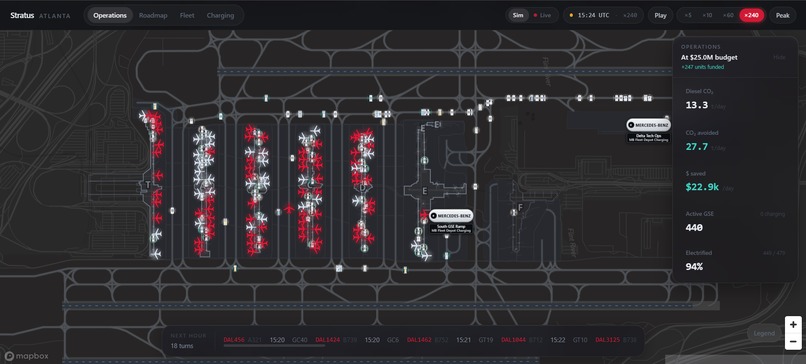
Map
-
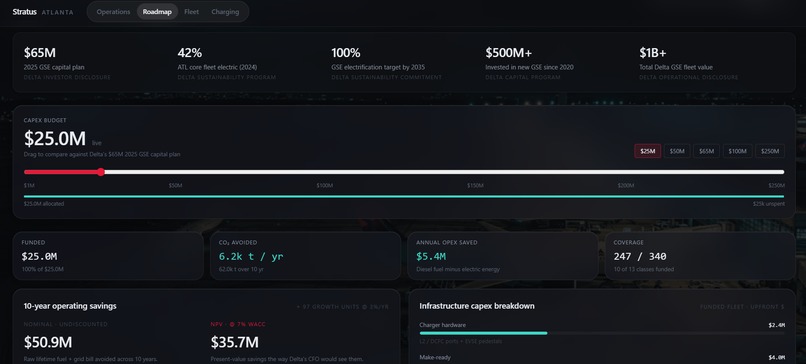
Roadmap 1
-
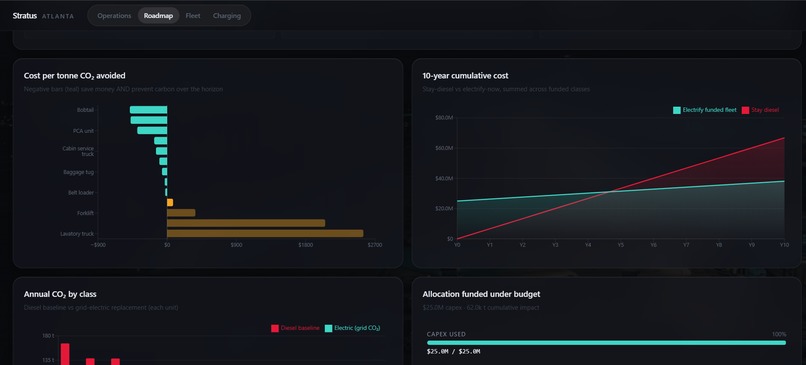
Roadmap 2
-
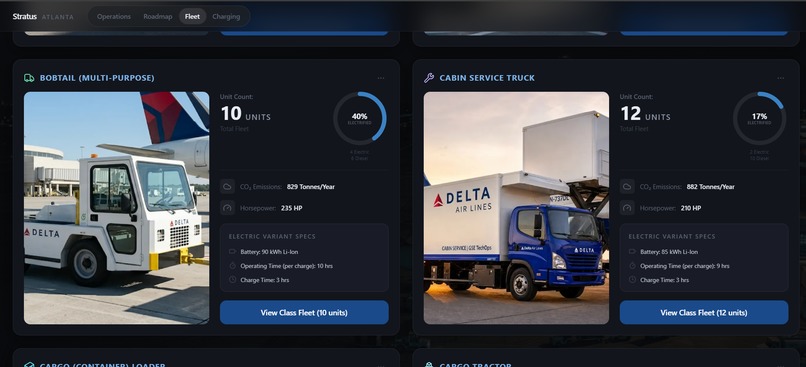
Fleet
-
Charging

Inspiration
We kept hearing the same conversation about sustainable aviation: SAF, electric aircraft, hydrogen. All 35,000-foot solutions. Then we looked at the ground. Hartsfield-Jackson runs nearly 1,000 Delta flights a day, and every single one triggers a swarm of diesel baggage tugs, belt loaders, GPUs, and pushback tractors. The ramp never stops. We couldn't find a single tool that helped an airline decide which vehicles to electrify first, when to charge them, or what the financial case looked like. Delta has already committed to 100% GSE electrification by 2035 and is spending $65M a year to get there. They have the ambition. We wanted to build the intelligence layer.
What it does
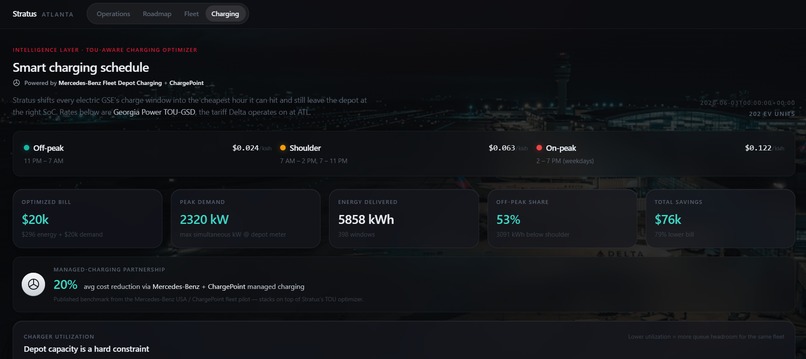
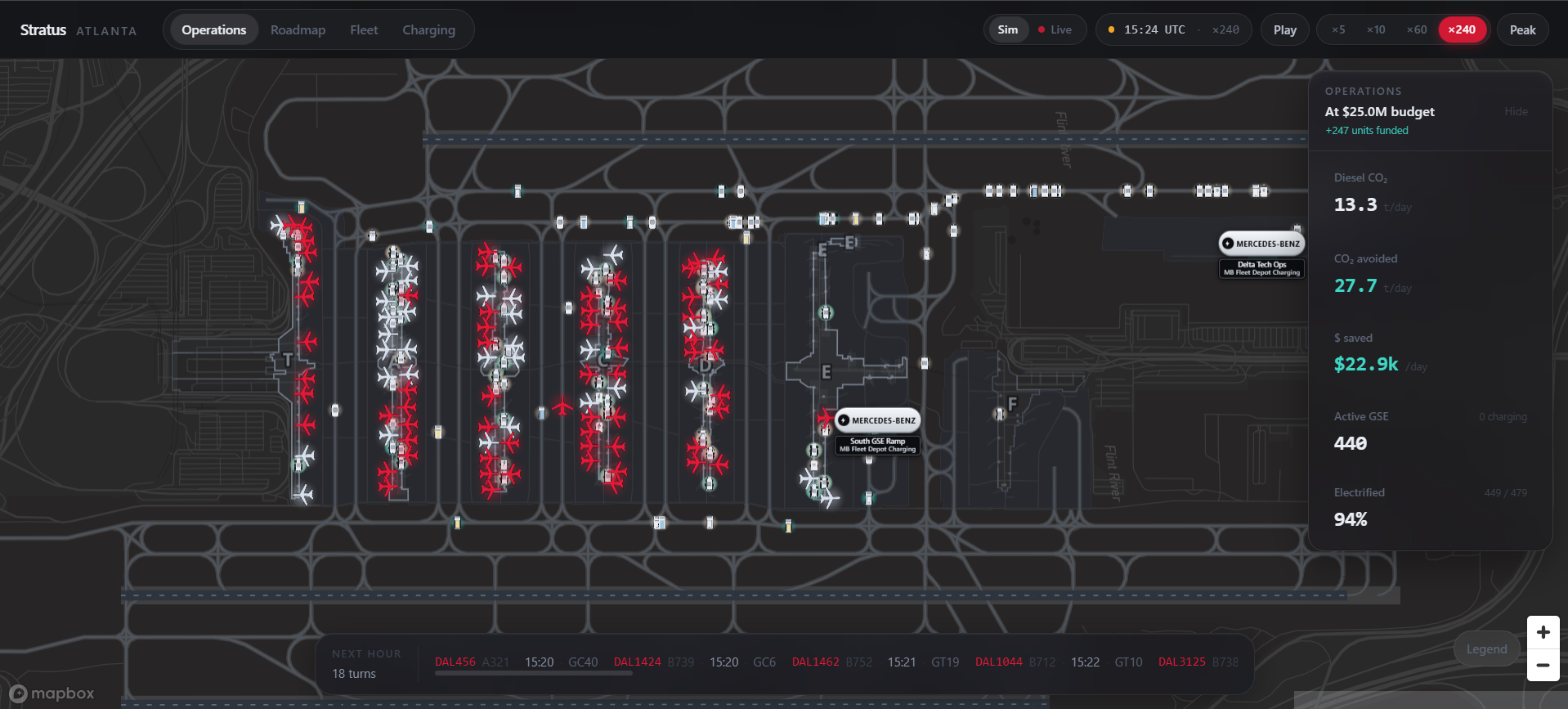
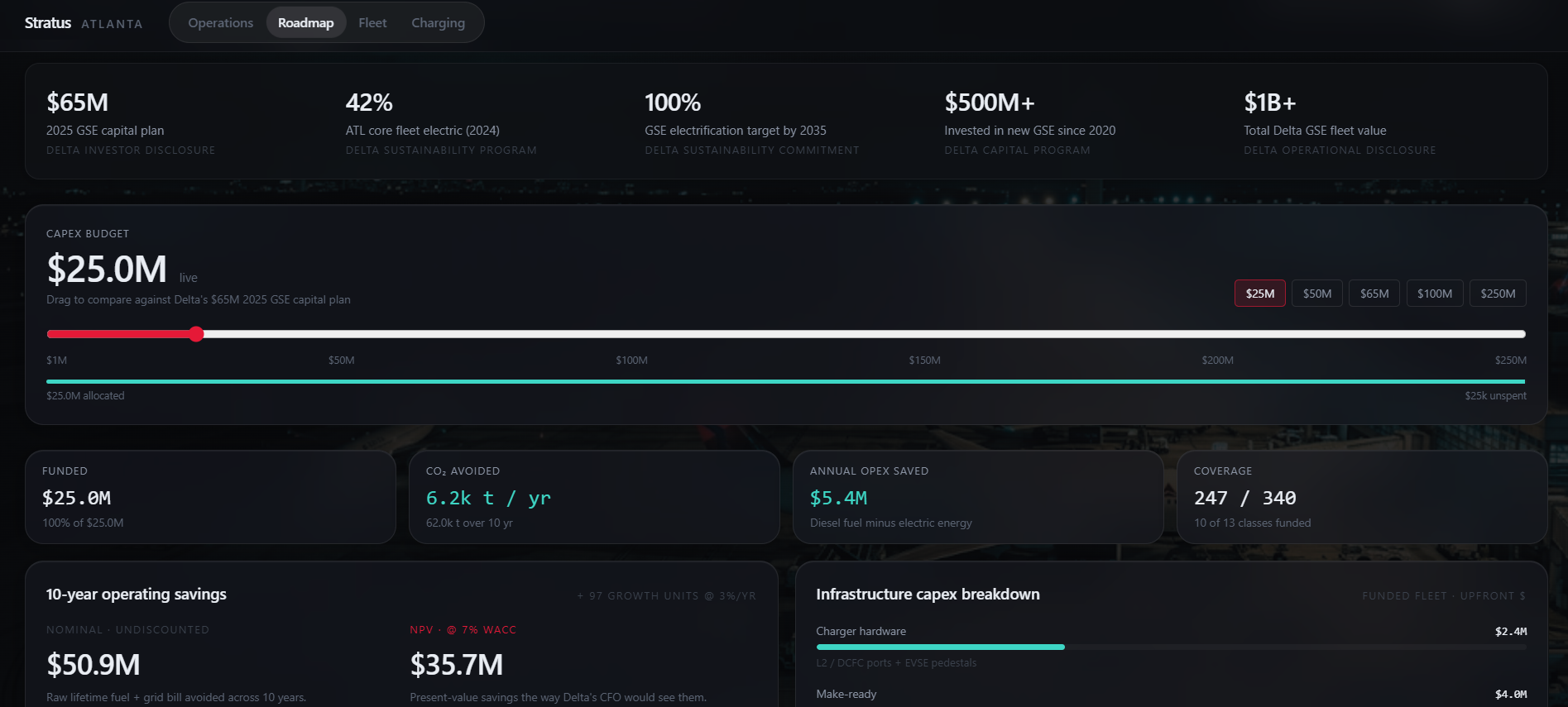
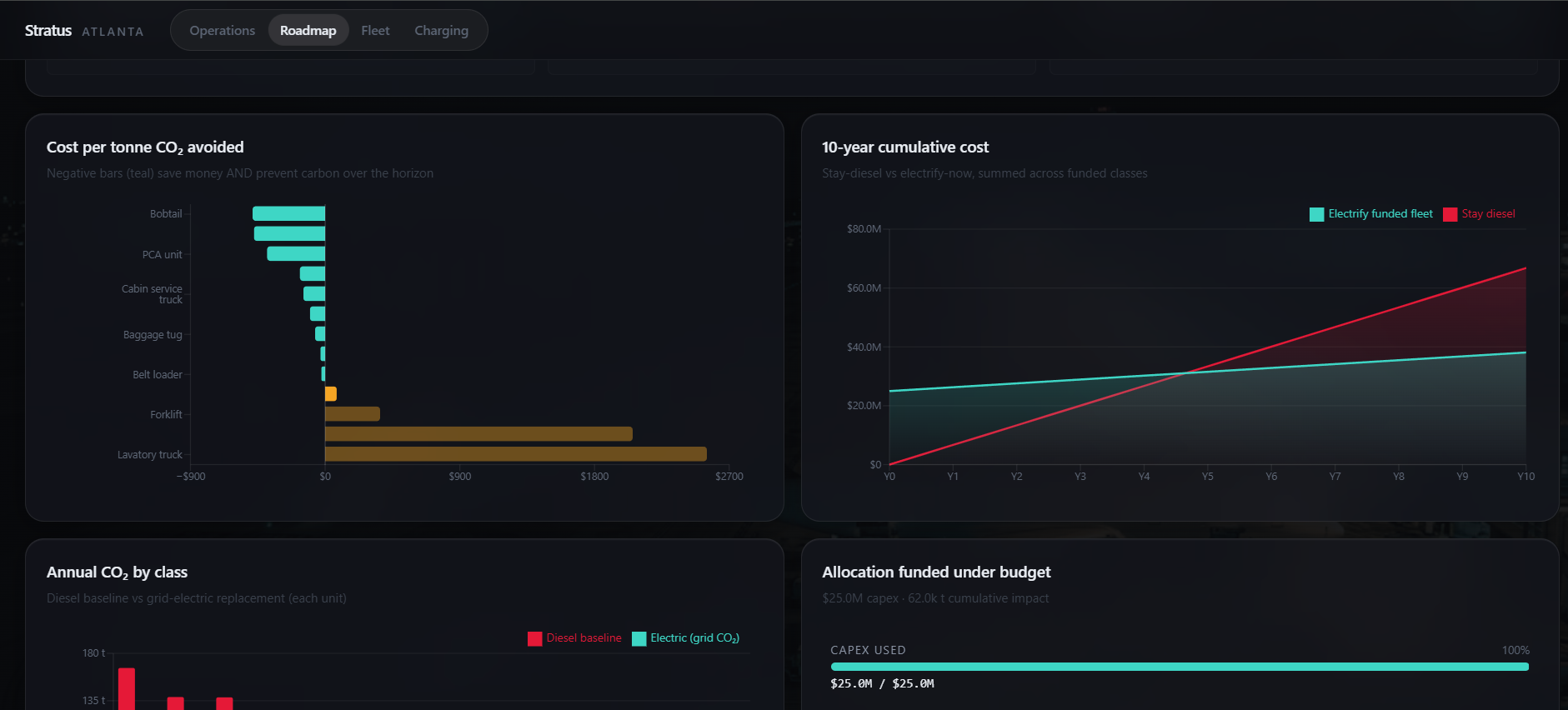
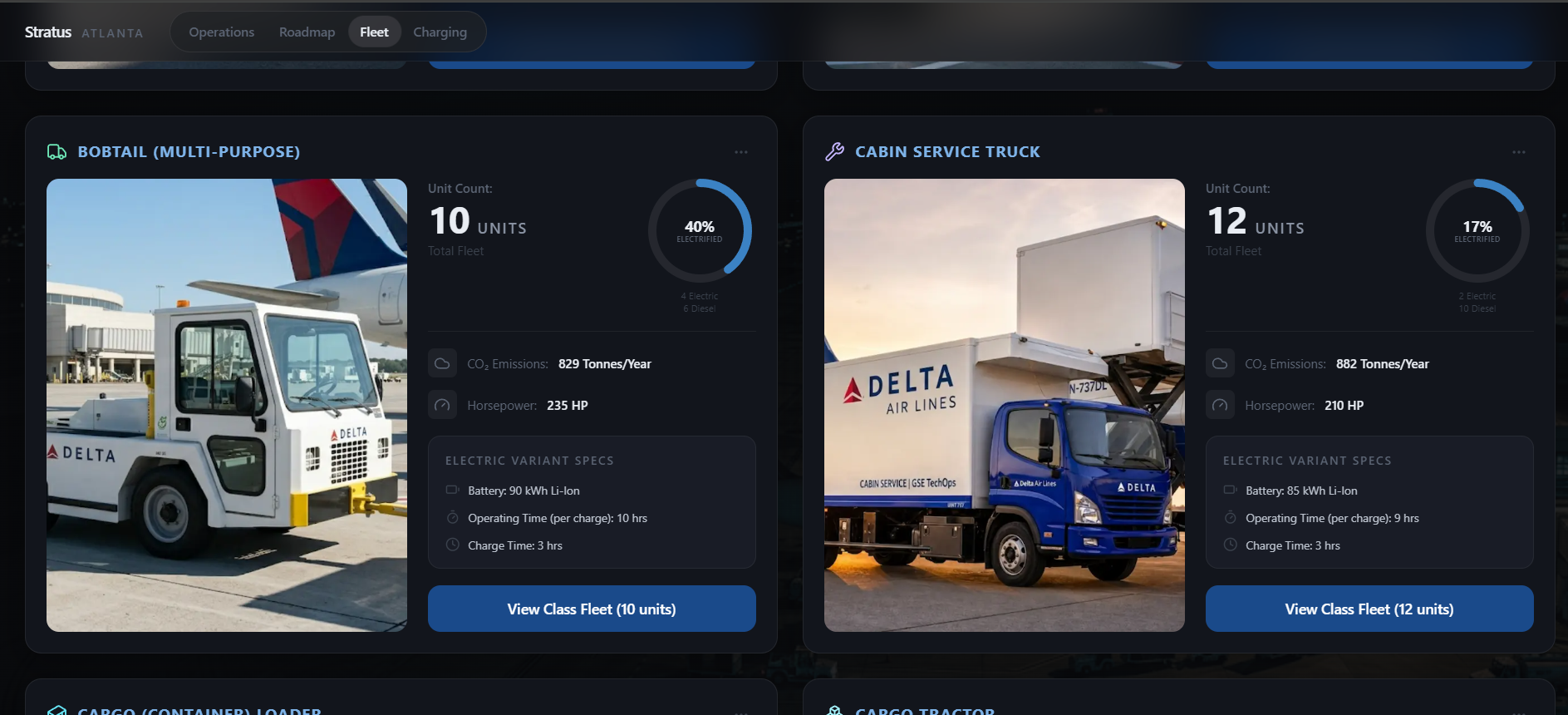
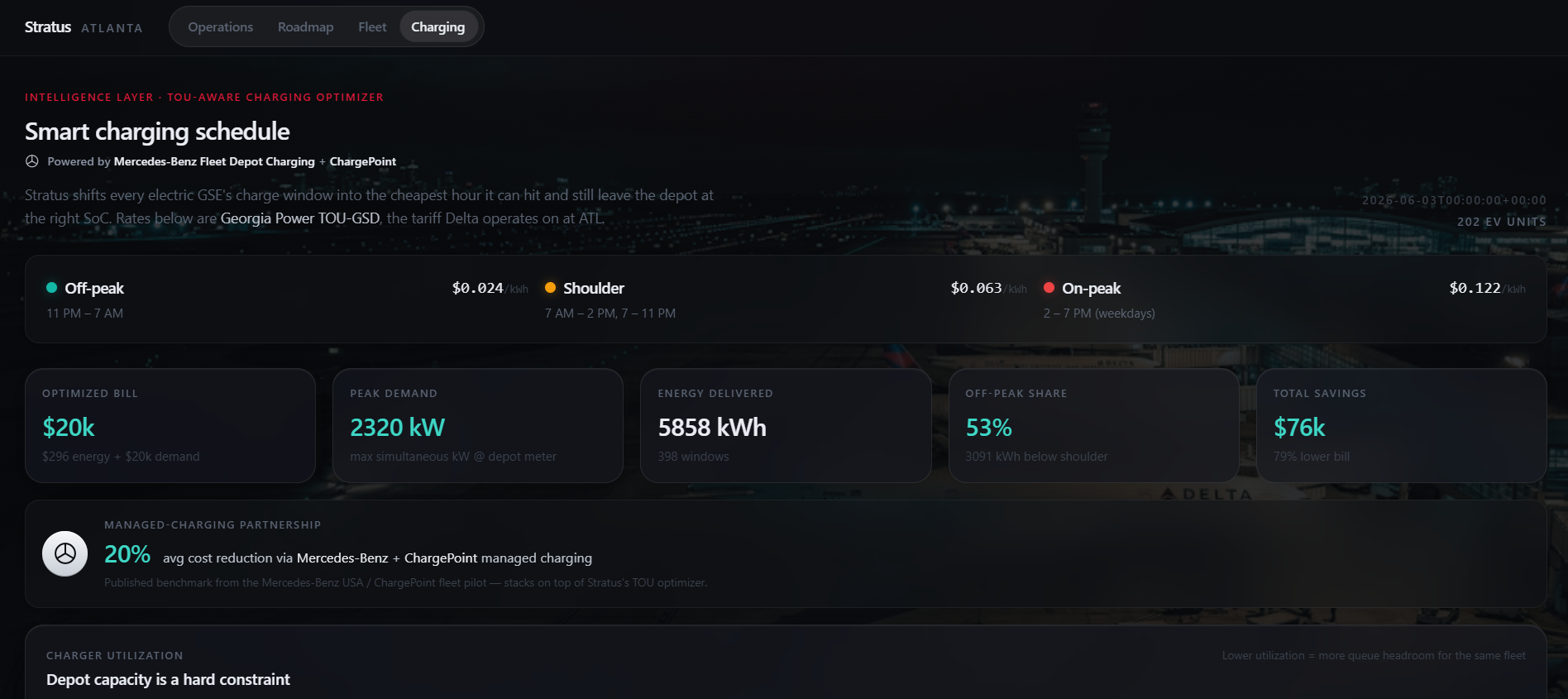
Stratus is a live operations dashboard for ground vehicle decarbonization at ATL. It does four things: -> It replays a real day of airport operations on an interactive map, with 1,422 actual flights triggering ground support vehicles that route along real taxiways between gates and depots. -> It ranks every diesel vehicle class by cost per tonne of CO2 avoided, so Delta knows exactly where each dollar of their $65M annual budget creates the most impact. -> It schedules electric vehicle charging against real Georgia Power time-of-use rates on Mercedes-Benz Fleet Depot Charging infrastructure, cutting charging costs by 80% compared to naive plug-in behavior. -> It models depot-side capital projects (solar, battery storage, civil works) with full NPV analysis at Delta's 7% cost of capital, including IRA tax credit stacking and Delta's $50/tonne internal carbon price.
How we built it
The backend is Python and FastAPI running an in-memory simulation. Every 100 milliseconds it advances a clock, dispatches ground vehicles to arriving flights based on aircraft-specific recipes, moves them along a precomputed taxiway graph built from OpenStreetMap data, and broadcasts positions over a WebSocket. The frontend is Next.js with Mapbox GL JS rendering the live map, Zustand managing state, and Recharts powering the roadmap dashboard. Aircraft motion (approach, landing, taxi, gate, pushback, takeoff, climb) is computed entirely client-side from the flight schedule and interpolated sim time. Emission factors come from ACRP Report 78, the FAA's published GSE emissions database. Every CO2 number in the app traces back to one validated Python file that matches the official worked example to the decimal. Electricity rates are the real Georgia Power TOU-GSD commercial tariff pulled from their published PDF. Flight data is 1,422 real turns from OpenSky Network for June 3, 2026. Airport geometry is real OSM data: 201 gates, 409 taxiway segments, concourse footprints, apron polygons.
Challenges we ran into
Performance was the biggest fight. Animating hundreds of aircraft and ground vehicles simultaneously on a Mapbox map while streaming WebSocket updates at 10Hz was melting the browser. We had to throttle the aircraft animation loop from 60fps to 12fps, debounce the Mapbox setData calls to 5Hz, cache KPI computations, and kill a polling file watcher that was burning 25% CPU doing nothing. The app went from draining a MacBook Pro battery in under two hours to running cool. Getting vehicles to follow real taxiway paths instead of cutting straight through terminal buildings was harder than expected. The OSM taxiway data has gaps and disconnected segments, so we had to build a graph, precompute Dijkstra routes for all 402 depot-to-gate pairs, and handle edge cases where segments didn't connect cleanly. Matching our fleet model to Delta's real electrification state took iteration. Our first version showed 5.6% electric when Delta has publicly stated 42%. We had to restructure the entire fleet seed with realistic per-class electrification rates based on which vehicle types the industry has actually converted first.
Accomplishments that we're proud of
The simulation feels alive. Planes descend on approach corridors, touch down on real runways, taxi to gates, get serviced by ground vehicles routing along real taxiways, push back, and take off. At 5x speed it looks and feels like watching a real airport operate. The financial modeling was well researched. NPV at 7% WACC, three honest framings per infrastructure project, IRA tax credit stacking, internal carbon pricing. We made it into an investment decision tool. Every number is defensible. We can trace any CO2 figure to ACRP Report 78, any electricity rate to the Georgia Power tariff PDF, any flight to an OpenSky record. Both track sponsors are addressed in one product. Delta owns the fleet. Mercedes provides the charging infrastructure. Georgia Power provides the electricity. Stratus connects all three.
What we learned
Aviation ground operations and infrastructure finance were completely new to us going into this. We learned how to read FAA emission factor databases, how IRA tax credits stack across multiple adders, how Georgia Power structures commercial electricity pricing, and how Delta thinks about capital allocation for their fleet. The biggest takeaway was that sustainability is ultimately a finance problem. The environmental case for electrification is obvious. The hard part is building the financial case in language a CFO acts on. Learning to think in NPV, payback periods, and cost per tonne avoided changed how we approach every part of the product.
What's next for Stratus
Multi-airport scaling is the next priority. The model is airport-agnostic. Swap the gate geometry and flight feed and it runs at JFK, LAX, or Heathrow. Delta operates at over 300 airports worldwide and the diesel ground fleet problem exists at every single one.
Built With
- fastapi
- mapbox
- mapbox-gl-js
- next.js
- opensky-network
- pydantic
- python
- react
- recharts
- tailwind-css
- typescript
- uvicorn
- websockets
- zustand


Log in or sign up for Devpost to join the conversation.