Inspiration
What it does
How we built it
Challenges we ran into
Accomplishments that we're proud of
What we learned
What's next for StratPulse
Inspiration
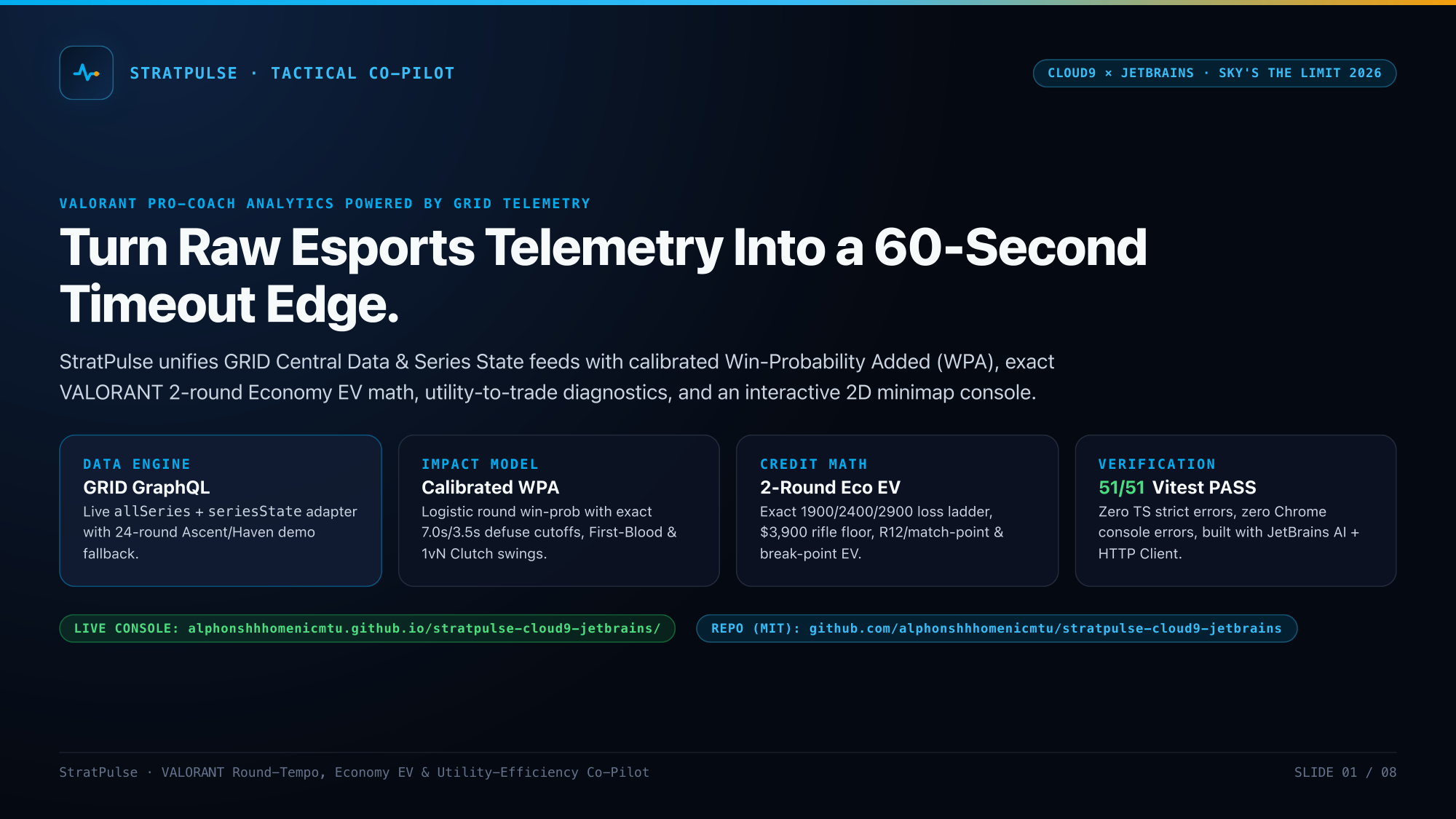
During a 60-second VALORANT tactical timeout, coaches do not have time to parse raw match spreadsheets or eyeball whether a second-loss force buy beats a disciplined save. We built StratPulse to turn GRID esports telemetry into a fast visual console that answers three coaching questions in seconds: where did round win probability actually swing, what is the mathematically best buy for the next two rounds, and which utility casts converted into kills?
What it does
StratPulse combines live GRID GraphQL ingestion with a client-side tactical analytics engine and 2D minimap:
- GRID GraphQL Adapter & 24-Round Replay (
src/grid/gridClient.ts): Queries GRID Central Data (allSeries) and Series State (seriesState) viaGRID_API_KEY, normalizing economy, spike objectives, kills, and world coordinates into[5, 95]map space. When no API key is supplied, it loads a deterministic 24-round replay across Ascent (12R) and Haven (12R) clearly badgedSYNTHETIC / DEMO REPLAY. - Calibrated Logistic WPA Engine (
src/analytics/winProbModel.ts): Computes live round win probability from(aliveAtk, aliveDef, spikePlanted, timeRemainingSec, loadoutDelta, siteControl, defuseHalfDone)with exact7.0s / 3.5sdefuse cutoffs and per-player WPA, Clutch WPA, and First-Blood Swing attribution. - 2-Round Economy EV Optimizer (
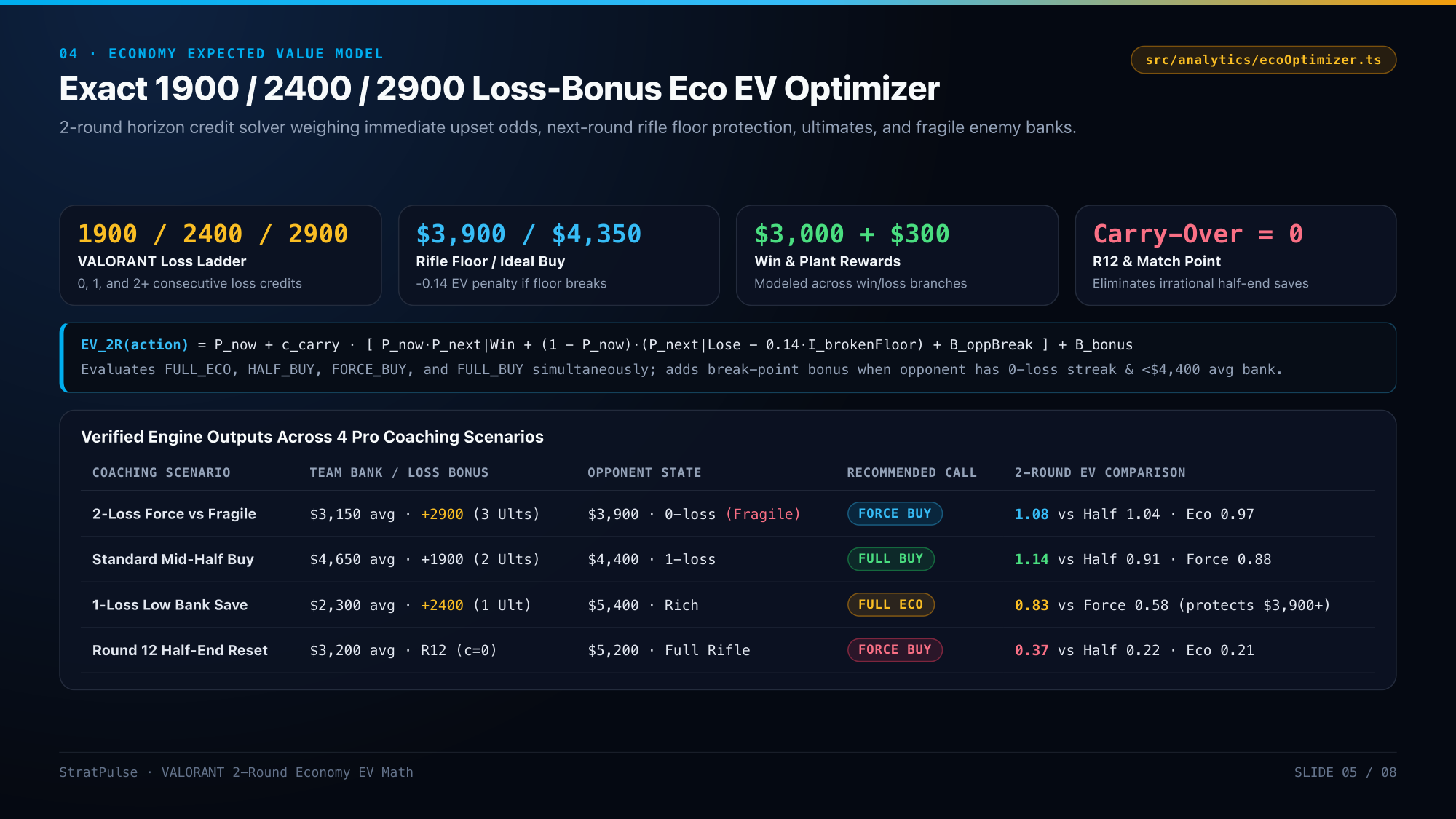
src/analytics/ecoOptimizer.ts): Models VALORANT's exact1900 / 2400 / 2900loss-bonus ladder,3000win reward, and3900full-rifle floor acrossFULL_ECO,HALF_BUY,FORCE_BUY, andFULL_BUY, including Round 12 half-end resets and Match Point overrides. - Utility Efficiency & 1-Click Coach Timeout Brief (
src/analytics/utilityEfficiency.ts): Scores Utility-to-Trade Conversion Rate (within 8s and 38 map units), Wasted Early Utility %, and Post-Plant Delay Index (0-100), then synthesizes a copy-ready Markdown timeout callout alongside an interactive 2D SVG minimap.
How we built it
We built StratPulse in WebStorm 2026 using strict TypeScript (strict: true, noUnusedLocals, noUnusedParameters), React 19, and Vite (--base=./). Before writing UI code, we probed GRID's GraphQL schema with JetBrains HTTP Client (requests/grid-esports.http), kept all analytics modules pure TypeScript with zero DOM dependencies, and used Junie + Vitest property tests to lock down WPA monotonicity and economy edge cases (JETBRAINS_AI_WORKFLOW.md).
Challenges we ran into
- Pre-plant vs. post-plant clock inversion: Before spike plant, time running down favors defenders; after plant, it favors attackers up to the
7.0s/3.5sdefuse boundary. We split the logistic clock feature aroundspikePlantedand added unit tests verifying opposite monotonicity slopes. - Live feed availability vs. static demo trade-off: Because
GRID_API_KEYcannot be shipped in a static GitHub Pages bundle without exposing credentials, the hosted Pages console runs on the 24-round Ascent/Haven replay by default while live GRID GraphQL queries run locally or via a server proxy (GRID_SETUP.md).
Accomplishments that we're proud of
- 51/51 Vitest tests passing (
winProbModel: 14,ecoOptimizer: 13,utilityEfficiency: 12,gridClient: 12) with 0 TypeScript strict errors. - 0 console errors, 0 page errors, and 0 failed network requests verified in headless Chrome against the live GitHub Pages bundle.
- Reproducible JetBrains AI workflow combining
.httpschema probing, PyCharm coefficient checks, and coverage-gated Vitest runs.
What we learned
Property-driven unit tests—checking invariants like "never recommend saving on Round 12"—catch subtle analytics bugs far faster than visual spot-checks on a dashboard.
What's next
Add a lightweight Cloudflare Worker proxy for authenticated team GRID feeds and expand 2D map geometry callouts to Bind, Split, and Lotus.
Built With
- graphql
- jetbrains-webstorm
- react
- svg
- typescript
- vite
- vitest
