-
-
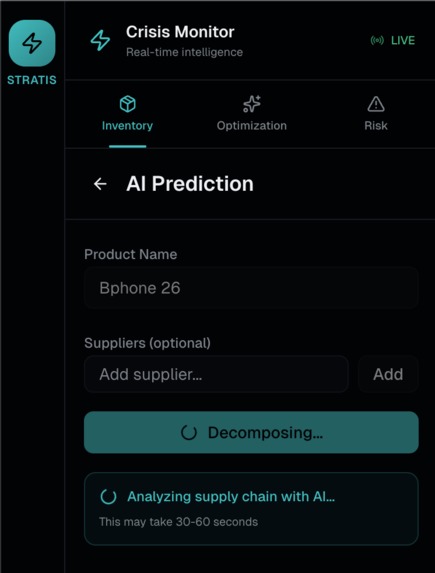
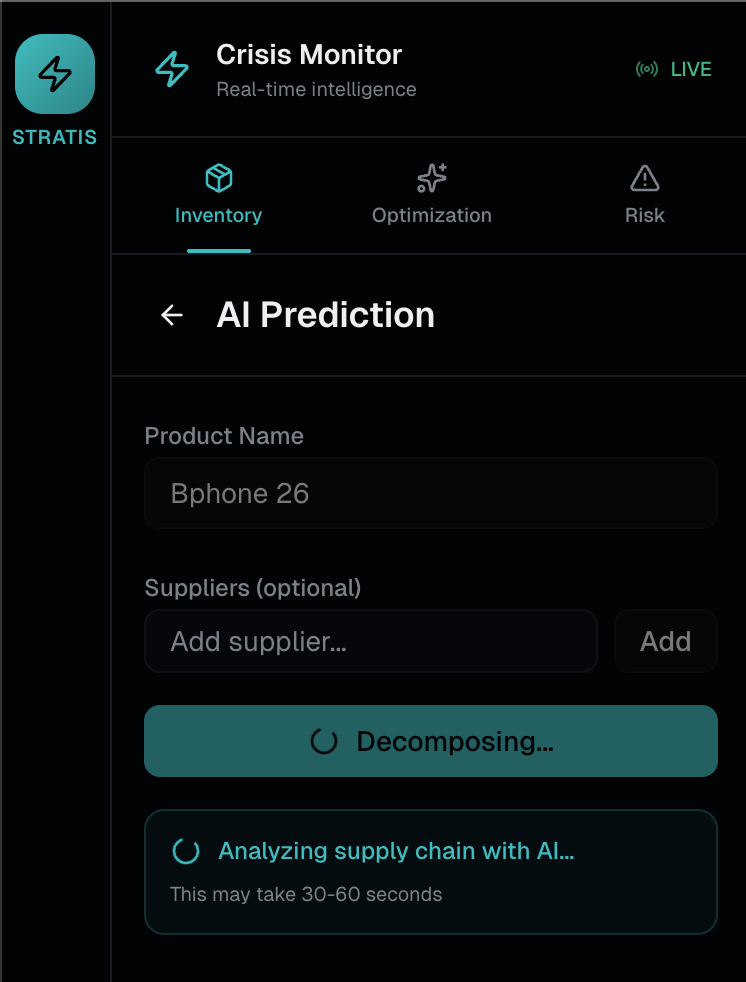
Generating supply chain prediction for our product
-
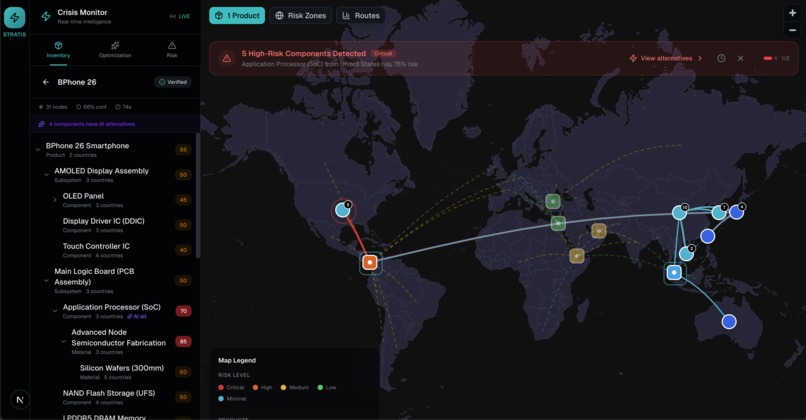
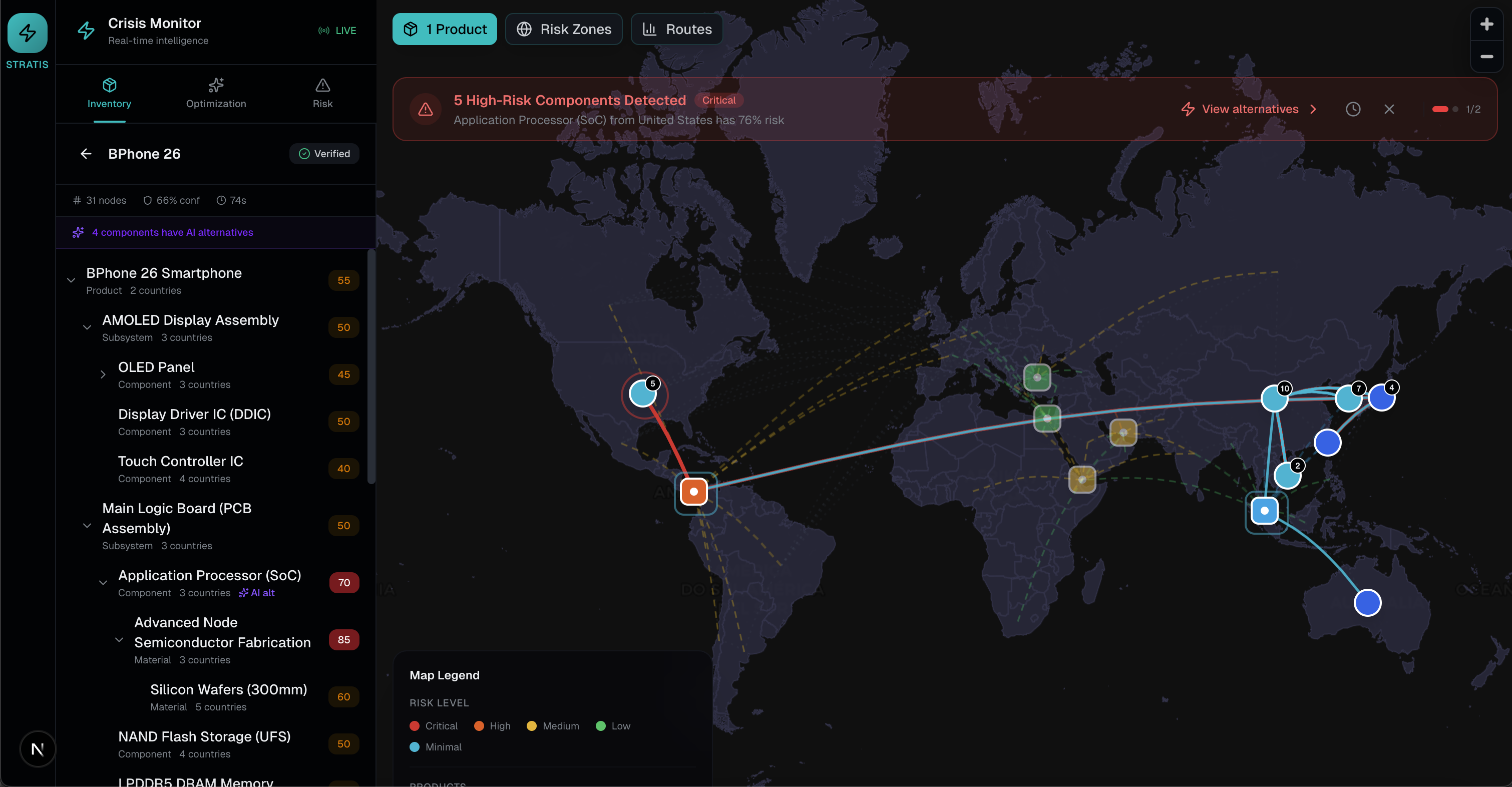
Supply chain map generated from basic information about product
-
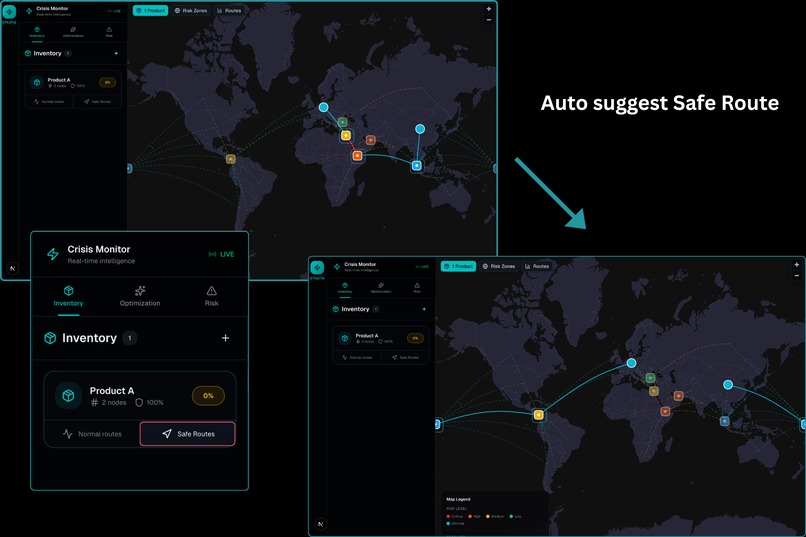
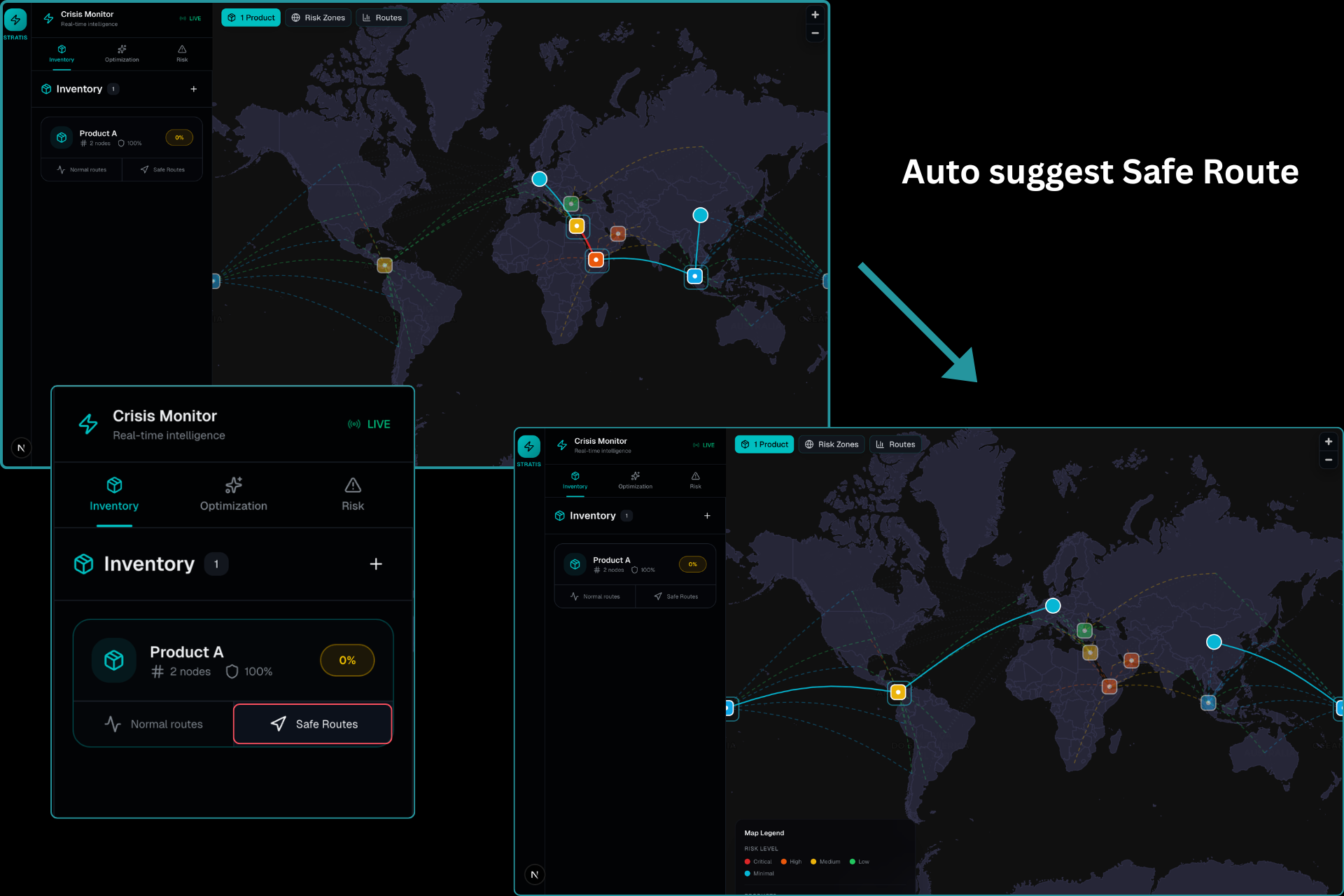
Safe Route function that find out the most safest route by using graph algorithm
-
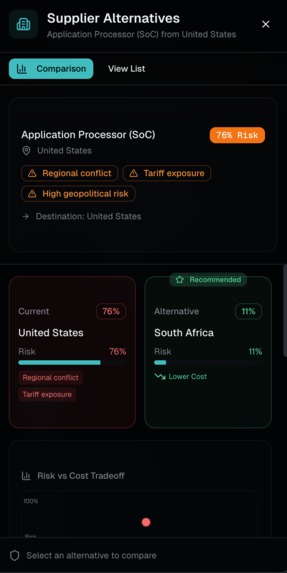
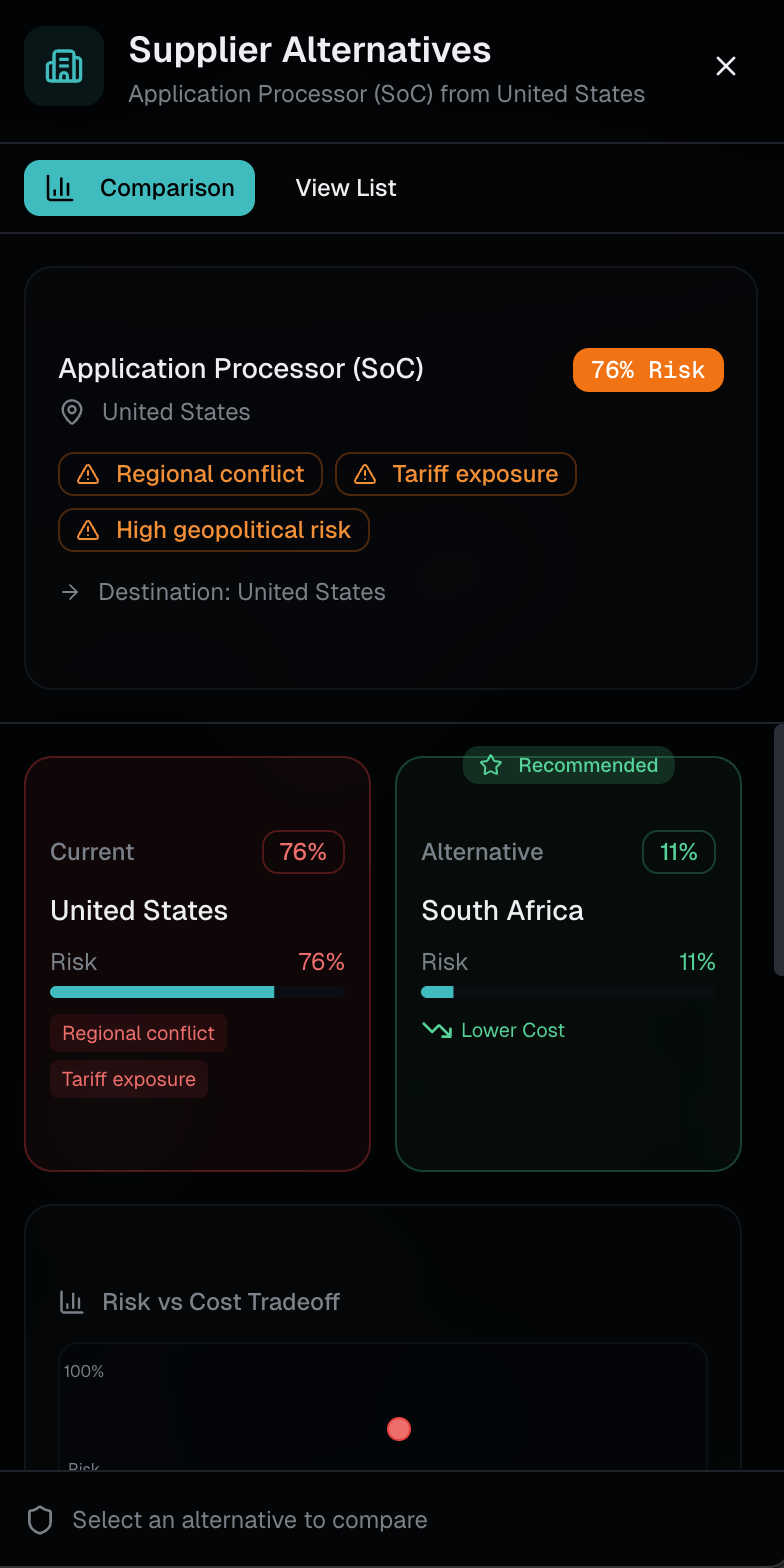
High risk product and our suggested possible alternative
-
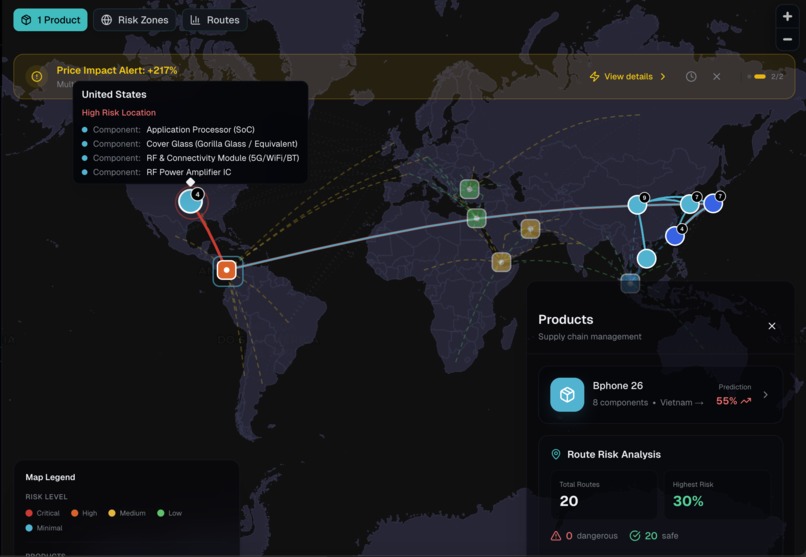
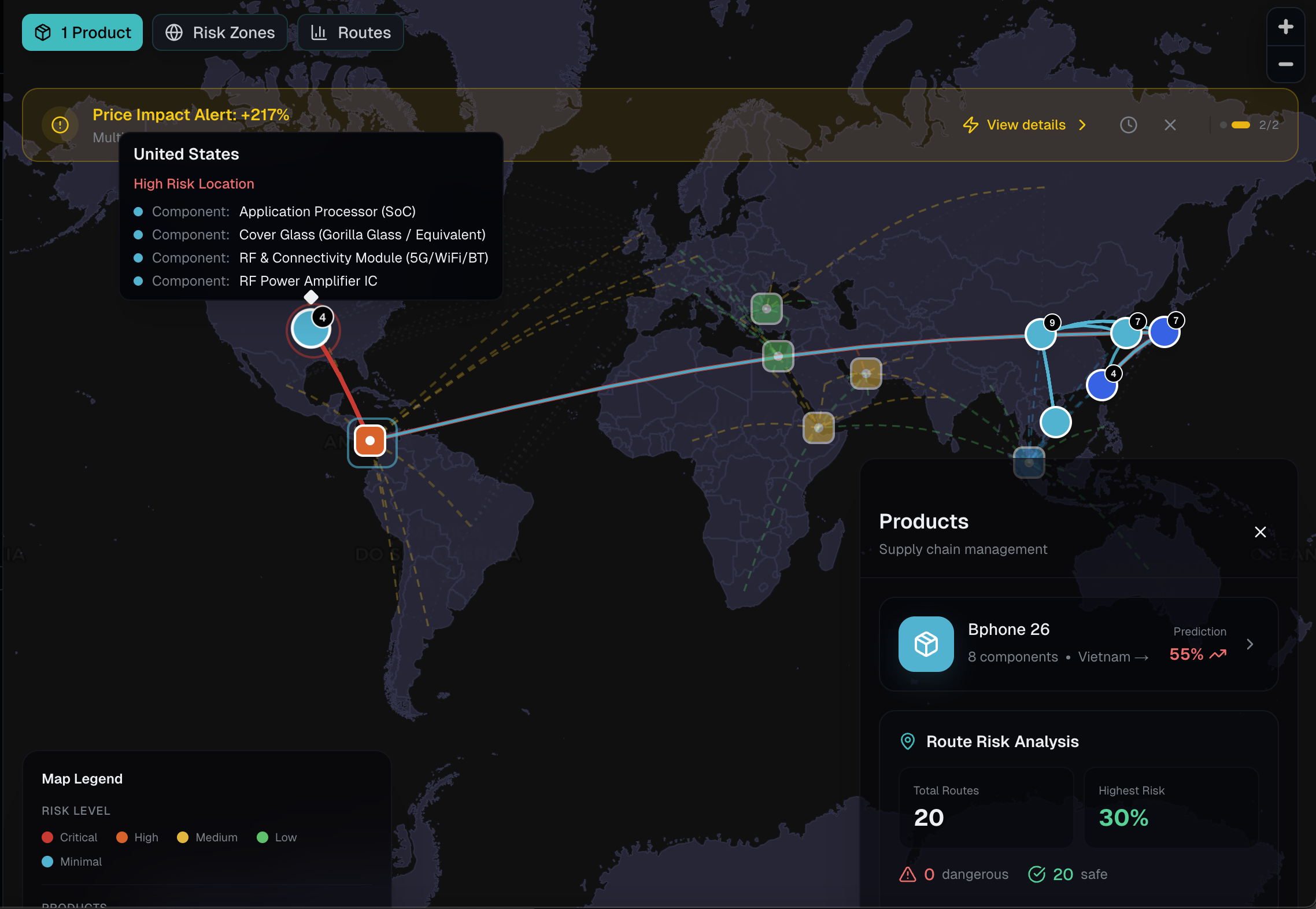
High risk location and components that are likely manufactured there
-
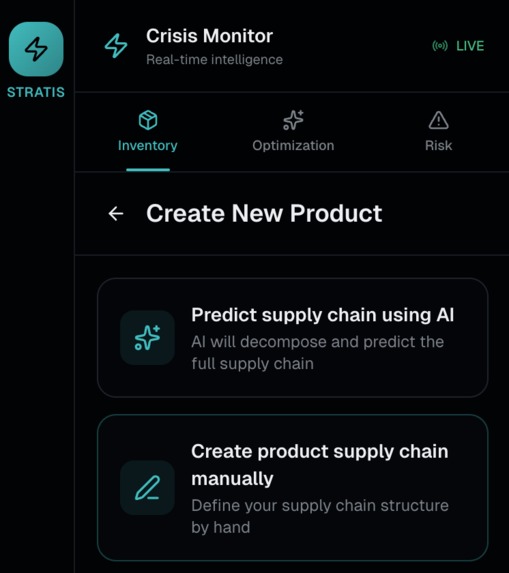
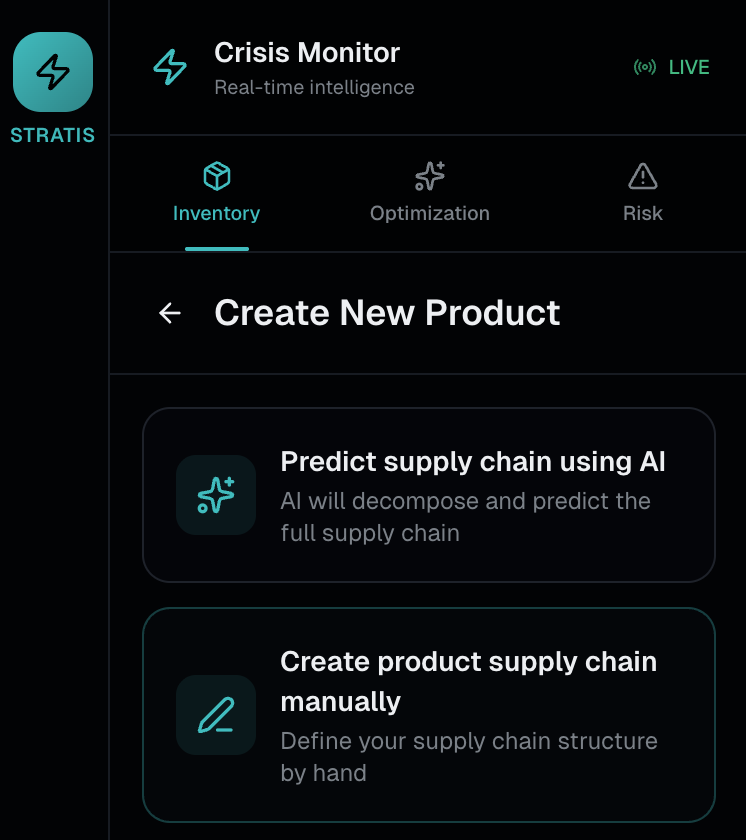
Menu to create new products
-
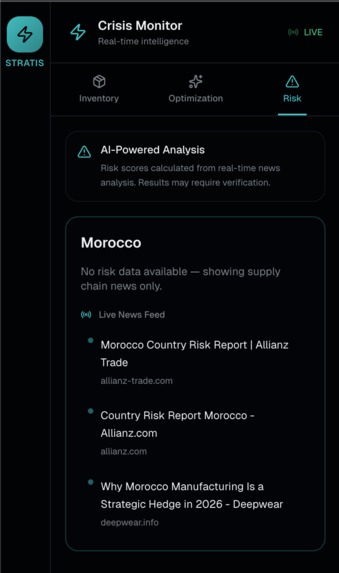
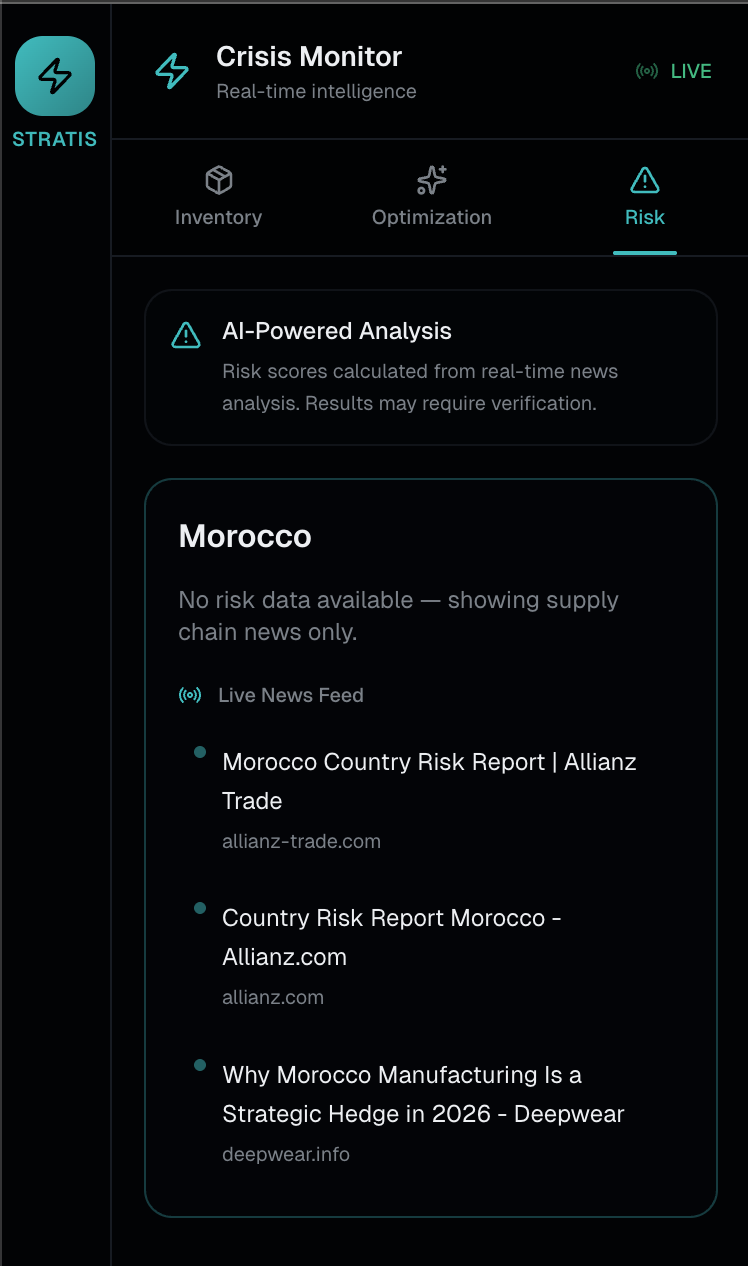
Live news feed from GDELT that integrates into our risk calculation
-
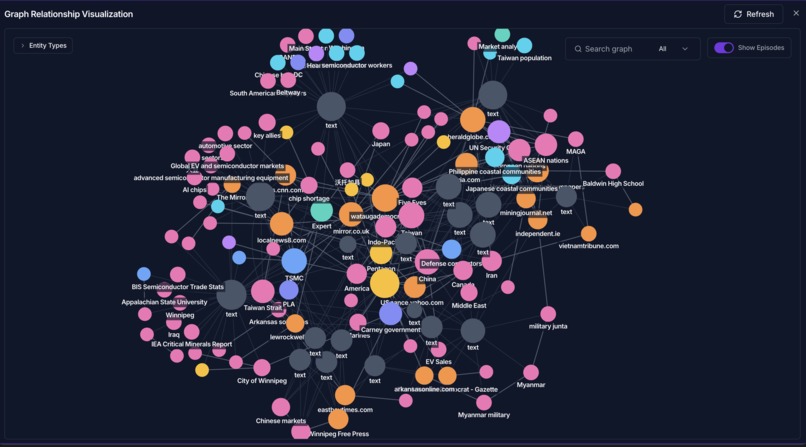
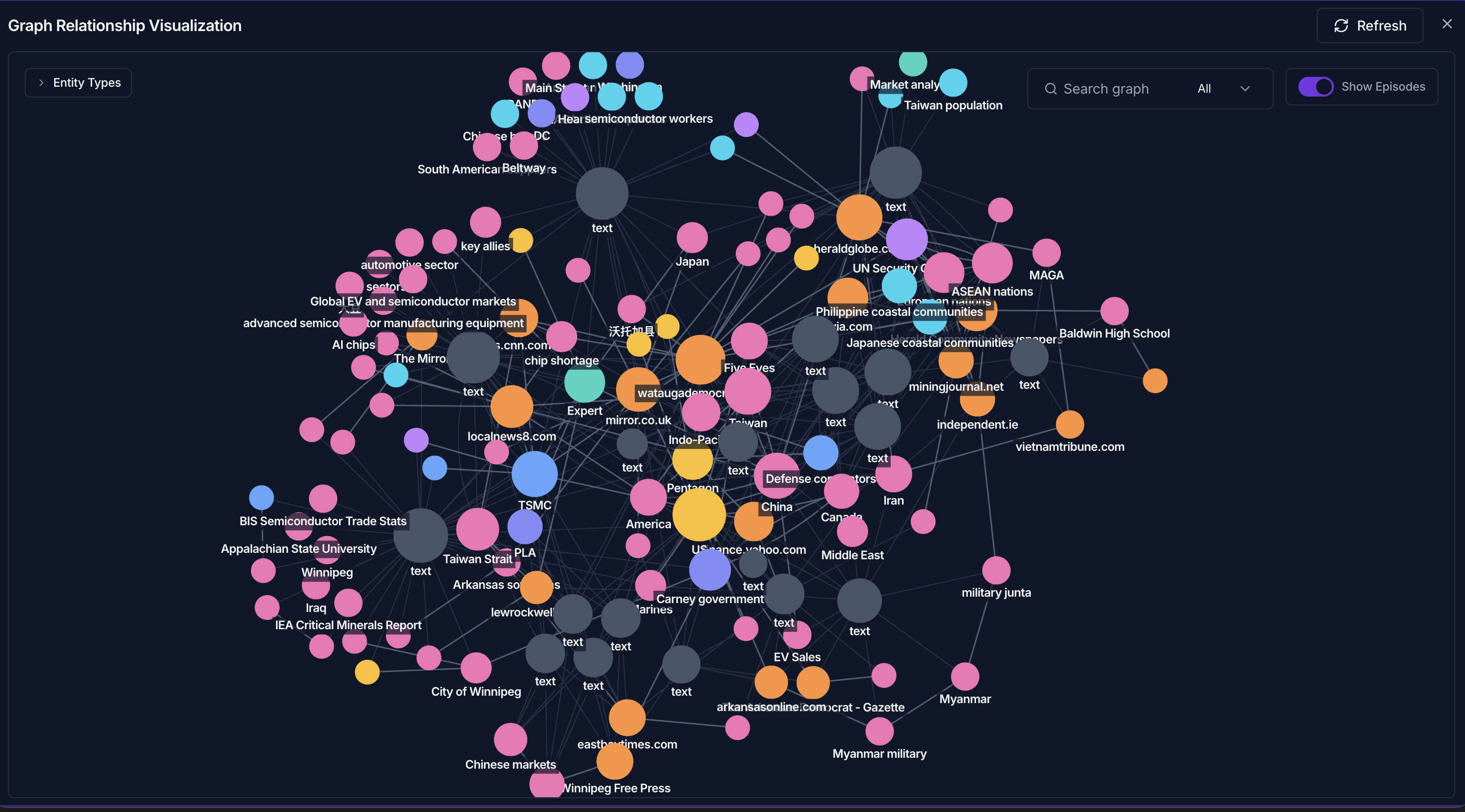
Context graph for Live news for the multi-agents system
🌍 Inspiration
Global supply chains are more fragile than ever. Tariffs can shift overnight, conflicts can disrupt major shipping lanes, and a single blockage can ripple across entire industries. Recent trade wars, port congestion, and geopolitical tensions inspired us to build Stratis.
Instead of reacting after disruptions occur, we wanted to create a tool that helps businesses understand risk before it becomes a crisis—a platform designed for supply chain intelligence, not just monitoring.
We believe that supply chain stability is a humanitarian necessity. When global routes fail, it isn't just electronics that stop moving—it is life-saving medicines, food supplies, and essential resources for vulnerable populations. We built Stratis to ensure these critical lifelines remain open during global crises.
🧠 What it does
Stratis is a real-time supply chain intelligence platform that helps companies visualize and de-risk global production networks.
Given product information and supplier data, Stratis decomposes products into their underlying raw materials and likely source countries. The platform then maps these relationships onto an interactive global network, where routes and supplier nodes are displayed on a dynamic map.
Each node is color-coded by risk, highlighting potential issues such as:
- Geopolitical instability
- Labor exploitation risks
- Logistics bottlenecks
- Trade disruptions
Stratis gathers country-level intelligence and live news data from the GDELT Project, continuously monitoring events that may impact supply chains. Using this information, the platform calculates a dynamic risk score for each region.
Users can inspect every node to see exactly how the risk score was calculated, including contributing factors such as recent news signals, regional stability indicators, and supply chain exposure.
MiroFish 67-Agent Crisis Simulation
Stratis features a 67-agent swarm intelligence system powered by MiroFish for geopolitical scenario simulation. Users can run "What-If" scenarios to predict potential political outcomes that could affect supply chains:
- Multi-role agent simulation: Government officials, military commanders, traders, diplomats, journalists, and civilians each act autonomously based on the scenario
- 10-round iterative simulation: Agents interact over multiple rounds, creating emergent geopolitical outcomes
- Risk trajectory prediction: Forecasts risk direction (up/down/stable) for affected countries with confidence scores and timelines
- Supply chain impact analysis: Cross-references predictions with your product inventory to show which components and materials are affected
AI-Powered Supplier Alternatives
When high-risk suppliers or regions are detected, Stratis automatically suggests alternative sourcing countries using AI-powered analysis:
- Intelligent suggestions: Kimi K2.5 analyzes component type, manufacturing capabilities, and geopolitical factors to recommend 3-5 lower-risk alternatives
- Risk validation: All suggestions are post-processed against a risk database to guarantee they are genuinely safer than the current supplier
- Cost tradeoff visualization: Side-by-side comparison showing risk reduction vs cost impact for each alternative
- One-click switching: View routes from alternative countries and instantly switch suppliers
Safe Route Finding
A routing engine identifies the safest shipping paths between suppliers using a Dijkstra based pathfinding algorithm with a weight of risk scores, chokepoint exposure. Users can exclude high-risk chokepoints to discover alternative routes.
Relocation Simulator
The relocation simulator allows companies to experiment with moving factories or sourcing locations to compare costs, resilience, and ethical sourcing impacts.
By mapping supply chains down to raw materials, we shine a light on the "hidden" layers where forced labor, child labor, and environmental exploitation often occur. Stratis empowers organizations to choose ethical partners, ensuring that global trade supports human dignity rather than undermining it.
🇪🇺 Why Stratis Fits the EU Shared Future Prize
Stratis aligns closely with the goals of the EU Shared Future Prize, which recognizes projects that contribute to a secure, stable, and cooperative global future.
Modern economies are deeply interconnected. A disruption in one region—whether caused by conflict, trade policy shifts, or infrastructure failure—can rapidly affect industries and communities around the world. These cascading effects threaten not only economic stability but also the movement of essential goods such as food, medicine, and humanitarian supplies.
Stratis addresses this challenge by increasing transparency and foresight in global supply chains. By combining real-time geopolitical intelligence, AI-driven risk analysis, and interactive supply chain visualization, the platform helps organizations anticipate disruptions and coordinate more resilient sourcing and logistics strategies.
The project promotes the spirit of international cooperation by making complex global dependencies visible. When companies, policymakers, and institutions understand how their supply chains connect across borders, they can make more responsible decisions that strengthen stability rather than amplify risk.
Additionally, Stratis supports the development of ethical and resilient trade networks. By exposing hidden supply chain dependencies and highlighting regions associated with labor or environmental risks, the platform encourages organizations to adopt safer and more responsible sourcing practices.
Ultimately, Stratis contributes to a shared global future by helping societies maintain the critical networks that sustain modern life. By enabling better anticipation of geopolitical disruptions and encouraging ethical sourcing, the platform supports the long-term goals of stability, cooperation, and resilience that the EU Shared Future Prize seeks to advance.
🤖 Why Stratis Fits the Quantium AI Solutions Prize
Stratis places AI at the centre of every decision in the supply chain risk pipeline.
Rather than using a single model for everything, we designed a multi-model architecture where each AI is chosen for a specific strength: GPT-4.1 Nano for fast, schema-enforced risk scoring; Claude Opus 4.6 for deep reasoning over complex product dependency trees; Kimi K2.5 for cost-effective generalist analysis of alternatives and relocations; Perplexity Sonar for grounding all outputs in real-time news evidence; and MiroFish's swarm intelligence engine for multi-agent simulation of how disruptions propagate through a supply chain.
AI is not decorative in Stratis. It powers the core loop of decomposing a product into its global supply chain, evaluating risk at every node using live geopolitical data, simulating future disruption scenarios, and recommending actionable mitigations. Each model output is validated, post-processed, and backed by deterministic fallbacks, ensuring reliability without sacrificing intelligence.
🛠 How we built it
The platform is built with a modern AI and web stack designed for real-time analysis and visualization.
- Next.js 16 powers the core application with a React 19 frontend
- Tailwind CSS 4 and shadcn/ui create a polished dark dashboard interface
- Mapbox GL JS renders the interactive globe and animated supply chain routes
For AI orchestration:
- OpenRouter + Claude generate product decomposition trees
- OpenAI GPT-4o evaluates risk signals and produces structured JSON outputs
- GDELT Project API provides live geopolitical news feeds used in risk analysis
- MiroFish 67-Agent Swarm simulates geopolitical scenarios with autonomous agents
The system builds a global route graph where a custom BFS-based pathfinding algorithm determines safer logistics routes.
To maintain reliability:
- Zod schemas validate API inputs and outputs
- A streaming SSE pipeline handles AI responses and stabilizes inconsistent JSON outputs
⚙️ Challenges we ran into
One of the biggest challenges was ensuring AI evaluations stayed grounded in real data rather than hallucinations.
We solved this by feeding live geopolitical news from the GDELT Project directly into GPT-4o, allowing the model to base its analysis on real events.
Other challenges included:
- Making product decomposition consistent and reliable across different product types
- Handling streaming AI responses with inconsistent JSON formats
- Tuning the route graph weighting system so recommended paths were meaningful—not just mathematically shortest
- Optimizing Mapbox rendering to display hundreds of animated supply chain arcs smoothly
- Orchestrating 67 autonomous agents to produce coherent, interpretable geopolitical outcomes
- Cross-referencing simulation predictions with supply chain data to surface actionable product-level insights
🏆 Accomplishments that we're proud of
We built a complete end-to-end workflow from product name to global supply chain visualization.
Key achievements include:
- A dynamic risk scoring system grounded in live news signals
- Transparent risk explanations showing how each score is calculated
- MiroFish 67-agent swarm intelligence for geopolitical scenario simulation with emergent outcomes
- Supply chain impact analysis that connects political predictions to your product components
- AI-powered supplier alternatives with validated lower-risk suggestions
- A relocation simulator that enables deep "what-if" analysis for manufacturing shifts
- The ability to model scenarios such as moving production from China to Vietnam in seconds
- A UI that makes extremely complex supply chain data intuitive and accessible
- Successfully orchestrating multiple AI models into a single coherent pipeline
📚 What we learned
Building Stratis taught us several important lessons:
- Coordinating Claude, GPT-4o, and MiroFish agents requires careful orchestration
- Real-world supply chains are far more complex and interconnected than most models assume
- Trade agreements, labor costs, and geopolitics interact in unexpected ways
- Streaming SSE pipelines in Next.js are essential for responsive AI applications
- The GDELT Project is an incredibly powerful free source of geopolitical intelligence
- Multi-agent swarm simulation produces emergent behaviors that single-model approaches cannot capture
- Something as simple as standardizing country names across datasets can become a surprisingly difficult problem
🚀 What's next for Stratis
We have several major improvements planned for the next version of Stratis.
First, we want to integrate live AIS vessel tracking data, allowing the platform to detect real shipping disruptions in real time.
Future features include:
- Historical risk trend analysis for forecasting disruptions
- User accounts and saved supply chains for ongoing monitoring
- Expanding the logistics graph to include rail and air freight routes
- A collaborative workspace where teams can share supply chain insights
- Enhanced MiroFish integration with custom agent configurations and longer simulation horizons
Our long-term vision is to make Stratis a global intelligence layer for supply chains, helping organizations build networks that are not only efficient—but also resilient and ethical.
Built With
- claude-(via-openrouter)
- gdelt-api
- kimi/k2.5
- mapbox
- mapbox-gl-js
- next.js
- openai-gpt-4o
- radix-ui
- react
- recharts
- shadcn/ui
- tailwind-css
- typescript
- zod


Log in or sign up for Devpost to join the conversation.