-
-
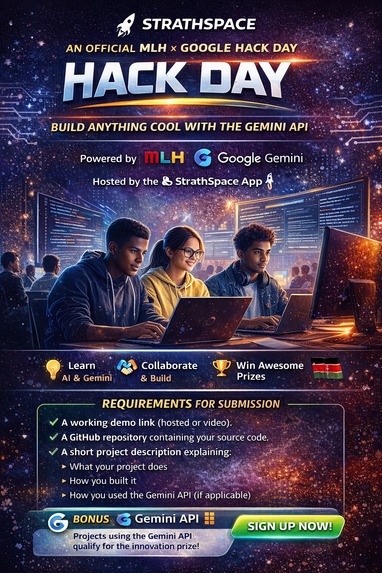
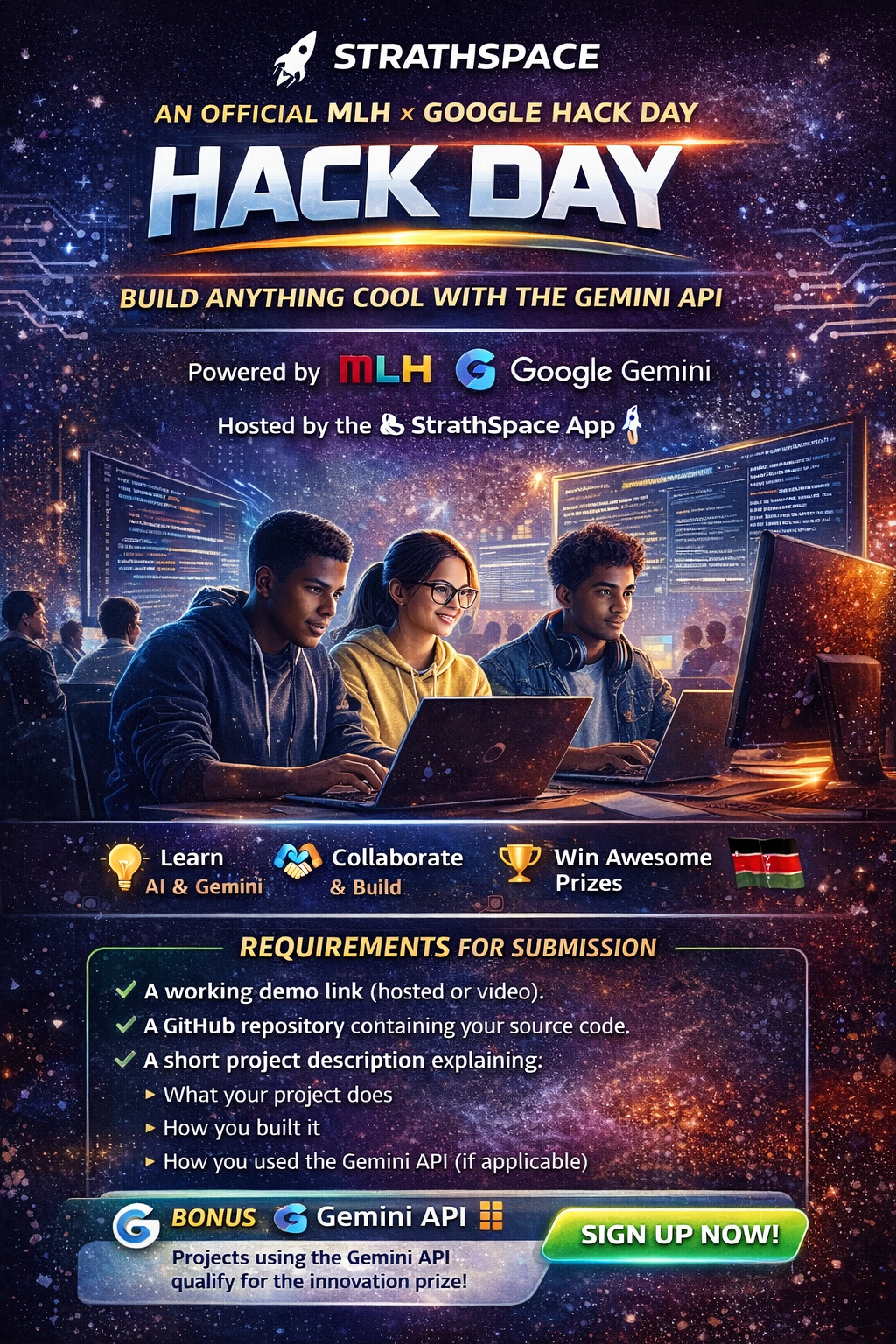
HACKDAY
The StrathSpace Odyssey: Architecting the Future of African AI I. The Catalyst: Why We Built This In the heart of Nairobi, within the halls of Strathmore University, there exists a hunger for innovation that transcends limited hardware resources. The digital divide in Africa is often characterized by a lack of access to massive localized compute power. However, the emergence of the Google Gemini API changed the variables of this equation.
Our inspiration was born from a simple observation: African developers are masters of frugal innovation. We don't need a warehouse of GPUs if we have a robust API that brings the world's most advanced reasoning models to our fingertips. We wanted to build a platform that doesn't just showcase AI, but acts as a springboard for 50+ young innovators to realize their potential.
"The mission was to democratize intelligence. If a student in Nairobi has an idea, latency and cost should be the only hurdles, never the lack of a brain for their application."
II. The Steep Learning Curve Transitioning from traditional software engineering to Generative AI orchestration was our primary educational challenge. We had to move away from deterministic "if-then" logic and embrace the probabilistic nature of Large Language Models (LLMs).
We learned that the quality of an AI application is directly proportional to the "Density of Context" provided in the prompt. We mastered the art of System Instructions, learning how to constrain Gemini 3 Flash to behave not just as a chatbot, but as a structured data architect.
Key technical takeaway: Multimodality is the future. Integrating image inputs for future vision-based grading was a breakthrough in our conceptual design.
III. The Build: Technical Deep Dive The architecture of StrathSpace is built on the React 19 + Gemini API stack. We treated the API as a "Cloud Processor" rather than just an endpoint.
To measure the performance of our idea generator, we developed a simple scoring formula for token utility ($\eta$):
$$ \eta = \frac{\sum_{i=1}^{n} (V_i \cdot C_i)}{T_{total}} \times 100\% $$ Where $V_i$ is the value of the idea, $C_i$ is the technical coherence, and $T_{total}$ is the total tokens consumed.
We implemented a custom geminiService that utilizes the responseSchema feature. This was critical because traditional string parsing of AI output is brittle. By enforcing a JSON schema at the model level, we ensured that our UI components never crashed due to malformed data.
IV. Challenges & The "Aha!" Moments Building in a high-intensity hackathon environment like MLH x Google brings unique stressors. Our biggest challenge was State Synchronicity during Asynchronous Streams. When the Gemini model is thinking, the UI must remain responsive.
Initially, our React state was updating too frequently, causing jitter. We solved this by implementing a Buffering Middleware.
$$ \text{Delay}_{\text{backoff}} = \text{base} \cdot 2^{\text{attempts}} + \text{jitter} $$ Another hurdle was localizing the AI. We found that generic models didn't understand the specific nuances of the "Kenyan Tech Scene." We overcame this by injecting localized context—mentioning places like "iHub" and "Strathmore"—into our System Instruction, transforming a global model into a local expert.
V. Looking Ahead StrathSpace is more than just a hackathon landing page. It is a testament to what happens when local talent meets world-class tools. As we conclude this build, we are reminded that the only limit to innovation in Kenya is the boundaries of our imagination.
Built With
- css
- flask
- geminiapi
- python
- react
- typescript

Log in or sign up for Devpost to join the conversation.