Inspiration
The hackathon itself was my first source of inspiration. I wanted to build something with WebMCP and explore what an AI-first product could look like.
By AI-first, I mean a product where the main way to interact is through an AI agent such as ChatGPT. The interface still matters, but instead of clicking through every step manually, the user can describe what they want and let the agent work with the application.
I started thinking about tasks that are difficult for an ordinary person to complete through a conventional interface. That led me to trading.
I remembered using TradingView and trying to test different strategies. I wanted to answer some basic questions. Is this actually a good strategy? Could it make a profit? What are its weaknesses? Does the strategy work, or does it only look successful because of the particular data used in the test?
I did not know the answers, and finding them was not simple. So I decided to build a product that could help investigate these questions.
ReTrade was built in about five days. The project became much more promising than I expected, and I genuinely enjoyed working on it.
What it does
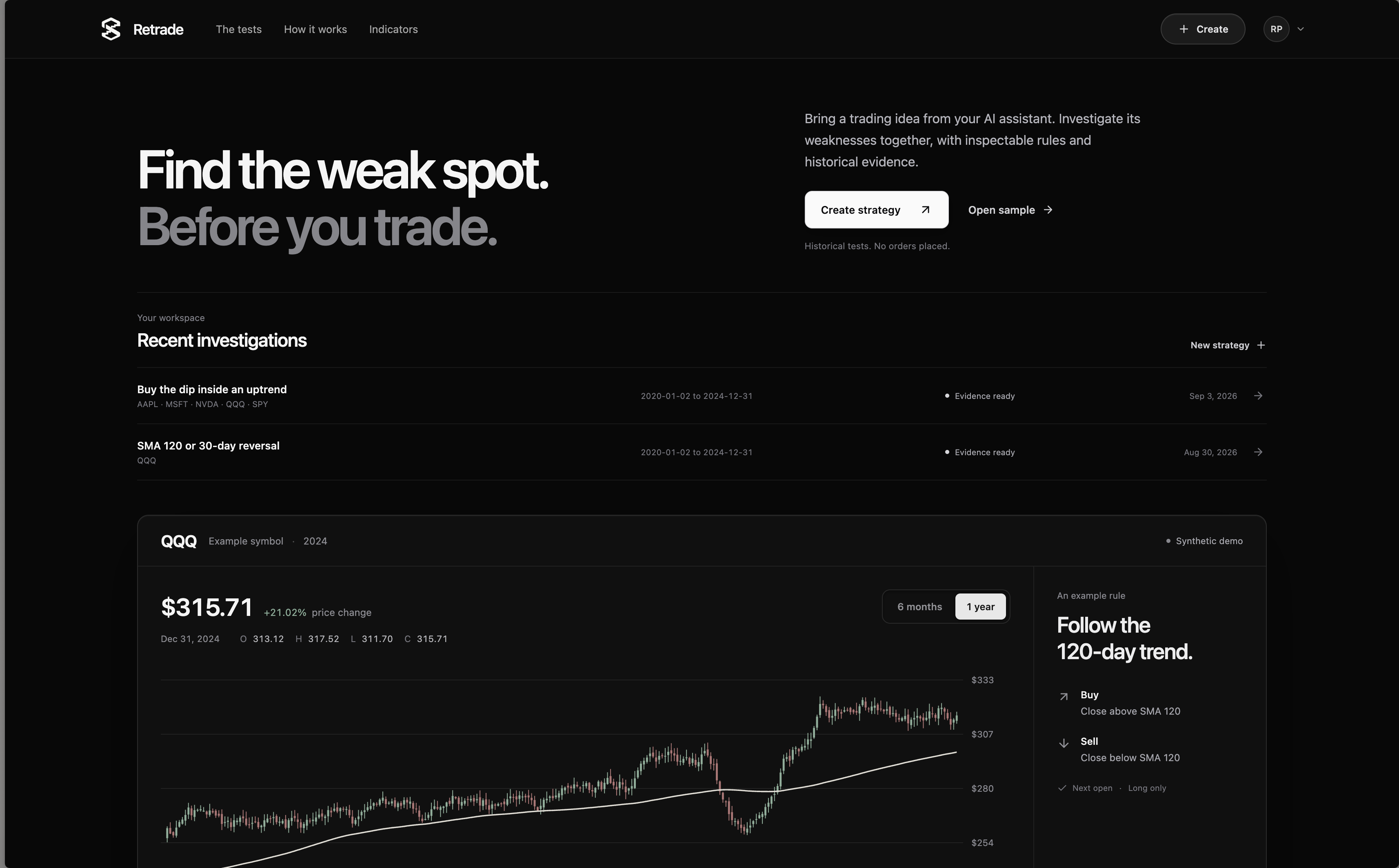
ReTrade helps people describe, organize, and test trading strategies before trying them with real capital.
A user can choose supported stocks or ETFs and define a strategy using technical indicators. They can work through the interface manually, but the main workflow uses an AI agent through WebMCP.
The user can describe a strategy in natural language or by voice. The agent turns that description into structured rules and prepares the strategy inside ReTrade. The user can then review and confirm those rules before running the test.
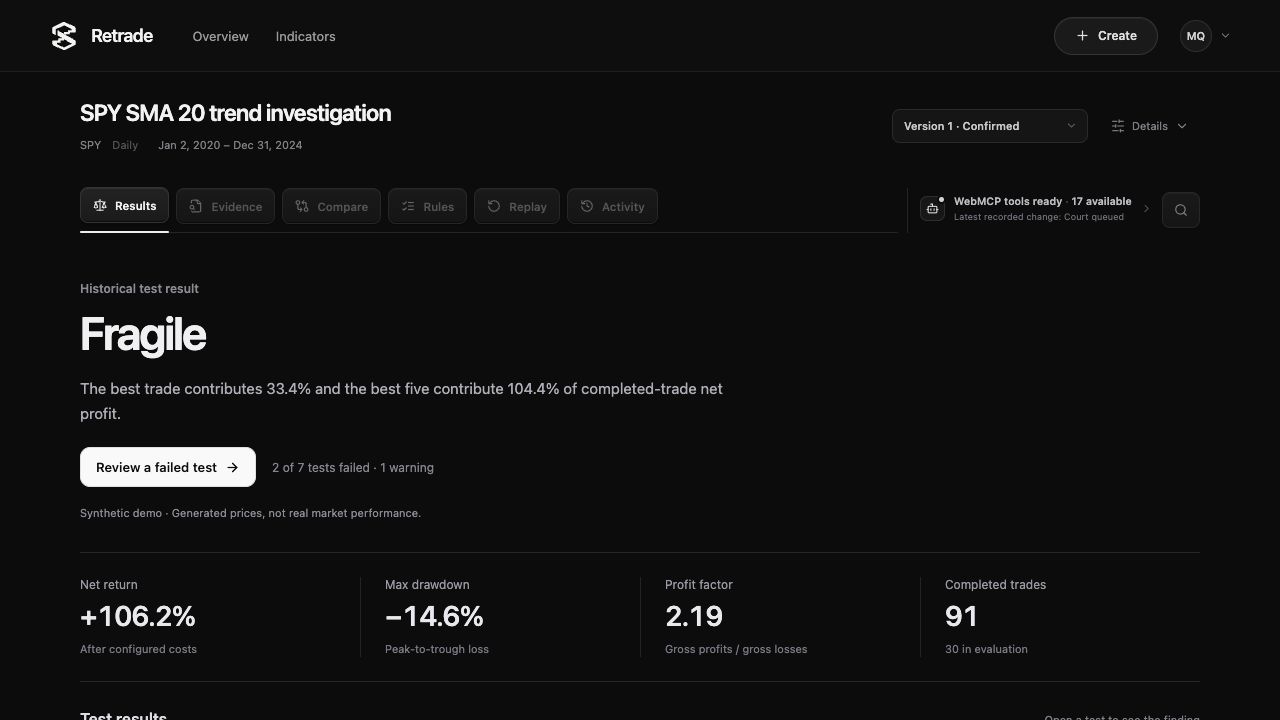
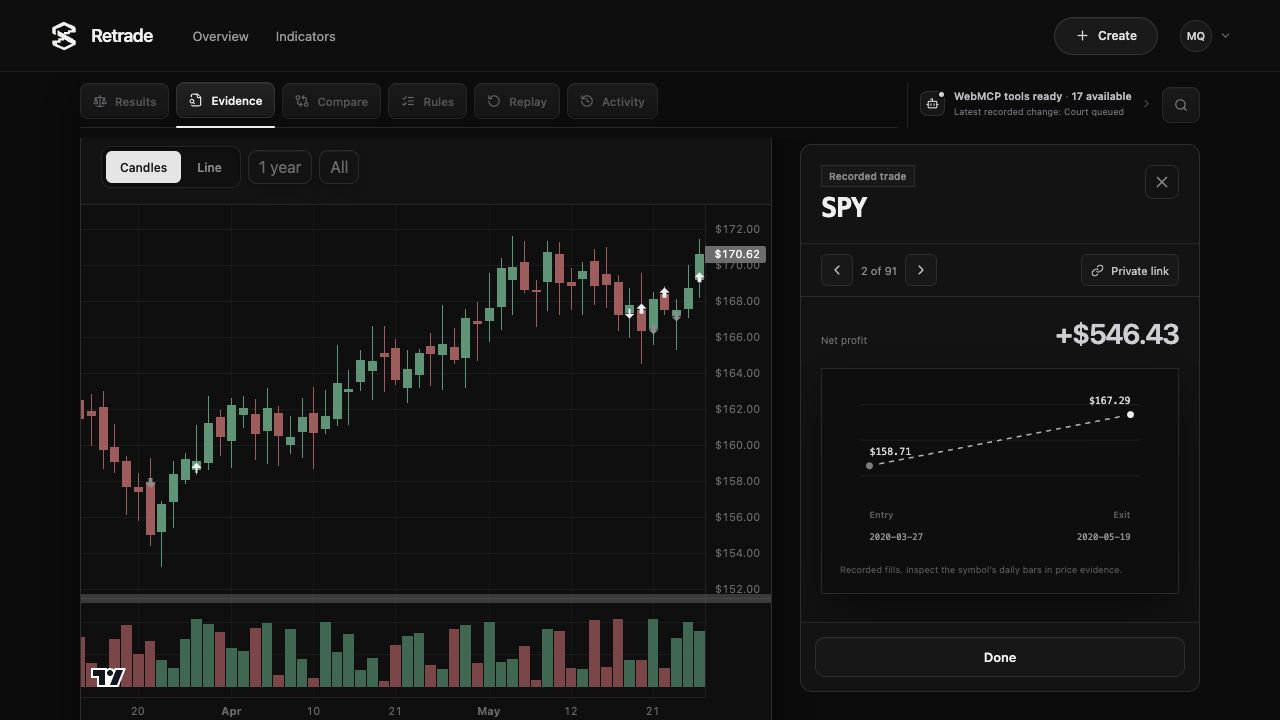
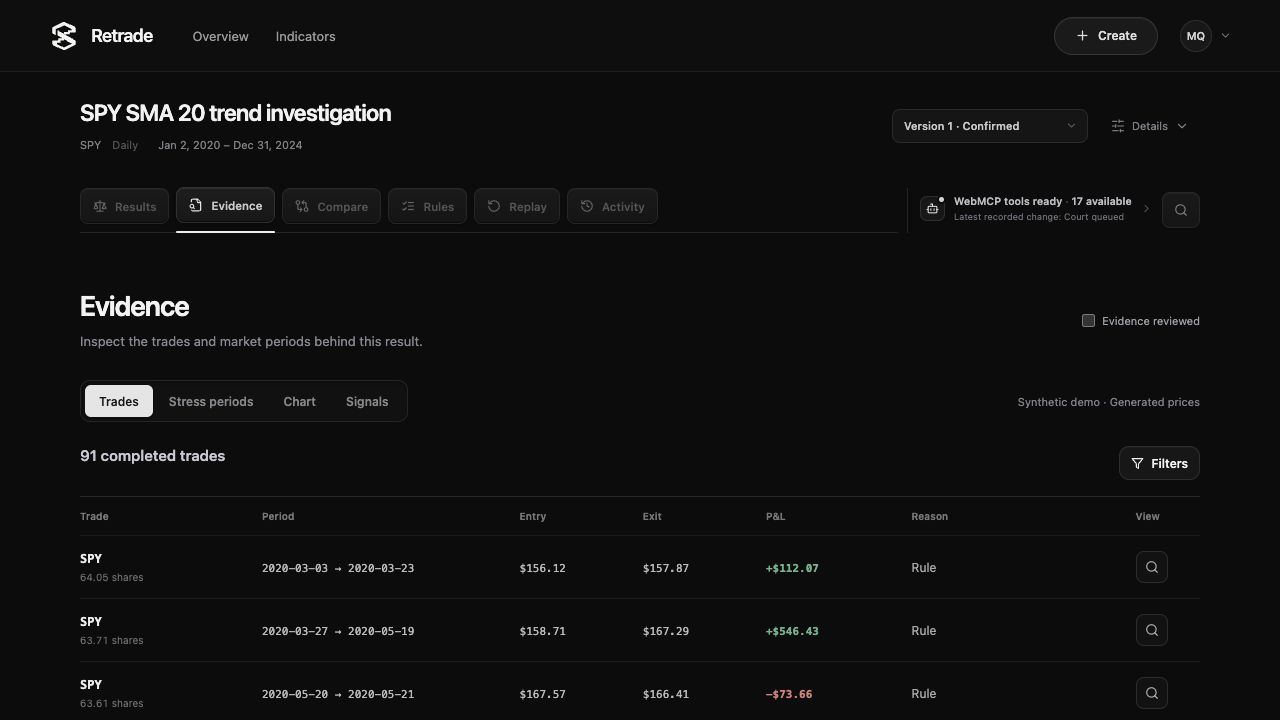
ReTrade returns information about how the strategy behaved. It shows whether the result was profitable, fragile, too dependent on a small number of trades, or simply unsuccessful. The user can inspect individual trades, failed tests, market periods, costs, and alternative versions of the strategy.
The goal is to give the user more than a final profit number. ReTrade helps them understand why the result happened and whether there is enough evidence to trust it.
How I built it
I built ReTrade primarily with Codex, mainly using GPT-5.6.
I researched interfaces from trading platforms and other financial products to collect ideas for the layout and user experience. Then I worked iteratively. I implemented a version, tested it, used the product, found the parts that felt confusing, and changed them.
A large part of the process was live coding with Codex. I described the behavior I wanted, reviewed the implementation, ran tests, and checked the application in both local and production environments.
I kept repeating that process until the product felt useful rather than looking like a short hackathon prototype.
Challenges I ran into
The first major challenge was the UI and UX.
ReTrade is an AI-first product, but it still needs a strong interface. A person must be able to inspect what went wrong, understand the evidence, and test a strategy manually without WebMCP.
Designing both workflows was difficult. The agent and the user had to work with the same strategy, evidence, and application state. The interface also needed to explain complex results without overwhelming the user.
WebMCP was another challenge. It is still a new technology, so there are fewer examples and established patterns than there are for traditional APIs. I had to study the documentation and give Codex precise instructions. Without enough context, tool registration and browser interactions were easy to implement incorrectly.
Debugging the complete workflow was also new to me. A problem could come from the interface, WebMCP registration, the API, application state, authentication, or the database. I had to test the real interaction instead of assuming that working code meant a working product.
Accomplishments that I am proud of
I am especially proud of the interface. I like how ReTrade looks and how it presents a complicated investigation without turning it into a page full of raw statistics.
I am also proud of the WebMCP interactions. A user can describe a strategy to an AI agent, ask it to test the strategy, and then inspect the result inside the same application.
The agent can open specific evidence, examine failed periods, and create controlled variations of the strategy. The person can make a selection in the interface, and the agent can understand what they selected.
The final result feels like a real interaction between a person, an AI agent, and a product. It does not feel like a chat window attached to an unrelated website.
What I learned
The main thing I learned was how WebMCP works and what it can add to a product.
WebMCP gives an AI model a structured way to understand a website and perform actions inside it. The model does not have to guess what is happening from screenshots or depend on fragile browser automation.
I now see many ways I could use WebMCP in future products. It can make complicated software easier to use because the user can describe the desired result instead of learning every part of the interface first.
I also learned more about working with Codex and AI agents. Before this project, I mostly used Codex for individual coding tasks. During the hackathon, I used it to implement features, test browser behavior, review the UI, debug production problems, and run scenarios in isolated environments.
I plan to keep experimenting with this way of building software.
What is next for ReTrade
I do not have a final business plan yet, but I would like to continue improving the product after the hackathon.
One possible direction is to turn ReTrade into a focused paid tool for strategy testing. Large trading platforms provide many features, and their subscriptions can be expensive for someone who mainly wants to test and understand a strategy.
ReTrade could offer a simpler alternative focused on that specific job. A user could describe a strategy, test it, inspect its weaknesses, and compare possible improvements without paying for a much larger trading platform.
Before introducing pricing, I would need to improve the product, test it with real users, expand the supported strategies and data sources, and make sure the results remain clear and trustworthy.
Built With
- better-auth
- bun
- postgresql
- typescript
- vue.js

Log in or sign up for Devpost to join the conversation.