markdown
Inspiration
Decisions, evidence, operational data, priorities, ownership, and executive reporting become disconnected; this leads to transformations failing between strategy and execution.
Leaders may receive a polished strategy deck while delivery teams work from different assumptions across project-management, engineering, service-management, financial, and collaboration systems. AI can generate more content, but without evidence controls and human accountability, it can also make unsupported recommendations appear authoritative. The deck created here is a rough draft, meant for a human design touch.
I created StrategyOS: The AI Transformation Operating System to connect that fragmented journey:
Business problem → evidence → priorities → execution → measurable value
What StrategyOS does
StrategyOS turns a complex business problem into a governed transformation package.
A user can:
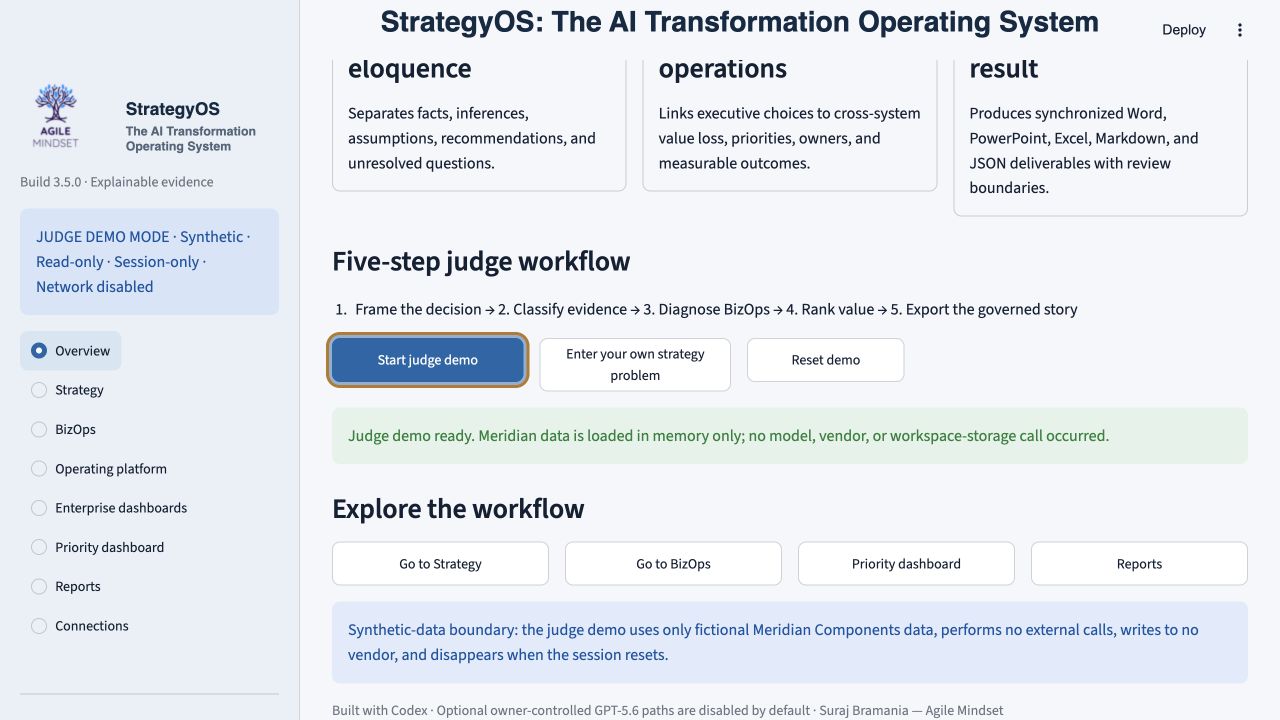
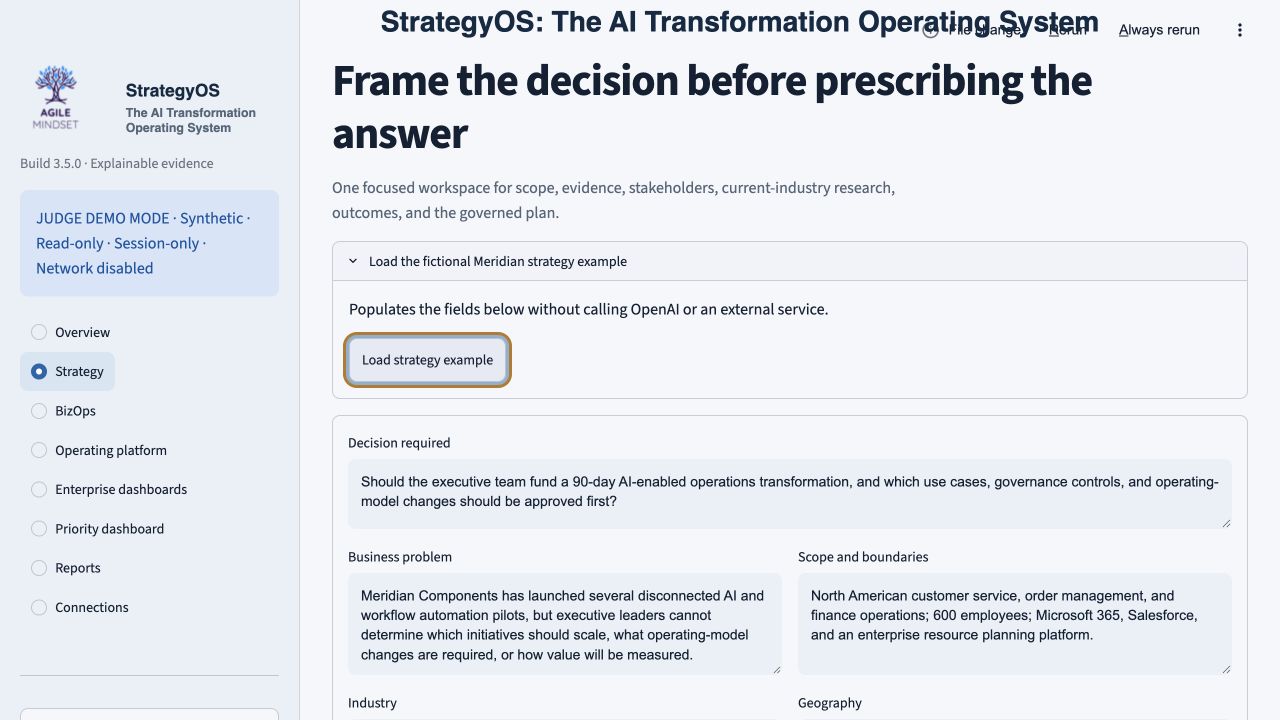
- Frame the business decision, scope, stakeholders, constraints, and success measures.
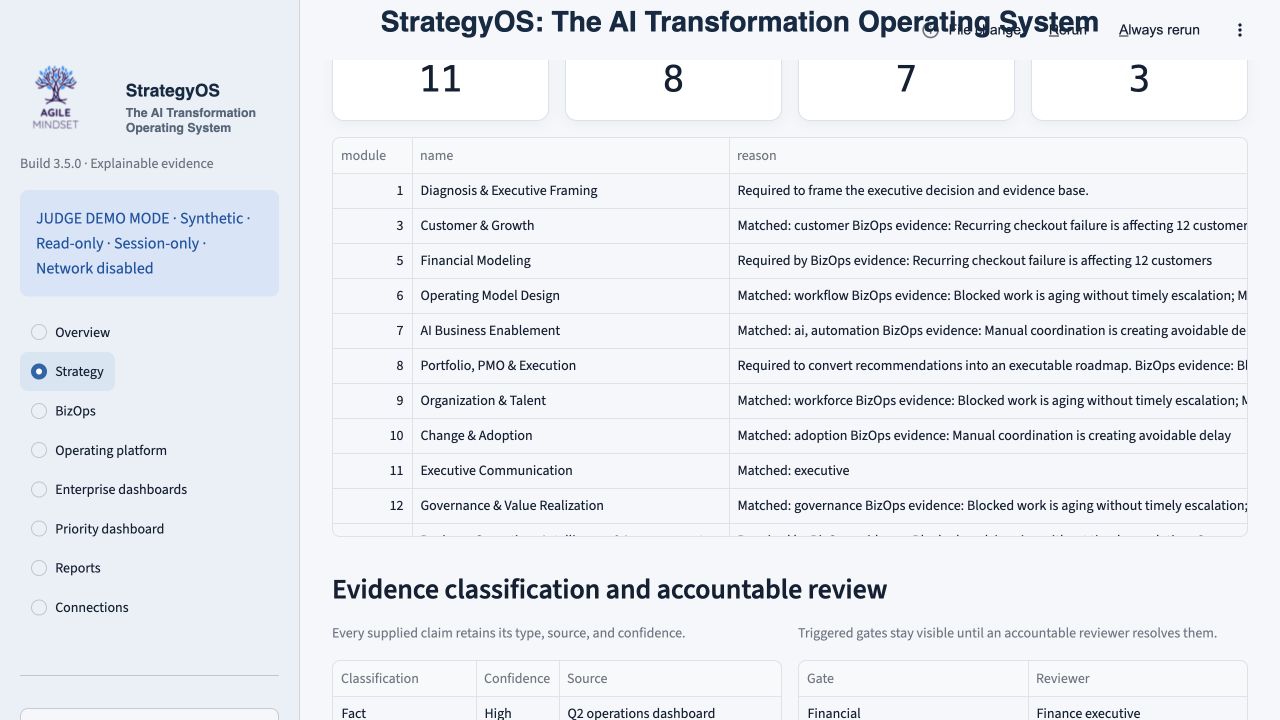
- Classify supporting information as facts, inferences, assumptions, recommendations, or unresolved questions.
- Identify required financial, workforce, privacy, security, legal, and technology review gates.
- Connect strategy to Business Operations evidence from delivery, engineering, testing, incidents, customers, finances, and approved collaboration channels.
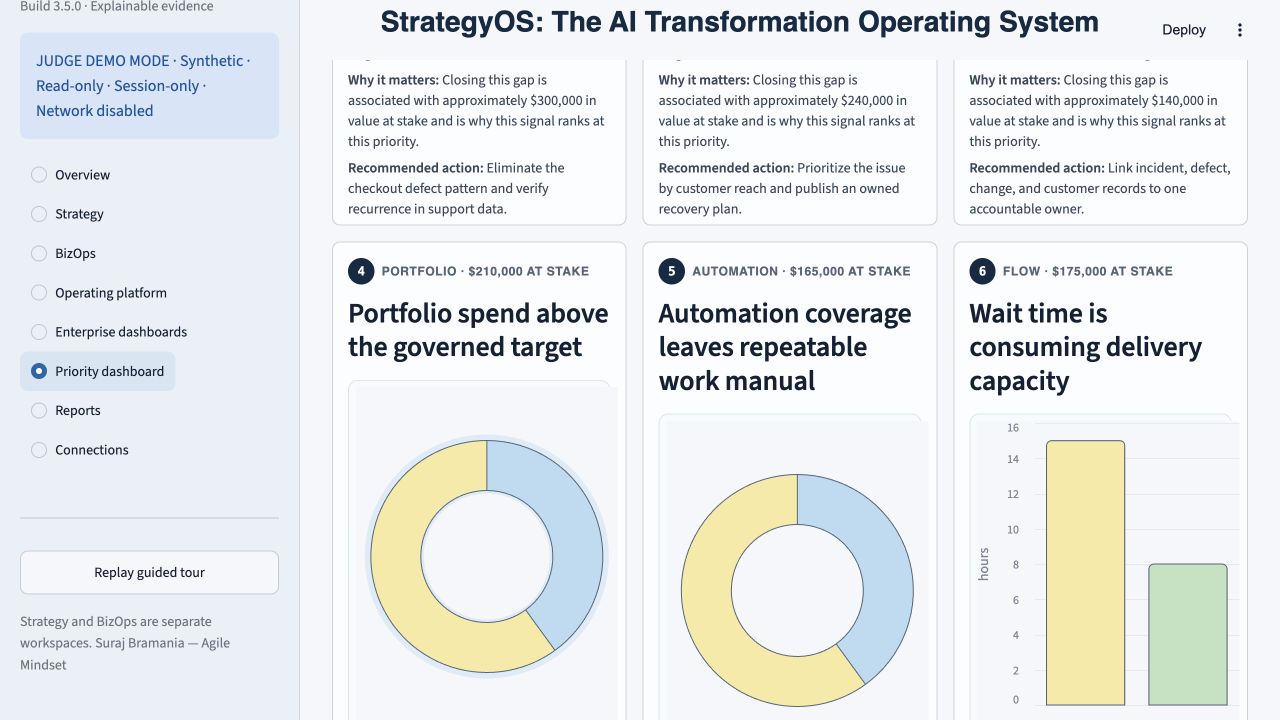
- Rank improvement opportunities by customer impact, operational risk, target gap, and estimated value at stake.
- Create an executable implementation plan with owners, measures, governance, and outcome tracking.
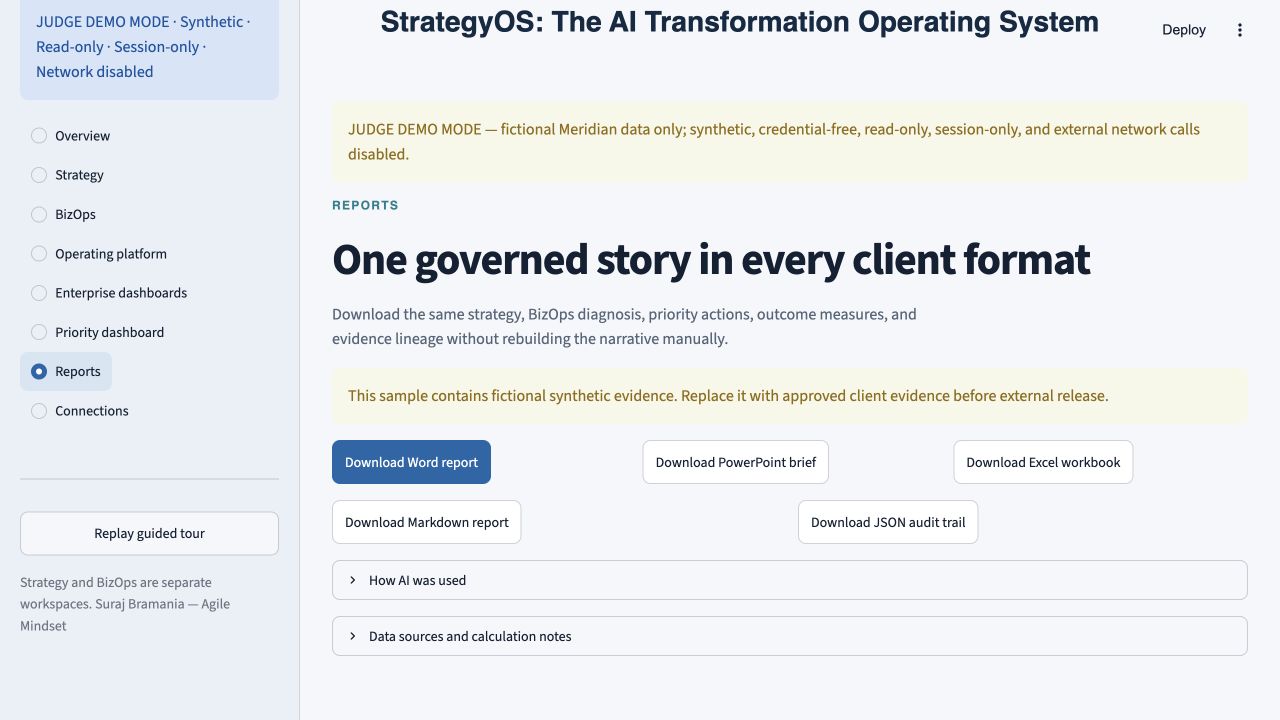
- Generate synchronized Markdown, JSON, Word, Excel, and PowerPoint deliverables from one governed result.
The public judge experience uses fictional Meridian Components data. It requires no credentials, makes no external calls, remains read-only and session-only, and cannot replace a client workspace.
How I built it
StrategyOS combines generative AI with deterministic analysis.
GPT‑5.6 has two deliberately bounded roles:
- converting an unstructured business brief into structured intake fields; and
- conducting optional, source-linked current-industry research.
When GPT‑5.6 is enabled by an authorized owner, StrategyOS records the actual provider, model, execution date, source count, and output digest. The model does not independently approve recommendations, assign evidence classifications, bypass review gates, or determine final priorities.
The deterministic StrategyOS engine handles:
- module routing;
- evidence classification;
- review-gate activation;
- Business Operations diagnostics;
- priority scoring;
- implementation planning;
- outcome governance; and
- synchronized export generation.
The application uses Streamlit for the interface and separates Strategy, Business Operations, operating capabilities, enterprise dashboards, priority analysis, reports, and connections into focused workspaces.
The underlying product includes 13 transformation and Business Operations modules, seven dashboard families, twelve value-ranked operational signals, five native export formats, and 48 read-only connector contracts. Those connectors are contract-tested but honestly reported as 0 live-certified until each vendor environment is validated with approved credentials.
StrategyOS includes six specialized agents. The StrategyOSAgent validates each engagement, selects the relevant transformation modules, classifies evidence, and develops the assessment, roadmap, governance structure, outcomes, and review gates. It is active in the Strategy and demonstration workflows and operates deterministically rather than through GPT-generated analysis.
The IndustryResearchAgent uses OpenAI-powered web research to find recent industry statistics, sources, publication dates, caveats, and implications relevant to the engagement. It runs only when the user enables current-industry research and provides an approved API key. It is disabled in the credential-free public demonstration.
The IntakeExtractionAgent converts an unstructured description of a business problem into the structured information required by StrategyOS. Although this agent has been implemented and tested, it is not currently connected to the Streamlit interface.
The PipelineBuilderAgent creates governed, read-only integration plans for vendor systems. These plans define the selected data fields, pagination rules, synchronization schedules, privacy treatments, and approval controls. This agent is available through the Connections page.
The PipelineExecutionAgent executes an approved connector plan. It minimizes and normalizes copied vendor records, maintains synchronization cursors, and adds the resulting evidence to StrategyOS without modifying the source system. This capability has been implemented and tested in the backend but is not available as an action in the public demonstration.
Finally, the OutboundSyncAgent handles lower-level read-only synchronization. It retrieves data through a connector, transforms vendor records into the StrategyOS common event format, appends them to the evidence ledger, and advances the appropriate synchronization cursor. It is implemented and tested as part of the connector infrastructure but is not directly exposed in the user interface.
How Codex contributed
Codex was my implementation and review environment throughout Build Week. - It was a great learning experience!
I used it to:
- inspect and understand the existing consulting foundation;
- design the application architecture and trust boundaries;
- implement the Streamlit experience and deterministic engines;
- build native Word, PowerPoint, Excel, Markdown, and JSON exports;
- create the BizOps data model and connector architecture;
- diagnose interface, session-state, routing, export, and Continuous Integration failures;
- create regression, click-through, security, accessibility, and end-to-end tests;
- review repository changes and resolve pull-request conflicts;
- prepare deployment, demonstration, architecture, and submission documentation; and
- repeatedly validate the complete client workflow.
The dated commit and pull-request history in the README distinguishes the pre-existing foundation from the functionality built or materially extended during July 13–21.
What existed before Build Week
Before July 13, the repository contained the initial StrategyOS foundation, roadmap, methodology, quality gates, engagement guidance, and evidence standards.
During Build Week, the project was materially extended into a working application with:
- the installable StrategyOS Agent;
- governed GPT‑5.6 intake and research paths;
- deterministic analysis and human-review controls;
- Business Operations intelligence;
- connector and pipeline architecture;
- enterprise and priority dashboards;
- synchronized native exports;
- the synthetic judge experience;
- Navi’s guided product-and-trust walkthrough;
- deployment preparation; and
- comprehensive submission assurance.
Challenges
The hardest challenge was not generating more AI content. It was controlling what the system was allowed to claim.
I had to separate model-generated language from verified evidence, prevent synthetic information from appearing as client evidence, preserve human approval for material decisions, and ensure every exported format represented the same underlying result.
Another challenge was presenting a deep enterprise product in less than three minutes. The final experience uses a concise executive workflow, progressive disclosure, a synthetic scenario, and Navi’s guided walkthrough while preserving detailed architecture, evidence, and controls for technical reviewers.
Maintaining consistency across five export formats also required extensive regression testing, including PowerPoint typography and template fidelity, Excel formula safety, routing boundaries, session-state isolation, repeated user actions, and network prohibition in judge mode.
What I learned
The strongest use of AI in transformation work is not autonomous recommendation generation. It is combining AI’s ability to structure and research information with deterministic controls that preserve provenance, accountability, repeatability, and review.
I also learned that a credible enterprise AI product must explain when AI was used, when it was not used, which model ran, what evidence supported the result, and which decisions still require a person.
Accomplishments
The current release candidate includes:
- 298 passing automated tests
- 13 StrategyOS modules
- 48 contract-tested, read-only connector contracts
- 7 enterprise dashboard families
- 12 value-ranked priority signals
- 5 synchronized export formats
- 10,000-event integrity and tenant-isolation validation
- explicit synthetic-data and AI-use disclosures
- accountable human-review gates
- a credential-free judge demonstration
These are repository engineering results, not claims of customer outcomes, live vendor certification, external compliance certification, or guaranteed return on investment.
What’s next
The next steps are to validate StrategyOS through controlled client pilots, certify individual connectors against approved vendor tenants, strengthen production hosting and identity controls, complete independent accessibility and security reviews, and measure whether the workflow improves real transformation decisions without weakening human accountability.

Log in or sign up for Devpost to join the conversation.