-
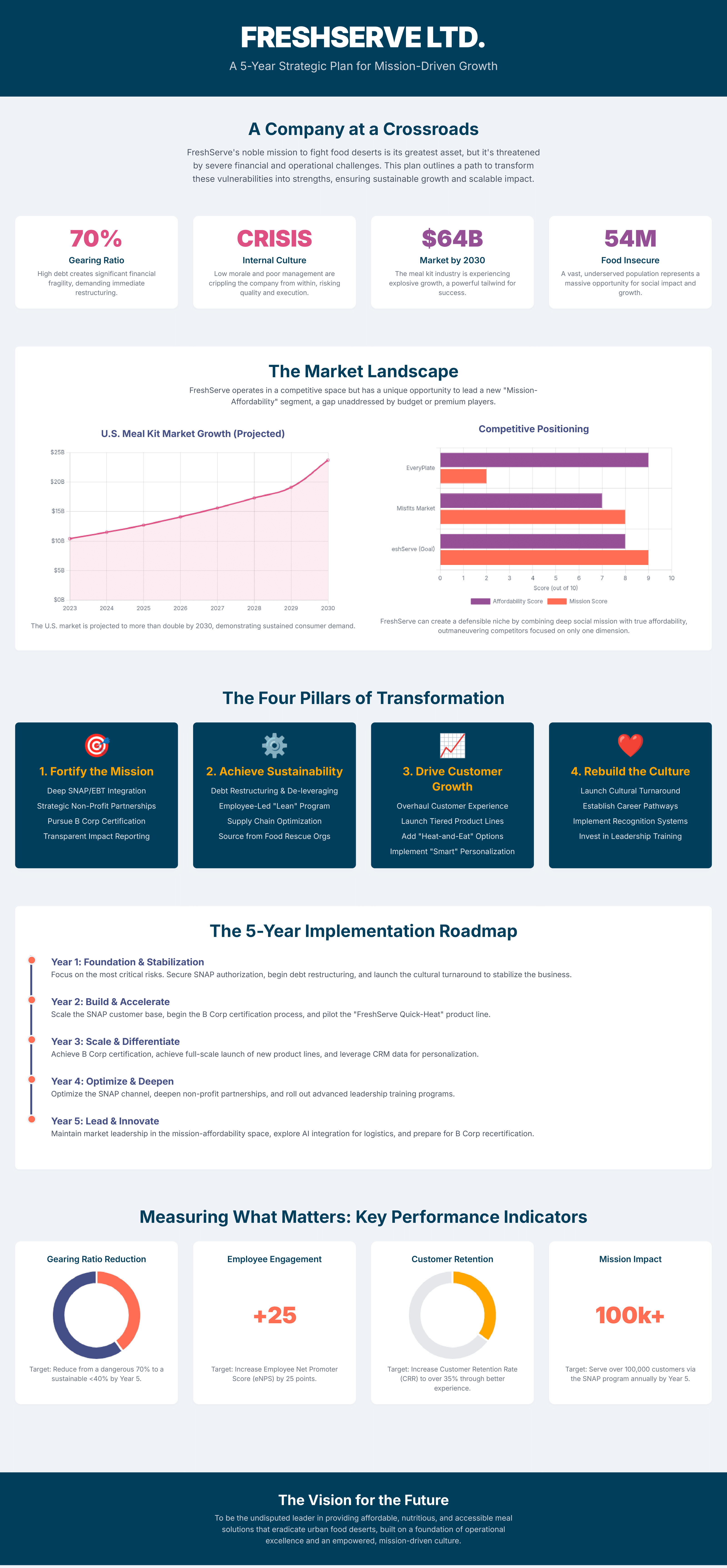
Strategy Infographic
Strategic Context
FreshServe Ltd. stands at a critical time. Its noble mission to combat urban food deserts is at risk of being undermined by severe internal operational deficiencies, a precarious financial position, and a growing disconnect between its brand promise and its internal culture. The company is currently competing in the hyper-competitive "affordable" meal kit segment without a sustainable cost advantage, while its true differentiator—its social impact—remains underleveraged. The path forward requires a fundamental realignment of strategy, operations, and culture to ensure not only long-term growth but the very survival and fulfillment of its mission.
Key Findings ##
Our analysis reveals four critical realities: 1) The meal kit market is robust but bifurcating into premium, budget, and mission-oriented segments, demanding clear strategic positioning. 2) FreshServe's high-debt, aggressive expansion has created significant financial risk and fostered a toxic internal culture that threatens quality and execution. 3) A massive, untapped opportunity exists in aligning with government programs like the Supplemental Nutrition Assistance Program (SNAP) to directly serve the company's target demographic in a financially sustainable way. 4) The current operational model, particularly the "lean" production initiative, is being implemented in a counterproductive manner that is eroding the company's most valuable asset: its people.
Summary of Recommendations
We propose a comprehensive 5-year plan built on four integrated pillars designed to transform FreshServe into a resilient, authentic, and scalable social enterprise:
- Fortifying the Core Mission: Transition from a company with a mission to a mission that drives the company. This involves deep integration with SNAP/EBT programs, forging strategic non-profit partnerships, and pursuing B Corp certification to institutionalize and validate the company's social impact.
- Achieving Operational & Financial Sustainability: Address the existential threat of the company's financial structure. This requires immediate action on debt restructuring, potentially through impact-aligned capital, and a complete re-engineering of the production model to one based on true lean principles of employee empowerment and continuous improvement.
- Driving Customer-Centric Growth: Evolve the product and service to better meet customer needs and increase lifetime value. This includes a systematic overhaul of the user experience (recipe clarity, portion control), the introduction of a tiered product architecture including "Heat-and-Eat" options, and leveraging data for smart, effective personalization.
- Rebuilding the Foundation: Acknowledge and reverse the internal cultural crisis. This pillar focuses on a comprehensive cultural turnaround, implementing transparent management practices, establishing clear career pathways and recognition systems, and investing in leadership development to foster a collaborative, mission-driven environment.
Expected Outcomes
This strategic realignment will transition FreshServe from a high-risk, mission-adjacent company to a resilient, financially stable, and authentic market leader in the social-impact food sector. We project a clear path to sustainable profitability, a de-leveraged balance sheet (targeting a gearing ratio below 40% by Year 5), and a significant, measurable increase in the number of food-insecure families served. This strategy does not ask FreshServe to choose between its mission and its business; it demonstrates that fully embracing the mission is the only viable path to building a sustainable business.**

Log in or sign up for Devpost to join the conversation.