-
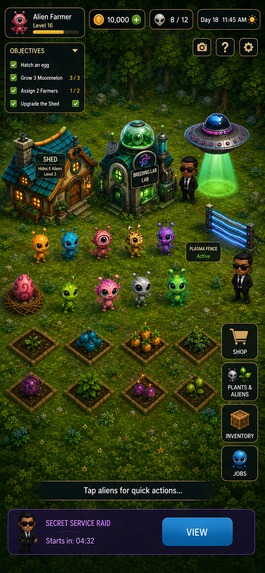
gameplay
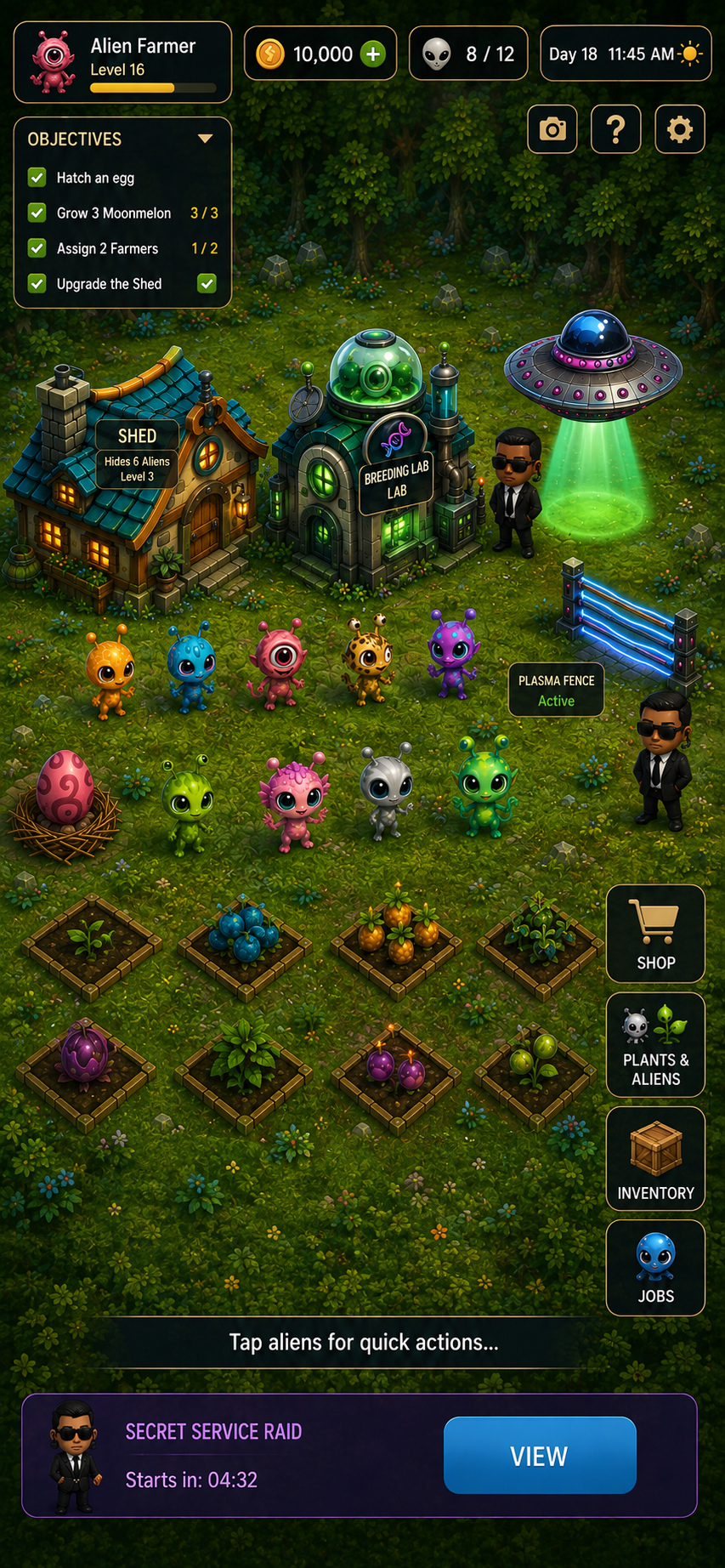
Inspiration
I wanted to create a management game that was easy to understand on a phone but still gave the player meaningful decisions to make. I liked the idea of combining a cozy farming game with something strange and unexpected, which led to Alien Farm: instead of raising ordinary animals, you manage a farm full of aliens with different traits, needs, and life stages.
What it does
Alien Farm is a single-player simulation and management game where you raise, feed, breed, protect, and sell aliens while building up your farm.
Aliens grow from eggs into babies, juveniles, and adults. Players grow and harvest crops, assign aliens to jobs, purchase upgrades, expand the farm, and breed adult aliens to create new offspring with inherited stats and a chance of mutations. A UFO periodically arrives to buy goods and aliens, while Secret Service raids create additional pressure.
The goal is to successfully manage the farm, breed a Legendary Alien, and reach 5,000 Galactic Credits. If the farm loses every alien and egg, the player loses.
How I built it
I built Alien Farm as a self-contained HTML5 mobile web game using HTML, CSS, JavaScript, and the Canvas API, with AI assisting throughout the development process.
I started with the basic management loop and then repeatedly playtested and refined it. Over multiple iterations I added alien growth, crops, feeding, jobs, breeding and inheritance, mutations, upgrades, farm expansion, the UFO merchant, Secret Service raids, objectives, audio, animations, particle effects, and win/lose states.
I also spent a large part of development optimizing the interface specifically for portrait mobile play. The final game uses local assets and does not require an internet connection while playing.
Challenges
One of the biggest challenges was keeping the game readable on a small portrait screen while still giving the player enough information and actions to make the management systems interesting. I redesigned and repositioned the UI several times to make important information and controls easier to understand.
Another challenge was balancing scope. During development I experimented with additional systems, including farm animals, crystals, more alien types, and extra jobs. Playtesting showed that these systems made the prototype more complicated without improving the core loop, so I removed them and focused on the strongest mechanics.
There were also many smaller technical challenges involving sprite sheets, drag-and-drop interactions, breeding placement, objective progression, mobile scaling, animation timing, audio, and keeping the final build completely self-contained.
What I learned
The biggest thing I learned was that more features do not automatically make a management game better. Alien Farm became much stronger when I reduced the scope and concentrated on making a smaller number of systems interact clearly.
I also learned how important continuous playtesting is. Features that sounded good while designing them sometimes felt confusing or unnecessary once they were actually playable. Iterating on those problems helped me improve the game's feedback, progression, controls, and overall clarity.
Finally, I learned a lot about using AI as an iterative development partner rather than expecting a finished game from a single prompt. The best results came from building something, testing it, identifying exactly what was wrong, and repeatedly refining it until the prototype matched the experience I wanted.
Built With
- chatgpt
- css3
- html5
- javascript

Log in or sign up for Devpost to join the conversation.