Inspiration
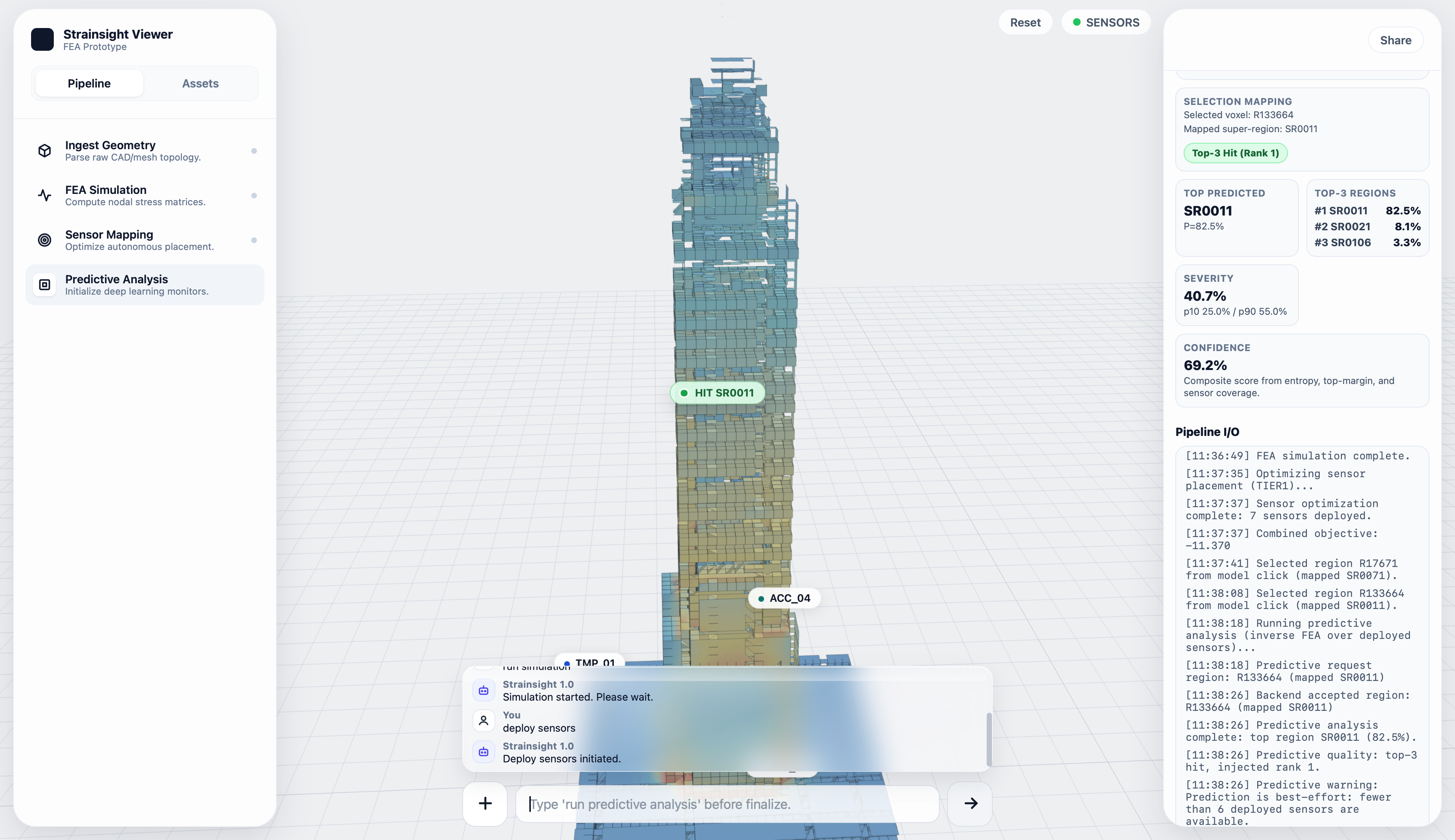
StrainSight was inspired by a simple question: what if structural engineers could see risk the way meteorologists see weather, as a living, evolving heat map? Modern buildings generate massive amounts of simulation and sensor data, yet most tools still present information in static reports or raw numbers. We wanted to build a system that translates complex structural behavior into an intuitive, probabilistic 3D visualization, helping engineers understand where integrity issues might exist and how they could evolve over time.
What it does
Throughout the project, we explored structural health monitoring, finite element modeling, modal analysis, and probabilistic inference. One of the biggest lessons was realizing that detecting damage is not just about measuring vibrations, it’s about combining physics-based models with uncertainty-aware algorithms.
How we built it
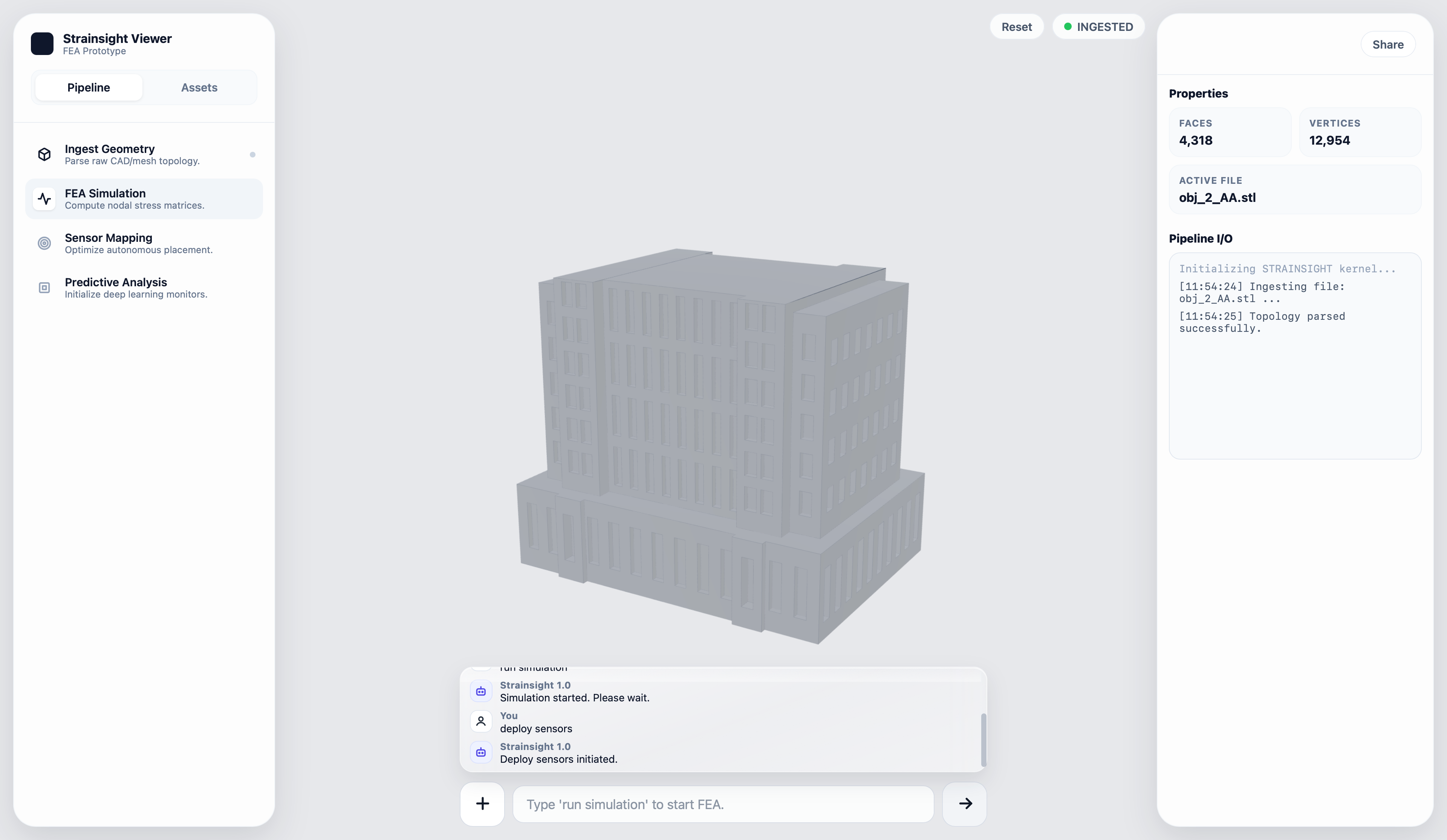
StrainSight starts with a user-provided 3D model. From that we are able to generate our own FEA model. From that model, we generate candidate sensor locations and use an optimization algorithm to determine optimal placements for vibration and other structural sensors. We designed a damage parameterization system that allows simulated stiffness reductions to be injected into regions of the structure, enabling us to generate synthetic “damaged” responses for testing. Using modal features extracted from simulated sensor data, we built a probabilistic inference pipeline that estimates where damage is most likely and visualizes it as a 3D heat map. To demonstrate long-term monitoring, we also implemented a simplified propagation model that predicts how damage risk could evolve over time.
Challenges we ran into
One of the biggest challenges was bridging theory and practicality. Structural health monitoring research often assumes idealized data or highly specialized equipment, but building a generalizable platform required us to balance realism with computational feasibility.
Accomplishments that we're proud of
One of our biggest accomplishments was building an end-to-end pipeline that connects structural engineering concepts with modern data-driven visualization. We developed a system that allows users to import a 3D FEA model, generate candidate sensor locations, and automatically compute optimized placements using our algorithm. We also designed a damage modeling workflow that makes it possible to simulate structural degradation and translate sensor responses into a probabilistic 3D heat map. Bringing together FEA processing, optimization, and probabilistic reasoning into a single cohesive platform was a major milestone for us.
What we learned
we learned how complex structural health monitoring really is beyond theory. We gained experience in modal analysis, uncertainty modeling, and the challenges of translating raw sensor data into meaningful engineering insight. One of the biggest lessons was understanding the importance of combining physics-based models with probabilistic thinking.
What's next for StrainSight
Our next steps focus on making StrainSight more realistic and powerful. We plan to expand our damage modeling to support richer propagation models and incorporate additional sensor types such as strain and environmental monitoring to improve localization accuracy. We also want to refine our probabilistic framework so the heat map reflects both risk and uncertainty over time, enabling predictive insights rather than just detection.

Log in or sign up for Devpost to join the conversation.