Inspiration
I've spent years in tower defense — Bloons, Kingdom Rush — and kept hitting the same wall: once you solve the optimal build, replay is just execution. The genre escalates by piling on more enemies and more HP, never by challenging the strategy itself. I wanted a tower defense where expertise keeps mattering because the enemy refuses to let a winning strategy stay winning.
What STRAIN is
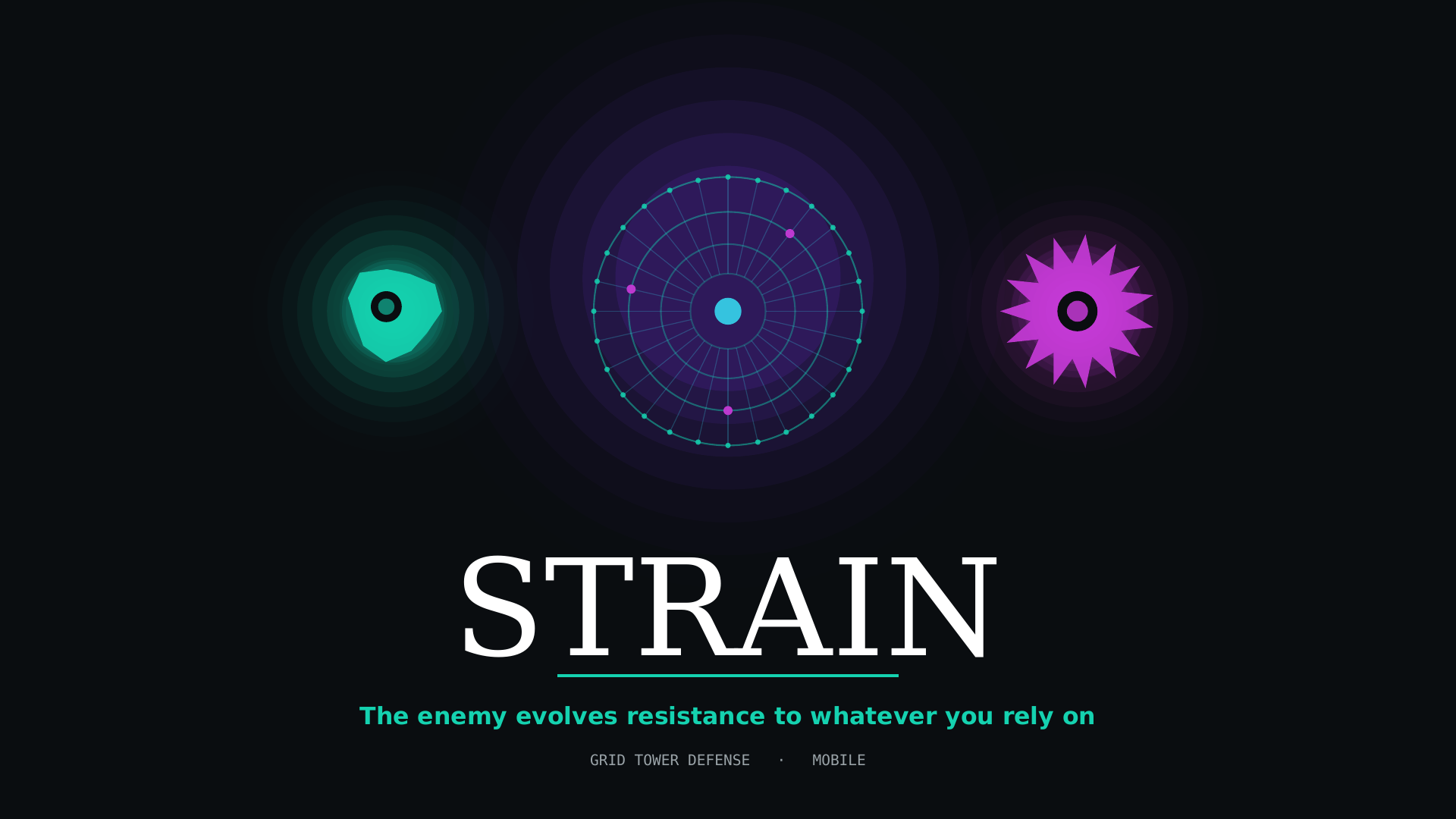
STRAIN is a mobile grid tower defense where you grow immune cells to defend a living body — and the pathogens evolve resistance to whatever you rely on. Spam one cell type and the next wave mutates to shrug it off, forcing you to diversify, rotate, and rest your defenses. The enemy adapts to you, so the meta never solves and no two runs reward the same plan.
What I learned
The hard part of an adaptive enemy isn't the mechanic — it's fairness. An enemy that counters you feels like cheating unless every escalation is visible and can be seen coming. Most of the design went into legibility: an always-on Resistance panel, mutations telegraphed a wave before they bite, and a bounded resistance curve so there's always a way out. I also learned to scope honestly — the MVP exists to prove one bet (is an adaptive enemy fun?) before any content gets built on top of it.
How I built the design
This is a complete pre-production package designed to cohere into one buildable game:
- Game Design Document — the concept, the Resistance system with exact numbers, the Plasma economy, and the fairness model.
- Player Journey Map — the first 15 minutes as an emotional arc, not a feature list.
- Visual Concept Package — one committed bioluminescent identity where color is the HUD: your cells glow cool, the threat glows magenta as it hardens.
- Production Plan — build sequencing, a ruthless MVP, and an honest look at the real risk.
The game targets Meta Horizon's mobile creation tools.
Challenges
Two. First, keeping four artifacts telling exactly one story — the visuals, the systems, the journey, and the build plan all describing the same game with no contradictions. Second, the balance problem at the core of the concept: adaptation that's too fast feels punishing, too slow feels like vanilla TD. The plan tackles it by exposing every resistance constant as live-tunable config and validating the loop on greybox before building anything else.
Built With
- ai-assisted
- claude
- game-design
- meta-horizon
- mobile
- tower-defense

Log in or sign up for Devpost to join the conversation.