-
-

StrAIn
-
Data Pipeline
-
Full Stack

What it does
Load management has taken over the world of sports at every level from professional down to youth, as athletes grow ever more conscious of the risks posed by injury to their careers and wellbeing. With over 1 million injuries annually in college sports alone, these fears are more than justified, and the result is a massive demand not just for quick and effective injury rehabilitation, but also early injury prevention. That said, it can be extremely difficult to quantify the risk of injury and/or pace of recovery, especially in game-time scenarios, leaving many athletes completely in the dark about their own health. That’s where StrAIn comes in.
Using computer vision to address this problem, StrAIn estimates the amount of torque on the ankles, knees, and hips, based only on the athlete’s body weight and a video. With the help of traditional biomechanics and novel ML techniques, StrAIn allows players to quantifiably track and monitor the wear-and-tear sustained from practices, training, and even games. This has the potential to revolutionize sports medicine, not only facilitating the path to a faster recovery, but helping to prevent countless injuries altogether.
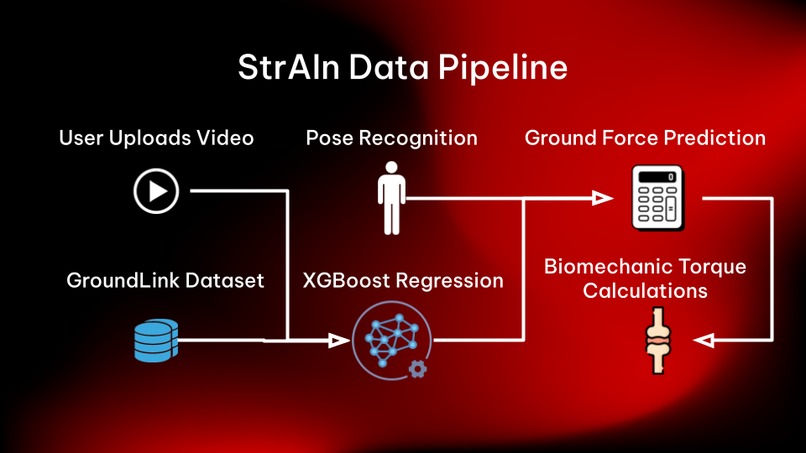
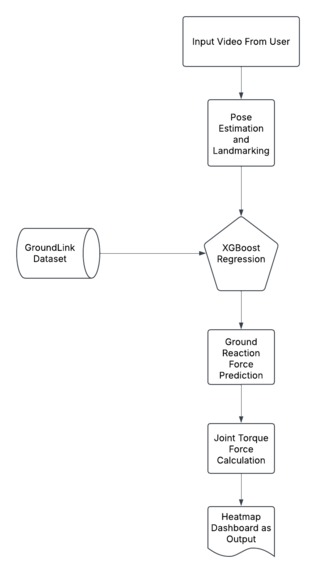
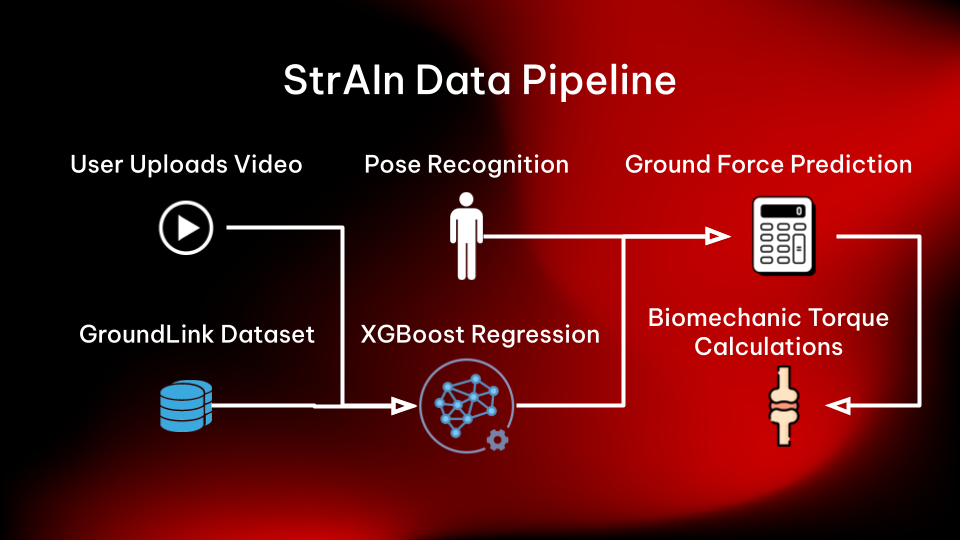
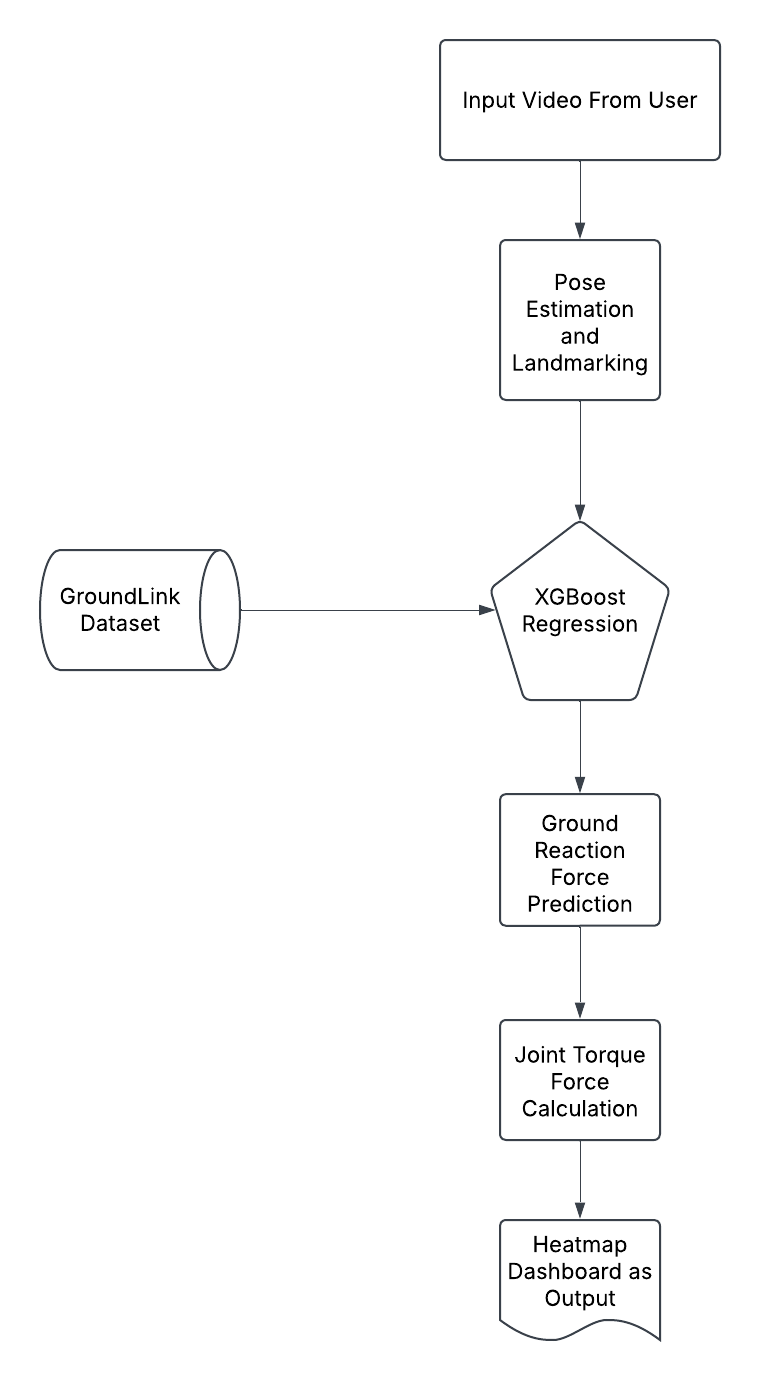
Trained on GroundLink, our model predicts ground reaction force based on motion capture. We then use this data, combined with joint angles and body proportions, to determine the forces acting on each major joint in the lower extremity for every frame in our video. Aggregating these forces across time for each joint, we can determine and quantify the total force on each joint for a given period of time.
With these powerful metrics placed in the palm of your hand, the possibilities are endless: real time injury wear-and-tear management in games, athlete injury risk scoring for roster optimization, strict tracking of injury rehabilitation, alerts for over-training, and more. With StrAIn, players are able to gain a deep understanding of their own risks, allowing them to make knowledgeable decisions with confidence.
How we built it
Using the Extreme Gradient Boosted Trees algorithm, we predicted ground reaction forces based solely on motion capture data with an R^2 = 0.6578. Then, using biomechanics, we were able to combine our predicted GRF vector with pose recognition to estimate each joint's external moment, inertia moment, and gravitational moment, which can be combined to determine net joint moment. From here, we summed the force at each frame for each joint to determine the total amount of force acting on the joint over the length of the video.

Log in or sign up for Devpost to join the conversation.